


Hantavirus: After Hantavirus, now Norovirus? How a stomach bug forced a French cruise ship into lockdown

An outbreak of gastrointestinal illness in Bordeaux, France, led French authorities to order 1,700 passengers and crew to stay on board as people passed by the British cruise ship Ambition.
French authorities eased restrictions on passengers aboard the British cruise ship Ambition on Wednesday after tests confirmed a gastrointestinal virus, likely norovirus and not hantavirus, was behind the outbreak that sickened dozens of people on the ship.The ship, operated by Ambassador Cruise Line, was earlier placed under a temporary lockdown in the port city of Bordeaux after concerns emerged over a possible link to the deadly hantavirus outbreak on the Dutch-flagged MV Hondius.However, French officials said there was “no reason” to link the two incidents.
What happened on board?
About 80 people on the Ambition have developed symptoms associated with an acute digestive infection since Monday, officials said.At least 48 passengers and one crew member were showing gastrointestinal symptoms as of Wednesday morning, according to news agency AP.The ship was carrying 1,233 passengers, mostly from Britain and Ireland, along with 514 crew members.French officials said testing confirmed the outbreak was a “gastro-intestinal infection of viral origin”. No serious cases were reported and asymptomatic passengers were later allowed to disembark.Passengers who remained ill were asked to isolate in their cabin.The ship departed from the Shetland Islands on 6 May and stopped in Belfast and Liverpool before arriving in Bordeaux. It was scheduled to proceed to Spain before returning to Liverpool on 22 May.
Passenger dies during journey
Concerns initially intensified after a 92-year-old British passenger died on the plane.But health officials later said the man had suffered a heart attack and his death was not linked to a gastrointestinal outbreak.“At this stage, no link with the gastroenteritis episode has been established,” officials said, according to news agency AFP.Officials said the passenger’s body was kept on board the ship in accordance with international maritime traditions.
Passengers describe conditions on board
Officials said the restrictions were imposed “out of an abundance of caution” amid global concern over the separate hantavirus outbreak on the MV Hondius.Seos Guillaidhe, a passenger from Belfast, told AFP via Facebook that life on the ship was continuing relatively normally despite increased hygiene measures.“We are on the ship with extra hygiene guidelines in place. It’s not as bad as it was during Covid. People are functioning normally,” he said while “playing bingo” on the ship.He later said: “We are allowed to disembark, restrictions have been lifted.”Others described more difficult circumstances. “It’s a challenge for the two of us to live in a cabin with bugs,” one infected passenger wrote on Facebook, according to AFP.
Why were the officials alert?
The recent hantavirus outbreak on the MV Hondius led to additional investigation into this outbreak, prompting an international health response.The World Health Organization confirmed eight laboratory cases of Andes virus, the only hantavirus strain known to spread between humans on the Honduras. Three passengers linked to that outbreak died.Health officials stressed that there is currently no evidence linking the Ambition outbreak to hantavirus cases.Cruise ships regularly suffer gastrointestinal outbreaks, often linked to norovirus.The Centers for Disease Control and Prevention recorded 23 such outbreaks on cruise ships last year.Gastroenteritis is commonly known as stomach flu. Its primary symptoms include vomiting and diarrhea. The disease spreads easily but does not usually have serious consequences, although it can sometimes lead to more serious problems such as dehydration.This is very different from hantavirus, which has a high mortality rate but spreads only in rare cases and requires close contact.
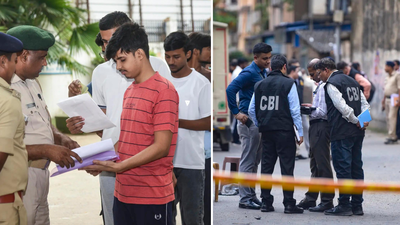
NEET-UG leak: Question paper handwritten, scanned and distributed; Students paid lakhs, CBI probe finds. india news
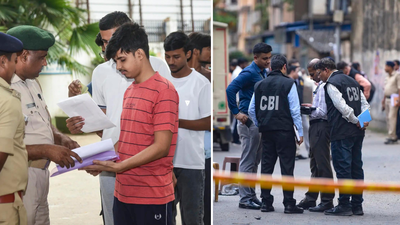
New Delhi: According to preliminary CBI investigation findings cited by sources in news agency ANI, a handwritten copy of the NEET UG 2026 question paper was scanned and converted into PDF files by the father of a candidate in Rajasthan.This development comes after the National Testing Agency (NTA) canceled the NEET exam held on May 3, a move that has affected lakhs of medical aspirants across the country.Preliminary investigation findings revealed that the question paper was first accessed and then circulated through Yash Yadav, who allegedly delivered it to Rajasthan. Investigators say Yash knew Vikas Biwal, whose father Dinesh Biwal is accused of scanning the handwritten paper and converting it into digital format.Officials alleged that the scanned paper was shared with students at coaching centers in Sikar, Rajasthan.Sources also said that Yash himself has not cleared the exam and is a Bachelor of Ayurvedic Medical Sciences student.CBI has interrogated the employees and owners of the coaching institute as part of the investigation. According to ANI, some students have told investigators that they paid between Rs 2 lakh and Rs 5 lakh to access the leaked material.One of the accused, Shubham Khairnar, has denied being the mastermind behind the leak. The agency is also trying to trace the original source of the question paper.Statements of students and accused persons are being recorded, while officials are also verifying the money transactions related to the case.
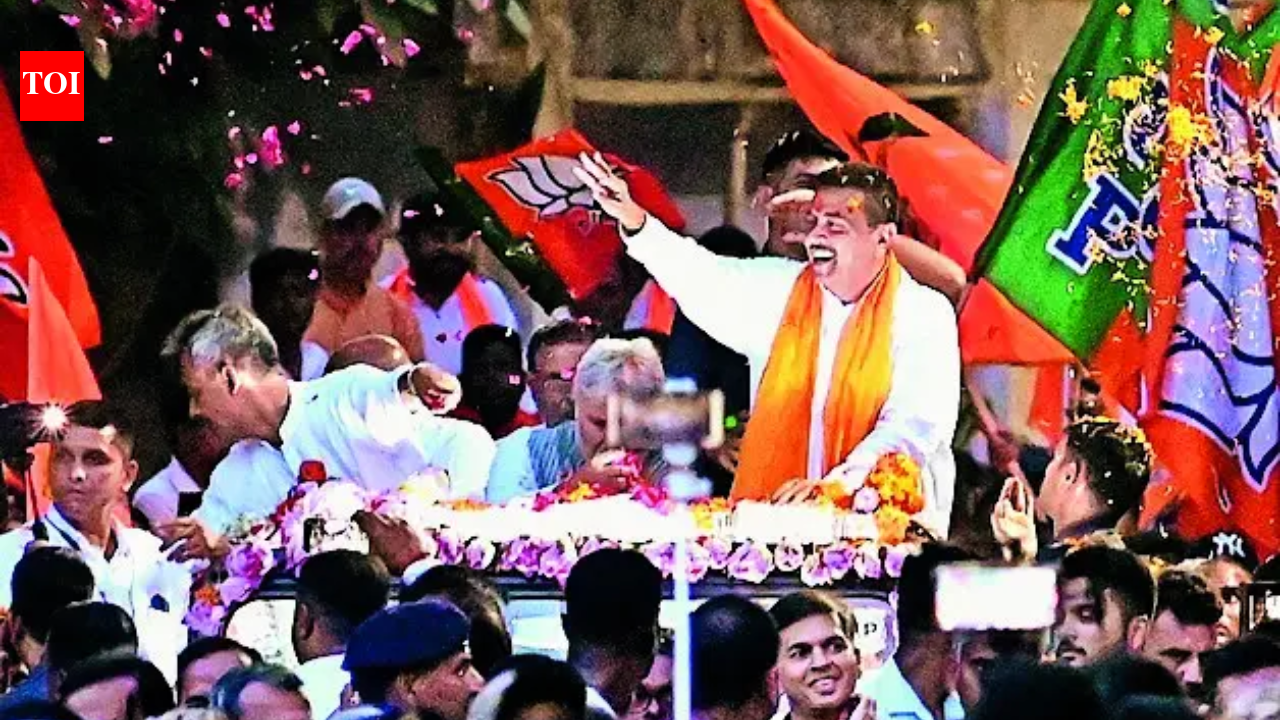
CM Suvendu Adhikari retains Bhawanipur, says he ‘will not forget’ Nandigram. kolkata news
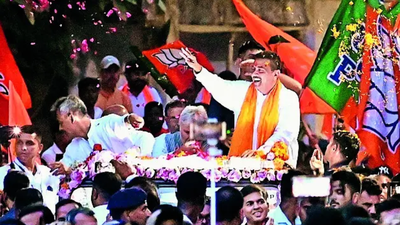
KOLKATA: Chief minister Suvendu Adhikari was sworn in as Bhawanipur MLA on Wednesday but stressed that he has “not forgotten” Nandigram, the other constituency that sent him to the assembly in the recent elections.Officer who defeated former CM Mamata Banerjee “Nandigram will elect someone else as MLA (in the by-election). I will not let the people there feel the loss in the next five years. I will fulfill all the development promises made to the people of Nandigram along with the rest of the state,” he told reporters at the assembly complex in Bhawanipur.The chief minister, who is a voter from the constituency in East Midnapore district, said, “I have not forgotten Nandigram.”Referring to Firoza Bibi’s tenure as Trinamool Congress MLA from Nandigram from 2009 to 2016, when Adhikari was a prominent leader of that party, he said, “I had provided full support to Firoza Bibi, the mother of a martyr killed in police firing in Nandigram in 2008… I will play a similar role this time too.”Nandigram voters resolved to retain the seat for Suvendu’s candidate.Nandigram: It’s been five decades since a CM has represented the Midnapore constituency, and the people of Nandigram are a little disappointed with CM Suvendu Adhikari choosing Bhawanipur over his old bastion. However, among the people of the constituency, who saw the defeat of then Chief Minister Mamata Banerjee at the hands of Adhikari in the 2021 elections, there is full confidence in the son of the soil. He has pledged that he will keep the seat for anyone nominated by the officer to represent Nandigram.Adhikari has been Nandigram MLA since 2016. He was the MP of Tamluk in 2009 and 2014. Nandigram is part of the Tamluk Lok Sabha constituency.Raju Mandal, a resident of Boyal in Nandigram, said, “It would have been good if he represented us. But now he is the face of our state. Whatever decision he takes, we are with him. We will keep Nandigram for Dada.”Local BJP leaders said they were sure that the people of Nandigram would bless the representative sent by the officer. Meghnath Pal, Adhikari’s closest aide in Nandigram, said, “We are already prepared for the upcoming elections. There has been change in the state under the leadership of Suvendu Adhikari. He is now the administrative head of the state, the CM. He has responsibilities. We are not at all concerned that he has chosen Bhawanipur constituency instead of Nandigram for his legislative post. Instead, we feel proud as residents of Nandigram.” Many believe that Pal may get the BJP nomination from Nandigram.The officer had promised to build the Haldia-Nandigram bridge. He also promised to build a modern residential English medium school in Gokulnagar. It was also proposed to set up an ITI at Sonachura. On May 6, during his visit after winning the elections, Adhikari had told Nandigram voters, “I will develop Nandigram hospital in such a way that no referral is needed. In six months, I will connect every house with water, which Mamata (Banerjee) did not allow.”

Hantavirus outbreak: Deadly Andes strain detected in cruise ship cases; Eight cases confirmed
 According to AFP Who Said, “Eight cases of Andes virus (ANDV) infection were laboratory confirmed, two are probable, and one case is inconclusive and undergoing further testing.”The outbreak has so far killed three people aboard the ship, which left Argentina on April 1 for a transatlantic cruise. WHO said two of the dead were confirmed to have Andes virus infection, while the third was classified as a probable case.Hantavirus is usually spread by contact with the urine, saliva, or feces of infected rodents. There is currently no vaccine or specific treatment for this disease.
WHO says public health risk remains less
WHO said the public health risk to passengers and crew aboard the ship is “moderate”, but “low” to the rest of the world.WHO believes the first infections likely occurred before the cruise set sail as the first victim, a 70-year-old Dutch passenger, developed symptoms on April 6.The incubation period of the virus ranges from one to six weeks.According to AFP, the inconclusive case involves an American traveler who has since been deported back to the United States. The passenger currently has no symptoms and is undergoing further testing following one positive and one negative result.
American patients are under observation
According to news agency AP, more than 120 passengers and crew members were evacuated from the cruise ship and sent to different countries for quarantine and monitoring.They included Dr. Stephen Kornfeld, an Oregon oncologist who was placed in a special biocontainment unit at the University of Nebraska Medical Center after an inconclusive nasal swab result.Kornfeld later told CNN, “I feel amazing, 100%.” He said he had earlier experienced flu-like symptoms during the journey, including chills, fatigue and night sweats, but had later recovered.Kornfeld has now been cleared to leave the biocontainment unit and has been transferred to a standard quarantine facility with other monitored Americans.US health officials said the widespread public risk is low because hantavirus does not spread easily between people, although the Andes strain identified in the outbreak can rarely spread between humans.WHO has advised all passengers and crew of the ship to remain in quarantine for 42 days.
Delhi HC orders Google and Apple to remove porn apps. india news
New Delhi: Social media intermediaries should also exercise due diligence while uploading apps. Delhi High Court The push came on Wednesday as it asked Google and Apple to remove mobile applications hosted on their online platforms that disseminate pornographic material.The court said, “We cannot allow an entire generation of the country to go to waste. We understand all types of freedoms under Article 19 but that does not mean that we allow (dissemination of obscene material).” The court reminded the intermediaries that their role is not limited to blocking content on receipt of a complaint.A bench of Chief Justice DK Upadhyay and Justice Tejas Karia said social media intermediaries should play the “most important role” by taking action against such apps even at the time of uploading.Hearing a PIL by Rubika Thapa against the hosting of mobile applications offering obscene and pornographic content on platforms run by Google and Apple, it also asked the Centre’s Indian Computer Emergency Response Team to investigate the spread of such content. The next hearing of the case will be on July 17.

IPL 2026: RCB vs KKR | Virat Kohli’s double feat: When a human and a superman were seen in Raipur
He stuck one to his leg. Even one. One run. And Virat Kohli punches the air like he’s just won the World Cup.
A crowd gathered at Shaheed Veer Narayan Singh International Stadium in Raipur. People laughed. not on him, but with him. Because they understood. Because for once, the mask slipped enough to remind everyone that beneath the swagger and the centuries and the ice-cold chase finishes, there is a man. A very humanitarian man.
RCB vs KKR: highlighted | Achievement:
“I was nervous,” he would later admit. “I just wanted to get out in goal and just celebrate and have a little fun out there.”
Virat Kohli. nervous. About getting out of the way.
That line is worth sitting with for a moment, because it’s both extraordinary and completely ordinary at the same time.
He went down under the weight of back-to-back ducks, against LSG, against MI, which was his most barren stretch. IPL 2026 season. Whispers had started. Was the form weakening at a crucial juncture? Were the ducks a sign of something else?
At the crease, commentator Ian Bishop was hawking it ball-by-ball: “Can he take a run, can he take a run?”
Then debutant Saurabh Dubey, the same fast bowler who was swinging the ball both ways and had already unsettled Jacob Bethel, lofted one inside and Kohli calmly tucked it down the leg side and moved on quickly. One run. A fist pump. A tremendous roar.
This moment went viral within minutes. But what happened next told the real story.
He scored 105 runs.
Undefeated. On 60 balls. His ninth IPL century. In pursuit. On a pitch on which it was not easy to bat. Against a KKR attack that had won four consecutive games.
His teammates predict
Two days before the match, Kohli’s RCB teammate Krunal Pandya had said something which raised some eyebrows at that time.
After his match-winning innings against Mumbai Indians, Pandya had said about Kohli: “First of all sir, Virat Kohli is a champion player. If he doesn’t score runs in two matches, I actually get more excited because you know Virat Kohli is going to come back strongly. He has a huge hunger inside him. He is a different animal, isn’t he?”
It sounded like a conversation between loyal teammates. In the end, it was a prophecy.
Because here’s the thing about Kohli: the ducks didn’t break him. They fueled it.
“Pressure is a privilege,” Kohli said after the match.
“It really keeps you humble, keeps you focused, makes you work hard again in practice. Some games that don’t go your way, you start feeling a little nervous again. It helps you go out there and work on your game and support yourself even more… And at the end of the day, when you look back, those failures are very important because they bring you back to where you got the performance in the first place.”
And then there was this: Not scoring eats at him. It bothers him. For a man who walks onto the crease like he owns it, who has made the impossible routine for two decades, these are shockingly raw words. But this is exactly the point. The composure you see at the crease is not a lack of emotion. That feeling, compressed and redirected, is transmitted in the footwork, in the shot selection, in that fist pump for a single that can say more than any century celebration.
Was he out of form?
What was remarkable about this innings was that it did not look like someone searching for form. He did not move forward to prove his point. He played his tune. He found his flaws. They made the chase seem like clockwork.
In the powerplay, he systematically dismantled Vaibhav Arora, picking up the gaps with surgical precision. RCB lost Jacob Bethel early, but Kohli and Devdutt Padikkal stitched a solid 92-run partnership that broke the back of KKR’s bowling.
When Padikkal was out on 39, captain Rajat Patidar came in – just then a bouncer from Karthik Tyagi hit his helmet. Patidar, naturally, slowed down in search of rhythm. Kohli read it quickly and took the responsibility upon himself, charging through the middle overs without any fuss, without any flourish, as if he had simply decided that he had to finish it off.
Then came the shot of the match, a moment that only a player of his experience could have done. In the 14th over, facing left-arm spinner Anukul Roy, Kohli suffered a slight blow to the flight but remained completely composed, waited and blasted the ball over the bowler’s head for six runs. He could barely follow. The ball still went into the stands. That is not technology. It is accumulated knowledge, distilled into one quick moment.
In the very next over, he showed the other side – pure wrist, pure power – smashing Tyagi’s full delivery into the mid-wicket stand. Wickets kept falling around him, but Kohli stood firm till the end. Eleven fours, three sixes. The remaining 43 runs came the old fashioned way: hard running between the wickets. 36 hrs. In the heat of Raipur.
Padikkal, who had the best vantage point for most of the innings, candidly said after the game: “I had the best seat in the house tonight. Some of the shots he played were remarkable. It’s never easy coming into this game after being out for ducks twice. And he showed why he is who he is. To not have that game in your mind and go out there and bat the way he does is incredible.”
Kohli is currently 36 years old. He has retired from Test cricket and T20I. He retreats from his hard work and lives in London to spend time with his family. When he comes for the IPL or India’s ODIs, it’s a conscious, deliberate choice – and he brings everything with him when he does.
Before Wednesday, there were real questions about whether he would be able to score more than 600 runs for a fourth consecutive IPL season – a streak that speaks to consistency almost no one in the history of the tournament can match. With 105 more games still to go in Raipur, he is firmly back in the race for the Orange Cap, and that streak is alive.
Virat Kohli is going through a period of doubt. He feels the pressure. He gets scared of one run. And then he scored a century and broke the record of the fastest player to score 14,000 T20 runs.
Human and supernatural. Sometimes in the same over.
That is Virat Kohli. He has always been Virat Kohli.
ipl 2026 | ipl schedule | ipl points table | ipl player stats | purple cap | orange cap | ipl video | cricket news | live score
– ends

Uber to set up its first India data center with Adani Group

Bengaluru: Ride-hailing platform Uber is setting up its first data center in India in partnership with Adani Group, its CEO Dara Khosrowshahi said on Wednesday. This is a significant expansion of the company’s infrastructure in one of the fastest growing markets.“As India is rapidly emerging as a leading innovation hub for Uber, we are setting up our first data center in the country with Adani Group to test and deploy our technology,” Khosrowshahi said in a post on X after meeting Adani Group Chairman Gautam Adani in Ahmedabad.The CEO said the investment would help the company “manufacturing at scale from India to the world” and added that the facility would be ready by the end of this year.The announcement comes at a time when global technology companies are deepening their infrastructure presence in India amid growing demand for cloud, AI and data processing capacity. It also adds to Adani Group’s growing ambitions in digital infrastructure, including data centers and connectivity. Uber already operates large technology and engineering teams in India, with Bengaluru serving as one of its largest global technology hubs outside the US.At the India AI Impact Summit in February, Adani Group had announced plans to invest $100 billion towards renewable-energy-powered, AI-ready data centers by 2035. The group had then said it was building a five-gigawatt data center platform through Adani Connex and highlighted a partnership with Google for a gigawatt-scale AI data center campus in Visakhapatnam.India’s data center market has already attracted a wide array of operators, including NTT Global Data Centers, STT GDC India, CtrlS, Sify Technologies, Nxtra by Airtel, Yotta and Equinix.Reliance Industries-backed Digital Connections, a joint venture with Brookfield Infrastructure and Digital Realty, is also building capacity in the country.

‘Home Alone’ at White House: Vance jokes about Trump’s visit to China for key talks

Vice President J.D. Vance compared his position while maintaining a grip on the White House Macaulay Culkin In the 1990 film Home Alone.U.S. Secret Service rules do not allow the President and Vice President to travel abroad together to protect the line of succession.us President donald trump Currently on an official visit to China and is expected to return on Saturday.Vance told reporters on Wednesday, “As you know, the President arrived in China just a few hours ago. You may know that because of Secret Service protocols, I do not travel out of the country with the President of the United States.”“So on days like today, I sometimes feel like Macaulay Culkin in Home Alone. I go to the White House, and it’s so quiet, and there’s nobody there, and it takes me a second to realize what’s actually going on,” the vice president said, prompting laughter from reporters.Vance, who leads the anti-fraud taskforce, also warned that the administration could “cut off” federal funding for government health insurance programs in states that do not cooperate with the Trump administration’s crackdown on suspected fraud.director chris columbusHome Alone tells the story of eight-year-old Kevin, who defends his home from thieves after his family accidentally leaves it behind when they go on a Christmas holiday abroad.Meanwhile, Trump was welcomed by his Chinese counterpart Xi Jinping At the Great Hall of the People in Beijing for key talks.
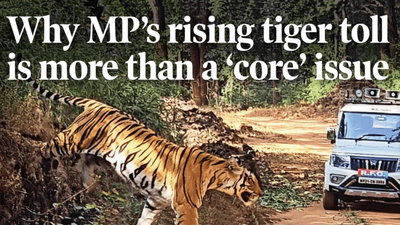
Why the increasing number of tigers in MP is more than a ‘main’ issue. india news
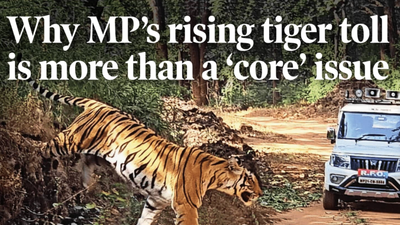
The state has lost 32 tigers in the first five months of 2026. Poaching is under control, but electrified fencing outside core areas has emerged as a major threat to the big cat. Canine distemper virus has killed a tigress and four cubs, raising concerns KanhaFive months, 32 dead tigers and not nearly enough answers. The recent incident of death of big cats, including a tigress and her four cubs, in Kanha in Madhya Pradesh has once again put the famous tiger reserves of the state in the spotlight. However, the real story behind the increasing numbers of big cats may not be inside their protected boundaries, but outside them. Forest officials said the most recent deaths have occurred outside the main reserve areas, where growing tiger populations are increasingly clashing with human-dominated landscapes. Here, crude electric wire traps – often laid illegally to kill wild boars and other animals for bushmeat or to protect crops – are emerging as one of the biggest threats to the big cats.Poaching networks that were once linked to international wildlife trade syndicates have been largely dismantled, officials said. However, in their place, a more localized and difficult to monitor threat has spread across the state. Electric shock is now at the center of changing patterns of tiger deaths.treacherous terrainAccording to the latest tiger estimation done in 2022, Madhya Pradesh is home to 785 out of India’s total tiger population of 3,682. The state has seen the fastest growth in tiger numbers in the country, recording an increase of 49% between 2018 and 2022 – almost double the national growth rate of 24%.But although the number of tigers has increased, their habitat has not expanded at the same pace. The result, officials said, is the increasing spread of big cats into protected forests and beyond reserve boundaries. Tigers are highly territorial animals and often come into conflict with members of their own species, often forcing weaker, older or younger tigers to move out in search of new territories.As sanctuaries become increasingly overcrowded, many tigers are increasingly moving into buffer forests, agricultural areas and village outskirts in search of space. Officials estimate that about 40% of the state’s tigers now roam in areas located outside protected areas, while about 20% move through heavily human-dominated landscapes surrounded by roads, farms and power lines.
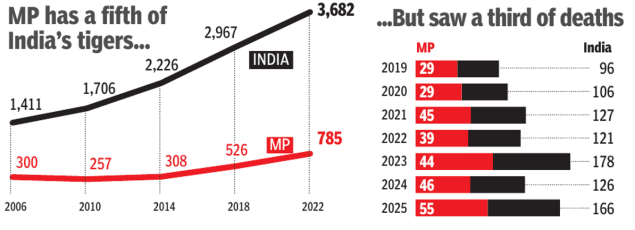
Forest officials said the pattern of tiger deaths in the state is changing due to the increasing overlap between tiger movement routes and human settlements. Nearly 80% of tiger deaths reported this year have occurred outside protected areas, with many of the carcasses recovered several kilometers away from reserve forests. Dispersion activities often bring tigers into direct conflict with villages, while they also face threats in agricultural areas where electrified wires are used illegally to deter or kill herbivorous animals such as wild boars and nilgai.Samita Rajora, MP’s chief wildlife warden, said electric shock has emerged as one of the most significant threats in these marginal landscapes. “Our analysis shows that seven tigers died this year due to electric shock, mainly from wire traps set up to protect wild meat or farm animals,” he said.Officials said many such traps involve illegal tapping of traditional 11kV power lines used for domestic and agricultural supply in villages on the fringes of forests. According to Special Tiger Protection Force (STPF) chief Ritesh Sirothia, poachers or those hunting for meat of wild animals often trap them using overhead lines using bamboo poles and create crude live-wire traps by extending the wires in the path of the animals.“When an animal comes in contact with the wire, it receives a severe electric shock, causing burns, paralysis and, in most cases, death,” Sirothia said. “Electric line tripping records become vital evidence in such cases. Whenever a person, animal or object touches a live wire, it causes the line to short out to ground, triggering tripping of the power supply. These records record the exact time, date, duration and location of the interruption, and often help establish timelines and confirm incidents of poaching.“According to officials, areas along the Bandhavgarh Tiger Reserve and Pench Tiger Reserve are currently emerging as particularly sensitive areas. “We are focusing on these high-risk areas and strengthening coordination with the power and revenue departments. Efforts are underway to analyze power-line trip data along with GPS locations to identify lightning strike hotspots,” Rajora said.numbers tell a storyComprehensive mortality data reflects the changing nature of threats facing Madhya Pradesh’s tiger population. In 2025, the state recorded the death of 55 tigers – meaning the mortality rate is about 7%, slightly higher than the national average of 5%, though officials said this is within ecological limits given the state’s density and growing tiger numbers.According to state forest department data, about 69% of these deaths were due to natural or accidental causes, including territorial fights, disease, age, road and train accidents and injuries sustained during conflict. At least 13 deaths involved cubs under one year of age – a category known to have a naturally high mortality rate and, therefore, is excluded from national tiger estimates.But officials acknowledge that more worrying trends lie elsewhere. Nearly one in every five tiger deaths recorded in the state last year was linked to electrocution, mainly from illegal electrical wiring. However, officials said most of these incidents did not involve evidence of deliberate tiger hunting or illegal trade of body parts. About 11% of deaths fall into the category of confirmed poaching cases – instances where tiger body parts were recovered and accused persons were identified or arrested.Officials highlighted that MP’s comparatively high detection rate of tiger deaths also shapes the numbers. Based on 2025 data, the national tiger mortality detection rate was around 54%, while MP recorded a higher detection rate of around 84%. Officials attribute this to intensive patrolling and monitoring systems that ensure that most tiger deaths occurring in remote regional divisions and buffer areas are ultimately detected and documented.Wire Traps, Deadly by DesignWhile poaching networks have weakened over the years, officials say the threat has increasingly shifted to decentralized actors – bush poachers and farmers who use crude electrified wire nets and fences to protect crops.Recent cases show how brutal and difficult to trace these deaths can be. In Seoni, a tigress died after being electrocuted by an illegal live-wire setup near a farm. Its body was dumped in a well, in what investigators suspect was an attempt to destroy evidence. Burnt wires were recovered from the spot and forensic investigation conducted under National Tiger Conservation Authority (NTCA) protocol confirmed the cause of death to be electric shock.In another case, in Chhindwara, a radio-collared tiger shifted from Bandhavgarh Tiger Reserve to Satpura Tiger Reserve was reportedly poisoned and buried, while its collar was burnt to avoid identification. Investigators suspect that the murder may be linked to illegal activities, including opium cultivation, in the area. Officials also acknowledged that delays in responding to caller signals exposed flaws in surveillance systems.The risk is not new and the warnings are not new. In 2018, the then Additional Chief Secretary (Forest) and Principal Secretary of the Energy Department had jointly issued instructions to all field officers, calling for coordinated action to prevent the death of wildlife due to electric shock, including joint patrolling, monitoring of power lines and real-time response to line faults. But there has been very little change on the ground.Wildlife activist Ajay Dubey said the electricity department has been reluctant to share the responsibility. “If they had come forward for joint patrolling and immediate data sharing, the problem of electric shock could have been prevented,” he said.However, officials said preventive efforts are now being intensified through coordinated patrolling in sensitive areas, monitoring of illegal electricity connections, awareness campaigns in marginal villages and action under the Electricity Act, 2003.Danger of ‘killer’ virusIf lightning is increasingly becoming a major threat outside reserves, disease outbreaks are highlighting the risks within core habitats. Recently, the Kanha Tiger Reserve has been battling an outbreak of canine distemper virus (CDV), a highly contagious disease spread from domesticated dogs to wild carnivores. The outbreak killed five tigers from the same family – a tigress and her four cubs.In response, forest officials initiated emergency containment measures in the buffer villages adjacent to the Kanha Reserve. Around 100 dogs in eight villages have already been vaccinated, while a 2 sq km forest area linked to the outbreak has been sealed.Rajora said the department has activated a multi-layered response to prevent further spread. “Since the virus spreads through dogs, vaccination in buffer villages is important. We have initiated quarantine measures, vaccination drives and intensive surveillance in the affected landscape,” she said.Officials said water bodies inside the quarantine zone were drained, disinfected using lime and bleaching powder, and temporarily sealed to prevent other wildlife from accessing potentially contaminated sources. Forest teams have also restricted the movement of tourists and closed entry points into the area.
SC: Courts should be cautious in reviewing rituals. india news
New Delhi: Nine judges Supreme Court On Wednesday, the bench appeared to be in agreement with the government on the narrow scope of judicial review of religious practices and said constitutional courts should be extremely cautious in questioning the collective religious beliefs of a sect.The remarks came from a bench comprising CJI Surya Kant and Justices BV Nagarathna, MM Sundaresh, Ahsanuddin Amanullah, Arvind Kumar, AG Masih, PB Varale, R Mahadevan and J Bagchi when Solicitor General Tushar Mehta said there was a multiplicity of sects and sub-sects with distinct religious practices and rituals, even if they were part of one sect.Mehta said, every sect, sect and sub-sect is entitled to practice its specific rituals and if certain secular activities are associated with these religious practices, then while testing the validity of a law restricting the secular part of that religious activity, the courts should be inclined towards protecting the religious practices while maintaining the identity of the sect, sect or sub-sect.Giving an example for his argument, the SG said, “The right to light ‘diyas’ is undoubtedly a matter of religion. However, if in a particular sect, it is mandatory to light 100 diyas every day, the question would be whether a ban can be imposed by the State limiting the quantity of ghee that can be purchased per day. Although purchase of ghee is a secular activity, it is intrinsically linked to something that is a matter of religion and, therefore, the State. It cannot be interfered with.”Justice Nagarathna and Justice Sundaresh said that they were of the view that constitutional courts should not question the collective religious beliefs of the followers of a sect. Mehta said reforms by a state through legislation should be on constitutional grounds – public order, morality and health.Responding to senior advocate Sanjay Hegde’s stand on rationalists that the right to freedom of conscience and the right to freedom of religion allows a person to “wake up as a Hindu, have lunch as a Muslim and sleep at night as a Christian”, Mehta said that if such a thought comes to a person’s mind, he “needs psychiatric treatment”.The bench reserved its decision on the reference related to the faith versus fundamental rights dispute.