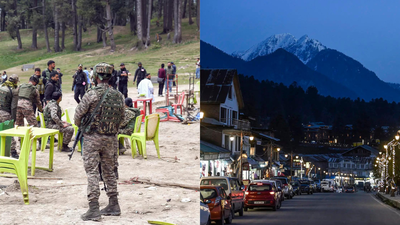
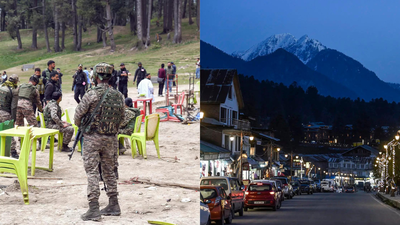
“Some boundaries should never be crossed.”A year on, the Army’s words no longer stand alone. They echo as memory and warning — marking the day that altered how Pahalgam is seen, felt and remembered. It was a moment when the valley’s calm fractured without warning.Birdsong gave way to gunfire. Routine turned to panic. Twenty-six lives were lost — and with them, the sense of safety in a place once celebrated on India’s tourism map, now grappling with a violence it was never meant to hold.One year on, the scars are still visible. In the half-filled hotels that once thrived on summer crowds and in the quieter streets, where tourism suffered, the effects still linger.
The nation remembers
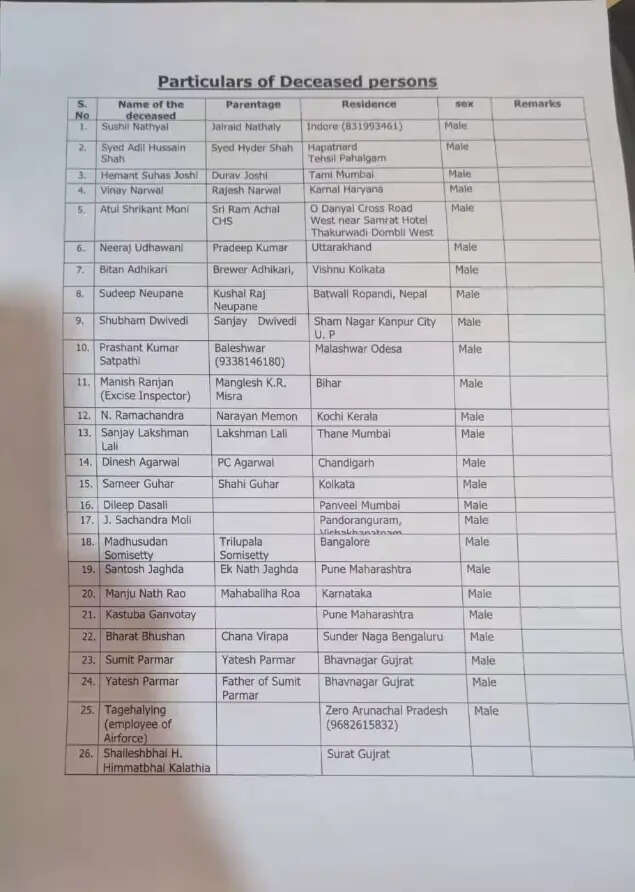
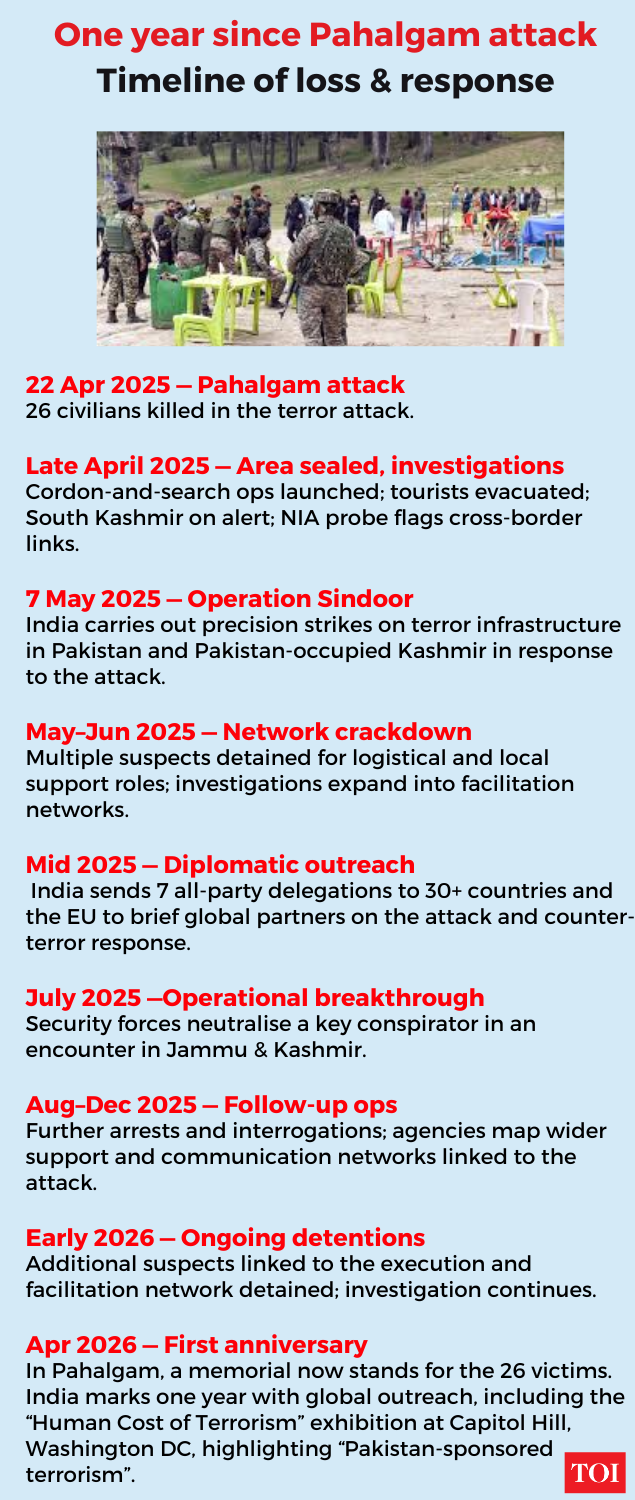
On April 22, 2025, gunfire was reported in the Baisaran meadow area near Pahalgam in South Kashmir, a major tourist destination. Within hours, authorities confirmed that 26 civilians were killed in what was described by security establishment sources as a coordinated terror attack targeting civilians in a high-footfall tourist zone.
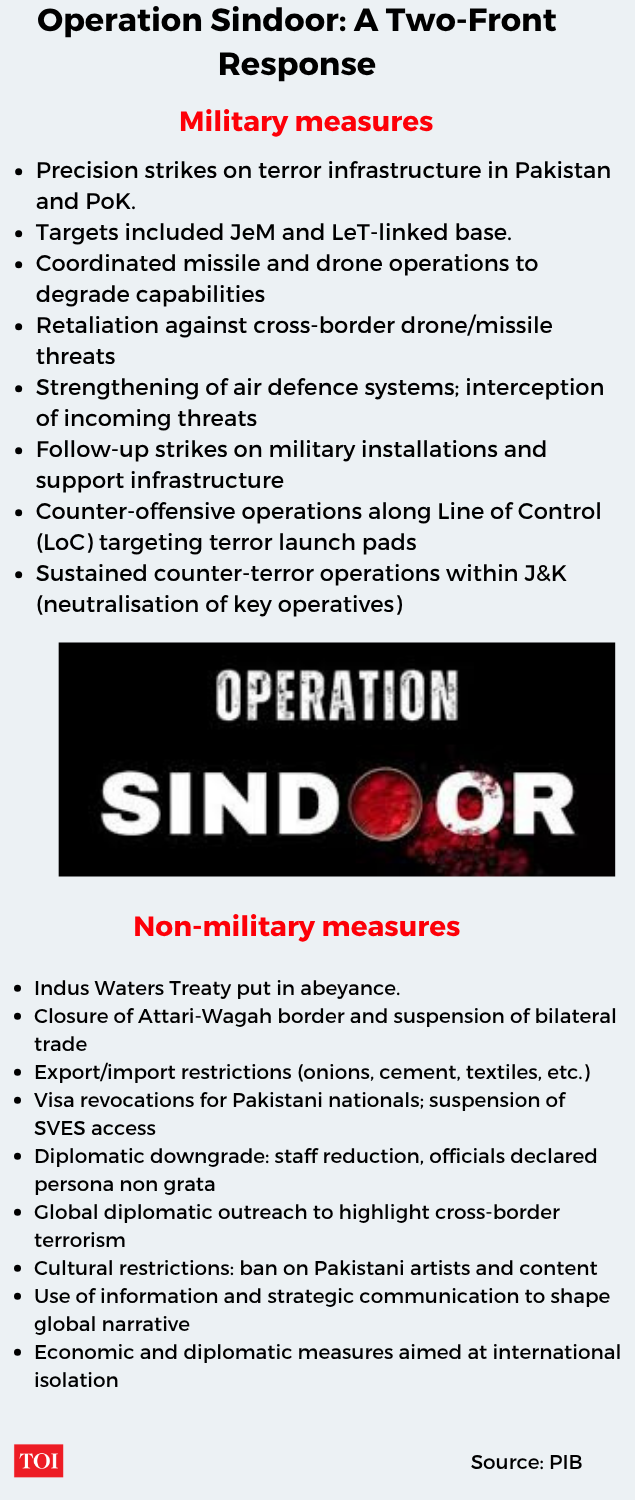
Security forces immediately launched search operations across surrounding forest belts, and the area was sealed off. Tourists were evacuated from adjoining routes as emergency protocols were activated across south Kashmir.In the days that followed, the incident was formally taken up by a multi-agency investigation mechanism involving central security and intelligence units. Officials associated with the probe indicated that early findings pointed to a structured terrorist module with logistical support networks operating across the Line of Control region.By late April 2025, security agencies expanded counter-terror operations across south Kashmir, with intensified surveillance along known tourist circuits. The response was framed within internal security briefings as a shift toward “preventive dominance” in high-tourism zones following the attack.In its first major response, on May 7, 2025, India launched “Operation Sindoor”, marking a defining shift in its anti-terror doctrine and a sharp escalation with Pakistan. The operation involved coordinated precision strikes on terror infrastructure across Pakistan and Pakistan-occupied Kashmir, representing India’s most direct cross-border military action since the Balakot strikes of February 2019.By late 2025, security agencies reported multiple arrests connected to the attack’s planning and facilitation network. Investigators indicated that communication links, logistical routes, and local support structures had been significantly degraded through sustained operations.
In early 2026, further detentions were reported in connection with individuals suspected to be directly involved in the execution of the attack. Security officials involved in the investigation said these arrests helped map wider support chains, though legal proceedings remained ongoing.Alongside military and security responses, India launched a coordinated diplomatic outreach in the days following the attack, briefing foreign governments and multilateral partners on the incident and its cross-border terror links.The Indian diplomatic outreach saw seven all-party delegations visit over 30 countries and the European Union, holding high-level briefings across major global capitals in North America, Europe, West Asia, Africa, and Asia. The missions presented India’s position on the Pahalgam attack and its counter-terror response, framing it as part of a broader effort to internationalise concerns on cross-border terrorism. As Prime Minister Narendra Modi said while marking the anniversary, the victims “will never be forgotten”.Read more: PM Modi pays tribute to Pahalgam victims on first anniversaryMeanwhile, as the security counter measures came into place, a broader impact trend started emerging through mid-2025. Tourism activity in Pahalgam and adjoining areas dropped sharply. Hotel associations and local tourism operators reported widespread cancellations during the peak summer window. Recovery began gradually by late summer, but with shorter travel cycles and increased dependence on security advisories.The attack reshaped the region in more ways than one — none more visible than in its tourism economy.
A town that lives on seasons
In Pahalgam, life has long been shaped by tourism, with summers traditionally bringing crowds, bookings, and a steady hospitality-driven economy built over decades. Hotels, pony operators, and small eateries all depend on this seasonal flow of visitors.That rhythm did not stop after the attack, but it fractured. The shift also reflected in early tourism data trends reported by Jammu and Kashmir tourism authorities, which indicated a sharp downturn in footfall in the immediate aftermath. Travel operators and hotel owners talking to TOI recalled the days that followed as a period of hesitation followed by slow but encouraging recovery. Cancellations came first. Then silence. Then cautious returns.Even now, they say, recovery is not measured in numbers alone, but in uncertainty. Decisions that once took weeks are now made days before travel, often after repeated checks on safety and advisories.Hotels in and around the region describe occupancy that returns, but unevenly. The summer peak still exists, but it no longer carries the same predictability.A representative from Galactic Gateways, a travel agency operating in Pahalgam, said, “On the ground, we saw an immediate 90–95 per cent spike in cancellations after the incident, with bookings dropping sharply for a few weeks.”He added that recovery was gradual over the following months, driven largely by repeat visitors, with tourism returning partially but remaining below earlier patterns.Another hotel operator in Pahalgam described the longer-term impact as more structural than seasonal, noting that occupancy levels remain significantly lower than pre-attack norms. She pointed to both economic strain and social fallout, including forced staff layoffs and the migration of some workers to alternative informal employment.She also stressed that while local support remained strong, external perceptions of safety had been harder to rebuild; putting emphasis on the need of continued confidence-building measures from local and national leaders which are essential for tourism recovery.Echoing similar concerns, Sheikh Khalid, director of sales at Hotel Royal Grandiose, Pahalgam, said, “The aftermath of the 22nd April terror attack proved devastating for Kashmir’s tourism sector. The impact was immediate and severe—properties that were once fully booked became vacant within days.”He further noted that while there were intermittent recoveries, external geopolitical tensions and lingering caution among travellers continued to weigh on arrivals. At the same time, he expressed cautious optimism, stating that Kashmir’s tourism potential remains intact despite present challenges.Thus, even as visitors continue to return in smaller numbers, operators across the region describe a shared reality: tourism has not stopped, but it no longer behaves the way it once did.What remains is not just a disrupted season, but a recalibrated tourism economy; one that is still searching for stability.
The people who stayed
The attack left a deep impact not only in Pahalgam but across Jammu and Kashmir, triggering widespread grief and concern across the region. In the immediate aftermath, parts of Jammu and Kashmir saw heightened security conditions and intensified counter-terror operations, reshaping everyday routines in sensitive areas.Among the direct victims, Syed Adil Hussain Shah, a local pony operator and one of the 26 people killed in the attack, is remembered by his family as someone who tried to protect others during the assault. Eyewitness accounts and later reports indicated that he attempted to resist the attackers and help shield tourists as the firing unfolded.Speaking to PTI on the first anniversary of the attack, his family said, “they continue to feel his absence every moment, even as they hold on to a sense of pride amid the unbearable loss.”Across Jammu and Kashmir, daily life continued, but under closer monitoring in sensitive zones and a visibly strengthened security presence, with the memory of the incident remaining part of everyday consciousness.Meanwhile in broader J&K, daily life continued, but under closer monitoring in sensitive zones, a stronger security presence, and the lingering proximity of events that unfolded in their home state.J&K residents, talking to TOI, describe an emotional hit that they are still finding hard to recover from. However, their emotions have shifted from visible fears and confusion to the sense of caution that has become an even part of their normal life.Aditya, a hotel operator in Srinagar, talked from both a personal and professional perspective.
There was a sense of fear amongst the locals and especially the tourists. Pahalgam was under lockdown and in Srinagar the security increased. I was getting calls from some tourists who wanted to leave Pahalgam overnight and come to us in Srinagar but were unable to do so as Pahalagam was under lockdown.
Aditya, a Srinagar resident
Further talking about the emotional impact, he added, “It has shaken the whole community in the J&K state especially the valley. People started to look at the people from the valley very differently. Unfortunately the people from this state have suffered the most financially, emotionally and psychologically too which will take a very long time to heal.”Another resident from Kishtwar, Irfan Ahmad, described the emotional impact despite being geographically distant.
I felt panicked at that time because such incidents had never happened before. It is 280 km away from my home. At that time, there were no restrictions or curfew, but we were in deep pain. We tried our best to oppose this heinous crime against humanity by posting on social media and through physical gatherings to mourn the loss of lives
Irfan Ahmad, Kishtwar resident
Further talking about the lingering effects he added, “Even now, that incident still haunts us — how it happened, who is responsible, and why anyone would commit such an act. Many questions still linger in our minds.”Monica Shivek, a work experience teacher with DIET, recalled her immediate reaction of fear and shock.
Talking about a year back, When I heard about the Pahalgam attack I was shocked and shattered and more than that I was afraid to learn about this terror attack, " adding that, “in the whole region everyone was seen escaping to save himself and to leave Srinagar by any means.
Monica Shivek, a work experience teacher with DIET
Reflecting on its longer impact a year later, she said, “I feel it was a barbaric attack and my heart cries out for those who were there facing those bullets…a sheer cowardly attack. After the abrogation of Article 370 a sense of peace was prevalent and as this incident happened once again a fear of terrorism again started hovering in our minds. A psychological impact of all this is still prevalent, maybe silently in our hearts.”Thus, for many, the change is not episodic but lasting; how they move, how they perceive public spaces, and how closely security remains integrated into daily existence.
Rebuilding confidence in safety and security
In the months following the attack and subsequent Operation Sindoor, security across key tourist circuits in Jammu and Kashmir was further strengthened, with increased deployment, tighter coordination between agencies, and expanded surveillance along sensitive routes.
Lieutenant General (Retd.) DP Pandey, former commander of the 15 Corps, told TOI, that the counter-terror approach is “based on intelligence to neutralise key leaders” and also aims to ensure that “financial networks that fund terror and separatist organisations are exposed.” He highlighted that while terror incidents had declined over time, the Pahalgam attack remained an exception in an otherwise improved security environment.He further said that post-incident reviews typically lead to reinforcement of security infrastructure near tourist areas and a “focused approach towards anti-terror operations in higher reaches of J&K to deny safe areas.”Meanwhile, a senior Army official talked to TOI about sustaining the confidence in security and retaining the trust of people. “The response of the people over the past year speaks for itself. Immediately after Operation Sindoor, we witnessed a footfall of over 4.1 lakh yatris for the Shri Amarnath Ji Yatra, reflecting strong confidence of the people in the security architecture and the enduring appeal of Jammu & Kashmir as a premier tourist destination.He also mentioned 1.9 crore tourist visits to Jammu and Kashmir in the past year, including strong winter arrivals.The official also highlighted the Udhampur–Srinagar–Baramulla Rail Link as a key boost to connectivity and tourism, while adding that “the spirit of Kashmiriyat… was evident as the people of J&K stood firmly with the nation in the aftermath of the Pahalgam terror attack.”
Watch
Indian Army Sends Strong Warning to Terror Groups Ahead of Pahalgam Terror Attack Anniversary
What remains
A year on, Pahalgam has not become a place defined solely by what happened. It continues to function, to host, and to receive.But it also remembers. In quieter hotel corridors during off-peak weeks. In conversations between local workers before the season begins. In the cautious optimism of businesses that know recovery is real, but still fragile for now.What lingers is not just the memory of that day, but the scars it left behind, shaping how, not just the valley, but the entire nation moves forward.Thus, a year later, the tragedy must be remembered as both a tribute to the victims and a reminder of a moment when the nation was hurt, and of what it left behind.


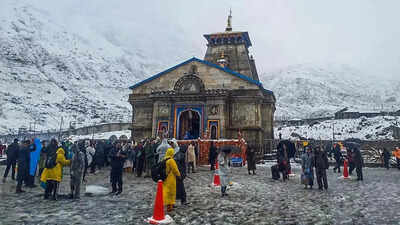
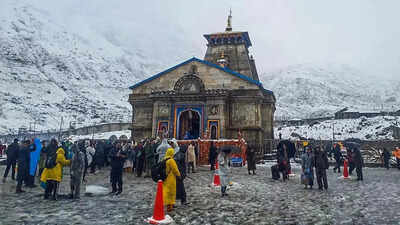 Supreme Court He did not support government control over temples and clarified that he had already laid out his own interpretation of the constitutional provisions that enable states to manage the secular activities of religious institutions.During the faith versus fundamental rights arguments before a nine-judge bench led by CJI Surya Kant, senior lawyer Gopal Sankaranarayanan said SG Tushar Mehta, appearing for the Centre, and AM Singhvi, senior counsel for the Travancore Devaswom Board that manages the Sabarimala Ayyappa Temple, had given a special interpretation of Articles 25 and 26 because the government wanted to control the temples.Mehta sought permission from the bench to refute Sankaranarayanan’s interpretation of his arguments and said, “The government does not want to control temples at all and what he mentioned was entirely the constitutional interpretation of Article 25(1)(A), which empowers the state to manage the economic, political and secular activities of any religion.”Justice Amanullah asked Mehta whether his “government should not control temples” argument was limited to Hindu religious institutions. The SG said that when courts and lawyers were engaged in the interpretation of constitutional provisions, they “cannot be viewed through a Hindu, Muslim, Christian or any other religious lens”.Justice Bagchi said the interpretation should be from a citizen’s perspective. The SG said he had given an overview of the diversity in Hinduism, Islam, Christianity, Buddhism and other sects.In Kerala, several state government-supervised bodies, including the Travancore, Cochin, Malabar, Guruvayur and Kudalamanikyam Devaswom boards, control about 3,000 temples. In Tamil Nadu, the Hindu Religious and Charitable Endowments Department controls over 30,000 temples. In Andhra Pradesh, the Tirumala Tirupati Devasthanam Trust Board controls the Tirupati Balaji temple. In Karnataka, the Hindu Religious Institutions and Charitable Endowments Department manages temples. Chardham Devasthanam Board manages the Badrinath and Kedarnath temples in Uttarakhand.
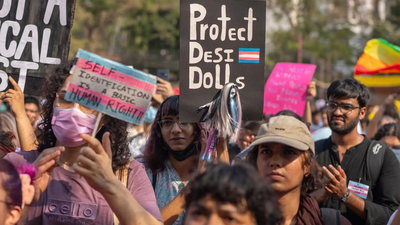
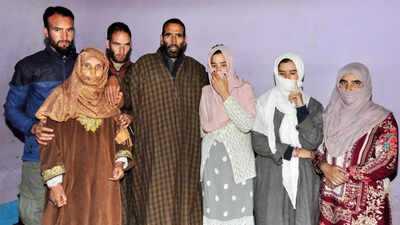
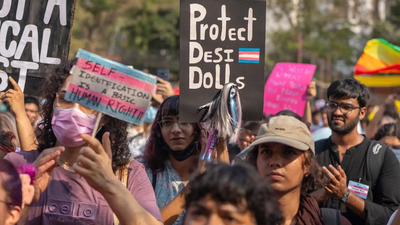 Driven by transgender rights activists Manveer Yadav and Vishwanath Maithil – who identify themselves as transmen – the petition said the 2026 amendment law brings sweeping changes to the 2019 law and is a “complete affront to the principles” laid down by the SC in the 2014 landmark ‘National Legal Services Authority vs Union of India’ case, which recognized “transgender” as a broad term, including trans men and trans masculinities. Covers a wide and diverse range of identities. identity, trans women, non-binary individuals, genderqueer individuals, and socio-cultural groups including Hijras, Kinnars, Aravanis and Jogtas, and held that the criteria for recognition should be ‘psychological testing’ and not ‘biological testing’.‘The two other petitioners are transgender rights activists and trans women Abhina Aher and Vinshi Shahi.The petitioners said the 2026 law replaces an identity-based, self-determination framework with externally verifiable biological markers and an explicit list of designated trans-feminine socio-cultural communities, none of which include trans men.Highlighting that before the amendments, “transgender person” was defined in the Trans Rights Act, 2019, to include trans men and trans women, persons with intersex variations, gender-queer persons and designated socio-cultural communities, regardless of medical intervention. Additionally, it guaranteed the right to self-perceived gender identity. “Taken together, this framework operationalized the constitutional mandate of NALSA. The 2026 Amendment Act systematically dismantles this,” he stressed.The petition states that the 2026 Amendment Act, firstly, replaces the open, identity-based definition of “transgender person” under the 2019 Act with a categorical and exhaustive list of: persons with designated socio-cultural identities (Kinnar, Hijra, Aravani, Jogta, and Kinnar); Individuals with intersex diversity defined through biological and chromosomal criteria; And individuals are forced to adopt transgender identities through forced physical modification.“Furthermore, a provision declares that the definition “does not, and has never, included individuals of diverse sexual orientations and self-perceived sexual identities.”Furthermore, the petitioners express concern as they highlight that “the right to self-perceived gender identity which is constitutionally protected has been completely abandoned without any valid rationale”. They say, “The combined effect of such amendments is to deny trans men and trans masculine identities all statutory recognition and protection.”“Furthermore, each named socio-cultural community by definition is, without exception, a trans-feminine community of individuals assigned as male at birth. Trans men and trans masculine identities have no equivalent named community formation in India; their structural invisibility is itself a defining feature of their experience,” the petition said.It further highlights that “the legislature’s privileging of community-visible, trans-feminine identities over self-perceived identities is not a neutral classification, it is a bias of visibility encoded in statute.”Raising various issues, the petitioners also drew attention to how the 2026 Amendment Act restructures the certificate regime under the Trans Rights Act 2019, “converting a convenient, self-declaration-based process on gender transition into an administrative decision and mandatory state surveillance”.“Under the 2026 Amendment Act, the District Magistrate is now required to examine the recommendation of a medical board and, where it is considered “necessary or desirable”, seek the assistance of other medical experts before issuing a certificate of identity. This directly reproduces the Corbett Biological Test clearly rejected in the NALSA case and creates a chilling impact on gender expression,” the petitioners say.They also highlight the Parliamentary Standing Committee report, which cautioned against such “medical gatekeeping” and sought the intervention of the apex court to protect the rights of the community, and urged the Supreme Court to declare the right to self-perceived gender identity a fundamental right protected under the Constitution of India.“Medical institutions are mandated to furnish details of any person undergoing gender-affirming surgery to the District Magistrate and designated authority without consent, purpose limitation or data protection safeguards. This violates the right to informational privacy, decisional autonomy and bodily autonomy under Article 21; violates doctor-patient confidentiality; conflicts with the Digital Personal Data Protection Act, 2023; and creates a state-controlled surveillance architecture on gender transition that is clearly arbitrary and capricious under Article 21.” Disproportionate under 14,” the petition said.It further says, “The protection that change of gender will not affect existing rights and entitlements under the Act has been removed, removing an important statutory protection and leaving individuals transitioning without protection of their rights.”In this backdrop, the petitioners seek the intervention of the apex court to protect the rights of the community and urge the Supreme Court to declare the right to self-perceived gender identity as a fundamental right protected under the Constitution of India.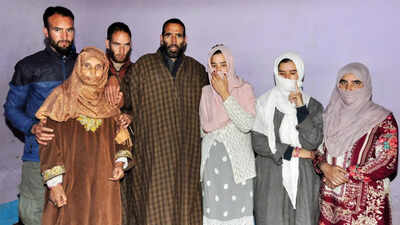
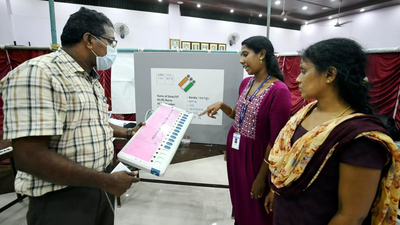
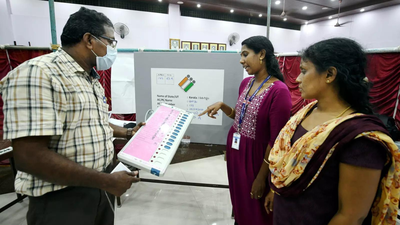 Election Commission Presiding Officers of all booths, particularly in West Bengal, have been directed to check and ensure that all candidate buttons on the Electronic Voting Machines (EVMs) are clearly visible and not covered with tape, glue or any other material including colour, ink, perfume or chemicals which may compromise the secrecy of the votes.In cases where candidate buttons are found with the above discrepancies, they fall under tampering or interference with Electronic Voting Machines (EVMs), which is an electoral offence.Election Commission officials on Tuesday said the commission will not hesitate to take criminal action or order re-polling in such cases.Wherever cases of molestation come to light, the Presiding Officer will immediately inform the Sector Officer or Returning Officer.