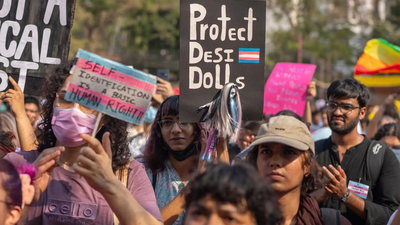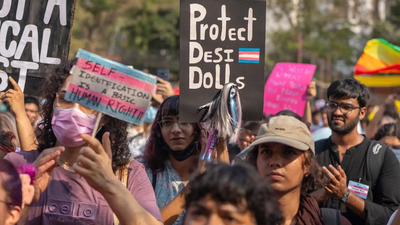
Driven by transgender rights activists Manveer Yadav and Vishwanath Maithil – who identify themselves as transmen – the petition said the 2026 amendment law brings sweeping changes to the 2019 law and is a “complete affront to the principles” laid down by the SC in the 2014 landmark ‘National Legal Services Authority vs Union of India’ case, which recognized “transgender” as a broad term, including trans men and trans masculinities. Covers a wide and diverse range of identities. identity, trans women, non-binary individuals, genderqueer individuals, and socio-cultural groups including Hijras, Kinnars, Aravanis and Jogtas, and held that the criteria for recognition should be ‘psychological testing’ and not ‘biological testing’.‘
The two other petitioners are transgender rights activists and trans women Abhina Aher and Vinshi Shahi.
The petitioners said the 2026 law replaces an identity-based, self-determination framework with externally verifiable biological markers and an explicit list of designated trans-feminine socio-cultural communities, none of which include trans men.
Highlighting that before the amendments, “transgender person” was defined in the Trans Rights Act, 2019, to include trans men and trans women, persons with intersex variations, gender-queer persons and designated socio-cultural communities, regardless of medical intervention. Additionally, it guaranteed the right to self-perceived gender identity. “Taken together, this framework operationalized the constitutional mandate of NALSA. The 2026 Amendment Act systematically dismantles this,” he stressed.
The petition states that the 2026 Amendment Act, firstly, replaces the open, identity-based definition of “transgender person” under the 2019 Act with a categorical and exhaustive list of: persons with designated socio-cultural identities (Kinnar, Hijra, Aravani, Jogta, and Kinnar); Individuals with intersex diversity defined through biological and chromosomal criteria; And individuals are forced to adopt transgender identities through forced physical modification.“
Furthermore, a provision declares that the definition “does not, and has never, included individuals of diverse sexual orientations and self-perceived sexual identities.”
Furthermore, the petitioners express concern as they highlight that “the right to self-perceived gender identity which is constitutionally protected has been completely abandoned without any valid rationale”. They say, “The combined effect of such amendments is to deny trans men and trans masculine identities all statutory recognition and protection.”
“Furthermore, each named socio-cultural community by definition is, without exception, a trans-feminine community of individuals assigned as male at birth. Trans men and trans masculine identities have no equivalent named community formation in India; their structural invisibility is itself a defining feature of their experience,” the petition said.
It further highlights that “the legislature’s privileging of community-visible, trans-feminine identities over self-perceived identities is not a neutral classification, it is a bias of visibility encoded in statute.”
Raising various issues, the petitioners also drew attention to how the 2026 Amendment Act restructures the certificate regime under the Trans Rights Act 2019, “converting a convenient, self-declaration-based process on gender transition into an administrative decision and mandatory state surveillance”.
“Under the 2026 Amendment Act, the District Magistrate is now required to examine the recommendation of a medical board and, where it is considered “necessary or desirable”, seek the assistance of other medical experts before issuing a certificate of identity. This directly reproduces the Corbett Biological Test clearly rejected in the NALSA case and creates a chilling impact on gender expression,” the petitioners say.
They also highlight the Parliamentary Standing Committee report, which cautioned against such “medical gatekeeping” and sought the intervention of the apex court to protect the rights of the community, and urged the Supreme Court to declare the right to self-perceived gender identity a fundamental right protected under the Constitution of India.
“Medical institutions are mandated to furnish details of any person undergoing gender-affirming surgery to the District Magistrate and designated authority without consent, purpose limitation or data protection safeguards. This violates the right to informational privacy, decisional autonomy and bodily autonomy under Article 21; violates doctor-patient confidentiality; conflicts with the Digital Personal Data Protection Act, 2023; and creates a state-controlled surveillance architecture on gender transition that is clearly arbitrary and capricious under Article 21.” Disproportionate under 14,” the petition said.
It further says, “The protection that change of gender will not affect existing rights and entitlements under the Act has been removed, removing an important statutory protection and leaving individuals transitioning without protection of their rights.”
In this backdrop, the petitioners seek the intervention of the apex court to protect the rights of the community and urge the Supreme Court to declare the right to self-perceived gender identity as a fundamental right protected under the Constitution of India.