Why the increasing number of tigers in MP is more than a ‘main’ issue. india news
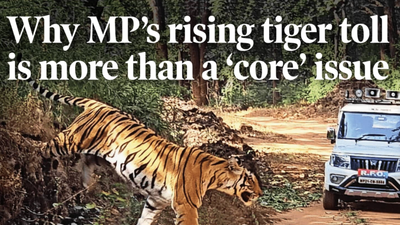
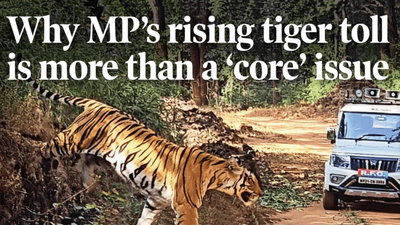
Why is the increasing number of tigers in MP more than a 'main' issue?

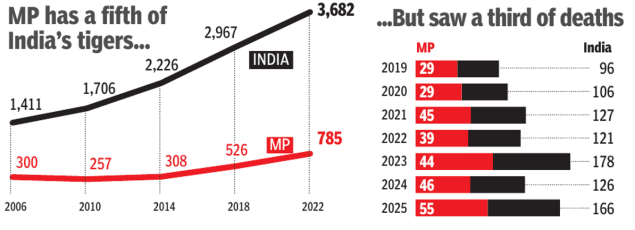
The state has lost 32 tigers in the first five months of 2026. Poaching is under control, but electrified fencing outside core areas has emerged as a major threat to the big cat. Canine distemper virus has killed a tigress and four cubs, raising concerns KanhaFive months, 32 dead tigers and not nearly enough answers. The recent incident of death of big cats, including a tigress and her four cubs, in Kanha in Madhya Pradesh has once again put the famous tiger reserves of the state in the spotlight. However, the real story behind the increasing numbers of big cats may not be inside their protected boundaries, but outside them. Forest officials said the most recent deaths have occurred outside the main reserve areas, where growing tiger populations are increasingly clashing with human-dominated landscapes. Here, crude electric wire traps – often laid illegally to kill wild boars and other animals for bushmeat or to protect crops – are emerging as one of the biggest threats to the big cats.Poaching networks that were once linked to international wildlife trade syndicates have been largely dismantled, officials said. However, in their place, a more localized and difficult to monitor threat has spread across the state. Electric shock is now at the center of changing patterns of tiger deaths.treacherous terrainAccording to the latest tiger estimation done in 2022, Madhya Pradesh is home to 785 out of India’s total tiger population of 3,682. The state has seen the fastest growth in tiger numbers in the country, recording an increase of 49% between 2018 and 2022 – almost double the national growth rate of 24%.But although the number of tigers has increased, their habitat has not expanded at the same pace. The result, officials said, is the increasing spread of big cats into protected forests and beyond reserve boundaries. Tigers are highly territorial animals and often come into conflict with members of their own species, often forcing weaker, older or younger tigers to move out in search of new territories.As sanctuaries become increasingly overcrowded, many tigers are increasingly moving into buffer forests, agricultural areas and village outskirts in search of space. Officials estimate that about 40% of the state’s tigers now roam in areas located outside protected areas, while about 20% move through heavily human-dominated landscapes surrounded by roads, farms and power lines.
-

Forest officials said the pattern of tiger deaths in the state is changing due to the increasing overlap between tiger movement routes and human settlements. Nearly 80% of tiger deaths reported this year have occurred outside protected areas, with many of the carcasses recovered several kilometers away from reserve forests. Dispersion activities often bring tigers into direct conflict with villages, while they also face threats in agricultural areas where electrified wires are used illegally to deter or kill herbivorous animals such as wild boars and nilgai.Samita Rajora, MP’s chief wildlife warden, said electric shock has emerged as one of the most significant threats in these marginal landscapes. “Our analysis shows that seven tigers died this year due to electric shock, mainly from wire traps set up to protect wild meat or farm animals,” he said.Officials said many such traps involve illegal tapping of traditional 11kV power lines used for domestic and agricultural supply in villages on the fringes of forests. According to Special Tiger Protection Force (STPF) chief Ritesh Sirothia, poachers or those hunting for meat of wild animals often trap them using overhead lines using bamboo poles and create crude live-wire traps by extending the wires in the path of the animals.“When an animal comes in contact with the wire, it receives a severe electric shock, causing burns, paralysis and, in most cases, death,” Sirothia said. “Electric line tripping records become vital evidence in such cases. Whenever a person, animal or object touches a live wire, it causes the line to short out to ground, triggering tripping of the power supply. These records record the exact time, date, duration and location of the interruption, and often help establish timelines and confirm incidents of poaching.According to officials, areas along the Bandhavgarh Tiger Reserve and Pench Tiger Reserve are currently emerging as particularly sensitive areas. “We are focusing on these high-risk areas and strengthening coordination with the power and revenue departments. Efforts are underway to analyze power-line trip data along with GPS locations to identify lightning strike hotspots,” Rajora said.numbers tell a storyComprehensive mortality data reflects the changing nature of threats facing Madhya Pradesh’s tiger population. In 2025, the state recorded the death of 55 tigers – meaning the mortality rate is about 7%, slightly higher than the national average of 5%, though officials said this is within ecological limits given the state’s density and growing tiger numbers.According to state forest department data, about 69% of these deaths were due to natural or accidental causes, including territorial fights, disease, age, road and train accidents and injuries sustained during conflict. At least 13 deaths involved cubs under one year of age – a category known to have a naturally high mortality rate and, therefore, is excluded from national tiger estimates.But officials acknowledge that more worrying trends lie elsewhere. Nearly one in every five tiger deaths recorded in the state last year was linked to electrocution, mainly from illegal electrical wiring. However, officials said most of these incidents did not involve evidence of deliberate tiger hunting or illegal trade of body parts. About 11% of deaths fall into the category of confirmed poaching cases – instances where tiger body parts were recovered and accused persons were identified or arrested.Officials highlighted that MP’s comparatively high detection rate of tiger deaths also shapes the numbers. Based on 2025 data, the national tiger mortality detection rate was around 54%, while MP recorded a higher detection rate of around 84%. Officials attribute this to intensive patrolling and monitoring systems that ensure that most tiger deaths occurring in remote regional divisions and buffer areas are ultimately detected and documented.Wire Traps, Deadly by DesignWhile poaching networks have weakened over the years, officials say the threat has increasingly shifted to decentralized actors – bush poachers and farmers who use crude electrified wire nets and fences to protect crops.Recent cases show how brutal and difficult to trace these deaths can be. In Seoni, a tigress died after being electrocuted by an illegal live-wire setup near a farm. Its body was dumped in a well, in what investigators suspect was an attempt to destroy evidence. Burnt wires were recovered from the spot and forensic investigation conducted under National Tiger Conservation Authority (NTCA) protocol confirmed the cause of death to be electric shock.In another case, in Chhindwara, a radio-collared tiger shifted from Bandhavgarh Tiger Reserve to Satpura Tiger Reserve was reportedly poisoned and buried, while its collar was burnt to avoid identification. Investigators suspect that the murder may be linked to illegal activities, including opium cultivation, in the area. Officials also acknowledged that delays in responding to caller signals exposed flaws in surveillance systems.The risk is not new and the warnings are not new. In 2018, the then Additional Chief Secretary (Forest) and Principal Secretary of the Energy Department had jointly issued instructions to all field officers, calling for coordinated action to prevent the death of wildlife due to electric shock, including joint patrolling, monitoring of power lines and real-time response to line faults. But there has been very little change on the ground.Wildlife activist Ajay Dubey said the electricity department has been reluctant to share the responsibility. “If they had come forward for joint patrolling and immediate data sharing, the problem of electric shock could have been prevented,” he said.However, officials said preventive efforts are now being intensified through coordinated patrolling in sensitive areas, monitoring of illegal electricity connections, awareness campaigns in marginal villages and action under the Electricity Act, 2003.Danger of ‘killer’ virusIf lightning is increasingly becoming a major threat outside reserves, disease outbreaks are highlighting the risks within core habitats. Recently, the Kanha Tiger Reserve has been battling an outbreak of canine distemper virus (CDV), a highly contagious disease spread from domesticated dogs to wild carnivores. The outbreak killed five tigers from the same family – a tigress and her four cubs.In response, forest officials initiated emergency containment measures in the buffer villages adjacent to the Kanha Reserve. Around 100 dogs in eight villages have already been vaccinated, while a 2 sq km forest area linked to the outbreak has been sealed.Rajora said the department has activated a multi-layered response to prevent further spread. “Since the virus spreads through dogs, vaccination in buffer villages is important. We have initiated quarantine measures, vaccination drives and intensive surveillance in the affected landscape,” she said.Officials said water bodies inside the quarantine zone were drained, disinfected using lime and bleaching powder, and temporarily sealed to prevent other wildlife from accessing potentially contaminated sources. Forest teams have also restricted the movement of tourists and closed entry points into the area.

Source link

Lavrov meets Foreign Minister before BRICS meeting, discusses India-Russia relations. india news

Lavrov meets Foreign Minister before BRICS meeting, discusses India-Russia relations

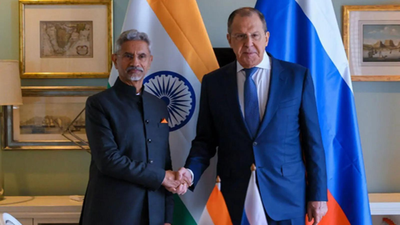
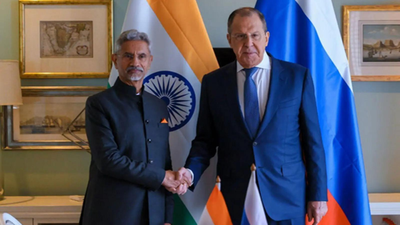
New Delhi: Foreign Minister S Jaishankar The meeting with counterpart Sergei Lavrov underlined the importance of India’s relations with Russia, saying political cooperation between the two countries is even more valuable in an uncertain and volatile global environment. Jaishankar told Lavrov that in a complex international situation, an open exchange of views is necessary, especially between two trusted partners.Ahead of the BRICS Foreign Ministers’ Meeting, the Ministers reviewed cooperation in a number of areas. Jaishankar told Lavrov that both countries would benefit from risk reduction and diversification. Jaishankar said on Twitter that he had a “productive” exchange of views with Lavrov. “Our talks discussed many aspects of the India-Russia Special and Privileged Strategic Partnership, including trade and investment, energy and connectivity, science and technology as well as facilitating mobility of skills and talent,” he said.

Source link

Venugopal, Satheesan or Chennithala? The suspense on Kerala Chief Minister will end today. india news

Venugopal, Satheesan or Chennithala? The suspense on Kerala CM will end today
VD Satheesan, KC Venugopal, Ramesh Chennithala

New Delhi: After nine days of intense lobbying fueling rumours, the Congress will end the suspense on Thursday morning by naming the next Chief Minister of Kerala, including leader of opposition VD Satheesan, AICC general secretary KC Venugopal and veteran Ramesh Chennithala.In one-on-one talks last Saturday, the three candidates strongly put forward their claims to the Congress leadership of Mallikarjun Kharge and Rahul Gandhi. While Rahul’s confidant Venugopal is said to have secured the support of most of the MLAs, Satheesan is widely seen as the man who led the party and the UDF in charge during the five years of the Left Front government, which won a re-term in 2021. Chennithala presented his stand on seniority and acceptability.After seeking the opinion of senior Kerala leaders a day earlier, Rahul held a 40-minute discussion with Kharge on Wednesday, amid expectations in Delhi and Kerala that the CM candidate would be announced immediately.‘The name of CM-Select will come in a sealed envelope’ But AICC spokesperson Jairam Ramesh told reporters that the high command has completed discussions on the next leader of Kerala and an announcement will be made on Thursday.Since Congress has called a legislature party meeting in Thiruvananthapuram on Thursday afternoon, it is believed that the name can be announced there. Some party leaders claimed that the name of the selected CM will come in a sealed envelope, which will be opened among the MLAs, who will then sign the paper and go to the Governor to stake claim to form the government.There are concerns in Congress circles that given the extreme level of lobbying by factional groups, there could be disappointment and resentment among supporters of those left out of the final decision. In such a situation, along with the CM’s announcement, the agreement formula will also have to be presented. Satheesan is said to have told the leadership that he will not join the government if he is not selected for the top post.During the day, eager supporters gathered at the residences of Satheesan and Chennithala in Kerala expecting an announcement in the evening.Former state Congress chief VM Sudheeran, who had met Rahul the evening before, said the people of the state are keen that his choice be chosen (as CM), adding that they are “concerned” about it.

Source link

33 people died due to heavy rain and dust storm in Uttar Pradesh. india news

33 people died due to heavy rain and dust storm across Uttar Pradesh

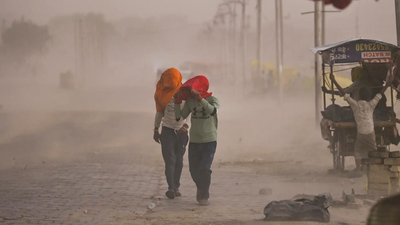
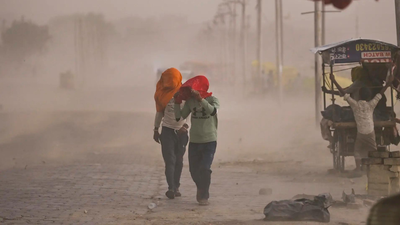
New Delhi: At least 33 people died as a powerful storm accompanied by heavy rain lashed five districts of Uttar Pradesh on Wednesday, officials told news agency PTI.Taking stock of the damage, Uttar Pradesh Chief Minister Yogi Adityanath ordered immediate relief measures and compensation for the affected families. He directed district officials to complete the relief work within 24 hours and asked officials to remain on alert amid weather-related concerns.The state government has also ordered a survey to assess the damage caused to crops, livestock and houses due to the unseasonal weather.According to officials, Bhadohi reported the highest number of deaths at 16, followed by Fatehpur with nine and Badayu with five. Two people died in Chandauli, while one death was reported in Sonbhadra. Several other people were injured in separate incidents related to the storm.Communication and rescue efforts were disrupted in some districts due to sudden weather changes. Officials said electric poles were uprooted and infrastructure damaged due to strong winds in Bhadohi, affecting mobile services. Emergency teams, police personnel and local administrators were sent to the affected villages to clear debris and assist residents.Many deaths occurred due to collapsing walls and falling trees as people attempted to escape the storm. Two young girls died when the wall of their mud hut collapsed during strong wind and rain in Badaun. In another incident in the district, a woman lost her life when a tree fell on a small structure where villagers had gathered for safety. A truck driver and a young man who was going to deliver food also died due to falling trees.In Fatehpur, officials said most of the deaths were reported from Khaga tehsil, where several structures collapsed during the storm. At least 16 people were injured in the district.

Source link

‘Structural flaws exposed’: Vijay demands abolition of NEET after paper leak. india news

'Structural flaws exposed': Vijay demands abolition of NEET after paper leak

New Delhi: Chief Minister of Tamil Nadu C Joseph Vijay said that the cancellation of NEET-UG 2026 exam exposed “structural flaws” in the system and demanded cancellation of the exam.Vijay said that governments in Tamil Nadu have “consistently and unanimously” opposed NEET since its introduction, arguing that it has “severely disadvantaged students from rural areas, government schools, Tamil medium backgrounds and socio-economically disadvantaged families”. He called on states to allow admission to medical students on the basis of class 12 marks.The National Testing Agency on Tuesday canceled the May 3 NEET-UG exam following allegations of paper leak. The decision has left over 22 lakh medical aspirants uncertain about their future and triggered widespread protests demanding accountability and resignation of Education Minister Dharmendra Pradhan.CBI arrested Mangilal Biwal, Vikas Biwal and Dinesh Biwal from Jaipur, Yash Yadav from Gurugram and Shubham Khairnar from Nashik. Officials said that more arrests are likely as the scope of investigation increases in many states.“Big people are protected and the common man is harassed,” said an accused in Jaipur while being taken to Delhi for questioning.The investigators seized mobile phones, laptops and other digital devices during the raid. The devices will be forensically examined to find out how the alleged question papers were circulated before the exams.The Special Operations Group of the Rajasthan Police, which first started investigating the case, said the “guess letter” came from a medical student from Sikar studying in Kerala. Officials alleged that the material was shared among coaching students and hostel residents before being spread to candidates in Jaipur and surrounding districts.Officials questioned more than 150 students, parents and coaching colleagues across Rajasthan. Investigators suspect that the leak may have originated in Nashik before passing through Gurugram and Rajasthan.Political tension also increased after Congress and Trinamool Congress leaders alleged that some of the accused had links with the BJP. Former Rajasthan Chief Minister Ashok Gehlot claimed that Dinesh Biwal was a BJP functionary and accused the state government of trying to suppress the case. BJP leaders denied the allegations, with state vice president Mukesh Dadhich saying Dinesh did not hold any post in the party.Meanwhile, protests broke out in several states, where Congress workers burnt effigies of Pradhan and student groups including NSUI, AISA, ABVP and SFI, demanding strict action and greater transparency in competitive examinations.

Source link

2 historic Indian bronze statues illegally removed from Tamil Nadu temples brought back to India from US. india news

2 historic Indian bronze statues illegally removed from Tamil Nadu temples brought back to India from US

New Delhi: In a significant milestone in India’s efforts to bring back stolen cultural treasures, two historic Indian bronzes originally from temples in Tamil Nadu – the 12th century Chola period sculptures of Somaskanda (Shiva and Uma) and the 16th century saints Sundarar and Paravai – were brought back to India on Tuesday night from the Smithsonian – National Museum of Asian Art in the United States. The third – the idol of Lord Nataraja – will be brought back after being displayed in an exhibition under a three-year loan agreement.Apart from highlighting the return of these temple artefacts, Culture Minister Gajendra Singh Shekhawat also said that under the framework of the recent cultural property agreement with the US, US law enforcement agencies have already handed over 657 additional art objects of Indian origin to the Indian Embassy in the US. He said arrangements are being made for their transportation and verification by ASI experts for their archaeological status.“These will be evaluated, packed and brought back to India, after which they will undergo detailed examination and certification,” Shekhawat said. The minister also pointed out that out of 668 antiquities brought back from different countries since 1972, 655 have returned after the Modi government came to power in 2014.Meanwhile, in the case of the ‘Shiva Nataraja’ statue of the Chola period (circa 990 CE), which originally belonged to the Sri Bhava Aushadesvara temple in Thanjavur district, the Government of India, at the request of the Smithsonian, has agreed to a three-year loan agreement with the museum (2025-28). The statue will be brought back after being displayed in an exhibition where the visitors will get a glimpse of the entire historical journey from origin to repatriation.The government has justified the decision to extend the loan arrangement in relation to Shiva Nataraja as a “goodwill gesture” and in support of “responsible museum participation”. The Minister said the spirit behind the agreement was to enable public presentation of its entire historical journey – from provenance to repatriation – while strengthening ethical museum practices and provenance research standards.“Guided by the personal interest and direction of the Prime Minister, the return of these antiquities has been possible due to coordinated efforts between the Ministry of Culture, ASI, Indian Embassies abroad and various enforcement agencies,” the minister said.These sacred temple bronzes, originally from Tamil Nadu, were illegally removed from India in the mid-20th century and later stored abroad.The two bronzes brought back from America are displayed in the National Museum along with 11 antiquities brought back from Australia, including Shunga-period terracotta objects, a Pala period statue of Varaha, an 11th-century Bodhisattva statue and a wooden statue of Brahma.In the case of three bronzes from the US, the Archaeological Survey of India (ASI) successfully traced the artefacts to their original temple sites in Tamil Nadu, through extensive provenance research using archival records, field documentation and historical temple photographs from the 1950s and 1960s. The findings formed the basis of coordinated talks involving the Ministry of Culture, the Smithsonian Institution, and the Indian Embassy in the United States. The photograph of Shiva Nataraja belonging to Sri Bhava Aushadeswara temple was taken in 1957 and the photograph of Saint Sundarar with Paravai sculpture was taken in 1956 at the Shiva temple of Veersolapuram village. The photograph of Somaskanda was taken in 1959 at the Vishwanath temple in Alathur village.In January 2026, the Smithsonian announced the return of three important Indian bronzes, which have deep spiritual significance and were historically used in temple processions.As for where the bronze statues from these temples will eventually be housed, according to the Culture Ministry, it is ideal that repatriated antiquities are returned to the place where they were originally located. In case of antiquities whose place of origin cannot be identified, they are retained by the ASI.

Source link

Two arrested including a teacher for providing support to terrorists in Jammu and Kashmir. india news

Two arrested including a teacher for providing support to terrorists in Jammu and Kashmir

Jammu: Police on Wednesday arrested two people, including a teacher, for allegedly helping foreign terrorists by providing them shelter and equipment in Kishtwar district.“One of the two, Mashkoor Ahmed, is a teacher in the school education department,” said Kishtwar SSP Naresh Singh.Earlier, a person named Manir Ahmed was also arrested for a similar crime.Both are residents of Kishtwar.

Source link

Avian flu confirmed in birds at 2 more poultry farms India News

Avian flu confirmed in birds at 2 more poultry farms

Nashik: Bird flu infection continues to spread in Navapur, with samples from two more poultry farms testing positive, prompting authorities to launch a fresh bird culling drive and expand surveillance beyond the already identified epicentres.Dr Sanjay Khachane, District Deputy Commissioner of Animal Husbandry Department, said the latest investigation indicated that the infection has spread outside the earlier prohibited areas.“The department had conducted surveillance of poultry farms beyond the centre, which included two different poultry farms. Samples from them were sent to the laboratory, where samples from two farms in different areas were found positive. This is the third group of farms, and both farms extend beyond the infected areas surrounding the first farms. This means the infection is still increasing,” he said.The authorities have now declared both the farms as new centers and have started re-survey of poultry units in the surrounding areas. Birds within the affected perimeter will be culled to prevent the spread.“Currently, the number of birds killed in both the farms is around 50,000. The survey will establish the exact number of birds killed in the farms,” ​​Khachane said.In the first outbreak, birds were culled at nine farms in the three epicentres. In the second phase, four farms from three epicenters were affected. In the latest instance, two new epicenters have emerged, indicating that the infection has spread beyond a 1 km radius of previously affected areas.Around 3.9 lakh birds have been culled so far, while 21.6 lakh eggs and 4.99 lakh tonnes of fodder have been destroyed by the rapid reaction teams engaged in containment efforts. The latest campaign to cull birds at newly identified farms will begin on Thursday as part of intensified measures to control the outbreak, officials said.Despite decline, Navapur remains an important food artery. Currently about 12 lakh layer birds lay an estimated 10 lakh eggs every day.

Source link

Sanjay Kapoor death case: Delhi Police arrests influencer ‘The Skin Doctor’ for posting on Kapoor family. india news

Sanjay Kapoor death case: Delhi Police arrests influencer 'The Skin Doctor' who posted on Kapoor family

New Delhi: Delhi Police on Wednesday arrested social media influencer Dr Neelam Singh alias The Skin Doctor for allegedly posting tweets against the Kapoor family following the death of businessman Sanjay Kapoor. News agency ANI quoted sources as saying that the Kapoor family had filed a complaint at Vasant Kunj police station. According to the police, further investigation is going on.Sanjay Kapoor, chairman of auto component company Sona Comstar and former husband of actress Karisma Kapoor, died while playing polo in London on June 12. Medical reports later described his death as natural and attributed it to cardiovascular causes including left ventricular hypertrophy and ischemic heart disease. However, the case later took a controversial turn when Sanjay Kapoor’s mother Rani Kapoor demanded a criminal investigation in the United Kingdom citing ‘unclear circumstances’ surrounding his death and allegations related to the family-run business and inheritance matters. Sanjay Kapoor and Karisma Kapoor married in 2003 and divorced in 2016. they have two children. After separation, Sanjay Kapoor married Priya Sachdev.

Source link