
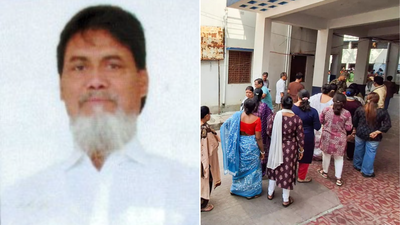

Surprising victory of ‘Sir’: Farakka candidate out of voter list ends Congress’s defeat drought in West Bengal. india news
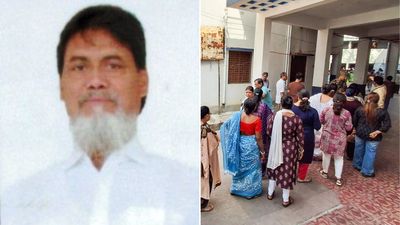
Farakka candidate of Congress wins the election after his name was deleted during SIR
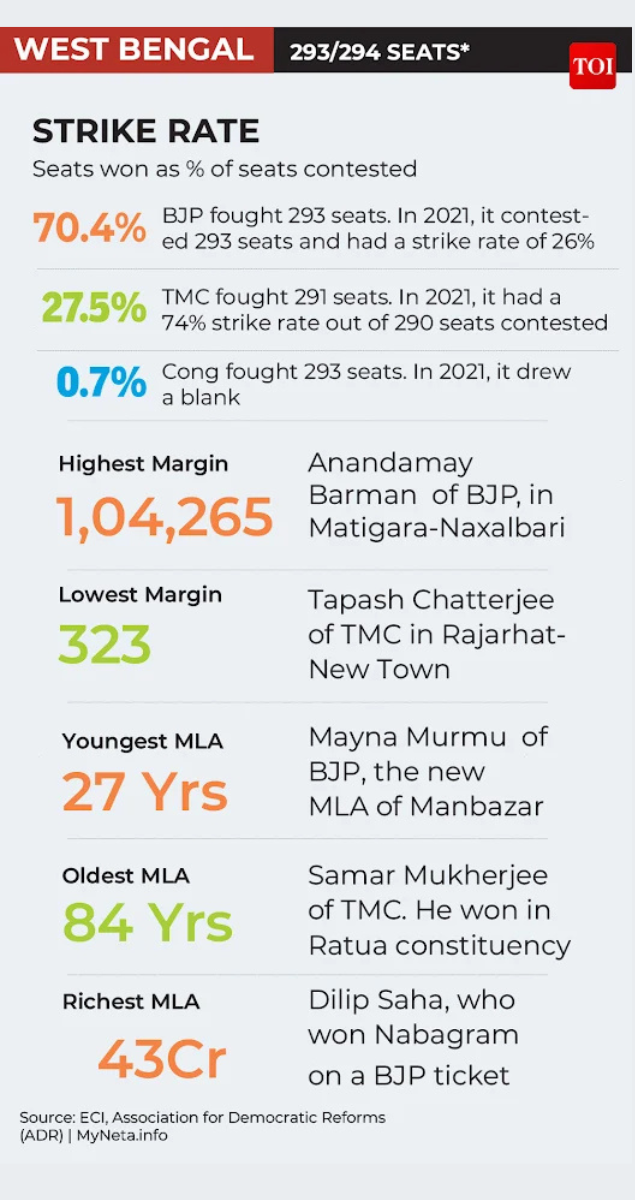
New Delhi: An interesting case related to special intensive revision and assembly elections has come to light in Farakka assembly constituency of West Bengal. A Congress candidate whose name was struck off from the voter list during SIR fought the case, won back his voting rights and later won the constituency as well.Congress candidate Motab Sheikh won the Farakka assembly seat in Murshidabad district, after successfully restoring his eligibility through the tribunal process directed by the Supreme Court.Sheikh defeated BJP’s Sunil Choudhary by 8,193 votes, securing 63,050 votes against Choudhary’s 54,857 votes, while Trinamool Congress candidate Amirul Islam came third with 47,256 votes.The victory marks a significant turnaround for the Congress, which also won the Raninagar seat, recovering from the setback of failing to secure a single seat in the 2021 West Bengal Assembly elections.Shaikh’s victory is noteworthy as his name was initially missing from the voter list after the SIR process. He challenged the annulment before the Appellate Tribunal, one of the 19 bodies constituted Supreme CourtThe tribunal mandated to investigate such cases restored his voting rights shortly before the nomination deadline, allowing him to contest the elections.In Sheikh’s case, Calcutta High Court lawyer Firdous Sameem appeared in person at Bichar Bhawan and submitted the necessary documents, thereby restoring his name on the roll.Citing the Supreme Court order of September 8, 2025, former judge TS Sivaganam said that Aadhaar card can be accepted as a supporting document. Although it is not proof of citizenship, it is “one of the documents enumerated for the purpose of establishing the identity of a person”.The Congress also won in the neighboring Raninagar constituency, where its candidate Zulfikar Ali defeated Trinamool’s Soumik Hussain by 2,701 votes, indicating a modest but symbolically important revival for the party in the state.
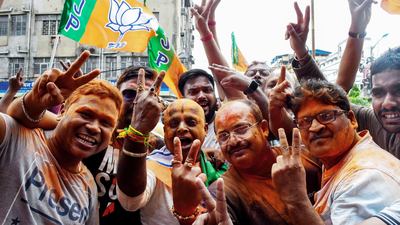
Sir, yes sir: How voter deletion affected West Bengal elections. india news
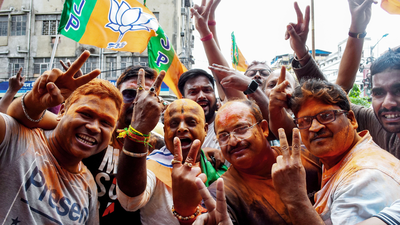
West Bengal has become saffron. Mamata BanerjeeThe 15-year rule of BJP ended and the Bharatiya Janata Party (BJP)BJP) is all set to form his first government in the state.So, what has contributed to this decisive political shift in the electoral landscape of the state? Well, there were many factors that contributed to the result, but the one that was most controversial was the Revision of Voter List – SIR.
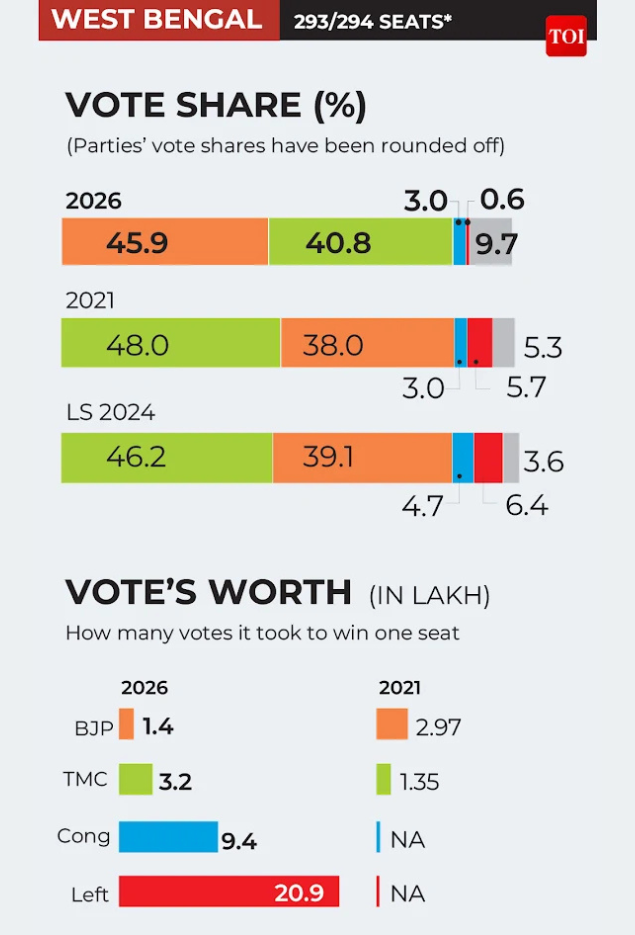
More than 90% voting took place in Bengal in this election, which is the highest ever.
How did SIR become a decisive issue of elections?
The Special Intensive Revision of Electoral Rolls (SIR) emerged as a central and intensely competitive factor shaping the 2026 West Bengal electoral contest. This practice led to the deletion of approximately 91 lakh names – approximately 12% of the electorate – leading to a significant change in the voter base ahead of polling. Of these, more than 60 lakh were classified as deceased, while the status of 27 lakh was pending or under investigation.According to various reports, a large proportion of the affected people were Muslims, while some sections of the Matua community and many Hindus were also affected. The BJP framed the SIR as a necessary cleanup of the voter list aimed at removing ‘invalid’ or duplicate entries. But Mamata’s party countered this and termed the exercise as systematic disenfranchisement, leading to an open war of words.Despite these competing narratives, the scale and spread of deletions changed voting trends in a way that coincided with the BJP’s gains across the state. The total voter base declined from 7.66 crore to about 7.04 crore, excluding those still subject to decision.
How SIR impacts 2026 state elections in Bengal
Electoral data: mapping SIR deletions to results
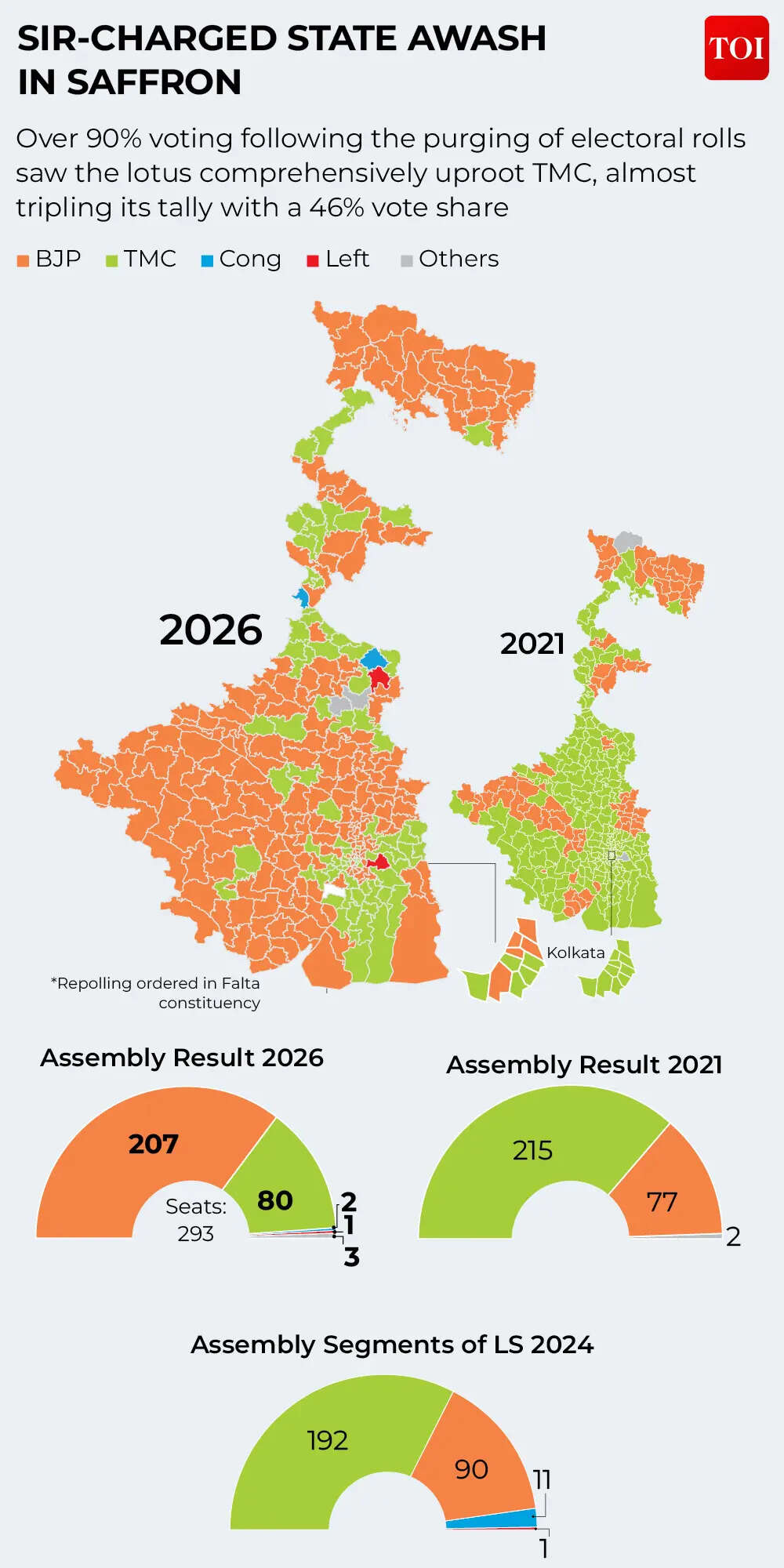
A closer look at the constituency-level results reveals a strong correlation between SIR-linked deletions and BJP gains.The BJP has improved its performance in seats where names have been removed on a large scale, whether the number of names removed is above 25,000 or below that limit. In the 169 assembly constituencies where over 25,000 names were removed, TMC dominated in 2021 and won 128 seats compared to BJP’s 41. However, this time the balance changed to a great extent.On the remaining 124 seats, where deletions were less than 25,000, the BJP’s tally increased dramatically from 36 to 108 in 2021 – representing a three-fold increase. This indicates that the party’s gains were not limited to the areas with the highest deletions, but extended to the broader electoral spectrum affected by the amendment practice.
There is a saffron wave in Bengal
Of the 38 constituencies where ‘logical anomaly’ deletions were highest, TMC won 34 seats in 2021. In the current election, its tally dropped to 22, underscoring the erosion of its earlier dominance in these areas.However, even in high deletion regions, the results were not uniform. Of the six constituencies with the highest SIR deletions, TMC managed to retain only four – Chowringhee, Shamsherganj, Metiyaburuz and Kolkata Port – while the BJP captured Jorasanko and Howrah North. It is noteworthy that in the last elections, all the six seats were won by the Mamata led party.Apart from Jorasanko, the BJP made significant gains in Kolkata and border areas, winning in Maniktala, Shyampukur and Cossipore-Belgachia in Kolkata North, and extending its lead to Rashbehari, Behala East, Bidhannagar, Baranagar, Dum Dum, Dum Dum North and Rajarhat-Gopalpur. It also won seats in Behala West, Tollygunge and Jadavpur – all constituencies where more than 25,000 deletions were recorded and which were previously held by Trinamool.Farakka was one of the exceptions. Despite seeing over 25,000 deletions, the BJP failed to win the seat. Congress candidate Motab Shaikh, whose name was initially removed during the SIR, successfully appealed through the Appellate Tribunal – one of the 19 set up following Supreme Court directions – and secured restoration of his voting rights. He won the seat by defeating BJP candidate Sunil Chaudhary by a margin of 8,193 votes.
How voting took place in Bengal – region wise
Margins, deletions and electoral effects
The relationship between extinction and margin of victory further underlines the impact of SIR. Of the 187 seats from which more than 5,000 names were removed, the BJP won 119 seats. In these constituencies, the number of excluded voters was more than the margin of victory in 47 seats.BJP’s deletion of 28 seats out of 119 seats recorded more than the victory margin of its candidates. Of these, 26 seats were won by Trinamool in 2021.Of the 20 constituencies with the highest number of deletions after the decision, TMC won 13, BJP six and Congress one. However, in the 2021 elections, all 20 seats were secured by Trinamool, highlighting its relative disadvantage this time.
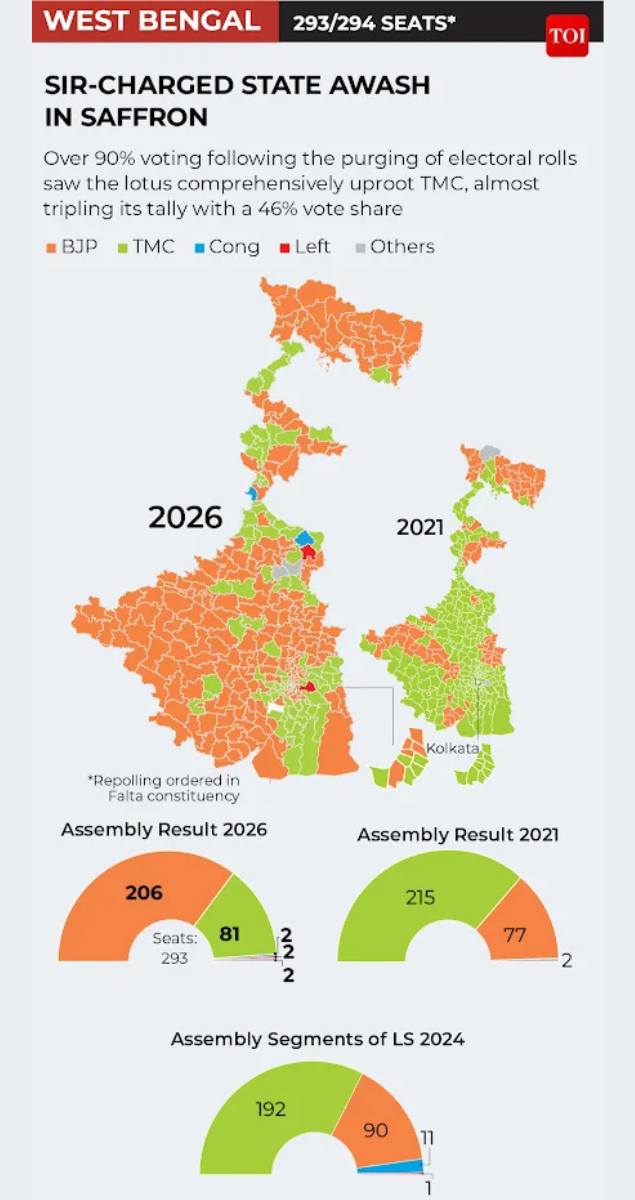
Kamal uproots TMC in Bengal
BJP’s ‘Security Fort’ to ensure smooth SIR process
The SIR exercise was also accompanied by unprecedented security deployment. More than 2.4 lakh personnel of the Central Armed Police Forces were deployed across West Bengal – more than three times the level seen in 2021 – in what the BJP described as a ‘security fortress’.Widespread deployment, along with close monitoring by the Election Commission of India, became another important pillar in enabling what the BJP described as “free and fair voting” in the politically unstable state.At one point, Mamata approached the Supreme Court over using only central government employees as counting observers, but the court refused to intervene.
The Mutua Factor: Identification, Concern, and Consolidation
The Matua community emerged as another important electoral variable shaped by the SIR practice. Despite discontent over mass deletions and concerns over citizenship documents under the CAA, the BJP retained its hold in Matua-dominated areas like Bongaon and Nadia.The deletion of nearly 1.2 lakh names under SIR created social and political tension in these areas. In six assembly constituencies of Nadia, more than 90% of the people placed under the decision did not find a place in the final voter list. A similar pattern was seen in Bongaon, where extinction rates ranged from 67% to 88%.Bagdah became the focal point of the competition, which saw a high-profile battle within the influential Thakurbari family. BJP candidate Soma Thakur defeated Trinamool MLA Madhuparna Thakur by 34,321 votes. The BJP also retained Bongaon North and secured Haringhata by a substantial margin.Despite concerns over the boycott, Matua voters – a marginalized Hindu sect consisting mainly of the Namasudra Scheduled Caste group – appeared to be uniting behind the BJP.
Disenfranchisement vs. electoral integrity
Clearly, the SIR exercise was the dominant narrative throughout the election and will continue to be debated in the times to come. The opposition sees SIR as a tool to target and purge its voters, while the BJP justifies it as a much-needed exercise to clean up the voter rolls.
‘Anga to Kalinga’ comes true: BJP completes eastern arc with Bengal win. india news
New Delhi: What was once a distant ambition BJP It has become a decisive milestone. With its landslide victory in West Bengal in 2026, the Bharatiya Janata Party (BJP) has completed a symbolic circle in eastern India. Bihar (Anga), Bengal (Banga), and Odisha (Kalinga).Victory is not just electoral; It marks the reinforcement of a long political project that began under Prime Minister Narendra Modi in 2014 and has steadily expanded into areas once considered resistant to the party’s ideological and organizational reach.With control over Anga, Banga and Kalinga, the BJP is stronger than ever. The saffron party, which looked to be on the back foot after losing numbers in the lower house following the setback in the Lok Sabha, has made a sharp turnaround. Victory in the Odisha Assembly elections in 2024, ousting longtime Chief Minister Naveen Patnaik from power, was the first major change in the former. In 2025, Bihar gave a strong mandate to the NDA under the leadership of Nitish Kumar, with BJP’s Samrat Choudhary becoming the Chief Minister after long time “good governance babu”. And in 2026, the BJP caps its eastern push by taking West Bengal by storm, dealing a decisive blow to the Mamata Banerjee-led Trinamool Congress.
From Margin to Momentum
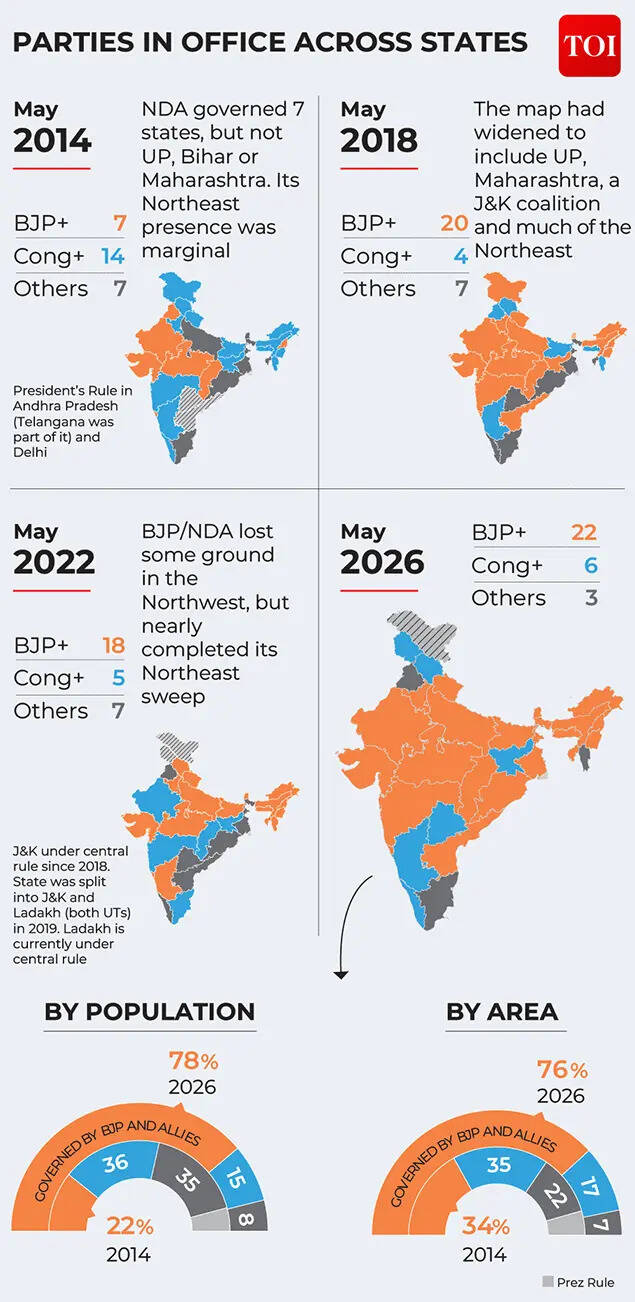
The BJP’s journey from a limited regional footprint to an almost pan-India presence has been impressive. In 2014, the party and its allies ruled only a handful of states. By 2026, this number has increased dramatically, with the National Democratic Alliance controlling a large portion of India’s political geography.This change is not merely administrative. This is demographic and geographic. A large section of India’s population now lives in states ruled by the BJP or its allies. The party’s influence extends across much of India, marking its transformation from a Hindi belt-centric force to a truly national political machine.
eastern success
The capture of West Bengal is the crown jewel of this expansion. For more than a decade, the state remained firmly under Mamata Banerjee And his Trinamool Congress. The BJP’s victory signals the end of that dominance and the culmination of sustained organizational efforts under the leadership of BJP’s ‘Chanakya’ Amit Shah.Shah’s strong insistence that the BJP will rule Anga, Banga and Kalinga has acquired a prophetic quality. His intense campaigning, supported by a nuanced grassroots network and a narrative focused on identity, welfare and governance, helped the party overcome one of its toughest boundaries.“The counting of votes will start on the morning of May 4. The ballot box will open at 8 am, the first round will end at 9 am and the second round will end at 10 pm. The counting will end at 1 pm and it will be ta ta, goodbye to didi.”Amit Shah’s words, spoken during a rally in Bengal, now read less like a campaign jibe and more like a script written with precision.His claim that the BJP would rule “Anga, Banga and Kalinga”, Bihar, Bengal and Odisha has now been realised, marking a rare moment of eastern unification under a single political formation.
This follows the earlier eastern advantage. The ouster of Naveen Patnaik in Odisha and the consolidation of power in Bihar under the NDA leadership set the stage for Bengal in 2024.
Assam: Consolidation, not just continuity
If Bengal marked expansion, Assam represented integration. Under the leadership of Himanta Biswa Sarma, the BJP not only retained power but also performed strongly, improving both seat share and vote percentage.
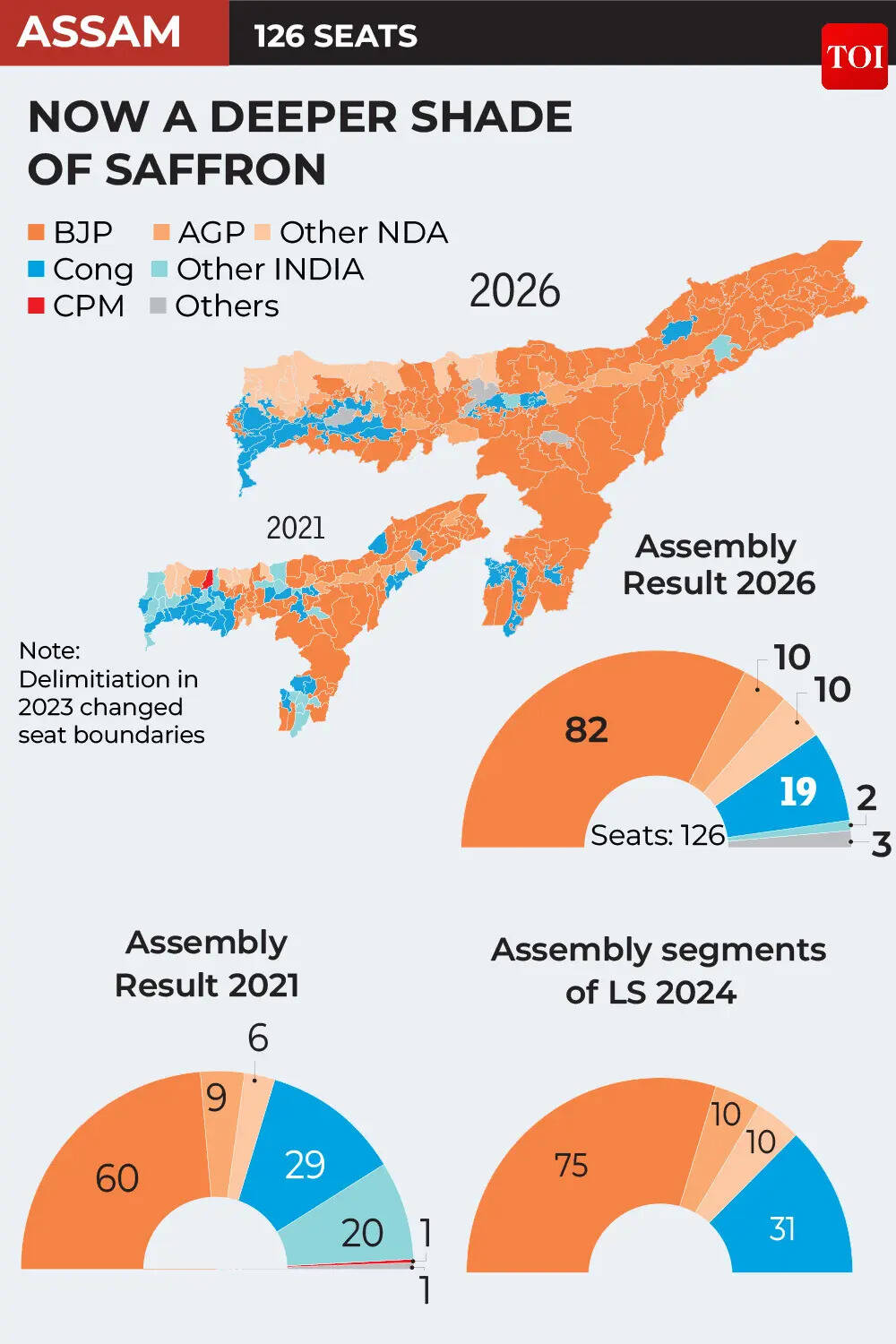
A mix of welfare schemes, identity politics and strategic alliances delivered a broad mandate. The delimitation changes and higher turnout, especially among women, further strengthened the NDA’s position, turning Assam into a model of sustained electoral dominance in the Northeast.
Beyond Geography: Conceptual Shift
The rise of the BJP in the East reflects a deep ideological shift. The Modi-led brigade has moved beyond its previous image as a Hindi belt unit, and is adapting its message to diverse cultural and regional contexts.In Bengal, narratives of religious identity and governance became one. In Assam, long-standing concerns about immigration were transformed into a powerful election issue. In all states, identity politics, welfare delivery and nationalist messages are working together to reshape the voter alliance.Even in areas like Kerala, the BJP has started making its presence felt, indicating incremental but notable penetration.
Modi factor: permanent anchor
Any analysis of BJP’s expansion returns to Prime Minister Narendra Modi. Despite setbacks in the 2024 Lok Sabha elections, Modi’s personal appeal remains a powerful force multiplier.His image of development, national pride and decisive leadership has helped the BJP bridge the organizational gap in challenging areas. Where local leadership may be lacking, PM Modi’s presence often fills the void and converts emotions into votes.In many ways, the BJP’s electoral model works in two stages. Modi creates momentum and Amit Shah’s organizational machinery turns it into victory.
cons squeeze
While the BJP is expanding, its rivals are facing shrinking political space. Despite sporadic successes like in Kerala, the Congress-led faction has seen its overall footprint contract. Regional parties that were once dominant in their strongholds are also under pressure.Leaders like Rahul Gandhi have questioned the integrity of the electoral processes, particularly in Bengal, alleging massive irregularities. These claims struggle to counter the BJP’s narrative on governance and development.Rahul Gandhi alleged, “West Bengal and Assam are ‘clear cases of stealing elections by the BJP with the support of the Election Commission’.”He said, “We agree with Mamata (Banerjee) ji. More than 100 seats were stolen in Bengal.”Congress President Mallikarjun Kharge called the results a “mixed bag”, emphasizing that “ours is an ideological fight…such a path demands patience, perseverance and unwavering resolve.”The broader challenge for opposition parties lies in balancing minority reach with broad electoral appeal, a balance that has become difficult to maintain.
Welfare, women and the changing voter base
One of the defining features of recent elections has been the centrality of welfare politics, particularly cash transfer schemes for women. What was once a benefit has now become a basic expectation.In Bengal, welfare fatigue and concerns over women’s safety have weakened a key support base for Mamata Banerjee. The BJP’s counter-promises, often on a large scale, helped attract swing voters.Across states, women and young voters are emerging as a decisive group, reshaping traditional loyalties and demanding both opportunity and security.
Migration and the politics of aspiration
Economic migration has quietly become a political issue, especially in Bengal. Many workers in this state, which was once an industrial centre, are now moving elsewhere in search of opportunities.This shift has given rise to a broader narrative around economic stability versus growth-driven governance, a dichotomy that the BJP has used effectively in its campaign.
Looking ahead: 2027 horizon
Even as it celebrates its eastern gains, the BJP has already shifted its focus to the next election cycle. States like Uttar Pradesh, Punjab, Uttarakhand and Goa are on its radar.The victory in Bengal has boosted the party’s confidence and provided a strategic buffer against possible losses elsewhere. With 42 Lok Sabha seats, Bengal is now as important to the BJP’s national ambitions as its traditional strongholds.For the opposition, the challenge is to rebuild the narrative, reconnect with voters and counter a political machine that is constantly expanding.
A reshaped political landscape
The BJP’s journey in Anga, Banga and Kalinga is more than fulfilling a slogan. This reflects the changed political scenario. The country’s electoral map in 2026 is being defined by a dominant national force rather than fragmented regional strongholds.Whether this consolidation endures or counter-mobilization begins will shape the next phase of Indian politics. For now, the message from the east is clear. BJP’s expansion continues and is gaining momentum.The Bharatiya Janata Party, having already fought off key challengers like Arvind Kejriwal last year and now Mamata Banerjee and MK Stalin, appears to be in a much more comfortable position to consolidate its hold on power.
Mamata ‘Goodbye’-Energy: BJP’s wave traps the big fish of West Bengal. india news
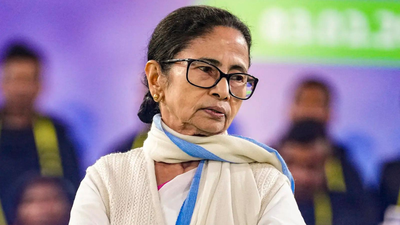
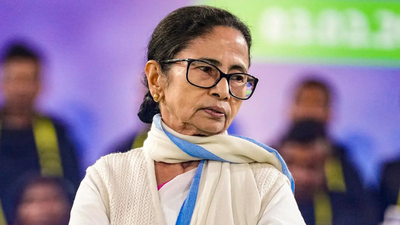
New Delhi: The big fish is stuck in Bengal as the rising tide of BJP has sidelined Mamata “Didi”. The saffron wave did not come just like that, it swept across West Bengal with force and shattered the stronghold that once seemed unshakable.The state which was Didi’s fort for a long time has given 207 seats to the BJP, which comfortably crossed the majority mark and finally turned around. Amit ShahA visionary call of “crossing 200” turned into reality in Bengal. From the initial impressions of the Congress era, to decades of Left dominance Mamata BanerjeeIn his 15-year rule, Bengal has seen its political complexion change dramatically. Red gave way to green and now, apparently, to saffron. This is not just an election result; This is a full scale political brainstorming.
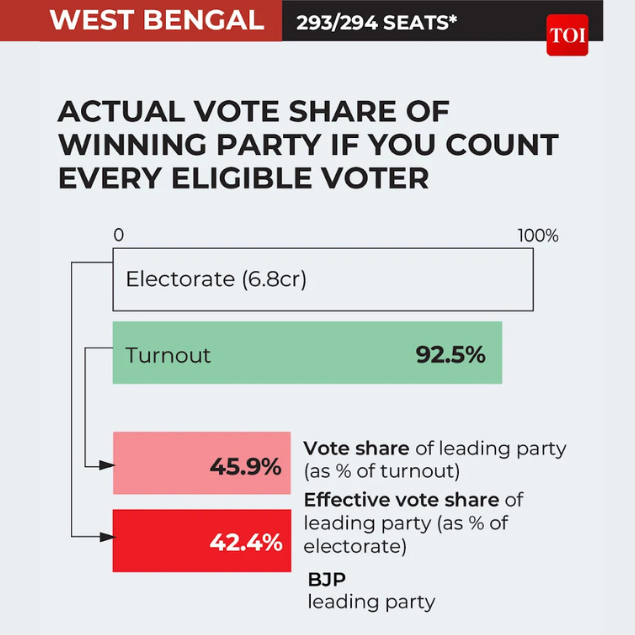
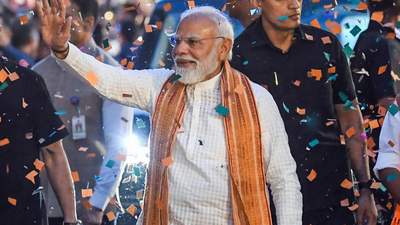
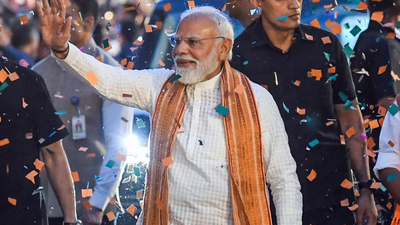
as prime minister Narendra Modi Announcement from BJP headquarters “Bangle Poribortan Hoye Geche,” There has indeed been change in Bengal. Dressed in traditional dhoti-Punjabi, the Prime Minister marked the party’s first victory in the state with symbolism as well as significance.The Trinamool Congress was reduced to double digits, which very few people had seriously imagined. In a twist full of political irony, Mamata Banerjee herself suffered a crushing defeat in Bhabanipur at the hands of her former disciple-turned-rival Suvendu Adhikari.If Nandigram in 2021 was the first crackdown, Bhabanipur in 2026 becomes its echo, more acute, sharper and far more consequential.Didi’s fort did not collapse overnight; It was destroyed by the weight of two sharp forces. One was 15 years of fatigue, an anti-incumbency wave that quietly gathered strength before erupting decisively. The second was the Election Commission’s “Special Intensive Revision” (SIR), a controversial but effective practice that cut the voter list by 12%, a number significant enough to change the electoral landscape in a way that would have boosted the BJP’s lead.This time PM Modi did not just taste ‘Jhalmuri’ in Jhargram, he also tasted victory in Bengal.
Bengal: The last frontier finally fell
The steady rise of the saffron party since 2014, as a major challenger to the UPA under Narendra Modi for the first time, had left one last frontier unconquered. Bengal, with its layered political memory and fierce regional identities, stood as the last test in the BJP’s march towards a truly pan-India footprint.On May 4, that border did not just fall, it also opened the doors to the throne of Kolkata.
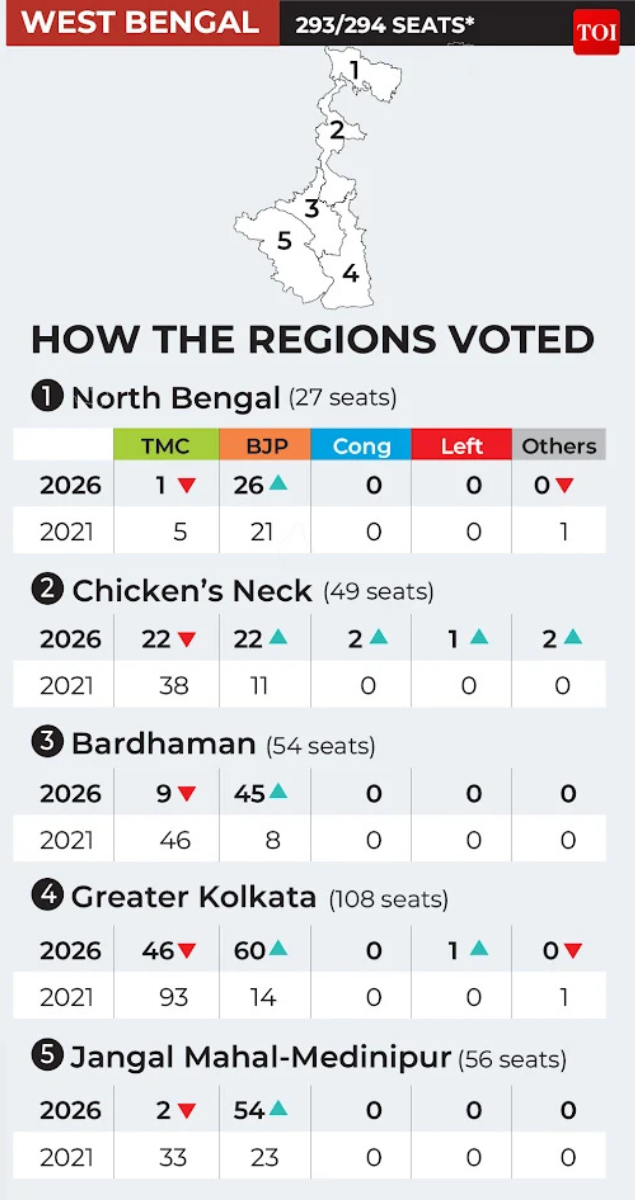
There were areas where Trinamool Congress was in control. Bleeding slowed in parts of South 24 Parganas, East Burdwan and Howrah. But on the larger map, the tide was unremarkable.From the northern parts, where the BJP was almost completely dominant, to North Dinajpur, where the Trinamool was almost completely wiped out, to the southern stretches of Jhargram, Purulia and East Midnapore, where the ruling party was completely wiped out, the message was clear.The Bharatiya Janata Party crossed the 200-seat mark, leaving behind the Mamata-led Trinamool Congress, while its vote share increased to 45.84%, leaving Didi’s camp behind at 40.80%.Even the margins tell their story: Matigara-Naxalbari gives BJP a massive lead of 1.4 lakh votes, underscoring the scale of the anti-incumbency wave.
Urban change that sealed the decision
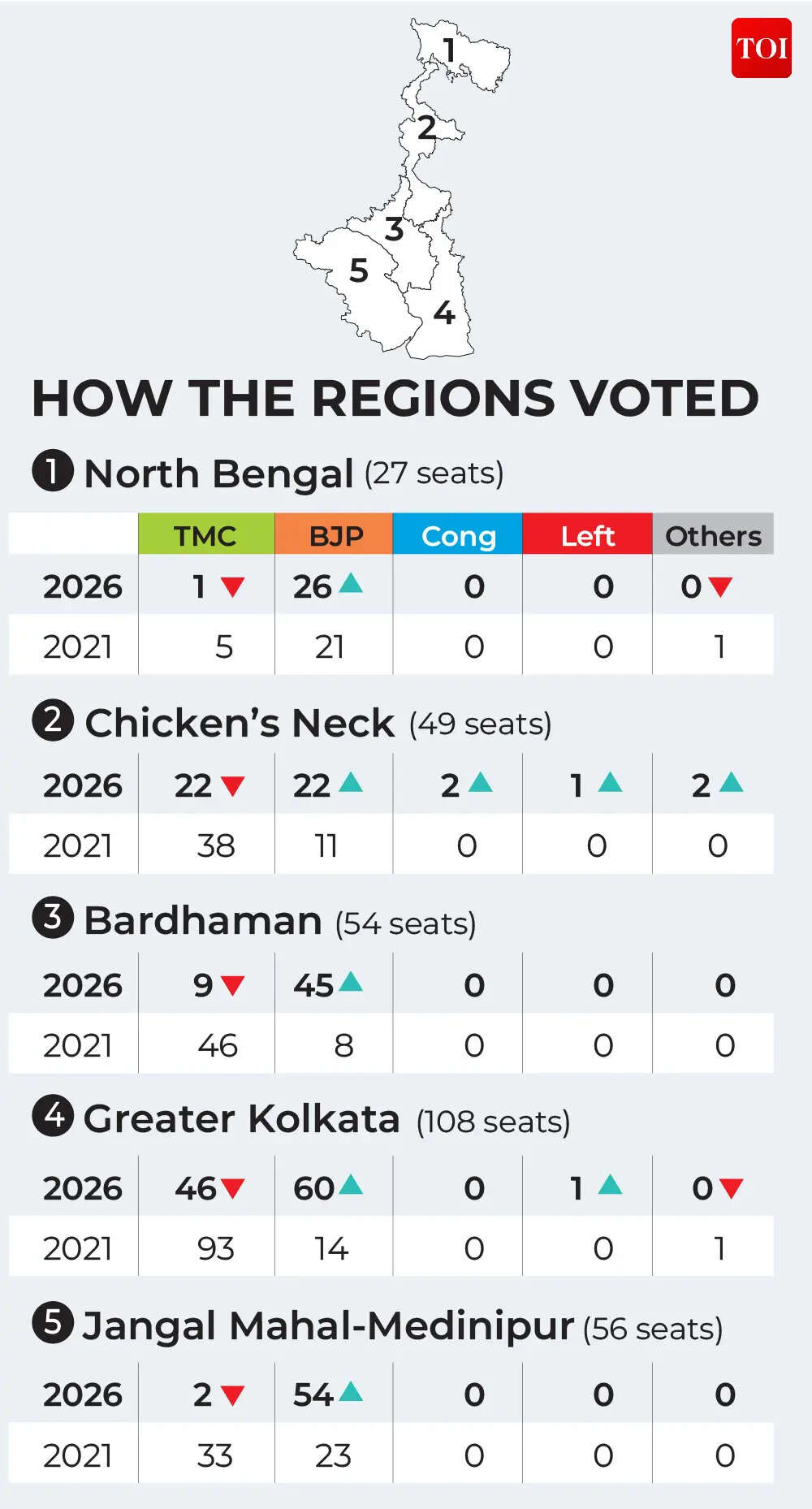
However, what really tilted the balance was the silent churning in urban and suburban Bengal. Kolkata and its fringes, from South 24 Parganas in the south to Howrah and the industrial belt of North 24 Parganas, shifted in ways that proved decisive. This was once Trinamool’s comfort zone. This time, it turned into a battlefield that decided its defeat.The cracks were visible in numbers. In 2021, Trinamool had captured 123 of the 142 seats in Kolkata, North and South 24 Parganas, Nadia, Howrah, Hooghly and East Burdwan. In 2026, this number will drop to only 48.In Kolkata itself, the decline was seen in key seats: Rashbehari, Jadavpur, Shyampukur, Jorasanko, Maniktala, while the party lost significant ground in North 24 Parganas, including Barrackpore, Bidhannagar, Dum Dum and Panihati. Howrah also slipped, where high-profile victories like Rudranil Ghosh boosted BJP’s momentum.The capital city and urban areas largely aligned with the BJP, leaving Didi on the sidelines.
Didi: ‘Only candidate’ pitch fails
Throughout the campaign, Mamata Banerjee focused heavily on her 2021 strategy, projecting herself as the “sole candidate” on all 294 seats. But this time the strategy faltered. The high-voltage rhetoric struggled to connect with the ground reality created by fatigue, resentment and changing aspirations. The gap between message and mood became so wide that it was impossible to bridge.
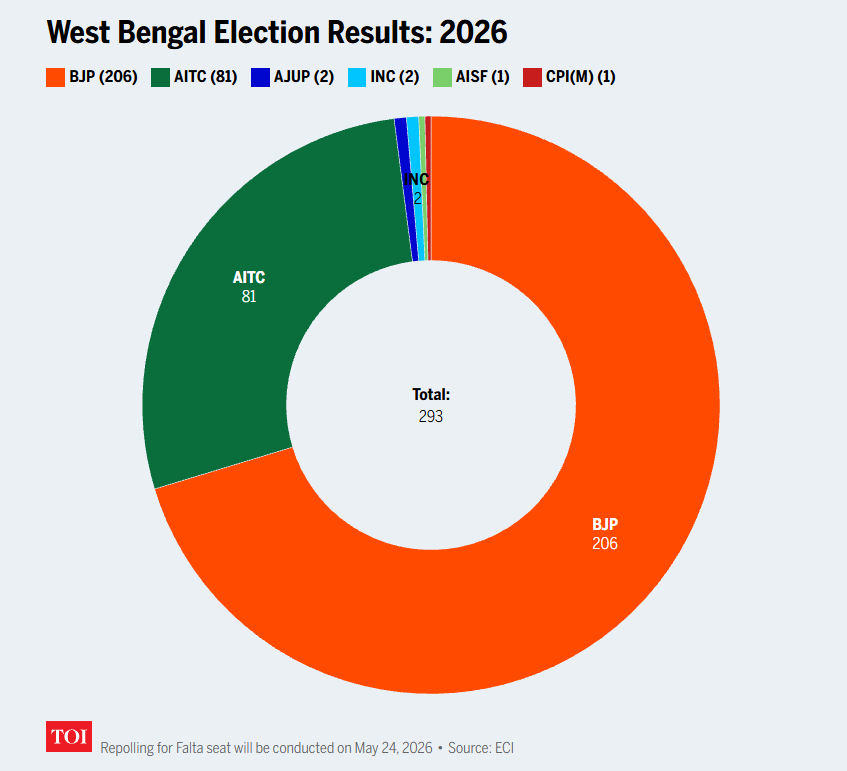
This blow was no less than a political earthquake for Mamata, who had made a deep impact at the grassroots level across Bengal. The anti-incumbency wave cut across rural and urban areas alike, eroding Trinamool’s base.Voters spoke of fatigue, of a regime they increasingly viewed as misgovernance, and of a desire for structural change.
‘Poribartan hoye gechhe’
“Bangale poribortan hoye gechhe (change has taken place in West Bengal),” victorious Prime Minister Narendra Modi, dressed in traditional Bengali attire of dhoti-kurta, said in his victory speech at the BJP headquarters here on Monday. He described the party’s first victory in the state as a new dawn in Bengal.“This is a declaration of a bright future for the country,” he said, as the BJP scored a hat-trick of victories in Assam and headed home for another term with its ally AINRC in Puducherry.He appealed to the parties in Bengal to pledge to end the endless cycle of election violence. He said, “There should be talk of revenge and not revenge.”From the BJP headquarters, the PM also recalled his statement after the Bihar victory that as the Ganga flows east, so will the BJP’s journey, adding that the party now rules every state along the course of the river from Gangotri to Ganga Sagar.He said, “Now women will get an environment of security in Bengal and youth will get employment.” He announced that the new government will adopt the Centre’s Ayushman Bharat scheme in its first cabinet meeting. He also promised strict action against infiltrators, cementing a key campaign issue.
Sir: The numbers behind the story
Beyond the rhetoric, the numbers tell a layered story.The Election Commission’s “Special Intensive Revision” (SIR) of the electoral rolls, which resulted in the deletion of approximately 91 lakh names – emerged as a significant factor.
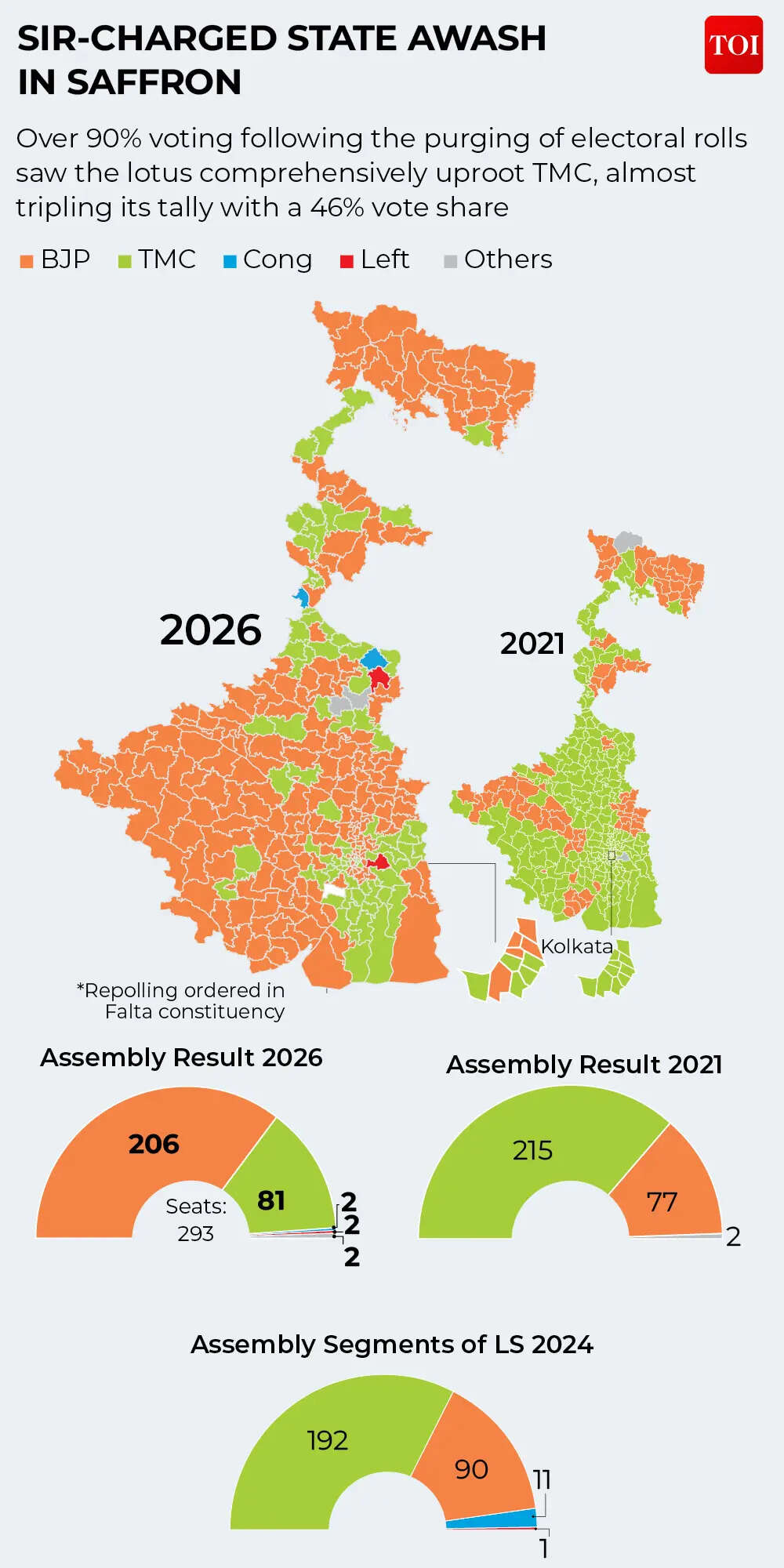
In 169 constituencies where deletions were more than 25,000 voters, BJP’s numbers increased dramatically from 41 in 2021 to nearly 100 in 2026, while Trinamool’s dominance declined. Even in seats with fewer deletions, the BJP’s growth was evident, with its numbers more than tripling.Meanwhile, the opposition scene witnessed a slight revival. The Congress bounced back with two seats in Malda, the Left Front bounced back with one seat in Murshidabad, and the ISF retained Bhangar, giving the assembly a more diverse palette than the 2021 binary contest.
Change in mood of voters
From welfare assurances to job creation, law-and-order narratives to identity politics, the BJP crafted a pitch that reached out to all sections – while Trinamool’s once reliable social alliance showed signs of strain.There was a clear change in perception also. For years, many voters continued to differentiate between Didi’s personal image and the actions of her party cadre. By 2026, that distinction had blurred. The gap between the leadership’s intentions and grassroots experience became difficult to ignore, leading a section of voters to seek an alternative.
Even before the formal campaign began, signs of change were visible in glimpses of political confrontation, moments that signaled a shifting balance of power. By the time PM Modi sharpened his message with a call for “Chun-Chun ke account will be taken”, the momentum had clearly changed.
What next for Bengal?
Now, with victory assured, the focus has shifted to government formation. PM Modi is likely to hold important meetings with Amit Shah and the BJP leadership in New Delhi to finalize the Chief Minister and Cabinet. The party’s “collective leadership” strategy during the campaign leaves the option open with an emphasis on a Bengal-based leader.
voting
According to you, what is the biggest reason behind BJP’s strong performance in Bengal?
Names from different generations, seasoned personalities and emerging faces alike are in contention as the BJP balances experience, representation and internal dynamics. Inputs from central observers and state leaders will shape the final decision, with the possibility of a deputy chief minister also being considered.For the BJP, this is more than just a victory, it is the culmination of a long quest. For Bengal, it marks another dramatic turn in a political journey that has never been short of turmoil. And as saffron takes over party offices and celebration gives way to governance, the real test begins: translating a historic mandate into a durable new dispensation.
‘Targeting civilians, infrastructure unacceptable’: PM Modi after 3 Indians injured in Iran attack in UAE’s Fujiara india news
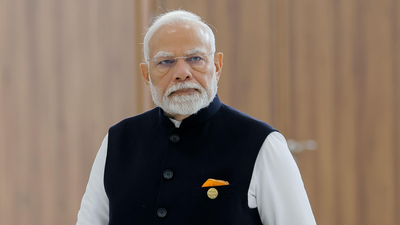
New Delhi: Prime Minister Narendra Modi on Tuesday condemned the Iranian attack on Fujairah in the United Arab Emirates in which three Indian citizens were injured.In a post on Twitter, PM Modi wrote, “Strongly condemn the attacks on UAE, which resulted in injuries to three Indian citizens. Targeting civilians and infrastructure is unacceptable.“The Prime Minister said, “India stands firmly with the UAE and reiterates its support for the peaceful resolution of all issues through dialogue and diplomacy. Ensuring safe and unhindered navigation through the Strait of Hormuz is vital for regional peace, stability and global energy security.”Earlier today, the Foreign Ministry also condemned the attack, calling it “unacceptable” and urging an immediate halt to hostilities targeting civilians.
New Delhi’s reaction came a day after a drone strike caused a fire at a major oil facility in Fujairah. Amid rising tensions in the region, the UAE has accused Iran of carrying out the attack.External Affairs Ministry spokesperson Randhir Jaiswal said, “The attack on Fujairah, in which three Indian citizens were injured, is unacceptable.” “We call for an immediate cessation of these hostilities and the targeting of civilian infrastructure and innocent civilians.”He said India continues to support “dialogue and diplomacy” to restore peace and stability across West Asia, while also calling for “free and unimpeded navigation and commerce” through the Strait of Hormuz in line with international law.The Indian Embassy in the UAE confirmed that the injured civilians were receiving medical care, with officials coordinating closely with local authorities.
voting
Which approach should be preferred to resolve tensions in the region?
The attack comes as the US-Iran ceasefire faces tensions, particularly around the Strait of Hormuz, a vital route for global energy supplies. The UAE said its air defense systems intercepted several missiles and drones, warning that it was ready to counter any threats to its security and sovereignty.

West Bengal election results: Rift in opposition? Rahul sent a message to the leaders who were ‘rejoicing’ over TMC’s defeat. india news

New Delhi: Congress leader Rahul Gandhi Cautioned party colleagues and other opposition leaders against celebrating on Tuesday Trinamool CongressThe defeat in West Bengal presents the election outcome as a major threat to Indian democracy. Without taking names, Rahul Gandhi said, “Some and others in the Congress are celebrating TMC’s defeat. They need to understand this clearly: The theft of the mandate of Assam and Bengal is a major step by the BJP in its mission to destroy Indian democracy.”Urging political parties to move beyond electoral rivalries, he said, “Keep petty politics aside. This is not about one party or the other. This is about India.”The Congress leader’s comments come a day after the BJP’s landslide victory in West Bengal, where the party crossed the majority mark and ended 15 years of rule. Mamata Banerjee And Trinamool Congress.Rahul Gandhi’s reference to “theft of mandate” appeared to echo allegations made by Mamata Banerjee, who claimed that “more than 100 seats were stolen” in the state, a charge rejected by the BJP.The Congress, which has had a limited electoral presence in West Bengal in recent years, managed to win two seats in the 2026 assembly elections.Earlier, Mamata Banerjee alleged that the BJP had “looted” more than 100 seats and termed the Election Commission as “BJP’s Commission”, terming the victory as “immoral” and “illegal”.BJP is going to form its first government with an overwhelming majority by winning 206 seats in the 294-member West Bengal Assembly. Re-polling in Falta constituency will be held on May 21.

Center tightens fire safety norms for hospitals, makes audit and evacuation plans mandatory india news

New Delhi: Aiming to prevent deadly fires in hospitals, the Union Health Ministry has issued revised national guidelines, mandating strict safety checks, regular audits and clear evacuation protocols in healthcare facilities.The National Guidelines on Fire and Life Safety in Healthcare Facilities (2026) set out a comprehensive framework for how hospitals should prevent, detect and respond to fire incidents, with a strong focus on patient safety – especially in the ICU and other critical care units such as NICU, PICU and operation theaters that cannot evacuate on their own.The revised guidelines go beyond the earlier building-level norms by introducing a hospital-specific safety framework with clear accountability, mandatory risk audits and detailed evacuation protocols for critical care areas – gaps that were not previously addressed similarly.Guidelines issued With nationwide emphasis on fire safety, the Center observed Fire Safety Week from May 4 to 10 and urged states and health facilities to reassess preparedness, conduct audits and strengthen response systems.The document states that hospitals are particularly vulnerable due to high oxygen usage, complex electrical systems and immobile patients, with electrical faults identified as the leading cause of fires in health care settings.Under the new framework, hospitals will have to conduct regular fire risk assessments, maintain a fire safety plan and conduct annual fire and electrical safety audits. Facilities are also required to classify ICU, NICU, PICU, operation theatres, oxygen storage areas and electrical rooms as high-risk areas, requiring strict monitoring.The guidelines state that each hospital should appoint a dedicated fire safety officer and form a fire safety committee responsible for preparedness, training and coordination with local fire services. Employees will undergo regular training and mock drills to ensure preparedness during emergencies.The main focus is early detection and quick response, with hospitals required to install and maintain fire alarms, sprinklers, hydrant systems and smoke control mechanisms, supported by round-the-clock monitoring.Given the risks involved in moving critically ill patients, detailed evacuation protocols prioritize horizontal evacuation – moving patients to safe areas on the same floor.As part of building a safety culture in healthcare facilities, officials have also emphasized strong compliance, including regular reporting of fire safety audits and extensive awareness efforts. Its purpose is to streamline preparedness, reduce the risk of major incidents, and ensure continuity of care during emergencies.
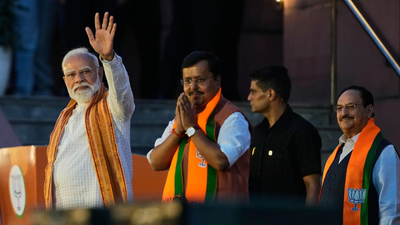
Election Results 2026: How BJP defeated anti-incumbency wave one state at a time, while rivals lagged behind. india news
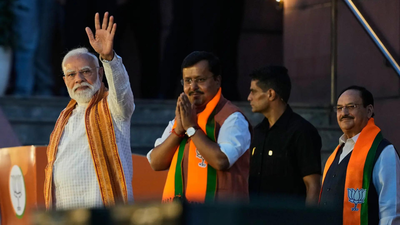
New Delhi: As the results of the 2026 assembly elections began to emerge, a familiar tune returned to Indian politics. Not loud or unexpected, but recognizable. Something which is in the making since the Lok Sabha decision of 2024. A similar rhythm has been followed in every election. BJP It has managed to overcome the anti-incumbency wave consistently (from Haryana to Maharashtra and now, Assam), not only defending its government but also securing a larger mandate.What once seemed like a temporary fix is now shaping up to be something more deliberate.
In many states, the party has defended its ground while venturing into new territory, repeating a pattern with striking continuity. There is a rhythm to it now, almost like the same tune being played over and over again, each election result feeling familiar.In Christopher Nolan’s Oppenheimer, there is a line: “algebra (in this case read: politics) Like sheet music. It is not important that you can read music, but that you can hear it.“And apparently, the BJP has.Here’s how the saffron party has chalked out its strategy to fight the anti-incumbency wave:
Shock
The trajectory of the BJP after 2024 is surprising for its methodology. In June 2024, the party was reduced to 240 seats in the Lok Sabha, losing its absolute majority and becoming dependent on coalition partners. The opposition Indian faction interpreted that result as a turning point. It entered subsequent state elections with confidence, often as the perceived frontrunner.Yet that momentum did not translate into votes. In state after state, the opposition struggled to convert narrative gains into electoral success. Meanwhile, the BJP made a swift recount. It refined its messaging, tightened its candidate selection, and leaned heavily on targeted welfare schemes addressing specific voter segments.Equally important was the party’s ability to maintain cohesion at all levels of leadership. The central leadership, especially Prime Minister Narendra Modi, continued to act as a unifying force, while state units adapted to local dynamics. This balance between central projection and local accommodation became a recurring feature of BJP campaigns.
Haryana Elections – Exit polls are proving wrong
The first sign that the Lok Sabha decision would not define the BJP’s path came in Haryana. After being in power for a decade, the state government started showing clear signs of fatigue. Exit polls were tilted towards the Congress, and the opposition campaign had built a consistent narrative around accountability.The BJP’s response was pragmatic rather than defensive. It replaced a significant portion of its sitting MLAs and transferred the leadership from Manohar Lal Khattar to Naib Singh Saini in a strategic move to stem the anti-incumbency wave.The result was, for the third consecutive time, 48 seats in the 90-member assembly. The victory was not overwhelming, but it was important. It demonstrated that anti-incumbency could be mitigated through timely intervention and organizational discipline.
Maharashtra 2024
Maharashtra was an even bigger victory for the BJP. The Mahayuti alliance won a landslide victory by winning 235 out of 288 seats. The change in the Lok Sabha elections held just a few months ago was dramatic.However, this result was not driven by any single factor. Welfare schemes like Ladki Bahin played a role in uniting sections of the voters. At the same time, coalition management proved decisive.PM Modi’s presence gave a major boost to BJP’s campaign joint welfare message. The opposition, despite its previous parliamentary success, struggled to present a cohesive counter-narrative and suffered from disjointed coalition tactics.
Delhi 2025: return to the capital
Delhi elections are a symbol of a different kind of change. The Aam Aadmi Party had built a strong governance narrative over a decade focused on public services and welfare delivery. However, by 2025, that model started showing signs of stress.Controversies, including the liquor policy issue involving Arvind Kejriwal, tarnished the party’s clean governance image. Public dissatisfaction, especially on infrastructure and environmental issues, created opportunities for the BJP.The BJP’s campaign focused on these weaknesses while offering its welfare commitments. The logic of administrative coordination between the Center and the state resonated even in a city with a unique constitutional structure.BJP returned to power in Delhi after 27 years by winning 48 out of 70 seats. The result highlighted an important lesson: Even the strongest regional players who have built a strong cadre can be toppled.
Bihar 2025: The strength of the alliance is increasing
The Bihar result reinforced the importance of alliances but also highlighted a shift within them. The NDA won a decisive victory with over 200 seats in the 243-member assembly. While Nitish Kumar remained in the central role, BJP emerged as the largest party.Then came the change: BJP’s Samrat Choudhary took over as chief minister, while Nitish Kumar, who held the state’s top post for two decades, moved to the Rajya Sabha. This was a big moment for the BJP: the party moved from a supporting role to the center of power.The campaign itself linked caste recalculation with welfare outreach. The opposition, led by Tejashwi YadavRan an energetic campaign but struggled to match the NDA’s organizational reach and coalition stability. It also struggled to form a cohesive coalition strategy with the Congress, while the India Bloc allies struggled to hammer out a seat-sharing deal until late in the election season.
Assam 2026: Fighting the anti-incumbency wave
Among the states where elections were to be held in 2026, Assam was the easiest for BJP. The government led by Himanta Biswa Sarma entered the elections with a relatively strong position.Welfare distribution, particularly targeted at tea garden workers and low-income groups, formed a central pillar of the campaign. This was complemented by a clear ideological position that strengthened the party’s support base.The NDA’s easy victory, easily crossing the majority mark, confirms the BJP’s dominance in the state. Assam became the “stick” in the broader pattern, a government that resisted the anti-incumbency wave without significant disruption.
West Bengal 2026: A Success
The most interesting result of this assembly election cycle came in West Bengal. For more than a decade, Mamata Banerjee and the Trinamool Congress had worked vigorously against the BJP’s progress. The 2021 elections had brought BJP closer but not that close.The years that followed saw the steady expansion of the BJP’s organizational network across the state. At the same time, the TMC faced growing challenges, including local anti-incumbency, allegations of corruption and internal tensions.The 2026 elections reflected these changes. The overwhelming voter turnout indicated a desire for change. The BJP’s campaign combined welfare promises with a strong ideological pitch, while also capitalizing on discontent at the constituency level, raising issues of anti-incumbency, corruption and deteriorating law and order.At the time of publishing, BJP has taken a decisive lead, crossing the majority mark. The result was not just a victory but a breakthrough in a state that had long resisted it.
Corrected what the opposition could not do
While the BJP managed the anti-incumbency wave with increasing sophistication, its rivals struggled to do the same. In Kerala, the Left Democratic Front lost power after its rare consecutive term, as voters reverted to the pattern of state choice. In Tamil NaduDMK faces a significant setback as Vijay-led TVK moves closer to a landslide mandate.These results highlight a broader issue within the opposition. India Bloc’s success in the 2024 Lok Sabha elections has created expectations that are not matched by organizational cohesion in state contests. Leadership remained fragmented, and strategies often relied heavily on national narratives that did not translate effectively at the state level.The anti-incumbency wave, which was a powerful tool against the BJP in 2024, has turned against these governments. Unlike the BJP, they lacked a consistent structure to manage that pressure.
emerging playbook
Politics is not a one-time game. It’s incredible, chaotic, and deliberate. A big victory or defeat can change the mood of party workers, but as Shahrukh Khan Will say, “The picture is still pending.” If the state assembly results since the 2024 Lok Sabha elections show anything, it is this: no party is so big that it requires a recalibration, and when it is done right, no setback is too big to recover from.The Indian camp walked out of the 2024 Lok Sabha elections believing that it had got the winning note. The result was read as a change in mood, a sign that the BJP’s dominance was at its peak. But state elections have a way of testing perceptions. One by one, those notions have been destroyed.In Maharashtra, Delhi, Bihar and now most dramatically in West Bengal, the story has been repeated with small variations but the end result is the same.But familiar enough to raise a tough question for the opposition: not how to win one election, but how to prevent losing the next one.
Sibsagar Assembly Elections 2026: Kushal Dowari to contest against Akhil Gogoi. india news
 In the 2026 assembly elections, BJP’s Kushal Dowari is facing off against Rajjor Dal’s Akhil Gogoi for the Sibsagar constituency, which is in alliance with the Congress.Sibsagar assembly constituency had a total of 209976 registered voters in the electoral rolls for the 2026 assembly elections, out of which 103484 were male, 106491 female and 1 belonged to the third gender.Exit polls released on Wednesday evening for the Assam battle indicate a clear majority for the current Himanta Biswa Sarma-led government, with a majority of pollsters favoring the BJP to secure a third consecutive term in the tea-producing state.Sibsagar Assembly constituency is a general (unreserved) seat located in Sibsagar district of Assam. It is one of the 10 assembly constituencies under Jorhat parliamentary constituency.In the 2021 Assam Assembly election, there were 1,52,087 registered voters in the constituency, with 1,24,219 valid votes. Independent candidate Akhil Gogoi won the seat with 57,219 votes. Bharatiya Janata Party (BJP) candidate Surbhi Rajkonwari came second with 45,344 votes, losing by a margin of 11,875 votes.In the 2016 assembly elections, Sibsagar had 1,38,397 voters, with 1,13,331 valid votes recorded. Congress candidate Pranab Kumar Gogoi won the seat with 48,584 votes, defeating BJP candidate Surbhi Rajkanwar who secured 48,042 votes. The victory margin was 542 votes.
Arani Election Result 2026: AIADMK’s Jayasudha L wins against DMK’s Mahalakshmi Govardhanan. india news

AIADMKJayasudha L emerged victorious by securing 76735 votes. DMKMahalakshmi Govardhanan by a margin of 5631 votes.Arani constituency witnessed a fierce and close contest in the 2026 assembly elections. The DMK has fielded Mahalakshmi Govardhanan with the aim of flipping the seat after a minor misstep in the previous cycle. His competition is AIADMK’s L. Jayasudha, who had campaigned to maintain the party’s ten-year winning streak in the region. The political scenario was covered by TVK’s A. Venkatesan Kumar gave further shape. In the 2021 election, Sevvur S.Ramachandran (AIADMK) won with 102,961 votes (46.86% vote share), defeating S.S. Anbalagan (DMK) who secured 99,833 votes (45.43% vote share), by a slim margin of 3,128 votes. In the 2016 election, Sevvur S. Ramachandran (AIADMK) won with 94,074 votes (44.89% vote share), defeating DMK’s S. Babu was defeated by 7,327 votes. Voter turnout reached 89.23%, a significant increase from 79.59% in 2021. This increase is mainly attributed to the Special Intensive Review (SIR) campaign. Arani (Assembly constituency no. 67) is famous globally as a major center of silk saree production. Located in Tiruvannamalai district, its economy is deeply linked to weaving and agriculture. As a general category seat with a highly active electorate, it serves as an important indicator of political mood among both the industrial workforce and the rural agricultural population in northern Tamil Nadu. The 2026 Tamil Nadu Assembly elections were held in a single phase on 23 April, recording a high voting rate of 85.15%, with results declared on 4 May. The elections saw an intense three-way contest that challenged the traditional bipolar political structure of the state. The electoral battle was mainly between the DMK-led alliance comprising Congress and other parties led by MK Stalin and the Edappadi K Palaniswami-led alliance of AIADMK, BJP and other parties. Tamilaga Vetri Kazhagam (TVK), marks the political debut of actor Vijay as the third force in all 234 constituencies.