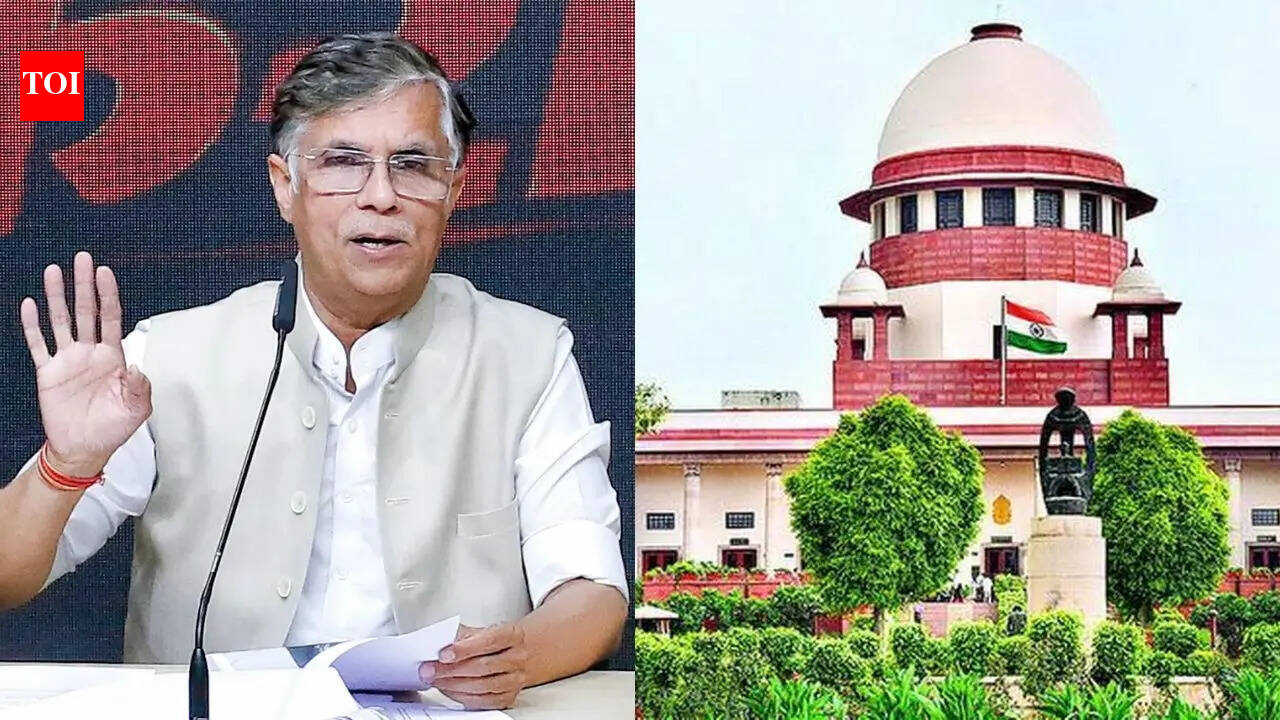
Passport controversy: What conditions did the Supreme Court keep while granting anticipatory bail to Pawan Kheda? india news

Supreme Court grants anticipatory bail to Pawan Kheda, cancels Guwahati HC order

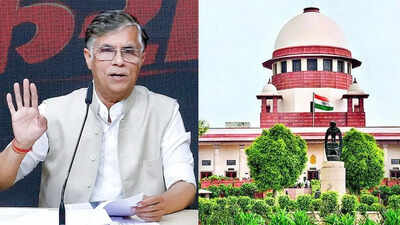
New Delhi: The Supreme Court on Friday granted anticipatory bail to Congress leader Pawan Kheda and directed him to cooperate in the investigation, appear before the police when called and not tamper with evidence. The court said he cannot leave the country without prior permission and allowed the trial court to impose additional conditions, while making it clear that his comments would not affect the merits of the case and the proceedings should continue independently.A bench of Justices JK Maheshwari and Atul S Chandurkar set aside the Gauhati High Court order denying pre-arrest protection and said, “While deciding an application for anticipatory bail, a careful balance must be struck between the interest of the State in ensuring a fair investigation and the individual’s fundamental right to personal liberty under Article 21.” The court said, “We are of the opinion that the allegations and counter-allegations, as evident in the present case, prima facie appear to be politically motivated and influenced by such rivalries, rather than revealing a situation requiring custodial interrogation.

Watch

Supreme Court grants anticipatory bail to Pawan Kheda, cancels Guwahati HC order

Giving relief, the top court directed that in the event of arrest, Khera should be released on anticipatory bail subject to key conditions. They have been asked to cooperate in the investigation, appear before the police whenever called and refrain from influencing witnesses or tampering with evidence. The court also directed that he should not leave the country without the prior permission of a competent court, while allowing the trial court to impose additional conditions if necessary.The Supreme Court clarified that its comments on documents and facts are limited to the bail stage and will not affect the merits of the case. It also said that the trial court should proceed independently without being influenced by his comments.

Top court highlights ‘political rivalry’ in proceedings

The bench emphasized that the criminal law must be applied with caution, adding, “Criminal procedure must be carried out with impartiality and caution to ensure that individual liberty is not jeopardized by proceedings being influenced by political rivalry.”It also found fault in the reasoning of the Gauhati High Court, noting that it had wrongly relied on provisions not invoked in the FIR and placed the entire burden on the accused. “In our view, the observations made in the order passed by the High Court are not based on a correct appreciation of all the materials placed on record and appear to be misconceived,” the top court said.The case stems from allegations that Kheda had claimed during press conferences in Delhi and Guwahati on April 5 that Riniki Bhuyan Sarma had multiple foreign passports and undeclared foreign assets. He denied the allegations and filed an FIR accusing him of using fabricated documents.Appearing for Kheda, senior advocate Abhishek Manu Singhvi argued that the case pertains to harm to reputation and does not require custodial arrest, adding that Kheda was willing to cooperate and was neither a flight risk nor likely to be tampered with evidence.Opposing the plea, Solicitor General Tushar Mehta, representing the Assam government, argued that the forged documents were publicly circulated and custodial interrogation was necessary to unearth their origin and any wider conspiracy.The FIR, filed by the Assam Crime Branch, invokes provisions related to forgery, cheating, false statement and defamation under the Indian Judicial Code.

Source link

From red to green to saffron? BJP is eyeing a change of power in Bengal as Mamata is saving her ground. india news

From red to green to saffron? BJP eyes change of power in Bengal as Mamata is saving her ground
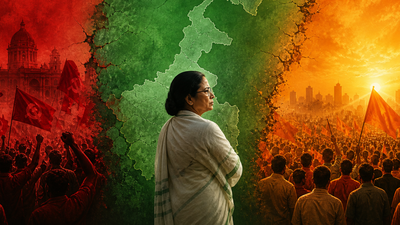
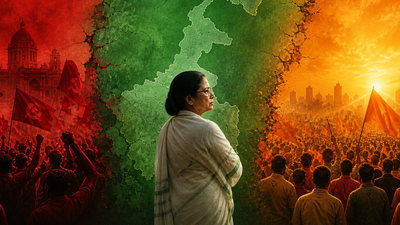
Use of AI-generated images for representation

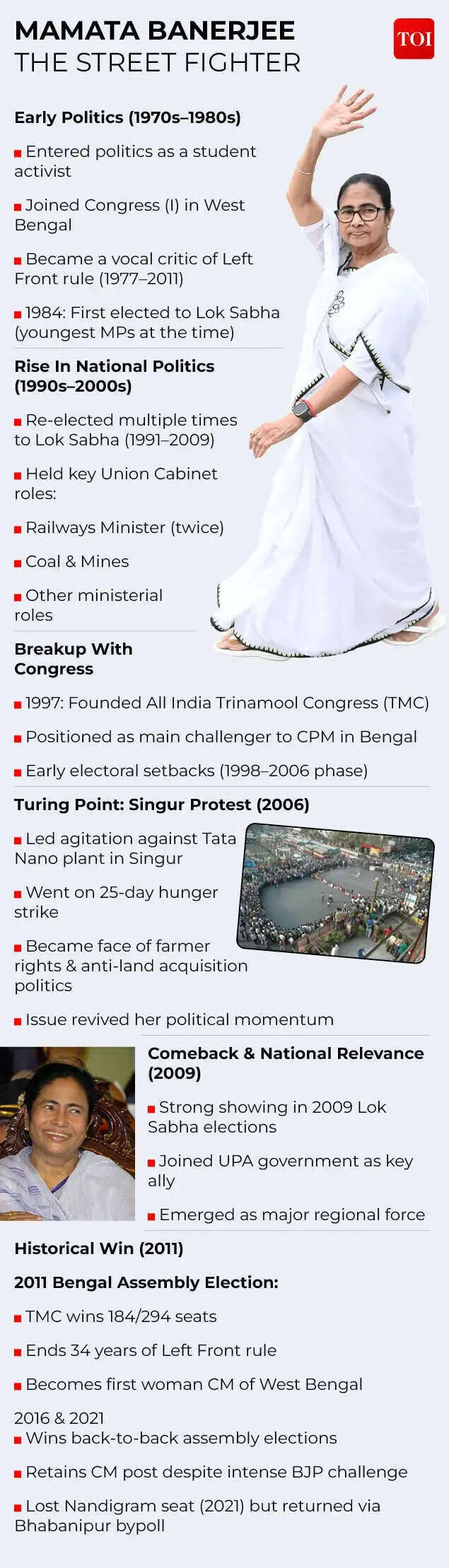
New Delhi: The Bengali ‘Manush’ have traditionally displayed deep-rooted political loyalty, often uniting decisively behind a single political force and allowing it to rule for long periods. In the nearly eight decades since independence, West Bengal’s political journey has not been merely a sequence of changing hands of governments, but a story taking shape in clear, influential eras, each of which has been marked by ideological conviction and long mandates.However, the 2026 assembly elections have injected a new intensity into this legacy. What is unfolding is not just another election contest, but a high-stakes, high-voltage battle between the long-serving Chief Minister Mamata Banerjee and a determined, aggressively expanding Bharatiya Janata Party brigade.

-

Didi’s 15-year rule is facing its toughest challenge yet. BJP has waged a relentless, grassroots campaign, deployed its top leadership and stepped up its attacks Trinamool Congress. The high command of the saffron party has even said that “the sun has set for TMC in Bengal.”But to understand the weight of BJP’s claim, the story of how Bengal’s political journey evolved has to be told.

Congress Era: Foundation of power and post-partition reconstruction

Like most states in newly independent India, the early political leadership of Bengal was shaped by the Congress. Bidhan Chandra Roy, one of the most important icons of the state’s history, became its first Chief Minister at a time when Bengal was struggling with the devastating effects of partition in 1947.Bidhan Chandra’s leadership extended beyond regular rule. He played an important role in stabilizing a fragmented society and laid the foundation of the administrative and infrastructure of modern Bengal. Among his lasting contributions was the development of Salt Lake City, a planned township that epitomized visionary urbanization.Kolkata, then Calcutta – was not only the state capital but also a political center for the Congress Party. The city hosted several historic sessions of the party over the decades, becoming a stage for defining moments of India’s freedom struggle and political evolution. From the first singing of Vande Mataram to the declaration of Swaraj, Bengal remained at the center of Congress.However, the dominance of the Congress gradually began to wane. Internal divisions, changing political aspirations and turmoil at the national level weakened its hold. The emergence of the Bangla Congress marked the first serious crack in its monopoly, introducing coalition politics and opening the door to alternative ideologies.The death of strong national leaders like Jawaharlal Nehru and Lal Bahadur Shastri further destabilized the party’s structure and its influence. The 1967 elections, often described as a “political earthquake”, dealt a decisive blow to Congress dominance in Bengal.

Red Age: rise and consolidation of left Effect

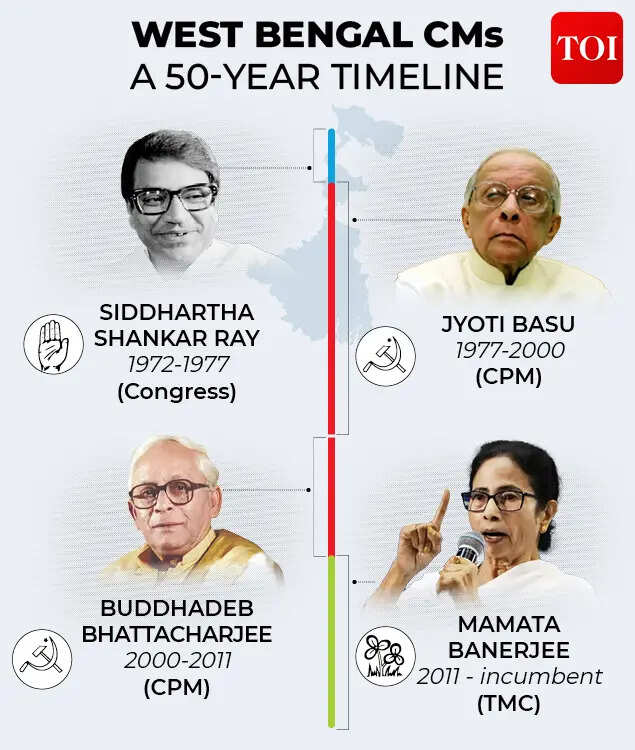
Even as Indira Gandhi consolidated her political dominance at the national level, especially after the 1971 election victory and the India–Pakistan war, Bengal was moving in a different direction.The Congress continued to lose in the state and its last Chief Minister to date, Siddhartha Shankar Ray, represented the end of an era. The political void was quickly filled by the Left Front, which came to power in 1977 on the back of strong grassroots mobilization and ideological clarity.At the center of this change was Jyoti Basu, a stalwart Marxist leader who went on to become one of India’s longest-serving chief ministers. Under his leadership, Bengal saw a profound restructuring of its rural and administrative systems.Major initiatives such as Operation Barga redefined land relations by strengthening the rights of sharecroppers, while the institutionalization of the Panchayati Raj system in 1978 decentralized governance and empowered local bodies. These reforms created a durable political base for the left.The Left Front ruled Bengal uninterrupted from 1977 to 2011, one of the longest tenures for any democratically elected communist government in the world. By 2000, Basu stepped down due to health reasons and handed over the command to Comrade Buddhadeb Bhattacharjee. While Bhattacharjee attempted to recast the Left’s image by focusing on industrialization, the ground reality had begun to change. Discontent was growing and a new political force was gaining momentum under the leadership of Mamata Banerjee.

Mamata Moment: Disintegration and Domination

Mamata emerged as a new strong leader in the state.Emerging as a fierce and persistent challenger, Mamata ended the Left’s decades-long dominance in the 2011 assembly elections. Leading the Trinamool Congress, she secured a sweeping mandate of 184 seats and became the first woman Chief Minister of Bengal.

-

His victory marks not only a change in government but also a complete political reset. The Congress and the Left, once the major forces in the state, were pushed to the margins. Despite ruling at the Center for almost 6 years under the leadership of Atal Bihari Vajpayee, the BJP remained an insignificant player in Bengal politics at that time.In 2016, Mamata further strengthened her hold and returned to power with an even bigger mandate, crossing the 200-seat mark. At this stage, their dominance appeared unquestioned, with opposition forces scattered and struggling to regain relevance.His style of governance, welfare reach and strong personal connect with the voters ensured that the Trinamool Congress remained the central pole of Bengal politics.

Rise of BJP: From marginal to formidable force

The political balance began to shift dramatically in 2021.The BJP launched an unprecedented campaign in Bengal under the leadership of its stars Prime Minister Narendra Modi and Union Home Minister Amit Shah, who is also considered “Chanakya” for the saffron party. The scale, intensity and resources deployed marked a new phase in the electoral politics of the state.While Didi retained power, the BJP’s performance indicated a major success. Winning 77 seats in the 294-member assembly, the party emerged as the principal opposition, defeating both the Congress and the Left.In fact, the strong rise of the BJP pushed the Congress and the Left parties to insignificant margins.This increase was significant not only numerically, but also symbolically. A party that was once struggling to make electoral inroads in Bengal has now established itself as the primary challenger to the ruling establishment led by TMC supremo Mamata.

2026 Showdown: Continuity or Change?

Now, as Bengal records the highest-ever voting percentage and sees an intense, high-decibel campaign, the stakes have never been higher.Is the state signaling change? As the BJP leadership claims, has “the sun set on TMC in Bengal”?Furthermore, the traditional notion of high voter turnout was interpreted as an undercurrent against the incumbent.The contest has increasingly assumed a bipolar character, squeezing out other political players and turning the election into a direct face-off between the Trinamool Congress and the BJP.Buoyed by its victory in 2021, the BJP has also fielded a huge number of candidates in TMC’s traditional strongholds like Bhawanipur and other constituencies in south Bengal. As a clear message – no seat is being given without a fight.Many pollsters have also given BJP an edge over Mamata’s TMC in their exit poll predictions. This could be the first sign of uneasiness for Didi. Poll of polls predicted that TMC will no longer be the single strong and leading force as it has been taken over by BJP. In 2021, Mamata faced her former ally and BJP leader Suvendu Adhikari in Nandigram and suffered a rare personal defeat, even as she retained power across the state. This time, the dynamics appear more complex, with both sides in a strong contest from Bhavanipre.The elections also saw a massive administrative exercise, including a special intensive vetting process that Mamata criticized but the Election Commission defended, adding another layer of political tension.Will it continue its long-term tradition of supporting a major power, or embrace change and write a new chapter?The answer to this question lies with Bengali ‘Manush’.

Source link

Why India’s heat is getting harsher in 2026: Early heatwaves, below-normal rainfall, El Niño risk and rising human cost | India News

Why India’s heat is getting harsher in 2026: Early heatwaves, below-normal rainfall, El Niño risk and rising human cost

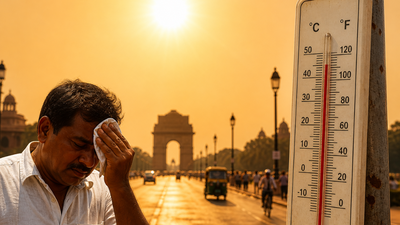
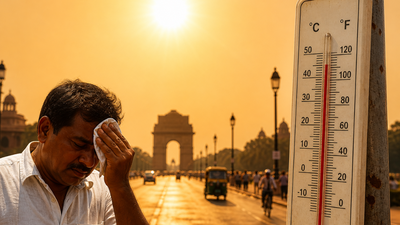
Step outside into 45-47°C heat and it is not just uncomfortable. It is immediate and overwhelming. The sun beats down relentlessly as the air feels heavy and unbearably still, hitting your face like a wave from an open furnace and clinging to the skin even as you step into shade. Within minutes, the body begins to slow. The throat dries, the eyes strain, and even standing still becomes tiring. The surroundings start to feel almost dizzying as roads shimmer in the distance and metal surfaces grow hot enough to burn on contact. The city no longer feels like it is moving through seasonal heat. It feels trapped under it.Indoors, relief isn’t the same for everyone. While air conditioning offers escape for some, it remains out of reach for many Indian households, and even where it is used, cooling systems push out waste heat into already dense urban spaces, adding to the surrounding temperature burden. For others, walls absorb heat through the day and release it slowly at night, keeping rooms warm well past sunset. Sleep is often disrupted, recovery remains limited, and for many, there is little escape from the cycle, often stretching for months.Scorching summer heat is not unusual in India, but this year it has arrived in sharper bursts, earlier than expected, and with greater intensity. In April, large parts of the country were already under heatwave conditions, with temperatures crossing 40°C in several regions and climbing close to 45°C in some pockets. Akola in Maharashtra recorded the highest temperature at 46.9°C as Vidarbha region entered an early-summer heatwave, briefly placing multiple Indian cities among the hottest in the world during peak afternoons even before May.In late April, a few isolated spells of rain offered brief relief, cooling conditions in parts of the country for short periods, but the respite did not last. The heat has returned in waves, keeping large regions locked in a cycle of rising discomfort. During this period, global temperature trend data showed that 95 of the world’s 100 hottest cities were in India, underscoring how widespread and intense the heat had become even before peak summer had fully set in.
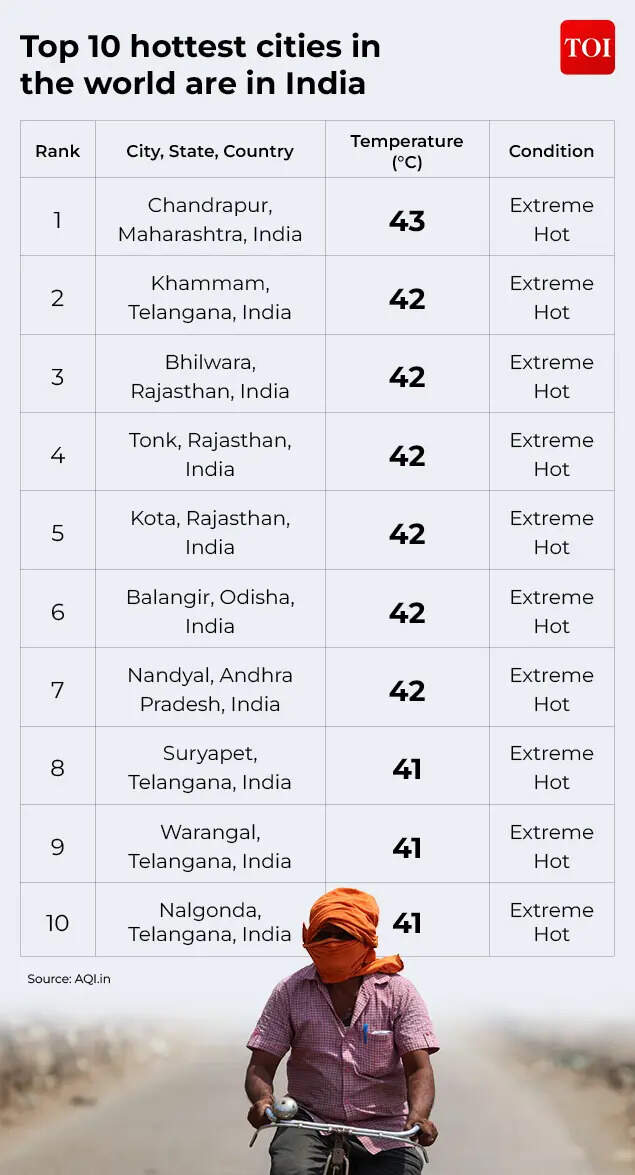
Top 10 hottest cities in the world as on May 1, 2026

Top 10 hottest cities in the world as on May 1, 2026

Is the worst of the heat yet to come?

This year’s heat is unfolding alongside a shifting global climate pattern. In the equatorial Pacific, El Niño is a naturally occurring ocean-atmosphere phenomenon marked by warming sea surface temperatures and weakening trade winds. It is part of the El Niño-Southern Oscillation system that influences weather across the world by altering rainfall, wind patterns and heat distribution.When it strengthens, it can intensify extreme heat, disrupt India’s monsoon and raise global temperatures. The World Meteorological Organization has indicated that conditions are tilting towards a likely El Niño development around mid-2026. This raises concerns of additional stress on an already warming world, particularly for India as this period coincides with the monsoon onset and can significantly affect the agrarian sector.

What is El Niño?

El Niño is a naturally occurring climate phenomenon that describes the periodic warming of sea surface temperatures in the central and eastern equatorial Pacific Ocean. It is part of a larger system known as the El Niño Southern Oscillation, or ENSO, which has three phases: El Niño, La Niña and neutral conditions.Under normal conditions, trade winds push warm surface waters westward toward Asia and Australia, while cooler waters rise along the South American coast. During an El Niño event, these trade winds weaken or reverse. As a result, warm water shifts eastward, disrupting the ocean-atmosphere balance.This shift has global consequences because the Pacific Ocean strongly influences atmospheric circulation. Changes in sea surface temperature alter rainfall patterns, jet streams and storm formation across continents.El Niño typically occurs every two to seven years and lasts around nine to twelve months. Its impacts vary by region but often include drought in Australia, Indonesia and parts of South Asia, and heavier rainfall in parts of South America and East Africa. It can also influence tropical storm activity, reducing hurricanes in the Atlantic while increasing them in the Pacific.
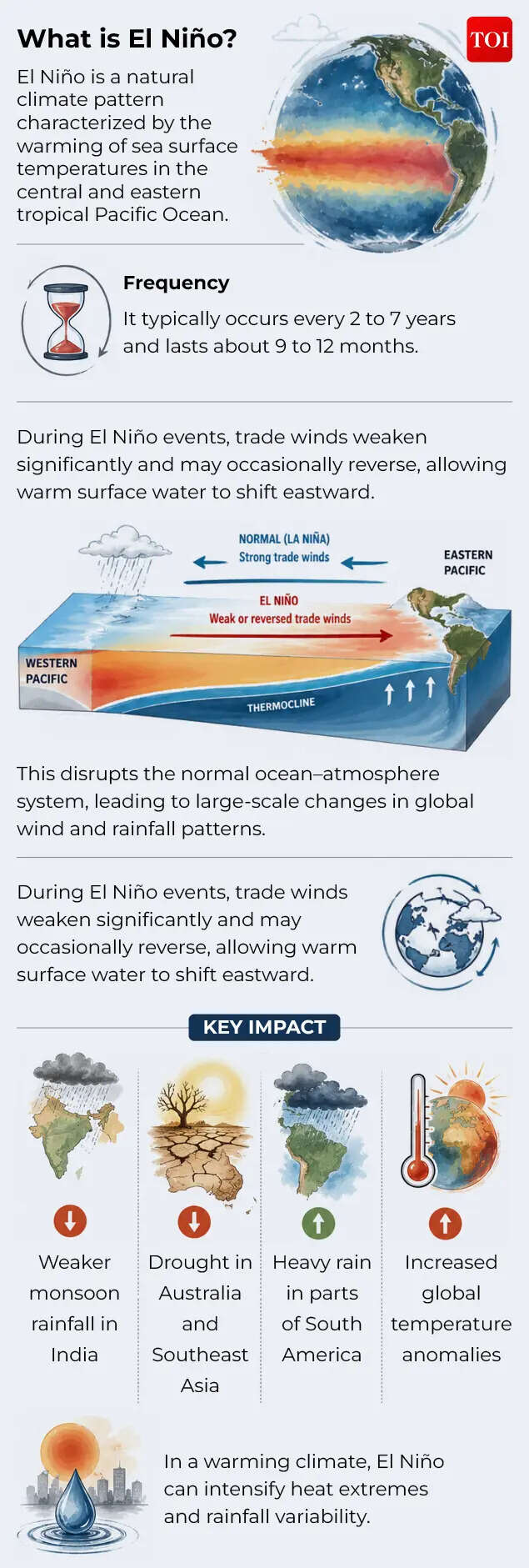
What is El Niño

What is El Niño

Importantly, El Niño does not operate in isolation. In a warming world, its impacts are amplified. A hotter baseline means that when El Niño adds extra heat to the system, extreme weather events intensify. This is why recent strong El Niño years have been linked to record global temperatures.

El Niño and India: a familiar but intensifying link

El Niño is one of the most influential climate drivers as it alters global atmospheric circulation, reshaping weather patterns across continents within months.Some of the strongest El Niño events in modern history include 1982 to 1983, 1997 to 1998 and 2015 to 2016. The 1997 to 1998 event was among the most intense and was linked to flooding in parts of South America, severe drought across Southeast Asia and Australia, and widespread wildfires in Indonesia. The 2015 to 2016 event contributed to global temperature spikes and major regional disruptions.For India, El Niño has a well-established relationship with the southwest monsoon. It is often associated with below-normal rainfall, delayed onset and uneven distribution. Years such as 1987, 2002, 2009 and 2015 saw weak monsoon performance and drought-like conditions in several regions. It is also linked with increased likelihood of intense pre-monsoon heat, raising heatwave risk across northern and central India.Historical records show how El Niño can intersect with food insecurity. The 1877 to 1878 event coincided with severe drought conditions across multiple continents and is associated with the global famine period of 1877 to 1879. Research links this period with widespread mortality in India and China, shaped by climatic stress interacting with structural vulnerabilities. Climate variability acted as a trigger, but outcomes were shaped by deeper social and economic conditions.What is increasingly important today is that these natural cycles are unfolding on a warmer global baseline. This amplifies their effects, increasing heat extremes and sharpening rainfall contrasts across regions.

What is a ‘super El Niño’ and why are scientists warning about it?

A “super” El Niño refers to an unusually strong version of the climate phenomenon, marked by sea surface temperatures in the central and eastern Pacific rising by at least 2°C. Such events are rare, occurring only a few times since 1950, with just one instance pushing beyond 2.5°C.Scientists say the stronger the warming, the greater the likelihood that El Niño’s global impacts are intensified, including heat extremes, disrupted rainfall patterns and shifts in monsoon systems.According to the US National Oceanic and Atmospheric Administration (NOAA), there is about a one-in-four chance of such a strong or “super” El Niño developing by the coming autumn or winter. However, researchers caution that forecasts made in spring can be less stable, as seasonal transitions often introduce uncertainty in climate patterns.Even so, early indicators are already pointing towards a potentially strong event. Dr Paul Roundy, professor of atmospheric and environmental sciences at the State University of New York at Albany, recently said in a post on X there is “real potential for the strongest El Niño event in 140 years.” Similarly, Dr Andy Hazelton, associate scientist at the University of Miami, noted that “all models and observations are pointing in the same direction: a very strong El Niño with significant impacts on global climate this year.

India’s heat reality: exposure rising, protection lagging

India is already experiencing a steady rise in heatwave frequency, duration and intensity. Climate assessments and meteorological records indicate that several of the warmest years in India’s history have occurred in the last decade.Despite this trend, heatwaves are not formally classified as a notified disaster under India’s central disaster framework. This limits structured compensation, long-term adaptation funding and a uniform national response mechanism. States can use State Disaster Response Funds for heatwave-related relief under certain conditions, but this creates a patchwork system where preparedness and response vary across regions.

What it means for India

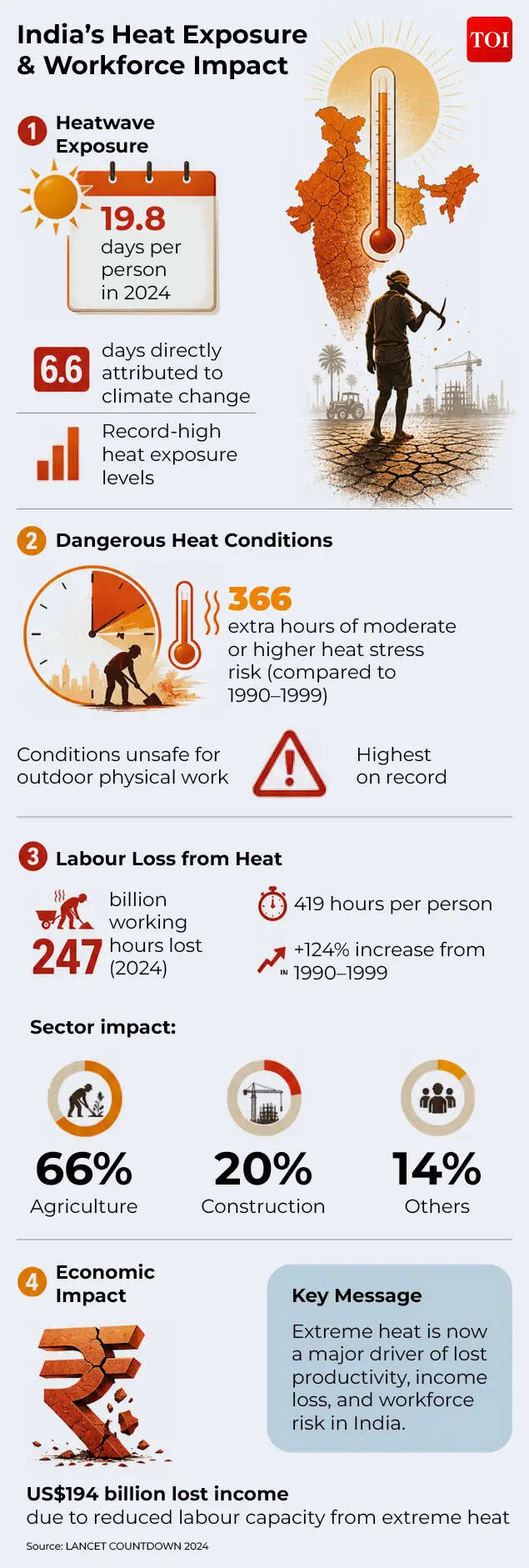
For India’s informal workforce, heat is not just a weather event but an occupational hazard that directly cuts wages and reduces working hours.Street vendors, construction workers, rickshaw pullers, farm labourers and delivery workers remain directly exposed to extreme temperatures with little protection. Office goers and daily commuters also spend long hours moving through the same conditions, often with limited relief. Work does not pause when temperatures rise, and air conditioning remains out of reach for many households. Even where it is used, cooling systems release waste heat into already dense urban areas, adding to the surrounding temperature burden.
-

The health and economic toll is already visible. According to the Lancet Countdown on Health and Climate Change, people in India experienced an average of 19.8 heatwave days in 2024, the warmest year on record. The study links rising heat exposure to increased illness, reduced labour capacity and falling productivity. It estimates potential income losses of about 194 billion dollars due to heat-driven labour reduction.At the same time, extreme heat is feeding into wider economic stress. Higher electricity demand for cooling increases power consumption, water shortages strain urban supply systems, and climate variability affects food production and prices, adding pressure to household budgets.

Health impacts

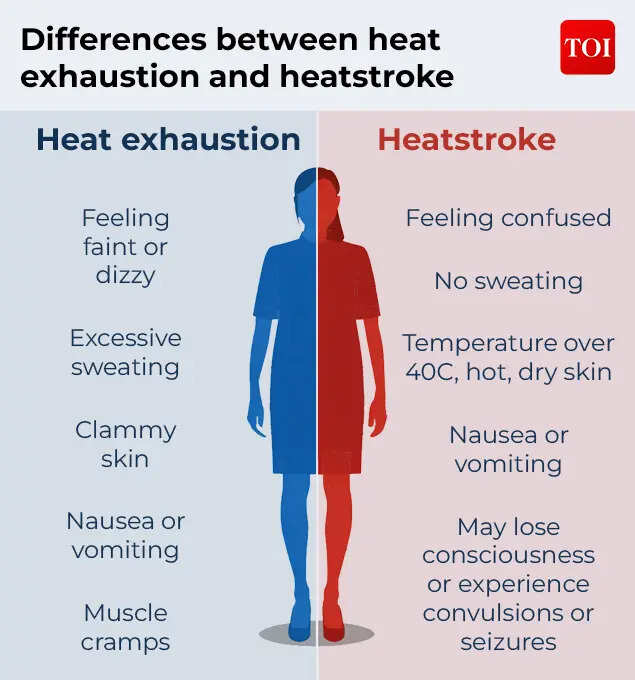
Extreme heat disrupts the body’s ability to regulate internal temperature. When ambient conditions exceed physiological thresholds, sweating alone becomes insufficient.Common conditions include dehydration, muscle cramps, heat exhaustion and heatstroke. Severe exposure can lead to organ failure and death.
-

Heatwaves are strongly associated with increased mortality from cardiovascular, respiratory and neurological conditions. Estimates suggest between 10,000 and over 20,000 heat-related deaths in India over two decades. Independent studies indicate that the actual toll may be higher due to underreporting, as heat is often not recorded as a primary cause of death.

Urban India: Heat trapped by design

Urban areas face amplified risk due to the urban heat island effect. Dense construction, reduced vegetation and limited airflow trap heat, making cities warmer than surrounding rural areas, especially at night, a phenomenon known as the Urban Heat Island (UHI) effect.Rapid urbanisation has replaced tree cover and green spaces with concrete surfaces that absorb heat during the day and release it slowly at night. This creates persistently high nighttime temperatures, reducing the body’s ability to recover between heat exposure cycles.Heat is therefore not only meteorological. It is also shaped by planning, land use and ecological change.

Economy under heat stress

Extreme heat is increasingly feeding into economic stress. Higher temperatures drive electricity demand for cooling, increasing power consumption during peak summer months.At the same time, agricultural productivity declines under heat stress and erratic rainfall. In 2022, unusually high pre-harvest temperatures during the grain-filling stage caused significant yield losses in major wheat-growing states such as Punjab, Haryana and Uttar Pradesh. This led to a ban on wheat exports aimed at stabilising domestic supply and controlling prices.For households, this creates a dual burden of rising food inflation and higher cooling costs.

A longer, harsher summer

In the convergence of rising temperatures, shifting climate patterns, India’s summer is no longer merely a seasonal cycle. It is becoming a prolonged test of endurance, measured not only in degrees Celsius, but in loss of wages, health risk, mortality and survival. And, as temperatures rise and climate patterns shift, India’s summer is becoming harder to navigate and stakes are rising. How the country adapts to this growing heat stress, whether by slowing deforestation and protecting existing forest cover, expanding urban green spaces that can lower local temperatures, reducing reliance on coal-based power, which still accounts for roughly 70% of electricity generation, and accelerating the shift to cleaner energy sources such as solar, will shape livelihoods and public health outcomes.

Source link

Bhagwant Mann: ‘All speculations have been put to rest’: Bhagwant Mann on AAP government winning trust vote in Punjab Assembly. india news

'All speculations put to an end': Bhagwant Mann on AAP government winning trust vote in Punjab Assembly

New Delhi: The Aam Aadmi Party The (AAP) government on Friday won the confidence motion in the Punjab Assembly with the Chief Minister Bhagwant Maan He stressed that the result put an end to speculations of instability within the party.The resolution was tabled during a special one-day session earlier in the day, days after the setback in the Rajya Sabha where seven AAP members quit the party. Bharatiya Janata Party (BJP).After the resolution was passed, Mann hit out at rumors of a split in the party. He told news agency ANI, “Today all those speculations which were saying that 65 or 40 AAP MLAs are leaving have been put to rest.”Taking a dig at the opposition, he also rejected Congress’s demand for alcohol testing. “He has no issues to raise,” Mann said.Earlier, while presenting the proposal, the CM had rejected claims of internal rift. He had said, “There are rumors that AAP will collapse and its MLAs will switch sides. Such rumors create confusion in the minds of people.”Reiterating AAP’s national footprint, Mann cited its representation in Punjab, Delhi, Gujarat, Goa and Jammu and Kashmir, saying the party continues to have a presence in many states.The ruling party had issued a whip to all its MLAs to ensure full attendance during the session.In the 117-member Punjab Assembly, AAP has an overwhelming majority with 94 MLAs. There are 16 Congress MLAs, three from Shiromani Akali Dal (SAD), two from BJP, one from BSP and one independent MLA.The trust vote comes in the backdrop of a political setback for AAP on April 24, when seven of its 10 Rajya Sabha members, including Raghav Chadha, Sandeep Pathak and Harbhajan Singh, resigned and joined the BJP, alleging that the party has deviated from its core principles and values. The six MPs who defected were from Punjab.

Source link

Allahabad HC rejects plea seeking FIR against Rahul Gandhi over ‘fighting the Indian state’ remark. india news

Allahabad HC rejects plea seeking FIR against Rahul Gandhi over 'fighting the Indian state' remark

New Delhi: Allahabad High Court on Friday rejected the petition seeking registration of FIR against the Lok Sabha Leader of Opposition. Rahul Gandhi Over an alleged controversial “fighting the Indian state” comment.Justice Vikram D Chauhan passed the order while hearing the plea of ​​Simran Gupta, who had challenged the earlier decision of the Sambhal court, which had rejected her request to direct the police to register an FIR against Congress leader Rahul Gandhi.The petitioner alleged that during the inauguration of the All India Congress Committee office in 2025, Rahul had said, “Now we are fighting the BJP, RSS and the Indian state itself.”According to the petition, this comment hurt public sentiments and is a seditious and anti-national statement intended to destabilize the country.

Source link

Rahul Gandhi: ‘I said this’: Rahul Gandhi blames 81% rise in LPG prices in 3 months; Sharp attack on the Center regarding inflation. india news

'I said it': Rahul Gandhi alleges 81% rise in LPG prices in 3 months; Sharp attack on center regarding inflation

New Delhi: Leader of Opposition in Lok Sabha Rahul Gandhi The government on Friday launched a scathing attack on the Center over rising inflation, which includes a huge jump in the prices of commercial LPG cylinders, including a hike of Rs 993 in a single day. congress leader He said he had previously warned that inflationary pressures would increase after the election, which he described as a sharp increase in rates.In a post on Twitter, Rahul Gandhi said the price of commercial gas cylinder has increased by Rs 993 in a single day, describing it as the biggest single-day jump. He further claimed that the prices have increased by Rs 1,380 between February and the current period, which he described as an increase of 81% in three months.“I had said – inflation will hit after the elections. Today commercial gas cylinder is costlier by Rs 993. Biggest increase in a day. This is an election bill. From February till now: Increase of Rs 1,380 – a huge jump of 81% in just 3 months.”He said its impact will be felt on small businesses like tea shops, dhabas, hotels, bakeries and sweet shops and household expenditure will also be affected.“Tea shop, dhaba, hotel, bakery, sweet shop – the burden on everyone’s kitchen has increased. And this will affect your plate too. First strike on gas, next strike on petrol-diesel.”Earlier on Tuesday, he had also alleged that the government will increase petroleum prices after the voting phase ends in several states, including West Bengal, Assam, Kerala, Puducherry and Tamil Nadu.Rahul Gandhi sharply criticized the Centre, saying, “Election relief is over, the heat of inflation is about to come! Be careful after April 29 – petrol, diesel, everything will become expensive. When oil was cheap, the Modi government made profits. Now when it is expensive, it will put the burden on you. A government that loots when it is cheap, and leaves the public to bear the brunt of inflation.”

Source link

‘How shameful’: Swati Maliwal accuses Bhagwant Mann of coming to Punjab Assembly ‘intoxicated’ india news

'What a shame': Swati Maliwal accuses Bhagwant Mann of coming 'intoxicated' to Punjab Assembly

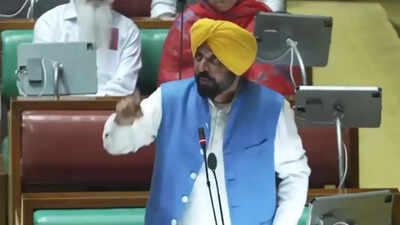
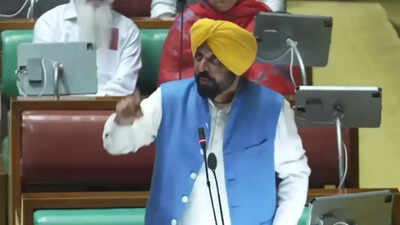
New Delhi: BJP Rajya Sabha MP Swati Maliwal alleged on Friday Chief Minister of Punjab Bhagwant Maan Arriving in the Legislative Assembly “intoxicated”.In a social media post on Twitter, Maliwal shared a clip of Mann addressing the assembly and said that Mann should undergo an “alcohol test” and be removed from the post of chief minister if found guilty.

Watch

Swati Maliwal’s explosive exit: Allegations of assault, ‘betrayal’ create stir in AAP, joins BJP

“Again today, Punjab CM Bhagwant Mann reached the ‘temple of democracy’ Punjab Assembly under the influence of alcohol.This man goes to Gurudwaras drunk, goes to temples drunk, comes to the Lok Sabha drunk, goes to government meetings drunk and even drinks so much abroad that he was kicked off the plane,” Maliwal said.“Before the elections, he had placed his hand on his mother’s head and promised that he would never drink alcohol again. The CM of a sensitive border state like Punjab is reportedly drunk all the time…signing files while drunk. What a shame,” she added.He said, “How can a person who abstains from alcohol only while sleeping run Punjab? CM Mann should undergo an alcohol test and if found guilty, he should be removed from the post of Chief Minister.”This comes days after Swati Maliwal, Raghav Chadha and five other Rajya Sabha members from the Aam Aadmi Party decided to quit and merge their faction with the Bharatiya Janata Party.Reacting to the controversy, opposition leader Pratap Singh Bajwa demanded immediate alco-meter and dope test of Mann and all the MLAs during the ongoing session of the Punjab Assembly.Elected to the Rajya Sabha MP in January 2024, Maliwal’s rift with the party began just a few months later in May, when she alleged that a close aide of hers had physically assaulted her at AAP convenor Arvind Kejriwal’s house – a claim she has reiterated after her exit.This is not the first time Mann has come into controversy. In 2022, the opposition targeted the Punjab Chief Minister and alleged that he was deboarded from a Delhi-bound flight at Frankfurt airport because he was “intoxicated”, a charge the ruling AAP termed as baseless.

Source link

Tenkasi Assembly Election Result 2026 | india news

Tenkasi Assembly Election Result 2026

Tenkasi is a major assembly constituency in Tamil Nadu, located in Tenkasi district, and is known for close electoral contests. In the 2021 assembly elections, Indian National Congress’s S. Palani Nadar won the seat by defeating Selvamohandas Pandian of All India Anna Dravida Munnetra Kazhagam by a margin of only 370 votes. The constituency is once again witnessing a competitive race, with the entry of Naam Tamilar Katchi’s Gaushik Pandian into the fray intensifying the competition between the major parties. Tenkasi assembly seat comes under Tenkasi Lok Sabha constituency. In the 2024 general elections, Dravida Munnetra Kazhagam’s Rani Sreekumar defeated AIADMK’s K. Won the parliamentary seat by defeating Krishnasamy by a margin of 196,199 votes.

Watch

DMK will win in Tamil Nadu; Close contest in Kerala, BJP’s lead in Assam: Today’s Chanakya Exit Poll

Source link

Alangulam Assembly Election Result 2026 | india news

Alangulam Assembly Election Result 2026

Alangulam assembly constituency is located in the Tenkasi district of Tamil Nadu under Tirunelveli Lok Sabha, a rural agricultural area focused on paddy and millet, with Alangulam town as its centre. PH Manoj Pandian (also known as Manoj Pandian) of AIADMK is the current MLA as of March 2021. He won in 2021 with 74,153 votes (36.44% share), defeating DMK’s Poongothai (70,614 votes) by a margin of 3,539 votes, resulting in a voter turnout of 77.4% and no change since then. Major issues include lack of irrigation, poor rural roads and electricity reliability, limited health care and education facilities, youth unemployment and demands for better welfare schemes in this underdeveloped region.

Source link