Automatic registration for the US military draft for males between 18-25? what we know so far
Illegal encroachment removed on India-Nepal border in Bihar. patna news
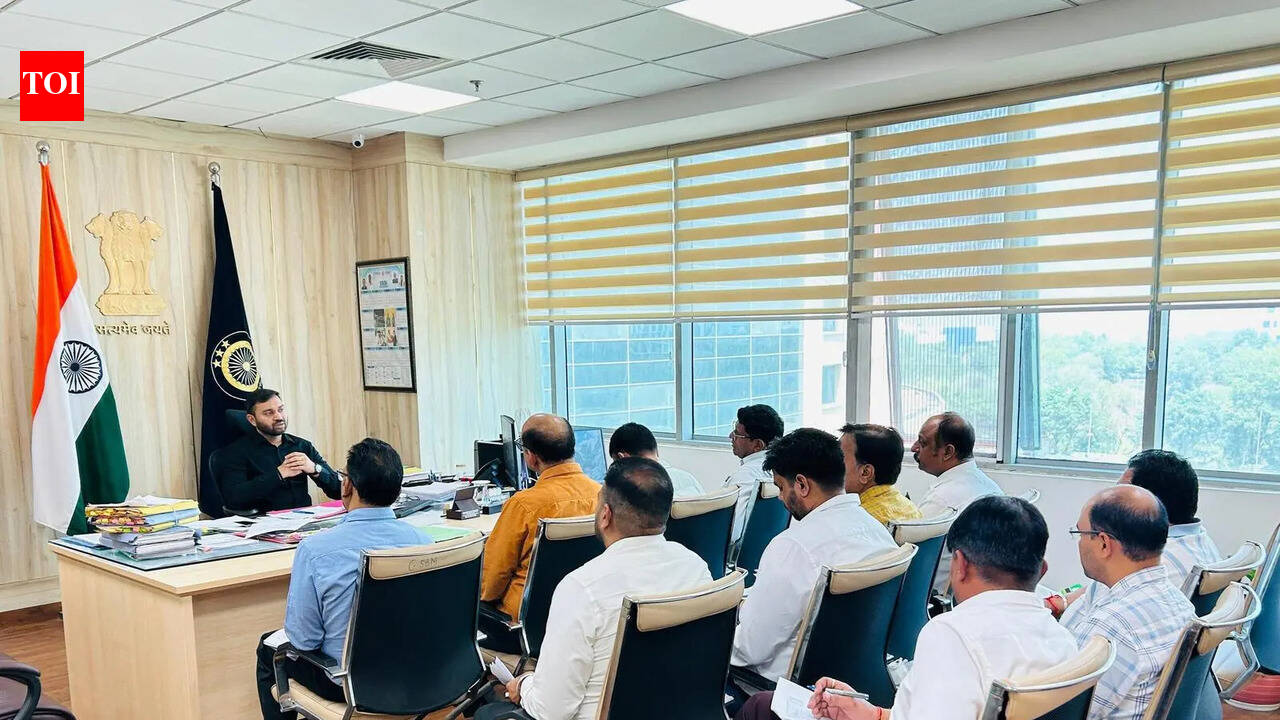
Patna: The intensive drive to remove illegal encroachments from the India-Nepal border area has yielded major results in the border districts of Bihar with the district administration reporting large-scale demolition of ‘no man’s land’ and illegal structures within 15 km of the International Border as part of a comprehensive effort to strengthen border management and security.The progress report was presented during a review meeting chaired by Chief Secretary Pratyaya Amrit, where the District Magistrates of East Champaran, West Champaran, Madhubani, Sitamarhi, Kishanganj, Supaul and Araria shared updates on border security and development works.According to the presentations, Madhubani has removed all 186 identified illegal structures in the last one month, while Kishanganj has removed all 34 identified encroachments. In West Champaran, 261 out of 272 encroachments have been removed, with coordination underway with Nepali authorities regarding the remaining cases.The review also highlighted progress in crime control and action against counterfeit Indian currency notes. Recently 10 accused were arrested in East Champaran and fake notes worth Rs 18,500 in Indian notes and Rs 25 lakh in Nepali notes were seized. In Sitamarhi, officials recovered fake Nepali notes worth Rs 49 lakh and Indian fake notes worth Rs 20,100.In cyber crime enforcement, the Sitamarhi administration facilitated refunds of over Rs 11.66 lakh in January. In Madhubani and Araria, an inter-state gang involved in manufacturing fake identity cards and Aadhaar cards was busted, leading to several arrests.Maintenance and verification of border pillars is being done through modern technology and joint survey. Regular monitoring of 1,237 pillars in East Champaran and 358 pillars in Madhubani is going on. Field survey team is taking action to repair damaged or missing pillars in Kishanganj and Sitamarhi. The repair work of all the damaged pillars in Supaul has been completed.It was told in the meeting that security agencies are maintaining surveillance against illegal infiltration of foreign citizens and arrests have also been made, which include citizens of Uzbekistan, Bangladesh, China and America.On the development front, hundreds of villages in the border area have been selected under the Vibrant Village Program-II. In Madhubani, detailed project reports are being prepared for 253 development schemes covering 36 villages, while 250 more villages have been added by the Government of India. Modern facilities including digital library and model agri farm are being developed in four blocks in Sitamarhi at a cost of Rs 24 crore. Rs 112 crore has been allocated under the program in Kishanganj.The review further said that agriculture and horticulture based economic activities are being promoted in the border districts with special focus on processing of dragon fruit, pineapple and tea.
‘We live on stolen land’: Indian-origin woman speaks out against racism at Frisco council meeting
Under police scrutiny for staying at the same station for more than 3 years. bhubaneswar news
Bhubaneswar: Police officers who have overstayed at their postings in violation of the government’s transfer policy are now under investigation. Odisha Police Headquarters has directed all district superintendents of police (SP) and deputy commissioners of police (DCP) in Bhubaneswar and Cuttack to ensure that officers serving at the same station for more than three years are transferred in line with state guidelines.A senior police officer said, “We have advised the heads of police districts and establishments to start identifying such officers and transfer them immediately as per the government’s policy. They have been advised to complete the process as soon as possible.”According to a circular issued by IGP (Personnel) S Praveen Kumar on Tuesday, no officer should be posted in the same district for more than six consecutive years, and no officer should be posted at the same station for more than three consecutive years. The instructions reiterate the policy of the state government. “Generally, a government servant can be transferred after serving a period of three years at one place,” the circular said.As per the policy, transfers are to be made annually between April 15 and June 15. “District transfer boards should be convened by April 20, proposals for inter-district transfers should be submitted to range offices by April 25. Range transfer boards should meet by April 30, while proposals requiring headquarters-level approval should reach the state police headquarters by May 10,” the letter said.The instructions emphasize that SPs and DCPs should conduct a thorough review to identify those personnel who have completed their tenure and initiate transfers within or outside the district. Officials have been directed to strictly follow the guidelines without any deviation.“The policy is clear, and it aims to ensure fairness, efficiency and accountability in policing,” said a senior headquarters official. “Transfers are routine, but this time the instructions are strict and uniform across all districts,” another official said.Some former police personnel have cautioned that posting at one place for a long time could lead to corruption and nepotism. A retired officer, requesting anonymity, said, “Many officers use unfair means and political influence to get good postings and remain in the same post for years. This practice must end.”
India’s oldest living cricketer, CD Gopinath, 96, dies in Chennai. cricket news
Mumbai: 96-year-old CD Gopinath passed away in Chennai on Thursday. Chingleput Doraikannu (CD) Gopinath, a resident of Chennai (formerly Madras), who played eight Tests between 1951–60, was previously India’s oldest living cricketer. Gopinath was the last player to survive India’s first Test victory over England at Madras in 1952.Following his demise, former India, Mumbai and Maharashtra wicketkeeper-batsman Chandu Patankar, aged 95 years and 136 days, is now the oldest living Indian Test cricketer.
Patankar played one Test for India against New Zealand in 1955. “Yes, someone gave me the sad news of Gopinath’s demise today. A friend told me that I am now the oldest living Indian Test cricketer,” Patankar told TOI. Asked how he maintained himself in the 90s, Patankar said, “It’s God’s grace. I don’t make any extra efforts.” After his retirement, Patankar served as the Secretary of the Cricket Club of India for many years. A wicketkeeper and lower-order batsman in his time, Patankar played one Test, the New Year Test, against New Zealand at the Eden Gardens in Kolkata in December 1955. He scored 13 and 1 unbeaten runs in that match. He took three catches and also made one stumping in the first innings. However, he missed a tough skier and was dropped from the playing eleven for the fifth Test played at the Madras Corporation Stadium.Patankar, a resident of Parel, was born in Pen in Raigarh district of Maharashtra. He attended Bombay University and obtained an M.Sc. He played first-class cricket for Bombay from 1950 to 1966, then moved to Maharashtra in his last season (1966–67). For the fourth game of Harry Cave’s five-match Test series against New Zealand in 1955–56, Patankar replaced his Bombay wicket-keeping colleague Naren Tamhane, who was injured, but lost his place when Tamhane replaced him for the final game of the series. Patankar thus joins the list of 51 cricketers, including six wicketkeepers, who have played just one Test for India.People close to Patankar describe him as a “good person”. In October 2022, Patankar decided to go to the Wankhede Stadium complex and vote in the Mumbai Cricket Association (MCA) elections. He also participated in the 50th anniversary celebrations of Wankhede Stadium in January 2025.
Bitcoin in trouble: Iran’s Hormuz Haftar stirs markets
TOI correspondent from Washington: Iran moved to re-assert control over the Strait of Hormuz just hours after Israel’s continued strikes in Lebanon, straining shipping movements just 48 hours before the talks are set to begin in Islamabad. Tehran’s actions – ranging from increased inspections to completely blocking tankers – have contradicted US claims that the strait is open and safe.The White House has dismissed reports of a renewed closure by Iran as exaggerated and stressed that any attempt to block the waterway would be “completely unacceptable.” Yet on land – or rather, at sea – the situation looks much worse. But shipping companies report delays, diversions and increased scrutiny by Iranian authorities, suggesting that control over the strait is, at the very least, disputed. Physical obstruction is also not necessary; Due to fears that Iran may have mined the strait, insurance companies are not covering the ships, resulting in the ships not sailing at all. Adding to the uncertainty is a shocking report from the Financial Times that Iran intends to impose tolls payable in cryptocurrencies on ships passing through the strait. According to Iranian industry representatives, to avoid traceability under sanctions tankers must declare cargo via email, undergo appraisal, and then be paid about $1 per barrel in a digital currency such as Bitcoin – within seconds. The Iranian proposal outlines Tehran’s broader strategy: leveraging its geographical advantage during the ceasefire while testing new mechanisms to circumvent Western financial sanctions. The fact that President Trump has suggested that the US could partner with Iran in exacting such a toll, thereby legitimizing the shelling, has also worried Americans. This dispute over maritime control is just one aspect of a much larger gap between the US 15-point framework and Iran’s 10-point proposal, with differences on almost every important issue: nuclear enrichment limits, regional proxy activity, sanctions relief and control of strategic waterways. While the ceasefire has provided a temporary pause in direct hostilities, both sides appear to be using the hiatus to regroup and consolidate their positions.In fact, President Trump himself acknowledged this in a particularly aggressive message on social media, warning that U.S. military forces would stand ready to take renewed action if Iran fails to abide by the “real deal.”“If for some reason it is not [complied with],” he wrote with cowboy swagger, “Then the shootin’ starts, bigger, and better, and stronger than anyone’s ever seen before.” He said, with a mixture of courage and ambiguity, that the American army “is moving forward and resting, in fact, waiting for its next victory.”Such rhetoric has done little to reassure skeptics – neither abroad nor at home. In Washington, criticism is growing that the administration, despite inflicting significant military damage on Iran, has inadvertently given up strategic and diplomatic ground. Even within Trump’s political base, voices are emerging that question the coherence of the approach. The so-called “Taco Tuesday” satire – short for “Trump Always Chickens Out” – has gained popularity among critics who view the ceasefire as an escalation rather than a well-intentioned pause.
Amarnath Yatra 2026: Registration process, important dates, eligibility criteria, preferred route and essential guidelines for pilgrims.
One of the largest religious pilgrimages undertaken in India is the Amarnath Yatra, and thousands of devotees travel to see the holy shrine of Amarnath. The tour’s scheduled dates in 2026 are from July 3 to August 9, spread over a period of 38 days. As per the rules set by the authorities, all the participants will have to go through the process of registration which will be started from April 15, 2026.Amarnath Yatra is organized by Shri Amarnath Shrine Board and strict eligibility conditions are followed during the yatra.
Registration Process: Online and Offline Options
Passengers wishing to undertake the Yatra have two options available for registration, either online through the SASB website or through the mobile application “Shri Amarnathji Yatra” or offline through designated bank branches.
online registration
The online registration process is expected to start from April 15, 2026. OTP verification process will be mandatory, which will require mobile phone number and email address. Additionally, pilgrims will be expected to upload a scanned version of the Compulsory Health Certificate (CHC) issued on or after April 8, 2026, along with a passport size photograph.
Official announcement of Amarnath Yatra
Offline Registration through Bank Branches
If pilgrims choose to register in person, they will have to start the process from April 15, 2026, at selected bank branches. Registration will be done on first come, first served basis.Pilgrims have to approach authorized bank branches with the help of their CHC card, which is issued by an authorized medical practitioner along with identity documents like Aadhaar. Biometric authentication of the individual will be done instantly using the eKYC system at bank branches. The registration fee remains Rs 150 per person.
RFID card mandatory for entry
One of the key requirements for the Amarnath Yatra 2026 will be the use of mandatory RFID cards. On registering themselves for the journey, all passengers will have to collect RFID cards from the designated centers located in Jammu and Kashmir after the eKYC biometric verification process. If one does not have RFID card, he cannot cross the gate point of Domel or Chandanwari.
Amarnath Yatra in Jammu and Kashmir
Eligibility Criteria and Health Requirements
The criteria to be eligible to participate in the Yatra remain the same. Only those people whose age is between 13 to 70 years can register themselves. Pregnant women who have completed more than six weeks cannot participate in the Yatra.Every candidate is required to have Compulsory Health Certificate (CHC), which must be provided by an authorized doctor or clinic as mentioned on the SASB website.
Routes and travel options
Amarnath Yatra can be done through two main routes:
- The Pahalgam route, which is the traditional route, covers about 46 kilometers (one way) and is preferred by those seeking a gradual climb.
- The Baltal route, a shorter but faster option, stretches for about 14 kilometers (one way) and is often chosen for quick access.
For the convenience of those who cannot walk the entire journey, helicopter facilities are available from both Pahalgam and Baltal to Panchtarni.
Features & Safety & Weather Alerts
For the benefit of the travelers, tents, accommodation and even government facilities are provided at various stopping places en route. Additionally, there are certain safety measures and SOPs that all passengers must follow. Since the climate here is harsh and harsh, it is advisable to be well prepared in terms of clothing and physical stamina.
Ran Samvad 2026: Navy keeping an eye on West Asia conflict, not rushing into decisions, says Admiral Tripathi
BENGALURU: Even as the ongoing conflict in West Asia is reshaping modern warfare, India’s Navy is holding back from drawing firm conclusions, instead choosing to observe, analyze and adapt in real time.Speaking at the RAN Dialogue 2026 in Bengaluru on Thursday, Navy Chief Admiral Dinesh K Tripathi said it was “too early” to draw definitive lessons from what he described as a still-evolving conflict.“The war continues… dynamic activities have not stopped. We are monitoring 24/7 what is working, what is not and what should be done or should not be done,” he said during a question-and-answer session. Nevertheless, some broad trends are already visible.
transparency and vulnerability
The Navy Chief said, the most important thing is the unprecedented transparency of the battlefield. “Anything that can be seen as dynamic or static is vulnerable,” he said, underlining that land, sea, air and even space-based assets are now exposed in previously unseen ways. Sub-surface platforms, particularly submarines, remain relatively low detectable, especially in complex waters such as the Indian Ocean, where salinity and hydrothermal conditions make detection extremely difficult.
Resilience on invincibility
Rather than invincibility, the conflict has highlighted the importance of resilience. Admiral Tripathi pointed to the continued operations of US carrier strike groups, including USS Abraham Lincoln, as evidence of enduring combat capability despite threats.“Every platform is vulnerable. What matters is the balance between the opponent’s offensive capability and your defensive strength,” he said.
Carrier and amphibious relevance retained
Responding to questions on the vulnerability of aircraft carriers to low-cost drones and asymmetric attacks, the Navy chief rejected suggestions that their role was being diminished. Carrier battle groups and amphibious ready groups, he said, “have relevance and purpose”, with their employment shaped by the operational and strategic context. He said amphibious forces in particular “pack a punch” and can be reused, as evidenced by supervised deployments during recent conflicts. Indian Navy Officials are closely monitoring the deployment and flight patterns of US naval personnel.
speed, scale, togetherness
In his address, Admiral Tripathi framed modern warfare as based on three defining characteristics – speed, scale and simultaneity. He cited the use of AI-enabled targeting systems in West Asia, which compress the decision cycle from detection to attack, as a sign of how warfare is shifting from linear kill chains to a network kill web.
Human judgment is still central
Despite rapid advances in artificial intelligence and data processing, he stressed that machines cannot replace human decision making. He warned of cognitive warfare, saying, “Machines can give choices. The final decision will remain human.”
Indian Navy’s response
In this backdrop, the Navy is focusing on building a networked, flexible and integrated force. This includes greater use of uncrewed and autonomous systems, integration of long-range precision strike and layered defense, and indigenous battle management systems linking sensors and shooters across all domains. The Navy has adopted spiral development as a guiding principle for technology induction, iterating on prototypes and scaling up what works rather than waiting for an ideal solution. Training in cyber, information and multi-domain operations is being progressively developed, with exercises such as the Navy-led theater level operational exercise TROPEX and a tri-service exercise coordinated by the Navy in November last year already incorporating cyber and information warfare elements.Admiral Tripathi said the doctrine and strategy are being continuously updated, with a revised maritime security strategy expected shortly. However, the bigger message was one of caution. The Navy is keeping a close watch, but is not rushing to conclusions. “The right lesson will come when the time is right,” he said.
Aditya Dhar was very strict, says Manav Gohil on the four-hour runtime of ‘Dhurandhar: The Revenge’: It’s important to show all this’
‘Dhurandhar: The Revenge’ has become one of the biggest successes of recent times. At a time when the ability to hold audience attention is very low Ranveer Singh The starrer managed to keep the audience engaged despite its long runtime. Manav GohilThe actor, who plays IB deputy director Bansal in ‘Dhurandhar: The Revenge’, reveals the unusually long running time of the film. Both parts of the franchise are among the longest Bollywood films in recent years; The second part runs for about four hours. Recently in an interview the actor told about that director. Aditya Dhar Was very particular about retaining all the researched information, even if it made the film longer.
Manav Gohil on Aditya Dhar’s strict attitude
In an interview with News18, Manav Gohil said that Aditya Dhar refused to compromise on the details. He shared, “There is a lot of information in the film. Aditya was very strict about not getting rid of any details. What we had was hardcore research-based information. ‘It was important to show all this,’ he said. He made no compromises on this. He was completely in tune with the smallest nuances of storytelling. And people loved it.” The actor admitted that the team felt they had shot enough, but Aditya was adamant about keeping everything to himself.
Manav Gohil had no prior knowledge about the sequel
During the same conversation, Gohil revealed that he was not told about the second part until much later. He said, “We all felt that we had shot too much. We were just shooting, getting done (laughs). We knew it was going to be a long film, but we didn’t think it would be divided into two parts. We came to know about it when we were about to release the first film. Then we realized it and were officially told that Dhurandhar: The Revenge would also be released.” Gohil revealed that he came to know about the sequel only when the first film was about to release.
Family’s reaction on ‘Dhurandhar’
Manav Gohil also revealed how his family, especially his wife and actress Shweta Kawatra, reacted to ‘Dhurandhar’. Gohil said, “It was very difficult to watch it with Shweta. He had a lot of questions to ask me. I had to tell her that she had to let me see the film first so that I could understand and answer all her questions.” He joked that after the film’s release, he suddenly became “important” to his family, and everyone would ask him about the story during dinner.
Manav Gohil’s reaction to screen time
The actor also addressed a common complaint of fans about his limited screen time. He laughed, “I felt the same way why is my screen time less (laughs). And even though people reacted very sweetly to my scenes and told me they liked my performance, they asked me, is there more?” (“I felt the same way, why is my screen time so little? (laughs). And even though people reacted very sweetly to my scenes and said they liked my performance, they kept asking, ‘Is there more?'”)Despite a small role, his performance as IB Deputy Director Bansal was appreciated by the audience. Ranveer Singh is in the film, Sanjay DuttSara Arjun, Arjun Rampal And many others are in lead roles.
Is BTS’s Jin dating Shin Se-kyung? Viral photos and ‘clues’ are fueling massive fan speculation.
BTS really needs no introduction. In the world of K-pop, the group has long been a global phenomenon, and its members are household names among Korean music, culture, and fans alike. Each Beatle-like personality in the lineup has carved out a distinct identity, and over the years, some have quietly stepped into the spotlight through dating rumors, brief public moments, and quiet interactions that fans love. Recently, attention has turned to one of the biggest and most beloved members, Jin, after a wave of images and speculations linked him to actress and singer Shin Se‑kyung.The discussion began when candid stylized photos of Jin and Shin Se‑kyung appeared online, showing them together in a way that seemed unusually close and comfortable. The two appear comfortable, almost as if they are used to being in the same frame, and the photos quickly went viral on Korean forums and fan communities. Some fans interpreted the photos as innocent meetings or coincidences; Others saw them as subtle evidence of a personal relationship. The big question that followed was simple but fraught: Is Jin actually in a cool, real-life relationship with Shin Se‑Kyung, or is this just another episode of fans’ imagination running ahead of the facts?
Till now no clear answer has come from either side. Neither Jin nor Shin Sekyung have confirmed anything publicly, and their respective agencies have remained silent, not releasing any official statements regarding the photos or dating rumors. This silence has only increased the discussion, not quelled it. On platforms like Nate Pan and small fan pages, posts linking the two have collected thousands of clicks, showing how much interest there is in their possible connection.One of the most talked about “clues” is the viral claim that Shin Sekyung was seen wearing a similar jacket to one of Jin’s concerts. Fans pointed out that in one photo, she is seen in a black T-shirt with a jacket and a brown mask, and in the other photo, Jin is seen in a beige coat, which is very similar to the coat she was wearing. The same jacket appears in different contexts – concerts, recording sessions and promotional settings – leading fans to speculate that perhaps the two are quietly matching clothes, perhaps even leaning into a subtle “couple code” that only regular followers will notice.For those who have followed their conversations for a while, the connection feels even more layered. Years ago, Shin Se‑Kyung appeared in Jin’s solo music video Don’t Say You Love Me, a highly emotional piece about letting go of the person you love most. The chemistry between them was praised for its raw, vulnerable quality. At the time, Jin himself admitted that he was nervous about working with a professional actor, saying in an interview that it was his first time acting in a music video with such an actor. He described feeling awkward, clumsy, and unsure of how to navigate the scenes, but was also grateful for Shin’s passionate performance.He said, “It was my first time acting with an actor, so I was very awkward and clumsy.” “I was so nervous that things didn’t go as well as I had imagined. Still, I’m grateful for Shin Se‑kyung’s passionate performance. If you look closely, you’ll notice that I’m acting weird.”That humble, almost childlike honesty made their dynamic on-screen experience even more honest. Now, with recent photos circulating, fans are re-watching that video, revisiting their expressions, and wondering if any of that nervous energy off-screen might have turned into something more personal.Public reaction to the rumors has been mixed. Comments from Korean fans, which dominated much of the initial discussion, suggest that many considered the photos to be nothing more than coincidences or friendly, professional encounters. The idea is that two people can look “cute” together without being romantically involved. At the same time, an equal or even more vociferous section of the fanbase is quietly supporting the pair, praising their looks together and calling it a “harmless, sweet scandal” compared to the darker, more poisonous rumors that sometimes swirl around celebrities. Some fans also joke that without major off-stage drama for a long time, Jin’s rumored relationship with Shin almost seems like a soft, heartwarming story rather than a scandal.The way Jin and Shin are connected now is a combination of old and new elements. The emotional depth of Don’t Say You Love Me created a cool chemistry that fans never quite forgot, and the new images stir that memory, making it feel like a narrative thread is quietly being picked up again. Plus, online sleuths are busy piecing together small details — shared jackets, similar incidents, close body language — that collectively feel like a story, even if it’s not official yet.For now, the honestest conclusion is also the simplest: fans have found a story that resonates with them, and the truth probably lies somewhere between coincidence, genuine friendship, and perhaps, if the universe is kind, a quiet, private romance that both of them can choose to keep to themselves. The Internet loves details, patterns, and “evidence,” but in the end, only Jin and Shin know what’s really going on between them. Until there’s an official statement, the viral photos will remain what they started – photos that spark conversation, imagination and a little hope that two people who seem so emotionally connected on screen can, perhaps, also be quietly connected in real life.