The contractor got six more months to complete the Porvorim elevated road. goa news

Contractor gets six more months to complete Porvorim elevated road

Panaji: The deadline for completion of the six-lane Porvorim elevated corridor has been extended to October, Public Works Department (PWD) officials said. This brings forward traffic relief anticipated from April on one of the busiest parts of the state.After the review meeting on Monday, officials said that about 70 percent of the work has been completed. The delay was attributed to fundamental reforms, which have since been implemented.Pending only the superstructure work, the elevated corridor is expected to open to traffic in October this year, thereby reducing congestion through Porvorim, an official said.However, with the extension in the contract, it also means a longer period for passengers to deal with traffic congestion on the Porvorim section. This also raises concerns over the difficulties faced by travelers during monsoon. Although diversions and new alternate roads have been provided, currently traffic jams are seen almost every day during peak hours on the Porvorim section.The Rs 450 crore project is being constructed by RRSM Infra and funded by the Union Highway Ministry.Work on the six-lane elevated corridor began in September 2024, with 50% of the work completed within the first four months. Contractors were aiming to complete the project by December 2025, four months ahead of the April 2026 schedule. However, the work was delayed due to traffic diversion issues. Porvorim is one of the busiest road stretches in Goa.The project, which is 5.2 km long, will start from Hotel Majestic in Porvorim and extend up to the junction towards Guirim.There will be a distance of 300 meters from the approach of the elevated highway at Atal Setu Landing and Hotel Majestic end. A Mersey-like junction will be built between the Atal Setu Landing and the elevated road approach, allowing traffic access on all roads including service roads.A similar distance of 300 meters will be maintained between the land of the elevated highway and the beginning of the Guirim overpass, with a junction provided to circulate traffic at this location.RRSM Infra will be responsible for the maintenance of the elevated highway for a period of 10 years.

Source link

DGP: Nine more forensic science laboratories will be made functional soon. patna news

DGP: Nine more forensic science laboratories will be made functional soon
Bihar is significantly enhancing its forensic capabilities with nine new laboratories becoming functional within two years, taking the total number of laboratories to 13. The move, driven by the new Indian Civil Defense Code, emphasizes evidence-based investigations. The state is also expanding DNA and cyber forensics facilities with plans for new laboratories and a National Forensic Sciences University campus.

Patna: Taking a major step towards scientific and evidence-based policing, Director General of Police (DGP) Vinay Kumar on Tuesday announced that nine more Forensic Science Laboratories (FSLs) will be made fully functional within the next one to two years, taking the total number of such facilities across the state to 13.Speaking at the two-day ‘Satellite Conference on Biological Sciences’ here organized by the Forensic Science Laboratory (FSL), CID, Patna, in collaboration with the Directorate of Forensic Science Services (DFSS) of the Home Ministry, the DGP said that currently four FSLs, located at Patna, Muzaffarpur, Bhagalpur and Rajgir (Bihar Police Academy), are functioning in the state.He said that buildings of nine other regional FSLs have already been completed and 102 Assistant Directors and Senior Scientific Assistants have been appointed, which will help in making these laboratories fully functional soon.The conference has brought together national and international domain experts, scientists from various state and central FSLs and other experts in the field.Underscoring the growing importance of scientific methods in crime investigation, especially after the implementation of the Indian Civil Code (BNSS), the DGP said that for crimes punishable with imprisonment of seven years or more, the officer in charge must ensure that a forensic expert visits the crime scene to collect evidence. “This provision aims to reduce reliance on witness statements and make the investigation more credible and evidence-based,” he said.The DGP highlighted the progress made by the state in forensic infrastructure in the last two decades. “In 2012-13, forensic services were provided in only 700-800 cases, when the number of scientists was around 30-35. Today, the state is handling around 18,000 such cases annually, which shows a massive expansion in capacity and capabilities,” he said.The DGP expressed concern over the increasing pendency in DNA testing, especially in POCSO cases, where DNA testing has now been made mandatory. Pointing out that Bihar currently has only one DNA laboratory, he urged DFSS to extend support to set up three to four such new laboratories in the state. He suggested that financial assistance could be taken from Nirbhaya Fund or other central schemes to address the backlog and ensure timely justice in sensitive cases.He said that in 28 districts, where regional FSLs have not been established, construction of buildings for district mobile laboratories has been completed and scientists have been deployed to make them operational. The state has also deployed 50 forensic vans in 40 police districts. These mobile units allow teams of scientists to quickly reach a crime scene, identify and collect evidence and send them to laboratories for testing, he said.The DGP said that to further enhance forensic capabilities, the state has signed a Memorandum of Understanding (MoU) with the National University of Forensic Sciences to set up a campus in the state, the site selection process for which is currently underway. He said that another MoU has been signed to set up cyber forensic laboratories in Patna and Rajgir to effectively deal with online and digital crimes.DFSS Director-cum-Chief Forensic Scientist SK Jain told the gathering that currently there are seven Central Forensic Science Laboratories (CFSLs) in the country, with eight more expected to be established soon. He said, “The Central Government has approved two major schemes – Nirbhaya Scheme for strengthening DNA and cyber forensics in state laboratories, and Scheme for Modernization of Forensic Capabilities (SMFC) for procurement of mobile forensic vans and equipment.Jain said: “Under SMFC, Rs 535 crore has been sanctioned for mobile vans, out of which Rs 360 crore has already been released to 22 states to purchase 223 vehicles.”Senior officials also participated in the conference, including GK Goswami, director of Uttar Pradesh Institute of Forensic Science; Additional Director General of Police (CID) Parasnath; and Hinjay Kumar, director of Forensic Science Laboratory, Patna.

Source link

CBI catches Delhi head constable taking bribe of ₹20,000. delhi news

CBI catches Delhi head constable taking ₹20,000 bribe

New Delhi: A head constable was caught red-handed CBI Allegedly taking a bribe of Rs 20,000.On Monday, CBI raided Shakarpur police station. According to initial reports, the bribe was linked to a molestation case, in which the accused was allegedly asked to pay Rs 50,000 in return for a favorable disposal of the case. However, the amount was reportedly negotiated down to Rs 20,000, following which CBI officials laid a trap and caught the constable in the act.In connection with the same case, a woman sub-inspector, considered the investigating officer, was also called to the police station for questioning. He was interrogated for several hours as part of the ongoing investigation.In a separate case, the CBI on Tuesday also arrested a manager and an investigator of an insurance company in a bribery case. It was alleged that the accused demanded undue favors of Rs 3 lakh from the complainant for reactivating the cashless medical facility for a private hospital in Manesar. In this the complainant had already paid one lakh rupees. Later the total amount was negotiated at Rs 2.6 lakh.

Source link

The UK barred Kanye West from entry due to his past anti-Semitic comments; Wireless Festival Cancelled.

The UK barred Kanye West from entry due to his past anti-Semitic comments; Wireless Festival canceled
The British government on Tuesday barred Kanye West from entering the country, citing public interest concerns over his past anti-Semitic comments, prompting organizers to cancel London’s Wireless Festival. According to the Home Office, West – now known as Ye – applied to travel to Britain on Monday, but his request was rejected because his presence was deemed “not conducive to the public good”, as the BBC reported.

The British government banned on Tuesday Kanye West Organizers forced to cancel London’s Wireless Festival, citing public interest concerns over his past anti-Semitic comments.According to the Home Office, West – now known as Ye – applied to travel to Britain on Monday, but his request was rejected because his presence was deemed “not conducive to the public good”, as the BBC reported.

The festival got canceled within a few hours

Organizers of Wireless Festival, where the rapper was scheduled to headline all three nights in July, announced the cancellation shortly after the decision.“As a result of the Home Office banning YE from entering the United Kingdom, Wireless Festival has been forced to cancel,” they said in a statement on Instagram, adding that all ticket holders would receive an automatic full refund. The sale of tickets had started a few hours in advance.

Sponsors reach out, offer outreach

The controversy intensified after major sponsors, including Pepsi and Diageo, withdrew support from the event.Amid the growing backlash, West attempted damage control by offering to meet with members of Britain’s Jewish community. In a Wall Street Journal advertisement titled “For the People I’ve Hurt,” he said his aim was “to present a show of change, bringing unity, peace and love through his music.”“I would be grateful for the opportunity to meet members of the Jewish community in Britain in person,” he said, acknowledging that “words are not enough.”

Previous comments and reaction to the song

The song came under renewed scrutiny in May 2025 after West released a track titled “Heil Hitler”, coinciding with the 80th anniversary of Nazi Germany’s defeat in World War II – leading to further outrage.While the rapper had previously expressed regret over his anti-Semitic comments, attributing them to bipolar disorder, UK Health Secretary Wes Streeting called such justification “appalling”.Prime Minister Keir Starmer also expressed concern over West’s booking, saying it was “deeply worrying” given his past comments and “celebration of Nazism”.

Watch

Beyonce’s mom criticizes Kanye West for hateful comments about her grandchildren in cryptic post Watch

Jewish groups respond

Phil Rosenberg said that the community would consider meeting West only if he withdrew from the festival lineup, emphasizing that “genuine repentance and change” must occur before any public forum.Meanwhile, the Campaign Against Antisemitism supported the government’s move, saying it had “clearly made the right decision” and urging sponsors to distance themselves.

European tour faces opposition

West’s planned European comeback is already facing obstacles elsewhere. In Marseille, the mayor publicly said the rapper was “not welcome” ahead of a scheduled concert in June, prompting widespread resistance across the continent.

Source link

Prithviraj Sukumaran celebrates completion of SS Rajamouli’s ‘Varanasi’ schedule: ‘Cheat meal good earnings’

Prithviraj Sukumaran celebrates completion of SS Rajamouli's 'Varanasi' schedule: 'Cheat meal good earnings'
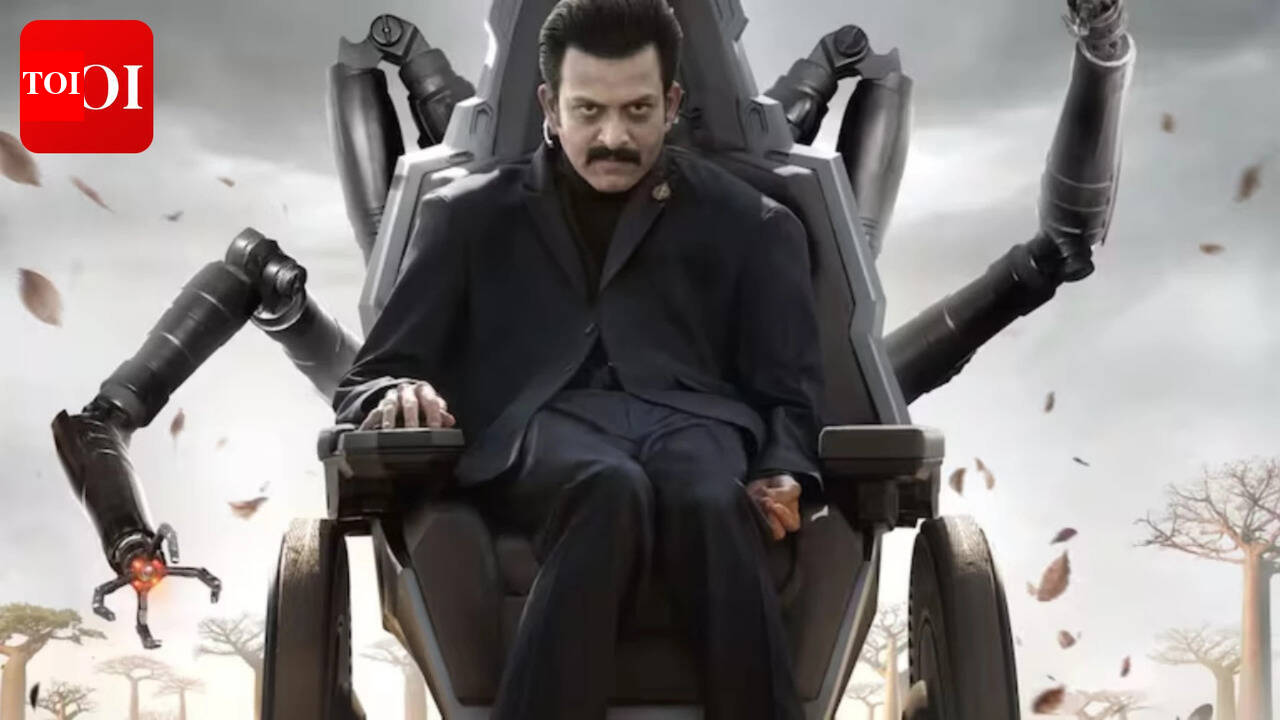
Malayalam star Prithviraj Sukumaran has completed his schedule for SS Rajamouli’s epic ‘Varanasi’, where he plays the villain Kumbha opposite Mahesh Babu. They celebrated with a delicious prawn masala feast. Rajamouli personally contacted Prithviraj and praised the antagonist role as one of his finest creations.

malayalam superstar Prithviraj Sukumaran Kumbha will play the lead villain in SS Rajamouli’s epic ‘Varanasi’. they will fight each other Mahesh Babu The actor has been working tirelessly on the film Globetrotter and for this role. Recently he shared that he has completed shooting his portion for the schedule.

Prithviraj Sukumaran enjoys a feast after hard work

Prithviraj Sukumaran took to his Instagram handle to share that he has completed a part of the film and is rewarding himself with a nice reward. He shared a photo of his meal and wrote, “End of the schedule I’ve worked so hard for. Cheat meal paid off well. See you in theatres, April 7, 2027. #Varanasi.”view instagram story

instagram story

The actor’s food looked very tasty and rich. It had prawn masala with fried cashew nuts and green chillies. There was also a big celebration of rice. It looked like a perfect dish after several days of hard work. He also thanked “Narayan Garu” for sending this special food.

How did Rajamouli bring Prithviraj with him?

Earlier, during the title launch of the film at Ramoji Film City in Hyderabad in November, Prithviraj Sukumaran had shared the story behind his joining the film. He told that the ‘RRR’ director called him and said, “Hi Prithvi, this is SS Rajamouli. The villain in my next film has come out very well, it is one of the best characters I have thought of. Would you be interested?” He said. He also described his first meeting with Rajamouli in the director’s office with the famous German Shepherd. He shared that he narrated the script to him and he was amazed in the first five minutes. He further added, “How does one think like this where you get the inspiration to portray something like this? Remember what I told you about 5 minutes, you can come back the day the film releases.” He further concluded by saying, “This is SS Rajamouli and his team taking over once again indian cinema “On the global stage, this time bigger, bolder and more daring than ever before.”

Release date of ‘Varanasi’

‘Varanasi’ stars Mahesh Babu and Prika Chopra, marking her much-awaited comeback to Indian cinema.The film will be released in theaters on April 7, 2027.

Source link

Mohan Bhagwat: Public awareness like Ram Temple is needed to stop cow slaughter: Mohan Bhagwat. india news

गोहत्या बंद करने के लिए राम मंदिर जैसे जनजागरण की जरूरत: मोहन भागवत

There is a need for public awareness like Ram temple to stop cow slaughter: Mohan Bhagwat

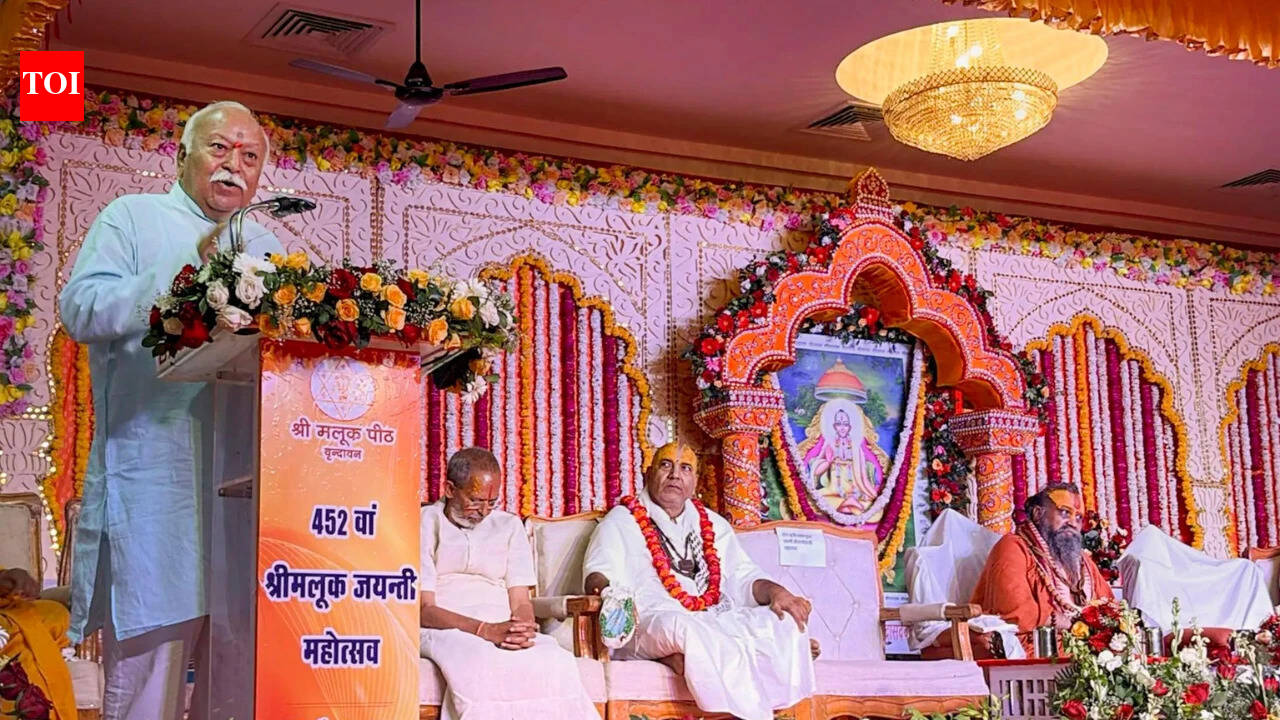
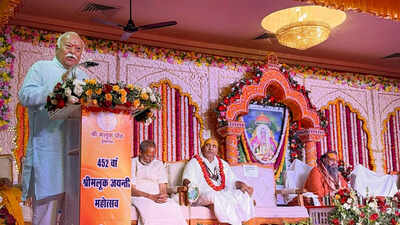
Mathura: RSS chairman Mohan Bhagwat Tuesday said public awareness could help end cow slaughter in India, and wished for a Ram Temple-style enthusiasm for the cause.“Make the society dedicated to cows, and cow slaughter will stop immediately. We have to make the public aware; The rest will follow,” Bhagwat said.He acknowledged the constraints of keeping cows in cities and suggested people support ‘gaushalas’ instead.The Rashtriya Swayamsevak Sangh (RSS) chief was speaking on the 452nd birth anniversary of Maluk Das Ji Maharaj at Maluk Peeth in Vrindavan.“If public sentiment exists, the system has to accept it,” he said.Bhagwat referred to the historic judgment of the Supreme Court which paved the way for the construction of Ram Janmabhoomi temple in Ayodhya.He said, “Ram temple did not come between 2014 and 2019. It came after 2019. Why? The Supreme Court, which said it had other very important matters, gave a unanimous verdict.”Bhagwat said the top court gave this decision due to the “sentiments” of the entire country. “Similarly, the same feeling should be shown for the cows also. You are also trying, we are also trying.” The decades-long struggle for the Ram temple in Ayodhya ended with the Supreme Court’s decision in 2019.A ‘Bhoomi Pujan’ ritual was conducted at the temple construction site in the presence of Prime Minister Narendra Modi in August 2020, followed by a ‘Pran Pratishtha’ ceremony in January 2024.According to a statement released by the organizers after the event, Bhagwat said he has no doubt that India will become a world leader.Bhagwat said, “India will provide a new direction to the world by taking inspiration from its saints and its spiritual values.”On unrest in West Asia, the RSS chief said the time has come for “India to emerge as a ‘Vishwa Guru’ and create a new, happy and beautiful world.” Bhagwat stressed the need for enlightenment for all and urged people to follow not only the words of the saints but also the feelings underlying them.He said that Maluk Peeth kept the tradition of Sant Maluk Das alive for 452 years. Everyone should learn the philosophy of life from this example.He said, “There cannot be (any) religion without truth and compassion. All must live in harmony. Compassion enters one’s life when the suffering of others feels like one’s own suffering.”Responding to Mahant Rajendra Das Maharaj’s demand for a complete ban on cow slaughter, Bhagwat said that make the society cow devotees, cow slaughter will automatically stop.He said, “Strengthen… This will be a bold step. Cow products will be made available to every single person. The Sangh will work in this direction.”

Source link

Macaulay’s children are triggered because Pujarini Pradhan, from Medinipur, didn’t ask for permission to think, and speak English |

Macaulay's children are triggered because Pujarini Pradhan, from Medinipur, didn’t ask for permission to think, and speak English

The controversy surrounding Pujarini Pradhan, better known as @Lifeofpuja on Instagram (with 751K followers), reminded me of a peculiar exchange in a cab about 18 years ago. The year was 2008. Author Salman Rushdie had won the ‘Best of Booker’ Prize, and newsrooms all over New Delhi, and the whole world, were abuzz. More than usual. This was the day after the news made headlines. After shifts got over, we were talking about the immense feat of the Indian-born British author (he hadn’t taken his American citizenship at the time) and waiting for Jha ji, the commander of the fleet of cabs that ferried journalists home at night.Jha ji was our favourite. He remembered all our names, and was a father figure for all of us who had come from different cities to make Delhi home, and quietly missed the elders we had left behind. He was in his mid-50s and we were mostly early-20-somethings. He had a baritone Bollywood would envy, and soft yet wise eyes that would smile but never tolerate any nonsense. He respected us, and took pride in ensuring every journalist — possibly his children’s age — reached home safely.Two minutes into the cab ride, we started discussing Rushdie’s feat, our headlines, our copies, the usual. Jha ji, as he sometimes did, joined the conversation. “Kaisi hai unki kitaab?” (How is his book?) he asked, referring to Midnight’s Children, which had won Rushdie his first Man Booker in 1981. A recent joinee, barely a few weeks into the job, turned to him and asked: “Aap jaante bhi ho Salman Rushdie kaun hai, Jha ji?” (Do you even know who Rushdie is?)Our driver was so stunned he actually slowed the car, looked back, and said quietly: “Haan, unko ‘Best of Booker’ mila hai. Akhbaar hum bhi padhte hain, waise. Hindi akhbaar. Usme bhi duniya ki khabar milti hai.” (Yes, he’s being awarded ‘Best of Booker’. I, too, read a newspaper. In Hindi. There’s world news covered in Hindi newspapers too)Pin-drop silence for the rest of the ride. But one thing was unmistakable: Jha ji was hurt. Hurt that a few kids he respected would think so little of him.Why did this person think less of Jha ji? Was it because he assumed knowledge and intellect were the exclusive preserve of the convent-educated, English-speaking middle class and above? Did it not occur to him that newspapers are published in every Indian language, and that the world arrives in people’s homes in many tongues? Was it foolishness, naivety, arrogance or some seamless, unreflective amalgam of all three?Which brings us to Pujarini. The controversy erupted while Pradhan was busy cutting vegetables, making videos, and talking about everything from menstrual leave to Stanley Kubrick, from why she wears a ghunghat while calling herself a feminist to Satyajit Ray. All in the same breath, with an ease and clarity of thought that is genuinely rare. And she does it in English. Not the impeccable, urban-approved, Macaulayan English that unlocks professional doors in Delhi or Mumbai, but English spoken with the unmistakable accent of someone who grew up in rural West Bengal and has absolutely no apology to offer for it. She is from Medinipur, to be precise. Urban India has a word for this kind of English: desi. Or ghati. The contempt is baked into the vocabulary itself.We may have reached the far side of the moon, Artemis 2, a first for humankind as evidence of just how far the human mind can stretch when it dares to dream. And yet that same brain remains perfectly capable of dragging others down simply to feel taller by comparison. Schadenfreude is as old as hunger. So is ignorance. We cannot always achieve something to feel superior, so we find the next best thing: diminishing someone else. Is she even real? How does she have access to international cinema? How can a rural woman edit her own content? As if curiosity has a postcode. As if Ray and Kubrick belong only to those with a metropolitan address and a particular vowel formation.This is not merely “influencer drama.” It is a sociological case study, a live demonstration of how urban Indians, conditioned by a colonial legacy that was never quite dismantled, continue to weaponise the English language to exclude and delegitimise voices that do not conform to metropolitan standards of aesthetics or articulation. It is the person in the cab, replicated across a thousand comment sections.When influencers like Niharika Jain and Aishwarya Subramanium accused Pujarini of being inauthentic, the accusation wasn’t really about authenticity. It was about register. About the unsettling dissonance they felt watching someone analyse Pather Panchali in an accent they had been trained—socially, culturally, almost genetically at this point—to associate with the domestic help rather than the film critic. The outrage wasn’t intellectual. It was hierarchical.To understand why Pradhan’s accent caused what some breathlessly called an “internet meltdown,” you have to go back to 1835 and Thomas Babington Macaulay’s infamous Minute on Education: a document that set out, with remarkable candour, to manufacture a class of Indians who were Indian in blood but English in taste, opinion, and intellect. Intermediaries. A buffer class that would administer an empire and, long after that empire crumbled, would continue to administer its values. What Macaulay built wasn’t just a school system. It was a self-replicating hierarchy of credibility, and nearly two centuries later, it runs on autopilot, maintained not by British colonisers but by their most devoted inheritors.
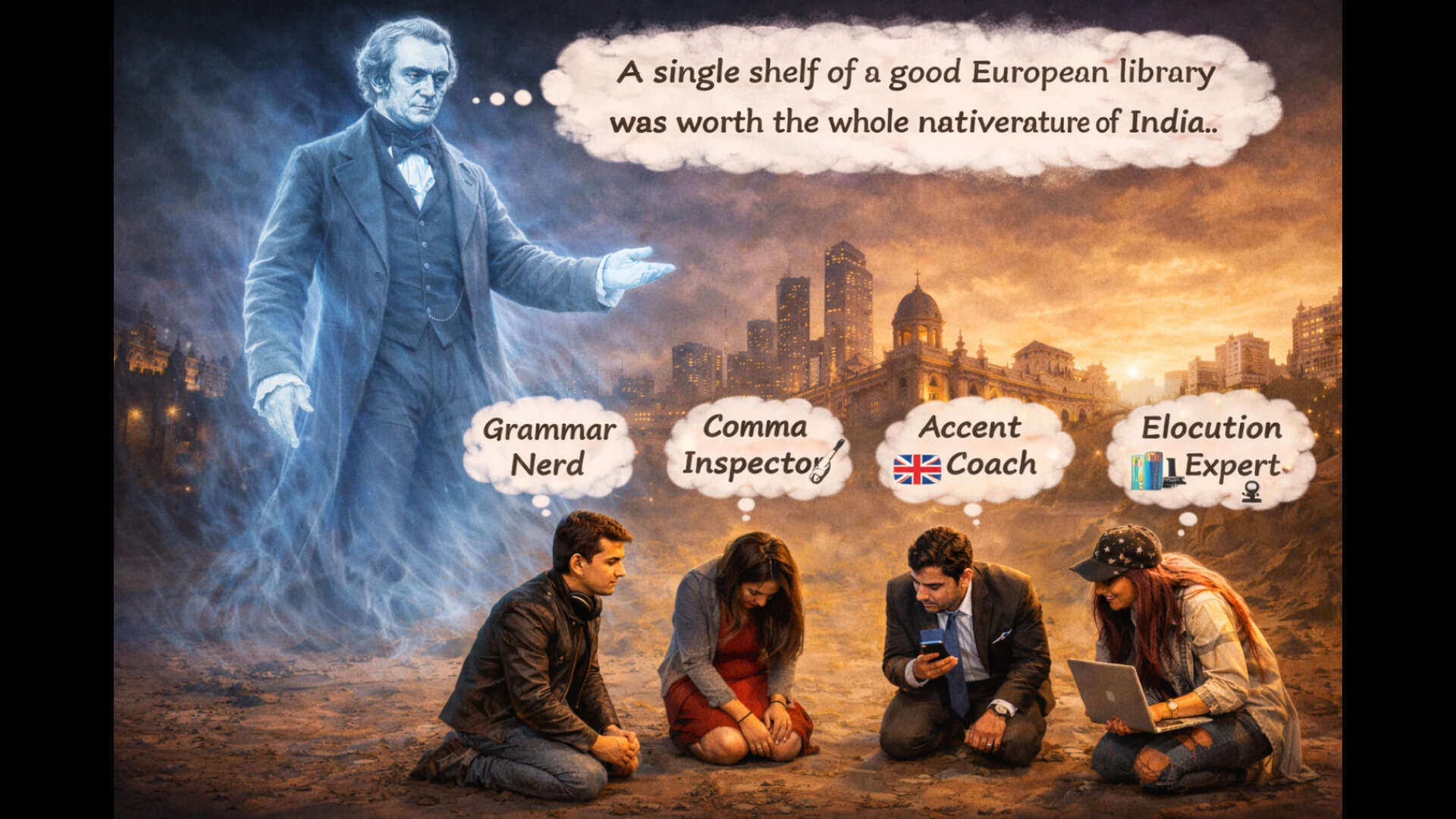
Macaulay's spectral influence on modern India

The ‘Macaulayan ghost’ haunts corporate offices and social media platforms with equal comfort. You’ll find it in the colleague who switches to English mid-meeting to subtly reassert authority, in the recruiter who mistakes fluency for intelligence, in the comment that says “at least learn to speak properly before having opinions”

The ‘Macaulayan ghost’ haunts corporate offices and social media platforms with equal comfort. You’ll find it in the colleague who switches to English mid-meeting to subtly reassert authority, in the recruiter who mistakes fluency for intelligence, in the comment that says “at least learn to speak properly before having opinions”. As if grammar were a prerequisite for thought. These are people who genuinely need a Prozac to recover from the Oxford Comma becoming history.

Community response to structural bias

What makes this more than a social media spat is that the bias Pujarini encountered isn’t just human — it’s infrastructural. Research into digital access in India reveals that over 53% of students from non-metro backgrounds believe their accent or mother tongue actively works against them when interacting with technology. They practise what researchers call “linguistic self-censorship”—consciously avoiding cultural references, flattening their speech, editing themselves before they even begin—to avoid being penalised by systems calibrated to a “standard” English that was never theirs to begin with. When urban influencers questioned Pujarini’s authenticity, they were doing the same thing, just without an algorithm. They became the algorithm, human proxies enforcing a standard that has no business being a standard, deciding who gets to be taken seriously and who needs to prove themselves first.What the accusers didn’t anticipate was the wall they ran into. The backlash against the backlash was swift, sharp, and surprisingly precise. Particularly from the Bengali community and from anti-caste voices who identified, almost immediately, what was really being said. People noted that the “savarna feminist” solidarity on display had a hidden clause: it extended only to those who cleared a certain socio-economic bar. “Bangali meye ra shob paare (Bengali girls can do anything)” became something of a rallying cry, less about regional pride than about collective refusal. What emerged wasn’t just defence of one creator; it was a reckoning with the particular cruelty of being told you don’t belong in a conversation you walked into on your own, with nothing but curiosity and years of quietly paying attention.There was one moment in all of this that cut through everything else. When critics pointed to the quality of her editing and colour grading as proof she couldn’t possibly be working alone, Pujarini’s response was three words: “Like it’s hard?”, a reference to Legally Blonde that was, in itself, a small act of cultural warfare. She wasn’t being dismissive. She was making a precise point: these are learnable skills, available to anyone with internet access and patience. The assumption of hidden expertise behind her work said far more about her critics than about her. They had tried to use her competence against her. She turned it around and made competence sound like the most ordinary thing in the world. Because for her generation, it is.

Pujarini is refusing to perform suffering

Perhaps the most revealing thread in the entire controversy is what Pujarini didn’t do. She didn’t display hardship. She didn’t frame her life as a struggle to be overcome or a condition to be pitied. Her videos are unhurried — moringa pakodas, a handcrafted toothbrush holder, opinions on Kubrick delivered while chopping vegetables. And this, it turns out, was the quiet provocation at the heart of everything. Urban audiences have been conditioned to receive rural India as a site of suffering, a moral project, a place that needs saving. A rural woman who is simply happy, articulate, financially independent, and entirely uninterested in your sympathy doesn’t fit that frame. She doesn’t give the elite the psychological foothold of feeling superior. As she put it herself: “They want me to see suffering in every video. They want me to see sad.” By refusing to perform poverty, she became, in their eyes, suspicious. Which tells you everything about whose comfort the narrative was always designed to protect.

What Pujarini actually represents and why that’s threatening…

The deeper discomfort isn’t that she speaks imperfect English. It’s that she speaks it anyway. Unselfconsciously, without the apologetic hedging that the hierarchy demands of those it considers outsiders. She hasn’t sought permission. She hasn’t code-switched to earn legitimacy. She picked up the language, the cinema, the discourse, and walked straight in through the front door and the gatekeepers are livid precisely because there was no gate to stop her.This is the thing about the internet that its early evangelists got right and its critics underestimated: it is, at its best, genuinely indifferent to your accent. A YouTube algorithm does not ask where you are from. A film doesn’t reveal its meaning only to those who watched it in a multiplex. Knowledge has always found ways around the walls built to contain it. Real, curious, hungry knowledge. Jha ji read the Hindi newspaper. Pujarini watched The Shining in Medinipur. The walls were never as tall as their builders believed.What we are witnessing, in the fury directed at her, is not a culture war about authenticity. It is the sound of a particular class realising, with mounting dread, that the thing they mistook for intelligence was always just access. And access, it turns out, is no longer entirely theirs to control.

Who is lifeofpujaa Meet Pujarini Pradhan, the viral 'village girl' with Netflix and Audible collabs, facing backlash for being 'too articulate'

Photo: @lifeofpujaa/ Instagram

What’s the Pujarini Pradhan controversy all about?

Influencer Niharika Jain and former fashion editor Aishwarya Subramanyam, also known as @otherwarya accused Pujarini Pradhan @lifeofpuja of being “inauthentic”, “manufactured” and siad she was possibly an “industry plant”. Actress Samantha Ruth Prabhu, who played the fiery Sri Lankan Tamil liberation rebel in ‘The Family Man’, liked the reel questioning Pradhan’s authenticity. Director Kiran Rao, known for ‘Laapata Ladies’, liked the reel by Otherwarya too. Given Rao’s public stance on inclusivity, it was disappointing. But it was also ironic because ‘Laapata Ladies’ is a story of rural women breaking barriers by using their wit while fighting social stigma. But the accusation backfired as more people on social media defended her, calling out the hypocrisy of urban creators and influencers. She also got support from director Vikramaditya Motwane, director Gunnet Monga, actor Archana Puran Singh and influencer Kusha Kapila, among others.


Source link

Adyar residents demand improvement in infrastructure ahead of Tamil Nadu elections. chennai news

तमिलनाडु चुनाव: अड्यार उम्मीदवारों के लिए मांग सूची जारी

Edappadi K. Palaniswami, a prominent political leader of Tamil Nadu

Chennai: Upgraded sewer lines, widening of Canal Bank Road, replacement of damaged transformers and streetlights are among the demands put forward by 5,000 residents of Kasturba Nagar in Adyar for the upcoming elections.Their primary concern is being unable to move freely due to encroachment on Canal Bank Road and Kamaraj Avenue between First Street and Old Mahabalipuram Road. 2022 Madras High Court order directed removal of encroachments, but Canal Bank Road received no relief. D Radhakrishnan of 4th Main Road said, “Most of the encroachments have developed into houses. There are also many eateries, resulting in parking of two-wheelers reducing the road space for pedestrians.” The presence of Tasmac on the stretch adds to the problems. Other demands include replacement of the damaged transformer on 8th Main Road, which causes frequent power outages, and replacement of malfunctioning CCTV cameras and lights. “We have prepared a list of these demands and will submit them to the candidates contesting in this election,” said D Balaji, vice president of Kasturba Nagar South Residents Welfare Association.Residents of other prominent nearby areas including Gandhi Nagar and Indira Nagar also said the same. A common demand is to replace sewer pipelines laid 30 years ago. K Aditya of Indira Nagar said, “Earlier, most of the residences were independent houses. Now, they have turned into flats with four times the number of residents. The pipelines cannot take the load.”

Source link

Microsoft responded to viral claims over the language of Copilot’s terms of service; Says: The phrase ‘entertainment purposes’ is…

Microsoft responded to viral claims over the language of Copilot's terms of service; Says: The phrase 'entertainment purposes' is...

Microsoft has now clarified that its Co-Pilot terms of use highlighted a clause stating the AI ​​tool is “for entertainment purposes only” after the viral post. The phrase, seemingly inconsistent with the way the company has marketed Copilot as a productivity and enterprise solution, immediately gained attention online and raised questions about Microsoft’s confidence in its flagship AI product.

Microsoft explains role of legacy language in viral controversy

In a statement first published by PCMag, a Microsoft spokesperson explained: “The phrase ‘entertainment purposes’ is legacy language from when Copilot originally launched as a search companion service in Bing. As the product has evolved, that language no longer reflects how Copilot is used today and will be replaced with our next update.”The company further stressed that CoPilot’s current role as integrated into Microsoft 365 and enterprise workflows goes far beyond entertainment. CEO Satya Nadella recently praised Copilot’s accuracy and latency during a January earnings call, underscoring its importance to Microsoft’s AI strategy.

How competitors build their AI tools

Microsoft’s terminology is different than that of rivals. OpenAI, Anthropic, Meta and XAI all include disclaimers about AI limitations but avoid the phrase “entertainment purposes”. For example, OpenAI’s terms warn users not to rely on outputs as the sole source of truth, while META explicitly prohibits using AI outputs for regulated activities such as medical or financial advice. Elon Musk’s xAI goes further, requiring users to indemnify the company against liability.The “Entertainment” section dates back to the initial Bing Chat terms in 2023, before Microsoft rebranded the service as Copilot. Observers say bizarre disclaimers are not new to Microsoft – some have pointed to humorous provisions in previous software licenses, including Windows NT of the 1990s.

Source link