


From election defeat to ministerial resignations: why is Keir Starmer in trouble? All frequently asked questions answered
 The crisis deepened on Tuesday when three ministers from Starmer’s own government resigned within hours of each other, a moment many Labor insiders described as the most serious threat yet to Starmer’s leadership.The resignations exposed deep rifts inside the ruling party and fueled speculation over whether Britain could soon see another change at No. 10 Downing Street.Miata Fahnbulla, the Communities Minister and MP for Peckham, became the first minister of the Starmer administration to openly resign over concerns about the direction of the government.He urged Starmer to “do the right thing for the country and the party and set a timetable for an orderly transition.”Soon after, Jess Phillips, one of Labour’s most recognizable voices and Home Office minister, also stepped down, saying she was frustrated by the government’s inability to act decisively.In her resignation letter, Phillips said she was “tired of seeing opportunities for progress stalled and delayed,” adding that Starmer’s reluctance to embrace bold reforms was becoming politically damaging.Alex Davis-Jones, Minister for Victims of Violence Against Women and Girls, arrived shortly afterwards.He pointed to Labour’s “disastrous” election defeat and warned that the party had lost voter confidence.But the local election defeat is not the only reason behind the growing ‘Labour pain’ around Starmer.There have been calls for Peter Mandelson’s resignation for weeks following the controversy surrounding the appointment of Peter Mandelson as Britain’s ambassador to Washington.Critics accused Starmer of ignoring concerns over Mandelson’s long-known relationship with disgraced financier Jeffrey Epstein, fueling allegations of poor judgment at the top of the government.At the same time, Labor is also struggling to stem the rise of Nigel Farage’s Reform UK, which has steadily eroded the party’s traditional working-class support base in northern England and the Midlands.As Starmer faces the biggest political crisis of his prime ministership so far, here are answers to the top frequently asked questions:
Why is Keir Starmer facing demands for resignation?
The immediate trigger was Labour’s disastrous performance in local and devolved elections across Britain. Party MPs fear the results have exposed deep divisions between the Labor leadership and voters, despite the party returning to power with an overwhelming mandate in 2024.Many MPs are concerned that if this trend continues, the Labor Party may face a humiliating defeat in the next general election.Internal anger intensified after several ministers and aides resigned, while more than 80 MPs publicly or privately urged Starmer to step down or announce plans to step down.The Mandelson controversy further increased the pressure. Critics within Labor argued that Starmer’s handling of the controversy undermined the party’s promise of professionalism and clean governance.Economic concerns have further weakened confidence. Britain’s sluggish growth, weak consumer spending and increasing political instability have raised concerns within Labor ranks about whether Starmer can regain public confidence.
What happens if Starmer resigns?
If Starmer voluntarily steps down, Labor will launch a formal leadership contest to choose a new party leader, who will automatically become the next Prime Minister of Britain as Labor still has a parliamentary majority.The leadership contest will likely lead to talks between labor groups, trade unions and senior ministers over the future direction of the government.Britain has seen rapid leadership churn in recent years, with six prime ministers in almost a decade.
Can Starmer be forced out?
Yes, but labor has a structured process.A challenger would need the support of at least 20 percent of Labor MPs to formally trigger a leadership contest. The Labor Party currently has 403 seats in Parliament, meaning at least 81 MPs would have to support a challenger.So far, several MPs have called for Starmer to resign, but no rival has garnered enough support to officially launch a direct challenge.If multiple candidates enter the race, labor members and affiliated organizations, including trade unions, will vote to decide the winner.
How has Starmer responded to the rebellion?
Starmer has refused to step down and insists he will “keep fighting.”Addressing his cabinet following the resignations and mounting pressure, Starmer accepted responsibility for Labour’s election defeat, but argued that the formal threshold for a leadership challenge had not been met.“The country expects us to continue to govern,” he told ministers.Starmer aides say they believe voters still want Labor to deliver on its promises rather than descend into another leadership contest.
If Starmer leaves, who can replace him?
Several senior Labor figures are already being discussed internally as potential successors.Health Secretary Wes Streeting is seen by many as a strong contender due to his visibility and appeal among centrist Labor MPs.Deputy Prime Minister David Lammy and Home Secretary Yvette Cooper are also seen as influential figures with strong cabinet profiles.Some within the party believe that Labor may move further to the right politically to counter the rising popularity of Nigel Farage and Reform UK.However, so far no candidate has launched an open campaign against Starmer.
Why is the rise of Reform UK worrying Labour?
Nigel Farage’s reform has emerged as one of UK Labour’s biggest political headaches.The party has gained support among working-class voters in Northern England and the Midlands: areas that traditionally form Labour’s main electoral base.Many Labor MPs fear that Starmer’s cautious and technocratic leadership style has failed to excite voters, allowing Reform UK to exploit frustrations over immigration, the economy and public services.
Can Starmer survive this crisis?
Yes for now.Despite the resignations and growing rebellion, Starmer still has the support of parts of the cabinet and a large number of Labor MPs. Importantly, no formal leadership challenge has yet crossed the necessary threshold.But political pressure is increasing rapidly. With resignations rising, public polling worsening and labor divisions increasingly visible, the coming weeks could be crucial for Starmer’s leadership.

Indian engineer blamed for Maryland bridge accident in US, six construction workers killed in 2024

In 2024, a 900-foot ship collided with the Francis Scott Key Bridge in Dalry, Maryland. Six employees were killed.
Two companies, one Indian and the other from Singapore, and an Indian engineer have been accused of conspiring to defraud the US and cause the deaths of six construction workers in 2024. On March 26, 2024, Dali, a 900-foot container ship registered in Singapore, collided with a bridge and crashed. Radhakrishnan Karthik Nair, 47, who was Dali’s technical superintendent, worked at both Singapore-based Synergy Marine Pte Ltd and Chennai, India-based Synergy Maritime Pte Ltd.The US accused the three entities of conspiracy, willful failure to promptly notify the US Coast Guard of a known dangerous situation, obstruction of agency proceedings, and making false statements.The Justice Department said both companies have been charged with violations of the Clean Water Act, Oil Pollution Act and Refusal Act for discharging pollutants into the Patapsco River, including from shipping containers and their contents, oil and the bridge.
US says it was a preventable tragedy
Acting Attorney General Todd Blanch said the Francis Scott Key Bridge collapse was a preventable tragedy of large scale. Six construction workers lost their lives, critical infrastructure was destroyed, pollutants were released into the Patapsco River and Chesapeake Bay, and economic damages now exceed five billion dollars. The department is committed to providing justice to the victims and ensuring action against those responsible.“
how did the accident happen
According to the indictment, the Dali lost power twice in four minutes while heading out to sea from the Port of Baltimore, causing it to crash into the Key Bridge. A loose wire in a high-voltage switchboard probably caused the first power loss. Critical systems on DALI were originally designed with reliable redundancy and automatic restart capabilities, so that DALI could quickly regain power after a blackout.But shortly after the ship’s power was restored, it lost power again.According to the indictment, the accused allegedly altered the vessel and relied on a flushing pump to supply fuel to two of Dali’s four generators. However, the flushing pumps were not designed to restart automatically after a blackout, and Dali’s generators could not operate without a fuel supply, so the ship eventually experienced a second blackout. The indictment alleged that if Dali had used the proper fuel supply pumps, the ship would have received power in time to navigate safely under the Key Bridge.

If a company changes its CEO…: Indian-origin tech leader says he supports billionaire Michael Milken’s idea

Billionaire Michael Milken had earlier said that if a company appoints an Indian-origin CEO in place of an American CEO, he buys its stock.
Indian-origin tech leader Deddy (Debarghya Das) shares what billionaire Michael Milken said about Indian-origin CEOs replacing US-born CEOs in American companies and presents the results, sparking a huge social media debate. Milken had earlier said that if an American company replaced an American-born CEO with an Indian-born CEO, he would buy the stock. Das said he supported the idea. “Over the last 15 years, this would have grown your money 50x: 7.5x more $$ and >2x IRR vs. S&P500: 30% vs. 14%!” Das concluded.As the findings sparked debate over Indian-origin leadership of tech companies, Das said it was just a correlation he observed and did not establish that stocks rose because of Indian-origin leaders.Reactions to the post were mixed as many claimed it was just a coincidence and that one should also look at companies founded by Indian-origin tech leaders.One wrote, “The Indian-born/immigrant executives who run major American companies are usually the ones who had to overcome awkward hurdles at every level, from school, to jobs, to immigration, to promotion. The insight is very simple: If America lets the best people in from everywhere come, American companies win.”Another wrote, “The first thing they start doing is cutting American jobs and offshoring or automating them. Good for the company but this has been going on for 50 years. How long will this be allowed to happen before businesses realize that when Americans don’t have money, they don’t buy anything.”A third user wrote, “The stock price did not rise through innovation but because they did massive layoffs, outsourcing and salary cuts. It’s been 2 decades now. All those companies have been producing waste and dying because of their inefficiency.”Another wrote, “Now the companies are started by Indians. Not companies whose monopoly has been created by the previous CEO. Monkeys could have run the companies mentioned when they reached the size after the CEO took over.”

160 million year old ‘technicolor’ dinosaur fossil with four wings and bird-like feathers discovered in China.

For years, the development of flight seemed quite simple. Dinosaurs developed feathers, learned to fly to some extent, and eventually, birds appeared and mastered the sky. Now, a strange fossil from China is forcing scientists to rethink that neat timeline. The feathered dinosaur Anchiornis huxleyi reportedly had four wings, colorful feathers and a surprisingly messy moulting pattern that suggests it would not have been capable of proper flight.Experts say this indicates that some dinosaurs may have evolved flight-related characteristics and later lost the ability entirely. Something like a modern ostrich or penguin. The fossil has also been described as the first true “technicolor” dinosaur discovery because traces of its original feather pattern were preserved in remarkable detail. And honestly, it seems almost impossible that color could survive for 160 million years.
Fossil of four-winged dinosaur discovered in China that changed the way birds flew
The research focuses on nine fossils discovered in eastern China that belong to Anchiornis huxleyi, a small feathered dinosaur that lived about 160 million years ago. Scientists already knew that this species was unusual because it had long feathers not only on its arms, but also on its legs. Which basically gave it four wings.Obviously, there are no four wings in the sense of an insect. Nevertheless, the structure appears to have facilitated gliding or aerial movement in some way. Researchers believe that these dinosaurs belonged to a larger group called Pennaraptora, which later gave rise to modern birds.Feather fossils are already extremely rare. Feathers decay quickly, so it is quite unusual to find a preserved feather. Finding fossils that still show the color patterns is on a whole other level. The wings of Anchiornis huxleyi reportedly appeared mostly white with pronounced black tips on the edges of the wings. Scientists say those patterns helped them identify which feathers were old and which were still growing.According to Earth.com, Dr. Yosef Kiat of Tel Aviv University explained that feathers grow for a few weeks before turning into dead material. Over time, they degrade and are replaced in a process called molting.Birds that rely heavily on flight usually moult carefully and symmetrically. They cannot afford to lose too many flight feathers at once, otherwise flying becomes difficult. Flightless birds molt in a more disorganized manner because being in the air is no longer necessary.
How these ancient feathers confounded researchers
The preserved black spots created a surprisingly clear map of the dinosaur’s feathers. Scientists noticed that some of the new feathers did not line up properly with others.That uneven growth pattern appears to indicate that the dinosaur was moulting randomly rather than in a controlled sequence. According to the researchers, the molting pattern strongly points to the fact that Anchiornis huxleyi is largely flightless, despite having a feather-like structure and elaborate wings.For decades, feathers and wings were often regarded as signs of steady progress toward modern birds. This fossil indicates that evolution may have been very messy. Some dinosaurs may have experimented with flight, partially succeeding, but later lost the ability when the environment changed.
Rare fossil that revealed the hidden side of evolution
This discovery could reshape scientists’ thinking about the origin of bird flight. Experts suggest that there may have been several different attempts to develop flight among feathered dinosaurs. Some lineages survived and improved. Others possibly stopped or moved backwards.Modern birds present similar examples even today. Ostriches, emus and penguins are all descended from flying ancestors but no longer fly themselves. Penguins instead turned their feathers into underwater tools.Still, it is rare to see evidence of it in fossils so old. Particularly through the color of the feathers being preserved rather than just the bones. Dr. Kiat reportedly said that feather colors allow scientists to identify behavior and functionality, not just physical appearance. In other words, the fossil revealed how the animal might have lived, not just what it looked like.

World’s deadliest snake: King Cobra Capitals: 10 countries where the world’s deadliest snake thrives world News

The king cobra is one of the most dangerous and scientifically fascinating reptiles on Earth. Recognized as the world’s longest venomous snake, it can grow more than 18 feet and release powerful neurotoxic venom capable of killing larger animals. Despite its deadly reputation, this species is naturally shy and generally avoids confrontation with humans. King cobras inhabit the forests, bamboo groves, mangroves and wetlands of South and Southeast Asia, where warm temperatures and dense vegetation create ideal conditions for hunting. Although exact population numbers are difficult to measure, several countries are considered major strongholds for the species, supporting some of the most important king cobra habitats in the world.
top 10 countries With a significant population of king cobras.
IndiaIndia is considered one of the most important king cobra habitats in the world. This species is found in the Western Ghats, Northeast India, the Himalayan foothills and the Andaman Islands. Dense rainforests, heavy monsoon conditions and abundant prey make these areas ideal for survival.The Agumbe Rainforest in Karnataka is particularly famous and is often referred to as the “King Cobra Capital of India”. Scientists at the Agumbe Rainforest Research Station have tracked and studied king cobras for years, helping researchers better understand their movements, nesting habits and territorial behavior.India is also unique because here female king cobras have been seen making nests out of leaves and forest debris before laying eggs. This behavior is extremely rare in snakes.ThailandThailand has one of the most visible and stable king cobra populations in Southeast Asia. This species thrives in tropical forests, agricultural edges, wetlands and bamboo thickets throughout the country.Thailand is famous for wildlife rescue teams that often relocate king cobras found in villages and near roads. In some parts of the country, trained handlers and snake conservationists work closely with local communities to reduce fatal encounters.The snake also appears in Thai folklore and traditional beliefs, where it is often viewed with both fear and respect.

IndonesiaIndonesia supports major populations of king cobras due to its vast rainforest systems spanning thousands of islands. This species is found in Sumatra, Java, Bali and Kalimantan in Borneo.Indonesia’s humid tropical climate provides ideal conditions for the king cobra to hunt reptiles and small snakes. The dense forest cover also helps them remain hidden from predators and humans.Scientists believe that some island populations may show physical and behavioral differences due to long-term geographic isolation.malaysiaMalaysia is another major habitat of the king cobra, particularly in the forests of Peninsular Malaysia and Borneo. This species is commonly associated with rainforest ecosystems, river banks, swamps and mangrove forests.Malaysia’s rich biodiversity gives the king cobra access to a wide range of prey species. They are considered apex reptile predators and play an important ecological role by controlling snake populations in the forests.This species is frequently documented in wildlife sanctuaries such as Taman Negara, one of the oldest rainforests in the world.myanmarMyanmar forms an important link in the chain of king cobras between India and mainland Southeast Asia. Large tracts of forest and hilly terrain provide suitable habitat for the species.Although Myanmar has been less studied than neighboring countries, researchers believe there may be significant populations of king cobras in its forests because many areas remain relatively untouched.The country’s biodiversity hotspots are also home to several other venomous snake species, forming a rich reptile ecosystem.

bangladeshBangladesh The king cobra mainly inhabits forested areas and hilly areas such as the Chittagong Hill Tracts and Sylhet forests.This species is rarely seen due to its secretive behaviour, but occasional sightings are reported near forest villages and tea plantation areas.Bangladesh’s tropical climate and dense vegetation provide suitable hunting conditions for the snake, although habitat loss remains a growing concern.NepalThe king cobra population in Nepal is mainly in the hot Terai region and the foothills of the lower Himalayas. The snake is uncommon in cold mountainous regions but survives well in subtropical forests and grassland ecosystems.King cobras in Nepal are often associated with protected areas and forest corridors associated with northern habitats in India.The species also holds cultural significance in parts of Nepal, where cobras are associated with traditional religious beliefs and festivals.vietnamVietnam remains an important habitat for the king cobra, particularly in tropical forests and protected reserves across the country.Vietnam has long faced challenges from the illegal wildlife trade, and king cobras are sometimes targeted for snake wine, exotic meat markets, and traditional medicine practices.Conservation groups have warned that habitat destruction and poaching could threaten local populations if protection is not strengthened.cambodiaCambodia supports king cobra populations in tropical forests, wetlands and remote wildlife sanctuaries.The snake plays an important role in Cambodia’s ecosystem by controlling populations of rodents and other snakes. Many of the king cobra’s habitats overlap with protected forests that also shelter elephants, clouded leopards, and rare bird species.Wildlife experts continue to study how deforestation is affecting reptile populations across the country.ChinaChina represents the northern edge of the king cobra’s natural range. This species is found mainly in southern provinces such as Yunnan, Guangxi, Guangdong, Hainan and parts of Hong Kong.The hot and humid forests of southern China allow the king cobra to survive despite the cooler climate further north.Chinese researchers have increasingly focused on the study of king cobra venom because of its complex neurotoxin and potential medical applications.Why are king cobras so unique?Unlike true cobras, the king cobra belongs to its own genus Ophiophagus, which means “snake eater”. Its diet consists mainly of other snakes, including rat snakes, pythons, kraits, and even small cobras.This species is highly intelligent compared to many reptiles and is known for its strong defensive behavior. When threatened, it can raise about one-third of its body off the ground, spread its hood and produce a deep snarling hiss.King cobras are also one of the few snake species where females actively guard their nests until the eggs hatch.
Are king cobras endangered?
The king cobra is currently listed as vulnerable by the International Union for Conservation of Nature. Habitat destruction, deforestation, road accidents, illegal wildlife trade and human conflict are decimating populations throughout Asia.As forests shrink and urban areas expand, encounters between humans and king cobras are becoming more common. Wildlife conservation groups in India and Southeast Asia are now working to protect forest corridors and educate communities about safe coexistence with one of the world’s most iconic snakes.

‘Planes remained grounded because…’: ‘Pakistan accepts Iranian military aircraft at its airbase, but calls US media report ‘misleading’

Islamabad peace talks were held on 11–12 April
Islamabad on Tuesday acknowledged the presence of Iranian military aircraft in Pakistan, but described US media reports on the matter as “misleading”.Read this also Despite meditating in US-Iran war, Pakistan allowed Iranian aircraft to use its airbase to avoid US attacks: ReportIn a statement, Pakistan’s Foreign Office (FO) said the aircraft arrived during the US-Iran ceasefire period following the initial round of peace talks and had “no connection” with any military contingency or protection arrangement.
“Such imaginary stories are aimed at undermining ongoing efforts for regional stability and peace. The Iranian aircraft arrived during the ceasefire period and have no connection with any military contingency or protection arrangement. Claims suggesting otherwise are imaginary, misleading and completely divorced from the factual context,” the statement said.The FO said that after the ceasefire and during the first round of Islamabad talks held on 11 and 12 April, aircraft from both Iran and the United States had arrived in Pakistan to facilitate the movement of diplomatic personnel, security teams and administrative staff associated with the negotiation process.It further added that in anticipation of a future round of talks – which ultimately did not succeed – some aircraft and support personnel remained in Pakistan.“Although formal talks have not yet resumed, senior-level diplomatic exchanges have continued. In this context, the Iranian Foreign Minister’s visit to Islamabad was facilitated through existing logistical and administrative arrangements. Pakistan is committed to supporting all sincere efforts aimed at promoting dialogue, reducing tensions, and advancing regional and global peace, stability and security,” the statement said.The “clarification” came after CBS News reported that Tehran had sent several aircraft to Noor Khan Air Base near Rawalpindi, Islamabad’s twin city and home to the Pakistan Army headquarters, days after US President Donald Trump announced a ceasefire with Iran in early April.“Among the military hardware was an Iranian Air Force RC-130, a reconnaissance and intelligence gathering version of the Lockheed C-130 Hercules tactical transport aircraft,” the report alleged.Following the revelation, Republican Senator Lindsey Graham called for a “complete reassessment” of Islamabad’s role as a “mediator” in efforts to end the US-Iran conflict, which began on 28 February and has been stalled since 8 April.The report came days after Pakistan confirmed that it had received Tehran’s peace proposals and, acting as a mediator, had delivered them to Washington.(With PTI inputs)
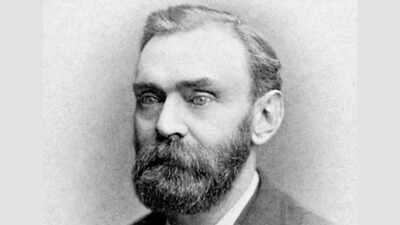
Alfred Nobel’s Quote of the Day: “A heart can no more be forced to love than a stomach can be coaxed into digesting food.” |
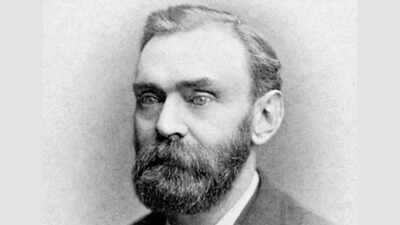
Love, emotions and human relationships have always been some of the most complex aspects of life. For centuries, philosophers, scientists, writers and thinkers have tried to explain why people feel affection, attachment, trust or distance. Alfred Nobel made a very thoughtful comment on this point when he said, “A heart can no more be forced to love than the stomach can be forced to digest food by coaxing.”This quote may seem simple at first, but it speaks to a truth that is deeply human. Nobel compares emotional bonds to a physical, natural thing. You cannot tell the body to digest food just by words. You cannot make the human heart feel love through pressure, obligation, or force. Real feelings come naturally. They cannot be created by social expectation or persuasion.And this still rings true today. In modern relationships, friendships, workplaces, and even family structures, people still struggle with emotional expectations and the need for acceptance. Nobel’s words are a subtle reminder that some human experiences should not be controlled or demanded. They have to evolve naturally and honestly over time.
Today’s Quote by Alfred Nobel
“No more can a heart be forced to love than the stomach can be forced to digest food by persuasion.”
What is the hidden meaning in this statement of Alfred Nobel?
The beauty of the quote is its simplicity. Nobel makes a comparison that everyone can understand. Digestion is an automatic biological process. It cannot be done because someone says or argues that it should be done. Emotional attachment doesn’t happen because people want it to happen.The quote is about the difference between pressure felt from the outside and felt from the inside. Human emotions are very personal and often unpredictable. Love, trust and affection develop from shared experiences, understanding, care and emotional connection, not from obligation.Nobel’s words are also associated with an important psychological truth. Trying to pursue feelings often gets you resistance, not intimacy. No real emotional connection can develop under pressure in personal relationships or social settings.This observation remains relevant as many people struggle with expectations related to relationships, family approval, social obligations, and emotional conformity.
Beyond Who was Alfred Nobel? nobel prize
Today most people know Alfred Nobel as the founder of the Nobel Prize, one of the world’s most respected international awards. But Nobel’s own life was more complex than most people know.Alfred Nobel was a Swedish inventor, chemist, engineer, businessman and author born in 1833. During his lifetime, he held over 350 patents and became most famous for inventing dynamite, a safer way to handle nitroglycerin for industrial purposes such as mining and construction.Dynamite revolutionized engineering and infrastructure, but it also gained a reputation as a weapon of war and destruction. That double inheritance would later have a profound impact on Nobel’s life.In 1888, a French newspaper published an obituary on him, thinking that he had died (it was his brother, Ludwig Nobel, who had died). In his obituary he has been called a “merchant of death”. It is said that it had a deep impact on him when he read how the world would remember him.Many historians believe that this experience influenced Nobel’s decision to create a Nobel Prize in his will. He wanted his money to be used for achievements that would help mankind, be they science, literature, medicine or peace.
Why do Nobel quotes still connect with people today?
Modern society puts more pressure on relationships and emotional expectations. Sometimes social norms dictate that people should feel affection, loyalty, admiration, or emotional closeness.Nobel’s quote suggests the opposite. It knows that genuine feelings cannot be forced merely by social pressure.This message resonates strongly in today’s world, where relationships are increasingly defined by digital communications, public image, and external validation. Social media often shows idealized versions of love and emotional connection, which can create unrealistic expectations.Nobel’s words bring us back to focus on emotional honesty. True affection is not negotiable like a business deal. It comes naturally with trust, understanding and emotional compatibility.
Human emotions cannot always be rationalized
One reason the Nobel quote remains so powerful is that it recognizes the complexity of human emotions. People think you can control emotions with logic, but emotions don’t follow rules.For a long time, psychologists have studied how emotional attachment is created through a combination of biology, memory, environment, and personal experience. Emotional connection is more important than decision making.This reality is reflected in Nobel’s analogy of love and digestion. There are human processes that are natural and cannot be completely controlled by persuasion or reason.This is why forced relationships, emotional manipulation or social pressure often do not create real relationships.
The emotional cost of forced expectations
In many societies throughout history, personal relationships have been fraught with expectations. People were repeatedly advised to keep up appearances, regardless of how they were really feeling.People were sometimes expected to cling to relationships, beliefs, or social systems even if they were unhappy. Nobel’s quote gently refutes the notion that emotions cannot be forged through pressure.Modern psychology also knows the emotional effects of suppression of real feelings. Emotional dishonesty can also be a source of stress, anxiety, resentment, and emotional isolation.Healthy relationships are usually based on mutual understanding and voluntary emotional connection, not mere obligation.
Why does authenticity matter in relationships?
Nobel’s words also highlight the importance of honesty in human relationships. Real relationships generally emerge when people feel emotionally safe enough to speak their truth.Trust and emotional closeness are rarely sustainable in the long run when they are based on performance or expectation.These days, authenticity is more valuable than ever, as many people are tired of the constant pressure of social performance and digital presentation. For many, it is a competition for real emotional engagement in public image.Nobel’s quote reminds readers that emotions are still very human, and they cannot be completely controlled by social systems or persuasion.
Alfred Nobel’s life was full of contradictions
One reason Nobel is of historical interest is that his life was full of contradictions. He was a scientist whose inventions not only changed the face of industry, but also became associated with war. He acquired immense wealth but was said to suffer from loneliness and personal isolation.Nobel never married and traveled for business and scientific work for most of his life. Historians say that he was brilliant in intellect but restrained in emotions.His writings and personal letters reveal that he spent much time thinking about morality, relationships, and human nature. This quote, and others, reveal Nobel’s more contemplative and philosophical side, often influenced by his achievements in science.
Relationship between science and emotion
Nobel is remembered primarily for science and engineering, but his quote shows how deeply scientific thinkers can consider emotional life as well.Science is generally about understanding physical systems and what can be observed. But many great scientists have also investigated questions of meaning, emotion, morality, and human behavior.Nobel’s analogy between digestion and emotional attachment is an example of scientific thinking applied to human relationships. He states an emotional truth through an organic process.The reason the quote is so enduring is the combination of rational observation and emotional understanding.
Why do people still struggle with emotional control?
Despite advances in psychology and communication, humans still often attempt to control emotions through persuasion, pressure, or expectation.Parents may push their children into certain relationships or career choices. Social systems may promote emotional congruence. Public opinion can influence the way people express their personal feelings.But as Nobel’s quote shows, you can’t demand emotional authenticity merely by existing.This is still true today, as many people feel this tension between emotions and expectations.
Love as a natural human experience
One of the most enduring ideas in Nobel’s quote is that love is most effective when it is allowed to grow naturally.Healthy emotional attachments are typically formed over time through shared experiences, trust, vulnerability, and mutual caring. When you try to force or intensify emotional closeness, you usually only create instability.Literature, psychology and philosophy all reflect this viewpoint. Genuine human connection is something that emerges organically, not through control.Nobel expressed this truth in the simplest language possible. Perhaps that is why this quote has remained relevant across generations.
Other famous quotes from Alfred Nobel
- “If I have a thousand ideas and only one of them turns out to be good, I am satisfied.”
- “After agriculture, humbug is the greatest industry of our age.”
- “Satisfaction is the only real wealth.”
- “Good wishes alone will not ensure peace.”
- “Hope is nature’s veil to hide the nakedness of truth.”
- “Nature is a good place to start studying chemistry.”
How does Nobel’s legacy continue today?
Today, the name Nobel is known throughout the world because of the Nobel Prize, which is awarded annually for outstanding achievements in the fields of physics, chemistry, medicine, literature, peace and economic sciences.The awards recognize those whose work has greatly benefited mankind. Nobel’s decision to establish these prizes revolutionized global recognition of scientific, cultural and humanitarian achievements.The Nobel Prize is recognized around the world every year because it is a symbol of excellence, discovery, and worldwide influence.But even more than the awards, the Nobel Prizes themselves remain of interest because they show a more philosophical and humanitarian side of the inventor.
Why do simple quotes often leave the deepest impact?
Nobel’s quote is memorable in part because it expresses a complex emotional truth in the language of common human experience.People understand hunger, digestion, love and emotional despair. Nobel weaves these familiar experiences in a way that feels immediate and honest.Unlike abstract philosophy, it appears to be based on everyday life. It acknowledges what most people learn from experience: that you can’t always control your emotions with logic or persuasion.That simple insight is what gives the quote its lasting emotional impact.
The enduring relevance of Nobel’s words
More than a century after Alfred Nobel’s death, his words still resonate because human emotions have not fundamentally changed. People still want love, acceptance, emotional security, and real relationships.Many people struggle at the same time with the expectations placed on relationships by society, family, or personal pressure.Nobel’s quote subtly reminds the reader that real love cannot be ordered or bargained into existence. It must happen spontaneously, truthfully, willingly.That understanding remains deeply relevant today in every generation.

Nigerian man wrongfully released from London jail after kidnapping 5-year-old son from France; UK started search operation

Nigerian-British man kidnaps son
British authorities have launched a search for a Nigerian-British man accused of kidnapping his five-year-old son from France to Nigeria after he was wrongly released from a London prison and may have fled to Britain within days.Ifedayo Adeyeye, 58, was released from London’s HMP Pentonville on April 21, despite being sentenced to an extra 12 months in prison the day before for repeatedly defying court orders to return his son, Lories, to his mother in France.According to court proceedings reported by Sky News, Adeyeye spent hours “loitering” in London after his release, reportedly enjoying dinner and drinks at a pub before traveling to Spain the next day. Police were reportedly informed about the jail disturbances only three days later, drawing sharp criticism from the court.Calling it a shocking state failure, High Court judge Mr Justice Hayden said prison authorities showed a “worrying lack of urgency”.The judge said, “If the police had been contacted immediately, perhaps, almost certainly, this could have been prevented. The public is entitled to expect much better than this.”
Kidnapping of a child during first night stay
The case centers on Lories N’Dozsé Adeyeye, a five-year-old boy born in France to Adeyeye and Claire N’Dozsé, a Cameroonian citizen.The couple met in Grenoble in 2020 and later separated. After DNA tests confirmed that Adeyeye was Loris’s biological father, a French court granted him supervised visitation rights, while full custody remained with the mother.The trouble began in July 2024 during Laurie’s first night staying with his father.Instead of returning the child, Adeyeye allegedly took her from France to England and then to Nigeria without the mother’s consent.When N’Djosse asked for answers, Adeyeye reportedly claimed that the child had gone on a “two-week vacation” with relatives. Investigators later discovered that he had secretly smuggled the lorries out of France.French authorities later issued an international arrest warrant against him on child kidnapping charges.UK court used rare powersThe case later took an extraordinary legal turn when the High Court of England ruled that it had the authority to order the return of the child, even though Laurie was outside Britain.Justice Hayden said the case was highly unusual because it involved three countries – France, Britain and Nigeria. The court also observed that Nigeria is not a signatory to the Hague Convention on International Child Abduction, complicating efforts to ensure the boy’s return.Despite this, the High Court exercised its “inherent jurisdiction” based on the Lories’ British nationality and ordered Adeyeye to return the child directly to France.After repeatedly ignoring court orders, Adeyeye was jailed for six months in January 2026 for contempt of court. While serving that sentence, he was found guilty of further breaches and on 20 April was sentenced to a further 12 months.However, prison officials reportedly failed to process the new sentence in time, resulting in his mistaken release the next morning.
Judge calls kidnapping an ‘act of cruelty’
Justice Hayden described Adeyeye as “arrogant and cunning”, “cold and calculating”, and said the kidnapping was “an act of cruelty that even this court rarely witnesses”.The judge said of Lauries, “He now finds himself in a foreign country, without his father or mother,” adding that the child’s entire world had been “taken away.”The judge also highlighted concerns raised during supervised visits to France before the abduction. Contact center staff reportedly described Adeyeye as aggressive, neglectful, and uninterested in understanding his son’s daily routine or emotional needs.
The suspect may have fled to Spain
During the latest hearing, the Metropolitan Police told the court that Adeyeye may have traveled to Spain on April 22, a day after his wrongful release. Spanish authorities have reportedly been alerted.The court heard that prison officials blamed a “communication failure” with the courts for the release, with Justice Hayden dismissing this claim as “completely baseless”.Lawyers representing Ms N’Jose accused British authorities of repeatedly failing the mother and child.His lawyer Chris Bryden said, “The state has failed him not only in securing the father’s release, but also by not notifying the Metropolitan Police immediately.”
Court removes anonymity to aid search
In a rare move, the High Court allowed the identification and images of both Adeyeye and Lawries to be published to help locate them.Family court proceedings involving children are usually kept confidential, but the judge ruled that transparency was justified in exceptional circumstances and in the public interest.Britain’s Justice Ministry said it was working with police to recapture Adeyeye and acknowledged growing concerns over the wrongful release of prisoners.Official figures show that 179 prisoners were wrongly released in England and Wales between April 2025 and March 2026.

This 1,000-year-old Viking treasure found in Denmark contains almost pure gold arm rings World News

In Denmark, archaeologists were really surprised when they found an extraordinary hoard of Viking Age gold in a forest in Himmerland. The treasure includes six solid gold arm rings weighing 762.5 grams; As reported, this is the third largest discovery of its kind of this era in Danish history North Jutland Museum. These treasures date back to the 10th century and were partially uncovered in the soil by a resident on a forest path rather than at the burial site. This could mean that it was deliberately placed there or hidden during political unification. Now declared state property, this ‘rolled treasure’ provides a rare, tangible link to the high-status craftsmanship and symbolic wealth of the Viking elite.
Unique Viking Age gold arm rings found in Denmark
In the forests of Himmerland, archaeologists found a hoard of six distinctive gold bracelets made entirely of solid gold, with a total weight of 762.5 grams. These treasures date back to the late 900s, possibly during the time of Harald Bluetooth. Torben Sarouw, cultural heritage manager and archaeologist at the Museum of North Jutland, explained how similar these rings are to each other. He notes that they would have been produced as a matching set, which would have served as a status symbol for wealthy Vikings. Such wealth has rarely been found in a single archaeological discovery.
Identified as Denmark’s third largest Viking gold treasure
According to a published report at the Museum of Northern Jutland, the find ranks as Denmark’s third-largest Viking Age gold treasure, largely due to its heavy weight and high purity. Such pure gold deposits are incredibly rare in Scandinavia, where silver is more commonly found. The sheer size of the find indicates ownership by someone very powerful or influential. As a result, archaeologists now have important new insights into how wealth was distributed in Northern Jutland in the late 10th century.
Why was gold buried alone
Museum archaeologists using a metal detector found the rings along a path in the Roald Skov forest. They were lying close to each other, it seemed as if someone had buried them together. Nearby, there were no burial mounds or signs of settlements, so experts believe the treasure may have been offered to the gods or hidden by an important person in a time of trouble.
How does Denmark protect its ancient stores?
After they found it, the discovery was immediately reported to the museum and classified as Denefo (treasure trove). This Danish law places important cultural objects in the hands of the public. The rings ended up in the National Museum of Denmark, where experts will carry out conservation and study their metallic properties. By doing so, they ensure that the 1,000-year-old gold is preserved under climate-controlled conditions. Experts also plan to examine how the rings were made to determine whether local artisans worked on them or whether the gold came from elsewhere.
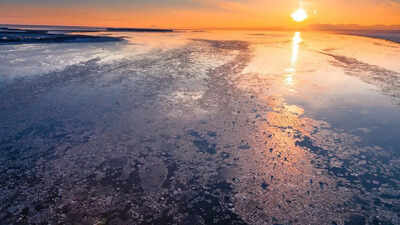
No sunset until August: Surviving 84 days of endless daylight inside Alaska’s northernmost city world News
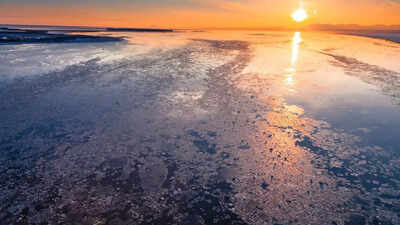
Most people expect night to arrive at some point during the day. In a remote corner of Alaska, this stops happening for a few weeks. Residents of Utqiagvik, the northernmost city in the United States, have now entered the annual ‘midnight sun’ season, a strange period when the sun is visible around the clock. The city will not experience another proper sunset until early August, leaving almost three months of continuous daylight. To outsiders, it seems almost surreal. Bright skies at midnight, children playing outside late into the evening, locals out for walks while the clock tells us it’s technically night time. Yet for people living above the Arctic Circle, this unusual cycle has become part of everyday life, even if it seems a little surreal when the darkness disappears again each year.
alaska midnight sun Returns to Utqiagvik for 84 consecutive days
As reported by an After briefly sinking below the horizon in the early morning hours, the sun has risen again and will now be visible until August 2.Utqiagvik, formerly known as Barrow, is located along the Arctic Ocean, about 320 miles north of the Arctic Circle. Due to its extreme northern location, the city experiences one of the most dramatic day-to-day changes anywhere in the US. During late spring and summer, the Earth’s tilt keeps the Northern Hemisphere tilted toward the Sun, allowing locations above the Arctic Circle to remain illuminated for longer periods without interruption. Experts say this phenomenon, commonly called the midnight sun, occurs to varying degrees in all Arctic regions. In Utqiagvik it lasts for about 84 consecutive days.For many visitors, the first experience of seeing the midnight sun is reportedly disorienting. The sky is never really dark. Time seems strangely irrelevant.
Why doesn’t Alaska’s midnight sun bring real summer heat?
People often imagine the endless sunshine that comes with hot summer temperatures. In northern Alaska, this assumption quickly breaks down.Even during July, which is usually the hottest month in Utqiagvik, the average daytime temperature only reaches around 9 °C. Snowfall is also not particularly rare during the summer. Last year, snowfall was reportedly recorded on several days in June despite almost continuous daylight. This contradiction gives the city an unusual atmosphere. Bright sunlight reflects off the icy roads and cold Arctic waters, while residents still wear heavy jackets outside. It seems as if winter is trapped in a summer day.Hot periods occur occasionally. Temperatures sometimes reach 20 °C during rare heat surges, although locals regard those moments as brief occasions rather than typical summer weather. The Arctic climate still dominates daily life, no matter how long the sun remains overhead.
What it’s really like to live with 84 days of daylight
The midnight sun affects more than just the sky. It changes the way people live. Many residents reportedly shift outdoor activities to late evening hours because of the intense light that persists throughout the day and night. Children continue to play outside well past traditional bedtimes, while some locals go fishing, walking or cycling during hours that usually feel too late elsewhere.Sleeping can be difficult for newcomers. Human body clocks rely heavily on darkness, and without it, many people have difficulty recognizing when the day should actually end. For this reason blackout curtains are common in Utqiagvik homes.Even with preparation, constant flashes may still feel unusual. Some residents say the endless daylight creates extra energy and activity around the city. Others find that it becomes tiring after several weeks. It seems the experience affects everyone differently.
What happens after Alaska’s endless daylight finally disappears
As unusual as the midnight sun may seem, winter in Utqiagvik can feel even more extreme. At the end of the year, the city will enter the polar night, a period when the Sun does not rise above the horizon for approximately 64 consecutive days. Instead of endless daylight, residents face weeks of darkness and hazy skies.That dramatic seasonal change is one of the defining characteristics of life in the Arctic. People adjust to being surrounded by constant brightness part of the year and almost complete darkness the other part. Visitors often find it difficult to imagine living in both extreme conditions in one place. Yet the local people have adopted this rhythm from generation to generation. Schools, businesses and daily routines continue despite the unusual circumstances outside.
From Fairbanks to Anchorage: Alaska’s extended summer light
Utqiagvik is most noticeable during midnight sun season, although many other Alaskan communities also experience unusually long days during the summer. Located just south of the Arctic Circle, Fairbanks reportedly sees approximately 70 days of extended daylight. During the peak weeks of summer, Anchorage experiences between 16 and 19 hours of sunlight, with only brief periods of darkness at night.Across the state, people enjoy spending more time outdoors when daylight arrives. The parks remain busy until late in the evening, while restaurants and shops often stay active much later than expected. However, in Utqiagvik, the experience feels more intense than almost anywhere else in the country.For now, the city will continue to live under a sun that barely moves across the sky. No sunset, no true night. Just endless arctic daylight stretching across the horizon in late August.