
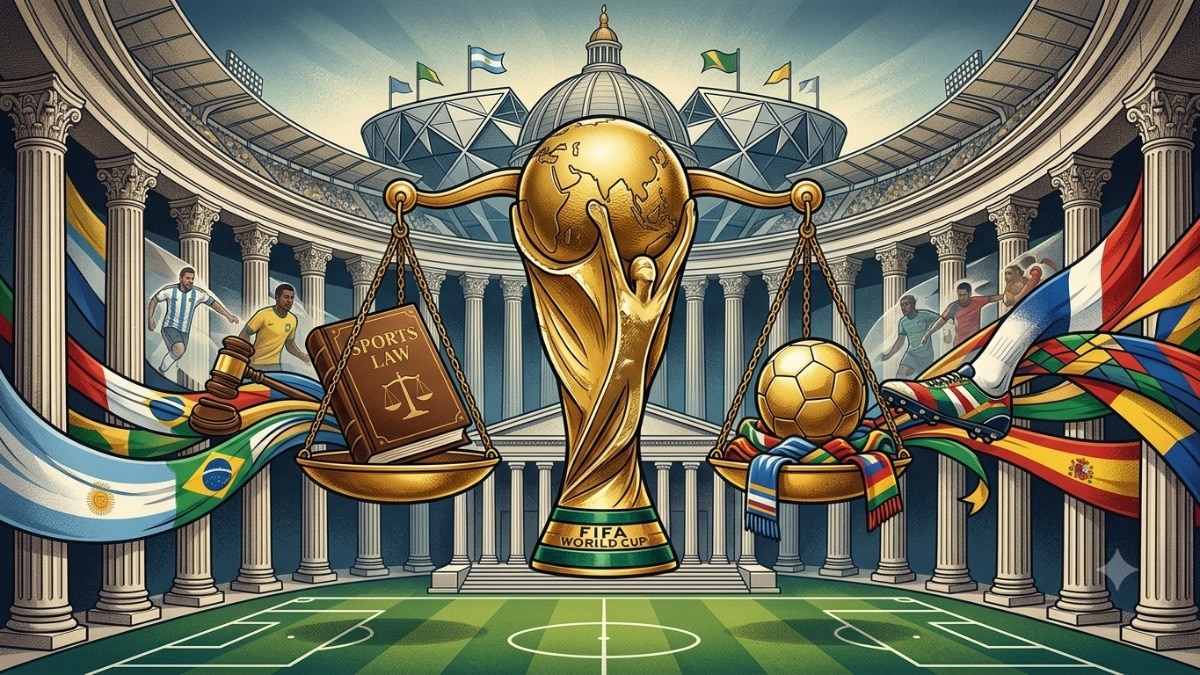

FIFA World Cup: order in the court of the ball – relations between the law of football and beyond
Stepping onto a football pitch is, in many ways, an analogy of entering a courtroom. Both the field and the courtroom are ritual-driven arenas where conflict is freed from chaos and disorder to live and die by a strict web of rules. In both, the final, unshakable authority – barring appeal – is entrusted to a neutral arbiter (be they in the referee’s kit, or on the bench) with the sole responsibility of ensuring that due process triumphs over bias. A trial is built on the foundation of procedure and sacred rules of evidence to uncover the truth and deliver justice.
Similarly, a football match depends on the sacred laws of the game to ensure fairness. Both systems depend entirely on a fragile, hope-filled assumption: that the rules apply equally to everyone, and that the process is immune to outside influence. Both are based on a simple basic principle to understand: may the best win.
shared ritual
Nevertheless, as of 2026 FIFA World Cup As the United States, Canada and Mexico reach their final resolutions, that vision is beginning to disintegrate in real time. The tournament is defined as much by administrative and legal friction, or, well, rules and regulations, as it is by sheer sporting talent. For example, when the chairman of FIFA’s disciplinary committee bypassed the process on his own volition American striker Folarin Balogun’s red card overturned suspension, or when the organization took advantage of Article 27 of its code to overturn Cristiano Ronaldo’s competitive ban so as to allow him to compete in his final World Cup, the decisions did not merely serve the role of promoting debate and discussion. They seem akin to a slow creep familiar to any qualified legal scholar, and certainly to any constitutional scholar: the erosion of due process protections to protect the powerful and profitable.
Where the rules are bent to preserve the interests of the elite, whether on the field or in the court, the entire system quickly loses its legitimacy. Remove the foundation, and you’ll very soon find that you have nothing of value left.
For decades, the field was considered a strange, crude mix of crude contracts and the internal bylaws of voluntary associations. This was the law of private clubs, each his own, then organized into disorganized leagues and federations. However, today, the rules of the game have become entirely formal, redundantly specific in some cases, and excessively rigid in others.
corporate creep
The 2026 tournament perfectly demonstrates the shift from quirkiness to commercialism. To protect market value and broadcast revenue, FIFA implemented a tennis-style seeding system that guaranteed that the top-ranked teams would be spared early elimination. Even more worrying is the introduction of mobility Pricing pushed ticket prices to last To the tune of over US$11,000, effectively locking the public out of the game initially intended for the public, and in the process, triggering consumer protection investigations in New York, New Jersey, Texas, and California.
If the evolution of sports law from quixotic to corporate represents the triumph of sovereignty over greed above all else, this tournament exposes to the world the rot of the domestic policies of host countries. Herein lies the nuance of modern sports: sporting events, indeed, mega-sporting events like the FIFA World Cup, do not exist in a vacuum. They are a lens magnifying the existing flaws in the system.
Take, for example, the (essentially Zionist) reaction before the World Cup Lamin Yamal Celebrating by waving the Palestinian flag; A Spanish player, waving the flag of the nation that is recognized by Spain, was praised for this act by the leaders of his own country, he was harassed by individuals and politicians from half the world away and demanded that his club (FC Barcelona) and his country strip him of his right to play for daring to speak out publicly. Through the lens of sport, his work becomes magnified, and cracks become visible.
human cost
Further, consider the civil liberties warnings issued by organizations such as the ACLU and Amnesty International during the tournament’s conduct. The World Cup coincides with an aggressive increase in domestic crackdowns on immigration in the United States, evidenced by mass detentions, increased border enforcement, and aggressive social media screening of incoming travelers, overshadowed by the curtain of celebrity due to the FIFA World Cup. The tournament, promoted under its 2026 logo as a celebration of unity, is held against a backdrop of restricted public spaces and unreasonably accelerated deportations. Under the guise of the World Cup there has been an abundance of security, surveillance and increasingly stringent police measures.
Obviously, this friction also extends to municipal administration, and, on a more broad level, to human rights. In many host cities, local governments have taken to demolishing camps, displacing homeless populations to present a sanitized, commercially plastic-perfect image to broadcasters – not unlike what our government in India does every time we host a global event, as seen during the G20 meeting in recent times, with hasty reconstruction, wall construction and poverty denial.
Sports law is no longer just about regulating the functioning of sport, or arbitrating contractual disputes in relation to sport. This, especially in recent years, has become a major arena where greed, pride and human rights openly collide.
For those of us at home, studying law and enthralled by the World Cup season, the modern, if somewhat nihilistic, message is crystal clear: the pitch can no longer serve as a useless escape from reality. Nor, indeed, can sport be considered a meaningless pastime. Even looking beyond the fortunes earned in sport, we must recognize its wider impact, not just in the moment the ball hits the back of the net, but in our daily lives, and in some ways, in the politics we live by.
(Neil Binoy is a Delhi-based law student and columnist on legal issues and policy.)
FIFA World Cup | fifa world cup schedule | fifa world cup points table | football news
– ends