
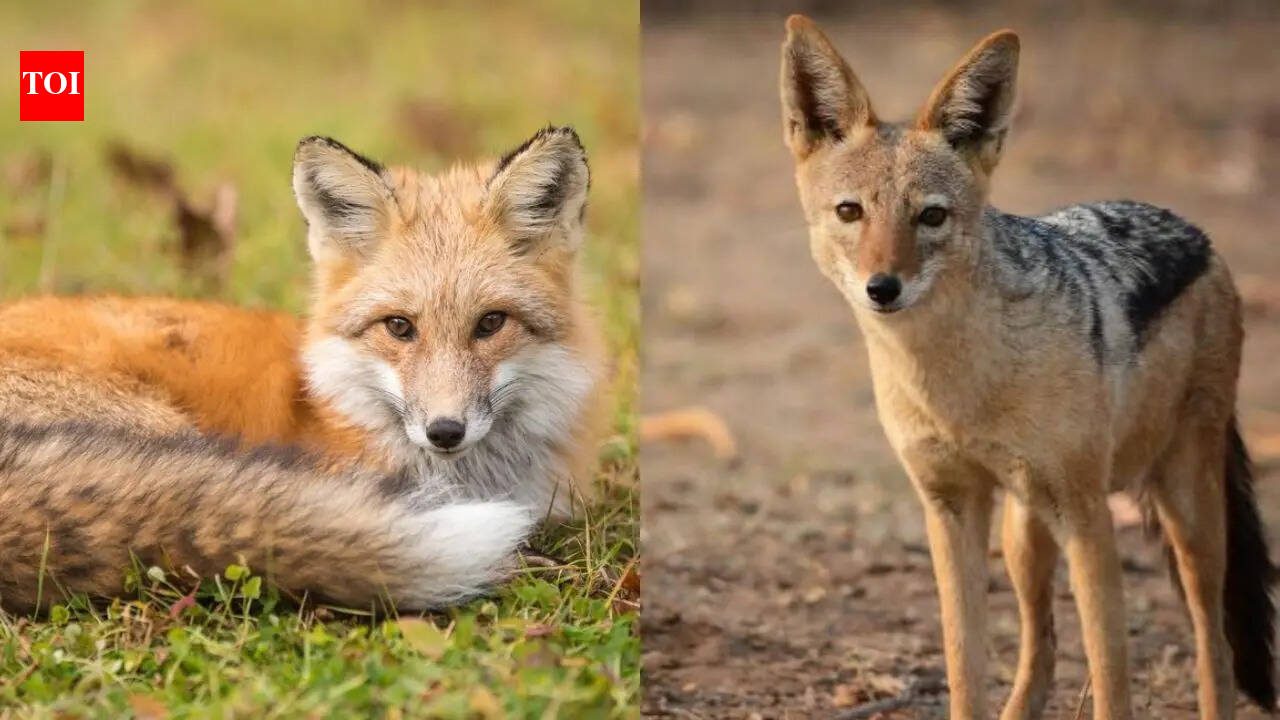

How to identify fox vs jackal: track, call and gait style
At first glance, a fox and a jackal can look surprisingly alike. Both belonging to the dog family, they have pointed ears, long snouts and bushy tails. In most areas of Asia, Africa, and Europe, wildlife observers or even residents commonly confuse the two animals if they see one in the early morning, late evening, or at night. However, an experienced tracker has ways of distinguishing one from the other besides appearance. Here are some ways one can differentiate between the two.
Jackals have different ways of walking.
For one thing, they are more similar to wolves, coyotes, and domestic dogs than they are to foxes. Jackals have a long, thin body and long legs, making their gait similar to that of a wolf or a small village dog. Instead of looking fragile, jackals appear strong and capable.According to Britannica, jackals are fast-moving animals that actively hunt but also behave like scavengers. Thus, they are distinguished by long continuous walks as they patrol their territories and search for prey.Another difference between jackal and fox can be seen in social behavior. It is rare to see more than one fox at a time. In contrast, the jackal can be found roaming with its partner or relative.
body structure settles the matter
In cases where visibility is excellent, body structure becomes another important clue.For example, foxes are characterized by a slender body, narrow head, and very bushy tail. The bushy tail itself may have become one of the distinguishing characteristics of the fox and may also serve various purposes, such as balancing or signaling. The body of the animal resembles that of a cat. Jackals appear to be quite strong. Specifically, their legs are usually long, their bodies are slim but strong and their tails are not bushy.
due to common confusion
This is natural because foxes and jackals share similar ecological niches in different regions around the world. Both hunters are opportunistic, both are highly adaptable, and they both become active mostly at dawn and dusk. Among online wildlife tracking circles, the question of how to distinguish these animals from each other often arises, with experienced trackers asking for more details on tracks, sounds and behavior to be sure of their decision. All signals should be paid attention to.A small, clean print, a sharp bark and a beautiful walking pattern indicate that it is a fox. A large track, a howling pack and a steady pace suggest it is a jackal. When identifying wildlife, a single description does not reveal the whole truth about the animal. When tracks, sounds and behavior are combined we get a complete picture.