
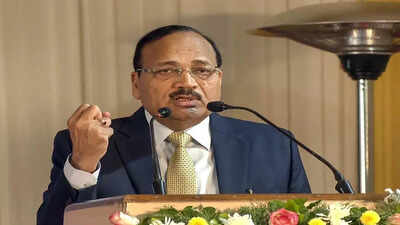

It is difficult for the court to give verdict on centuries-old religious beliefs: CJI Surya Kant. india news
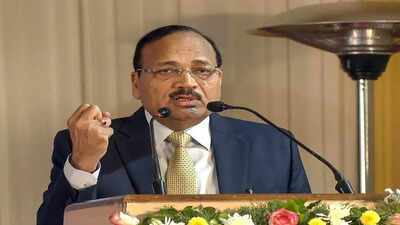
New Delhi: CJI Surya Kant on Wednesday said, “The most difficult part for the constitutional court is to decide whether the age-old faith of millions of devotees is right or wrong.” Dhananjay Mohapatra’s report.Justice MM Sundaresh sympathized with the CJI’s reasoning: “That too without listening to the views of those lakhs of devotees and based solely on the pleadings of the PIL petitioners, the State and religious organizations.”The comments come as the temple administration wing of the CPM-controlled Kerala government’s Travancore Devaswom Board on Wednesday said the Supreme Court could not strike down the age-old practice barring entry of women of menstrual age group into the Sabarimala Ayyappa temple as it was integral to the character of the deity as a brahmachari (atheistic celibate).Senior advocate AM Singhvi, appearing for TDB, told a nine-judge bench that while there are over 1,000 temples in India where women of all ages can enter and worship Lord Ayyappa, the deity at the Sabarimala temple has unique features and expressions.The TDB suggested that the Supreme Court should be extremely cautious while considering PILs of certain persons inviting judicial interference in matters of faith, belief and religion.Referring to the Supreme Court verdict in 2018 on the Sabarimala temple entry issue, Singhvi said, “Lord Ayyappa in Sabarimala is the only form of Ayyappa in the form of eternal celibacy, i.e. ‘Naishtika Brahmachari’.”Pointing out that the entry of fertile women in the age group of 10-50 years is prohibited in the temple, he said, “The foundation of his power and fame is his capacity as an eternal celibate. Therefore all forms of female reproduction and all practices of ‘grihasthashram’ should be sincerely kept away from the inner nature and identity of the deity.”Singhvi’s argument summed up the CPM’s political dilemma, where it had gone from enthusiastically supporting the Supreme Court’s decision in the Sabarimala case to opposing it with equal enthusiasm. This reversal led to a backlash, resulting in the CPM’s defeat in the 2024 Lok Sabha elections.Terming the 2018 Supreme Court judgment as wrong, Singhvi said, “This distancing and exclusion of fertile women with child-bearing potential has a direct bearing on the faith, belief and purpose for which the worshipers approach the deity and cannot be construed as exclusion for remotely extraneous and irrelevant reasons.”The TDB said it is not gender-exclusion as women below 10 years of age and above 50 years of age are allowed to enter the Sabarimala temple. According to age-old religious belief, “Maintaining the sanctity of the idol/deity in the form of secular celibacy is also a paramount object to be tried to achieve”.Singhvi told the bench that PILs should be discouraged in matters related to religious rights, which have innate rights.