

Scientists reveal how Egypt’s Great Pyramid was built by moving 2.3 million stones without modern machines. world News
More than 4,500 years after its construction, the Great Pyramid of Giza continues to puzzle scientists. Built during the reign of Khufu, the monument is composed of approximately 2.3 million stone blocks, some of which weigh several tons, all assembled with remarkable precision. For decades, experts have debated how ancient workers achieved this without cranes, steel or modern tools. Now, a new study led by Vicente Luis Rosell Roig has been published in the journal NaturePresents a compelling explanation that blends engineering logic with archaeological evidence, pointing to a hidden construction method underlying the pyramids.
How the Ancient Egyptians Moved Massive Stones to Build the Great Pyramids
At the heart of the research is a concept known as an integrated edge-ramp (IER) system. Instead of building massive ramps outside the pyramid, which would have required enormous amounts of material and space, the study suggests that the ramps were built into the structure itself.Workers probably deliberately left gaps along the outer layers of the pyramid. These gaps formed a spiral path that allowed workers to move stones upward as construction progressed. Once a section was completed, the voids were filled in, leaving no visible trace of the ramp in the final structure.As Roig explains in the study, the goal was to test whether such a system “could achieve the documented construction rates within the material and technological constraints of the Old Kingdom.” In simple terms, the model asks whether the ancient Egyptians could actually build pyramids in this way using the tools they had at their disposal.The scale of the challenge is staggering. Each block had to be excavated, transported, lifted and placed properly. The new model shows that workers used sledges, manpower, and carefully coordinated logistics, moving the stones along an internal ramp system.Instead of lifting the blocks vertically all at once, which would have been nearly impossible, the spiral route allowed gradual elevation. This reduced stresses, distributed weight more efficiently and kept the structure stable throughout construction.According to simulations, blocks could be deployed every four to six minutes during peak construction. When scaled to the entire project, this rate makes completion of the pyramid within a few decades much more plausible than previously thought.
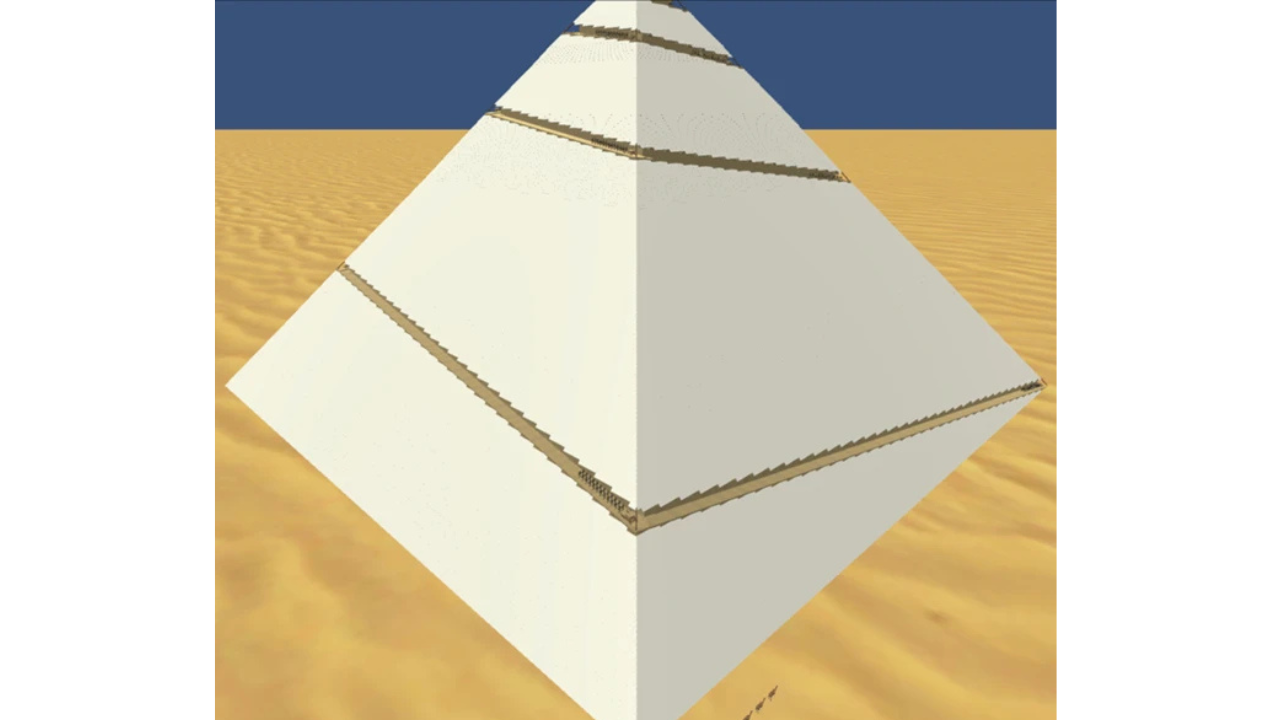
A 3D model showing a hidden spiral ramp used to transport stones to the top of the pyramid.
Why did earlier theories have to struggle?
For years, the leading explanation involved large external ramps. However, these theories ran into serious problems. A straight ramp would be large enough to reach the top of the pyramid, potentially requiring more material than the pyramid itself.Other proposals suggested internal ramps, but they often failed to explain how workers managed difficult turns or efficiently reached higher levels.Roig’s model is different because it addresses multiple constraints simultaneously. It takes into account limited space, manageable material usage, structural stability and realistic construction speed. It also matches what is known about ancient Egyptian tools and techniques.Archaeologists have long emphasized the ingenuity of ancient builders. As Egyptologist Mark Lehner has noted in previous research, “The pyramids were not built by slaves or in secret, but by skilled workers using clever organization and simple tools.”
The clues are hidden in the pyramid itself!
One of the most interesting aspects of the theory is how it explains physical features that have puzzled researchers for years. Some gaps, irregularities, and wear patterns within the pyramid may not be imperfections at all, but remnants of the construction process.The study suggests that areas showing signs of heavy use may have been routes for moving materials, while anomalies in stone placement may reflect sections that were filled in after serving as ramps.These details provide indirect support for the idea that the pyramid’s construction method was deliberately concealed as part of its final design.
Could it really have been built that fast?
The timeline has always been a major point of debate. Historical estimates suggest that the pyramid was completed in approximately 20 to 30 years. Critics have often questioned whether such a large project could be completed so quickly.However, the new model supports this time frame. By combining continued ramp access with efficient labor organization, the study shows that the pace of construction could realistically match historical records.When excavation, transportation, and workforce logistics are included, the timeline still fits within accepted limits, strengthening the theory’s credibility.
on which scientists still do not agree
Despite its merits, the integrated edge-ramp theory is not universally accepted. Archeology rarely provides definitive answers, and most evidence remains indirect.Some researchers point out that no completely preserved internal ramp has been directly observed. Others argue that multiple methods may have been used during different construction phases.Like many ancient mysteries, the truth may lie in a combination of techniques rather than a single solution.
A human achievement, no secret
This research ultimately confirms that the builders of the Great Pyramid of Giza did not rely on lost technology or supernatural help. Instead, they used ingenuity, planning, and an advanced understanding of materials and labor.The idea that ramps were built into the pyramid itself redefines the entire construction process. It reveals that what appears to be a perfect, seamless monument is actually the result of a carefully hidden system that has made the impossible possible.Even today, the pyramids stand as a reminder that ancient engineering was far more sophisticated than we realize.