
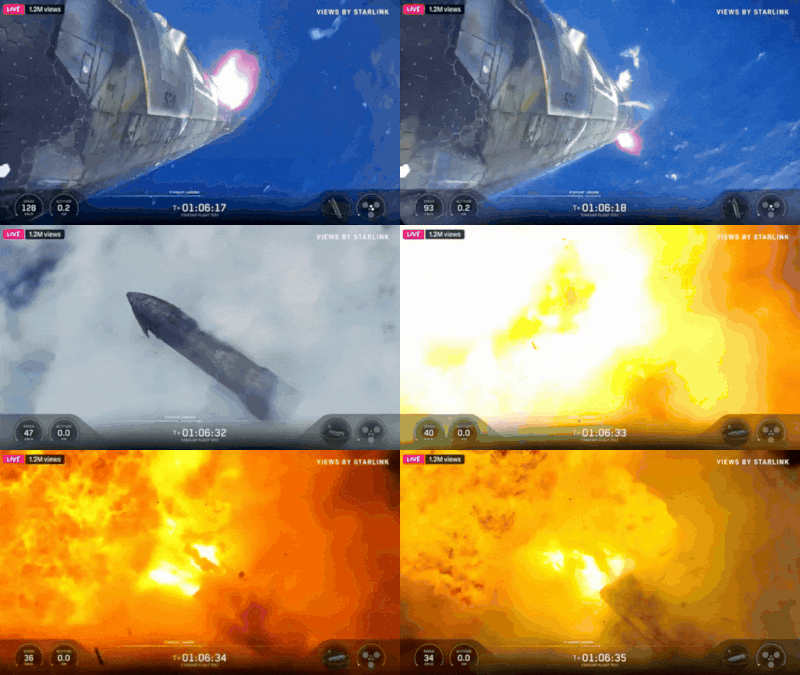

WATCH: SpaceX Starship catches fire in massive explosion in Indian Ocean after test flight
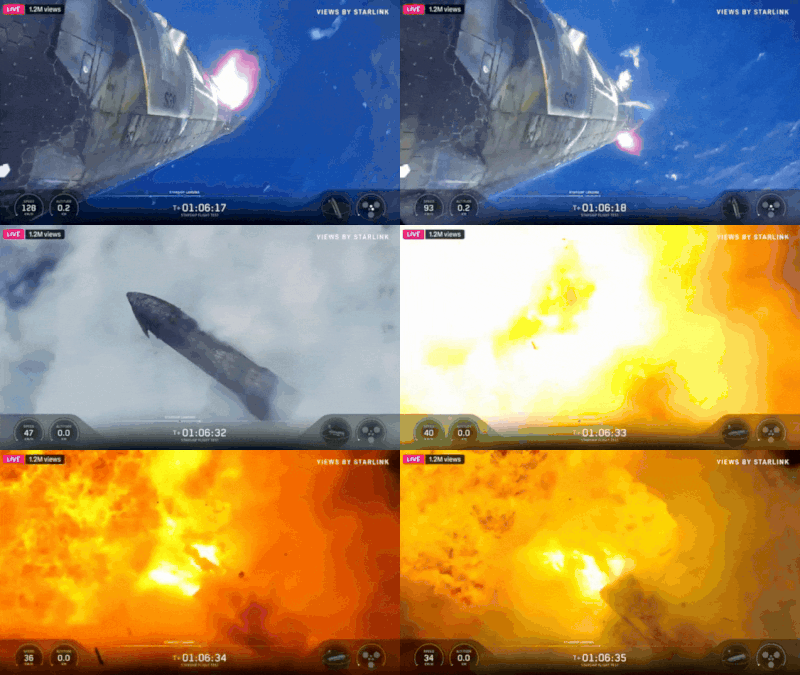
SpaceX on Friday successfully completed the 12th test flight of its massive Starship rocket system, with the spacecraft making a controlled landing in the Indian Ocean after a high-risk mission that included several technical glitches during the flight.The launch occurred shortly after 5.30 pm local time (2230 GMT), as SpaceX tested the latest third-generation version of Starship, the world’s largest and most powerful rocket system.Despite problems during the mission, SpaceX employees celebrated the completion of the flight during a company livestream. Visuals immediately after the splashdown showed the spacecraft surrounded by fire and heavy smoke as it descended into the Indian Ocean.“Splashdown Confirmed! Congratulations to the entire SpaceX team on the twelfth flight test of Starship!”. The company posted on Twitter after the spacecraft touched down safely.The company did not plan to recover the Super Heavy booster or upper stage spacecraft during this mission. According to SpaceX, the final landing in the Indian Ocean was fiery but controlled.During flight, the upper stage Starship successfully performed a complex maneuver in space, flying straight and restarting its engines for controlled re-entry, even though one of the engines malfunctioned during the mission.The spacecraft also deployed 22 mock satellites as part of the test. Two simulated satellites attempted to capture images of Starship’s heat shield to help engineers analyze the spacecraft’s performance during re-entry.However, the mission was not entirely smooth.SpaceX officials said the spacecraft could not achieve its intended orbit after one of its engines failed during the initial burn phase.“I wouldn’t call it a nominal orbital insertion,” SpaceX spokesman Dan Huot said during the livestream. However, he said the trajectory would remain ‘within the limits’ of earlier calculations.The Super Heavy Booster also faced problems after separation from the upper stage. According to Huot, the booster failed to complete its planned ‘boost-back burn’ and went out of control and fell into the Gulf of Mexico.Although SpaceX did not intend to recover the booster, the company hoped for a more accurate return.Friday’s test flight came a day after the first launch attempt was aborted due to a technical problem involving a hydraulic pin attached to the launch tower arm.SpaceX chief Elon Musk later said on Twitter that the problem had been fixed overnight.The latest Starship design is larger than previous versions and is more than 407 feet (124 m) long when fully stacked.The mission also comes at a critical time for SpaceX as the company faces increased attention following reports that it is preparing for a potentially record-breaking initial public offering later this year.Starship is at the center of NASA’s Artemis program, under which SpaceX is contracted to develop a modified version of the spacecraft capable of landing astronauts on the Moon.NASA aims to return humans to the lunar surface before the end of 2028, while China is also racing toward a manned moon mission targeted around 2030.NASA Administrator Jared Isaacman attended the launch and appeared during the pre-launch event.“We’re looking forward to seeing this fly by, because hopefully at some point in the near future we’re going to be in Earth orbit,” Isaacman said.SpaceX and Jeff Bezos-owned Blue Origin are both competing to develop lunar landing systems for NASA’s future Moon missions.However, industry experts have repeatedly expressed doubts about whether the ambitious timelines for lunar missions can be achieved, given the complex technical challenges.