Love wasabi? Here’s the real reason wasabi is always served with sushi

Love wasabi? Here's the real reason wasabi is always served with sushi

If you’ve ever eaten sushi, you know that bright green paste lying on the side of your plate. An accidental bite can send a fast, furious wave straight to your nose. While most people think it’s just to add a spicy kick, the real reason for associating wasabi with sushi goes back centuries — and it used to be a matter of survival.InventionYears ago, long before the invention of the refrigerator, it was incredibly difficult to keep raw fish fresh. Japanese cooks discovered that freshly grated wasabi acted as a natural shield against food poisoning. It contains a compound called allyl isothiocyanate, which fights harmful bacteria. Originally, cooks would hide a piece of wasabi between rice and fish as a natural preservative to keep diners safe. Today, we have modern refrigeration, but wasabi sticks around because it makes sushi taste incredible. High heat destroys the richness of fatty fish like salmon and tuna. This balances the oils, reduces any heavy fishy aromas, and cleanses your palate between different pieces.

yfyiu

love for wasabiSurprisingly, the green paste you usually find at local restaurants is not actually true wasabi. True wasabi comes from a rare plant called Eutrema japonicum, which grows only near cool mountain rivers in Japan. Because it takes up to three years to mature and is incredibly expensive, most places use a clever imitation.The “fake” wasabi that most of us eat is actually a mixture of horseradish, mustard powder, and green food coloring. Since horseradish contains similar spicy compounds, it mimics the kick perfectly. However, real wasabi is more delicate, slightly sweet and smooth, while the fake version gives you a harsher, more aggressive burn.

ytitou

Tracing the History of Wasabi:Wasabi has been a part of Japanese history for thousands of years, with archaeological evidence showing that people ate the wild mountain plant as far back as 14,000 BC. Long before anyone touched a piece of sushi, ancient Japanese society used it strictly as a medicine to treat respiratory and digestive problems and to preserve wounds. Actual cultivation began in the early 1600s when a villager from Shizuoka successfully grew it in a mountain spring and presented it to the shogun, Tokugawa Ieyasu. The shogun liked it so much – partly because the plant’s leaves resembled his family’s crested – that he declared it a highly guarded treasure, and banned anyone else from growing it outside his territory. By the late 1700s and early 1800s, following the invention of modern, unfermented sushi in Tokyo, wasabi officially came out of the medicine cabinet and onto the dinner plate as a natural defense against food poisoning.

Source link

Ukraine drone attacks: WATCH: Ukrainian drones attack St. Petersburg area again; Russia claims possession of Kharkiv village

WATCH: Ukrainian drone strikes St. Petersburg area again; Russia claims possession of Kharkiv village
WATCH: Ukrainian drone attacks St. Petersburg region again

Ukraine said on Saturday its long-range drones attacked targets inside Russia overnight, including a military facility near St. Petersburg and an oil depot in the southern Krasnodar region, as the war escalated with both sides reporting fresh battlefield gains and airstrikes.Ukrainian President Volodymyr Zelensky said the strikes targeted “an enemy naval arsenal and a base in Kronstadt” in Russia’s northwestern Saint Petersburg region, while another attack targeted an oil depot in Krasnodar, according to Reuters.In a post on“It is now time to end this war. But Russia’s rulers want to continue fighting,” Zelensky wrote, “Russia must end its war and stop its attacks on life.” “Any expression of injustice against Ukraine will receive an appropriate response.”

St. Petersburg residents told to stay indoors

The attack prompted officials in St. Petersburg, Russia’s second-largest city, to advise residents not to leave their homes, highlighting Ukraine’s growing ability to strike deep inside Russian territory.St. Petersburg Governor Alexander Beglov warned residents of a “large-scale” drone attack and possible disruption of mobile internet services.Regional governor Alexander Drozdenko said 141 drones were shot down in the surrounding Leningrad region, while Russia’s Defense Ministry claimed its air defenses intercepted 376 Ukrainian drones across the country, according to news agency AP.There was no immediate report of any casualties.The latest attack follows a Ukrainian drone strike earlier this week that set fire to an oil terminal and hit a naval base near St. Petersburg.

Russia claims to have captured a village in Kharkiv

Separately, Russia’s Defense Ministry said its forces had captured the settlement of Shevchenko in Ukraine’s northeastern Kharkiv region.Russian state news agency RIA Novosti reported that the village had been captured after what the ministry described as a “decisive action” by units of Russia’s Northern Military Group.

Fresh attacks have been reported from both sides

The latest developments come as both Russia and Ukraine continue long-range drone campaigns while fighting on largely static fronts.One person was killed and three others were wounded in Ukraine’s Dnepropetrovsk region after overnight Russian drone and artillery attacks, according to the AP.In the Zaporizhia region, five people sought medical treatment after a parking area caught fire following a Russian drone strike.Ukraine’s Air Force said Russia launched 272 strike drones overnight, of which 249 were intercepted.The fresh exchange came a day after Russian President Vladimir Putin rejected Ukrainian President Zelensky’s offer for a face-to-face meeting, saying he saw “no point” in such talks.

Source link

Tmc: The fall of the twin flowers: How Mamata Banerjee lost control of her party | India News

The fall of the twin flowers: How Mamata Banerjee lost control of her party

NEW DELHI: The Trinamool Congress was built around one leader, one family name and one political belief – that Mamata Banerjee alone could hold the party together and lead it to victory every time. Barely a month after a crushing assembly defeat, that belief is facing its biggest test as a rebellion threatens to split the party she founded 28 years ago.

Prologue: The unthinkable

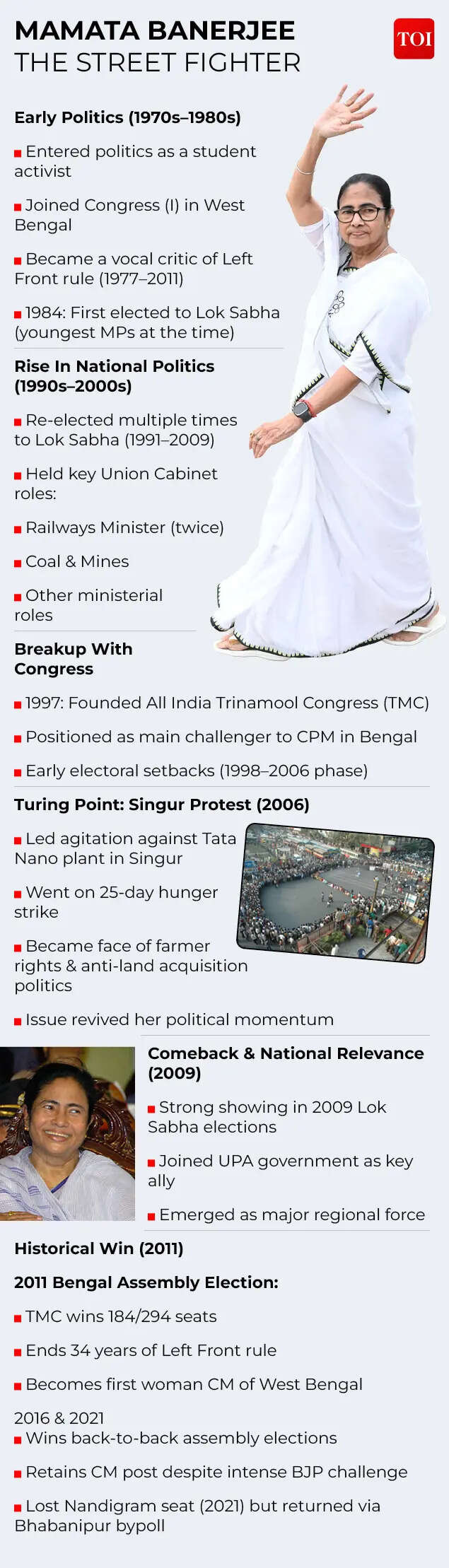
For nearly three decades, the Trinamool Congress (TMC) was Mamata Banerjee and Mamata Banerjee was the Trinamool Congress.She founded the party on January 1, 1998, after breaking away from the Congress, spent years battling the seemingly invincible CPM and, in 2011, achieved what many believed impossible: ending 34 years of Left rule in West Bengal.Through relentless street politics, welfare schemes and a carefully cultivated image as “Didi”, she transformed herself into Bengal’s undisputed political centre of gravity.Today, that edifice is facing its gravest crisis.Barely a month after suffering a crushing defeat in the 2026 assembly election, the TMC is confronting a rebellion unprecedented in its 28-year history. Fifty-eight of its 80 MLAs have rallied behind expelled leader Ritabrata Banerjee. The assembly speaker has recognised him as leader of the opposition. Senior leaders are questioning the party’s direction. Committees have been dissolved. And for the first time since the Trinamool’s birth, a rival faction is arguing that it, not Mamata Banerjee’s camp, represents the “real” TMC.The rebellion’s confidence was perhaps best captured by Ritabrata Banerjee’s remark after securing recognition as leader of the opposition in assembly.“We would request Mamata Banerjee to be our chief adviser to this opposition front.”For a leader who founded the party, built it and dominated Bengal politics through it for nearly three decades, the statement was both respectful and revolutionary.It suggested the battle was no longer about reforming the Trinamool Congress from within.It was about inheriting it.

Act I: The wheel turns

In May 2011, Kolkata celebrated the fall of a political giant.The Left front’s 34-year rule – the world’s longest-serving democratically elected communist government – had finally come to an end. Standing before jubilant supporters, Mamata Banerjee sought to reassure a deeply polarised state.“Bodloi noy, bodol chai” – change, not revenge.The slogan became the defining phrase of Bengal’s political transition.Yet Bengal’s political history has rarely followed the script written by its slogans.For more than three decades, the CPM had governed Bengal through a vast ecosystem of local committees, panchayat networks, trade unions, cooperative societies and neighbourhood party offices. In many districts, party offices often wielded more influence than formal institutions.When the regime fell, much of that machinery began moving.Local leaders switched sides. Panchayat chiefs recalibrated loyalties. Contractors adjusted. Organisational networks built under the Left increasingly aligned themselves with the new ruling establishment.Mamata Banerjee did not simply defeat the CPM.She inherited much of the ecosystem that had sustained it.The lesson was simple: in Bengal politics, institutions and leaders often survive by changing colours.Fifteen years later, the cycle appears to be repeating itself.The 2026 assembly election produced one of the most dramatic verdicts in the state’s political history. The BJP won 207 seats and formed its first government in West Bengal. The TMC was reduced to 80 seats. Mamata Banerjee herself lost Bhabanipur to her former lieutenant-turned-rival Suvendu Adhikari.The symbolism was impossible to miss.The politician who had dismantled the Left’s empire now found herself watching another political force dismantle her own.

Mamata Banerjee The Street Fighter

As BJP leaders celebrated, they reached for language strikingly similar to that used by Mamata Banerjee fifteen years earlier.“Badla nahi, badlav.”Not revenge, but change.Yet just as in 2011, political reality proved more complicated than political messaging.Reports of post-poll clashes surfaced from several districts. Local Trinamool workers complained of intimidation. Party offices that had functioned as nerve centres of political power suddenly found themselves vulnerable.Most importantly, the psychology of power changed.For fifteen years, access to government, contracts, influence and protection flowed through the Trinamool Congress.Suddenly, those channels pointed elsewhere.In politics, survival often depends on proximity to power.And power had changed hands.The first sign that the crisis ran deeper than an electoral defeat came in Falta.Traditionally regarded as a Trinamool stronghold, the constituency should have offered the party an opportunity to demonstrate resilience after the election debacle.Instead, it delivered a political shock.TMC candidate Jahangir Khan publicly announced his withdrawal from the repoll campaign, though his name remained on the ballot because the deadline for withdrawing nominations had passed.The result was devastating.The BJP won comfortably. The CPM and Congress also finished ahead of the Trinamool Congress.The former ruling party was pushed to fourth place.Within Trinamool circles, the result triggered alarm.Election defeats can be rationalised. A fourth-place finish in a traditional stronghold is harder to explain away.The atmosphere inside the organisation began shifting from disappointment to panic.

Act II: Operation crown prince

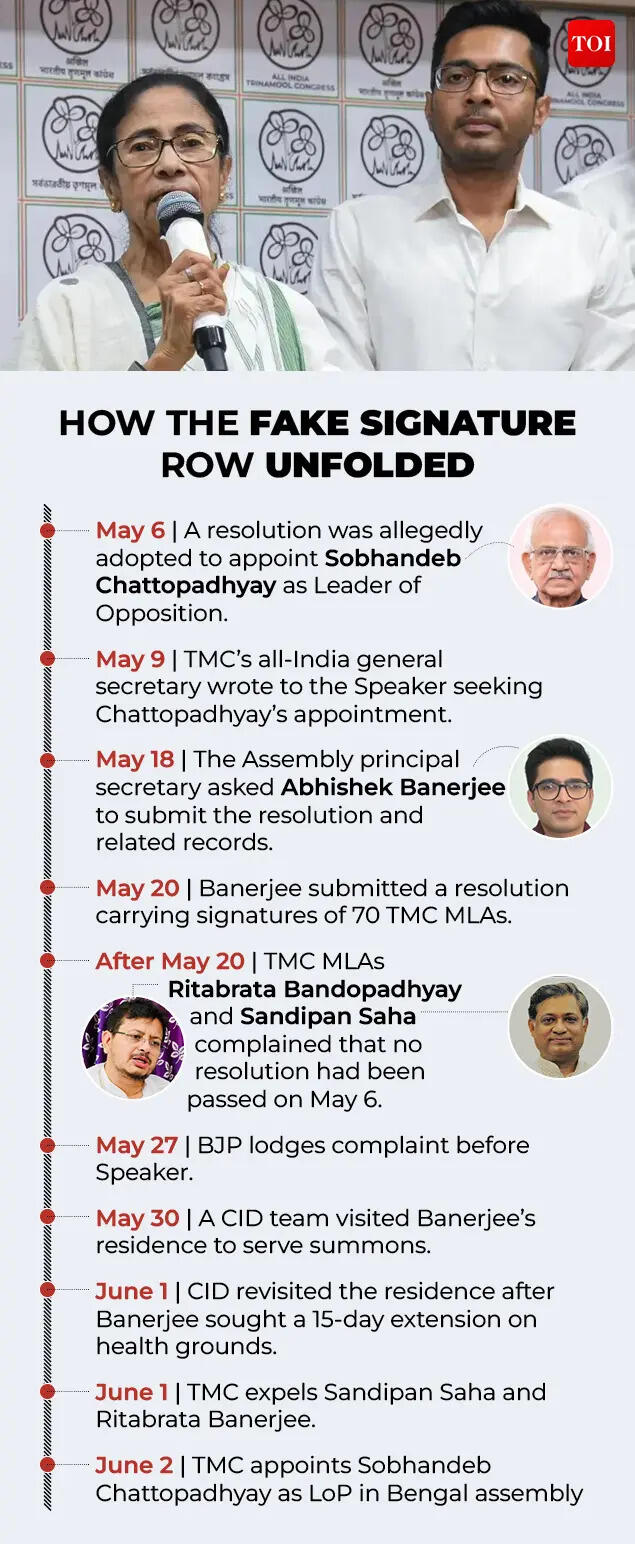
If the election defeat exposed the Trinamool’s vulnerabilities, what followed revealed its internal fault lines.The seeds of the rebellion were sown almost immediately after the results.According to rebel leaders, the trigger came at a meeting of newly elected MLAs on May 6.At the gathering, Mamata Banerjee reportedly asked legislators to rise and applaud her nephew and party national general secretary Abhishek Banerjee for his role in the election campaign.What was intended as recognition was interpreted very differently by a section of legislators.Expelled MLA Sandipan Saha would later describe the episode as a turning point.“As for the trigger point, it occurred following the party’s electoral defeat. When we attended the party meeting, a directive was issued to all MLAs. No one was permitted to utter a single word of criticism regarding Abhishek. Instead, we were instructed that he had performed exceptionally well and that everyone must rise to accord him a standing ovation,” Saha alleged.His criticism became even sharper.“This included MLAs who have been serving in the assembly since a time when Abhishek Banerjee was likely still attending school. They too were compelled to stand up and join in the standing ovation,” the rebel leader said.The comments offer perhaps the clearest window yet into what the rebellion is really about.The rebels insist they are fighting to save the Trinamool Congress, but perhaps their battle is against what they see as the growing concentration of power around Abhishek Banerjee.For years, Mamata’s nephew had been viewed as the party’s political heir. He was entrusted with organisational responsibilities, election management and strategic decision-making. As national general secretary, he increasingly became the face of the next generation.But succession politics inevitably creates winners and losers.Many senior leaders who had spent decades building the party felt sidelined as younger leaders rose through the ranks. Others worried that decision-making was becoming concentrated within an increasingly small circle.The first public signs of dissent emerged on May 19.At a party meeting, Ritabrata Banerjee and Sandipan Saha questioned why Falta MLA Jahangir Khan had not been expelled despite publicly distancing himself from the repoll campaign.Since Jahangir was widely seen as being close to Abhishek Banerjee, the criticism was interpreted as a direct challenge to the power structure evolving around him.The turning point came three days later.On May 22, Ritabrata Banerjee, who was in Delhi to complete formalities following the end of his Rajya Sabha tenure, visited Banga Bhavan for lunch.There, he had what PTI described as an “accidental” meeting with chief minister Suvendu Adhikari.Soon afterwards, another controversy engulfed the party.On May 25, allegations surfaced that signatures of several legislators had been forged on documents submitted to the Speaker regarding the leadership structure of the legislature party.The issue quickly escalated.On May 27, Ritabrata Banerjee and Sandipan Saha formally complained to the speaker. The assembly secretariat approached police. A CID investigation was launched.As legislators were questioned, what began as a procedural dispute evolved into a political rebellion.The signature controversy became a rallying point for disgruntled MLAs.Meetings multiplied. Lobbying intensified. And factions emerged.The crisis deepened further after Abhishek Banerjee came under a mob attack during a visit to Sonarpur on May 30.While political parties condemned the incident, several TMC leaders privately noted the muted response from sections of the organisation, interpreting it as evidence of a widening disconnect between the leadership and elected representatives.By the end of May, the erosion of authority had become visible.A meeting convened by Mamata Banerjee at her Kalighat residence reportedly witnessed poor attendance, depriving the leadership of the show of unity it had hoped to project.The rebel campaign had gained momentum and its target was unmistakable.

Act III: Et Tu, TMC?

The decisive rupture came on June 1.Hours after it became public that the CID probe had been initiated on complaints filed by Ritabrata Banerjee and Sandipan Saha, the TMC expelled both leaders.Instead of containing the crisis, the move accelerated it.The expelled leaders sharpened their attack on Abhishek Banerjee, accusing him of centralising authority within the organisation.Support rapidly shifted towards the dissidents.Then came the moment that transformed a political rebellion into an institutional reality.On June 4, a group of 58 MLAs submitted a letter to the speaker electing Ritabrata Banerjee as leader of the legislature party and nominating a new leadership team.

Timeline

The speaker accepted their claim.For the first time in the party’s history, a majority of Trinamool legislators had openly defied Mamata Banerjee.The rebels justified their actions as necessary for the effective functioning of the opposition.“After deliberating among ourselves, we concluded that if we were to effectively discharge our duties within the assembly and serve our respective constituencies, we needed to form a distinct group,” Sandipan Saha said.“Furthermore, we determined that this group should constitute the principal opposition and that the Leader of the Opposition should be selected from within this group.”The battle soon centred on competing claims over the leader of the opposition post.Mamata Banerjee had proposed Sobhandeb Chattopadhyay.The rebels challenged the process.“Some MLAs were not even present for selecting the LoP, yet their names were inscribed in block letters,” Saha alleged.“When we voiced our objections, we submitted a formal letter to the speaker, who then ordered an inquiry. Once the inquiry commenced, evidence began to surface confirming the veracity of these allegations. Other MLAs began reaching out to us.”The face of this rebellion is among the most unlikely in Bengal politics.Ritabrata Banerjee began his political career in the CPM and rose rapidly through the Students Federation of India. He became one of the Left’s most visible young leaders and was rewarded with a Rajya Sabha seat.Then the CPM expelled him.After a period in political wilderness, he joined the TMC, where he rebuilt his career, headed the party’s trade union wing, secured another Rajya Sabha term and eventually entered the assembly.Not long ago, he was publicly invoking Vladimir Lenin while explaining Mamata Banerjee’s political appeal.Today, he is leading the biggest revolt against her.And parallels with Maharashtra’s Shiv Sena and NCP splits are becoming increasingly difficult to ignore.Like Eknath Shinde an Ajit Pawar, Ritabrata’s strategy has centred on demonstrating legislative strength rather than organisational control.The difference is that this battle is unfolding entirely within opposition politics.Yet the danger for Mamata Banerjee remains enormous.If the rebels can demonstrate influence beyond the assembly – in Parliament, local bodies and organisational structures – they may eventually seek recognition as the authentic TMC.That battle could determine ownership of the party’s name, symbol and political inheritance.The fallout has already begun.The TMC dissolved its committees and frontal organisations, citing the need for introspection.Then came another symbolic blow.Firhad Hakim, one of Mamata Banerjee’s closest political associates, stepped down as Kolkata mayor.The crisis was no longer confined to the assembly, it was spreading through the organisation itself.

Epilogue: The empire strikes itself

The tragedy of politics is not that leaders lose power. It is that they often become victims of the same systems they once mastered.The Left front built a vast political machine and watched it migrate to the TMC.The TMC built an even larger machine and is now watching parts of it drift away in search of a new centre of gravity.Not long ago, Ritabrata Banerjee was invoking Lenin to explain Mamata Banerjee’s appeal among ordinary Bengalis.Today, he leads the biggest challenge to her authority since she founded the party in 1998.The irony is difficult to miss.In 2011, Mamata Banerjee inherited a political ecosystem abandoned by the Left.In 2026, she is watching parts of her own machine drift away in search of a new political home.The twin flowers once replaced the hammer and sickle.Now they are fighting to avoid the same fate.


Source link

AICWA urges legal action against actress Shilpa Shinde over false sexual harassment allegation

AICWA urges legal action against actress Shilpa Shinde over false sexual harassment allegation

alert: This article discusses allegations of sexual harassment.The All India Cine Workers Association (AICWA) has strongly reacted to actress Shilpa Shinde’s recent confession that the sexual harassment allegations leveled by her against the producer of Bhabiji Ghar Par Hain were false. Shilpa recently revealed that she had made false allegations against the show’s producer during a podcast with Bharti Singh and Haarsh Limbachiyaa. Many celebrities from the industry have reacted to this revelation on social media.In a recent statement, AICWA expressed disappointment over Shilpa’s confession and said that such actions can have serious consequences. In the statement, AICWA urged Maharashtra Chief Minister Devendra Fadnavis to intervene in the matter and ensure that strict action is taken as per law. “A false allegation of sexual harassment can cause irreparable damage to a person’s reputation, family, children, career and mental well-being. Such allegations can permanently tarnish a person’s image and can have devastating consequences not only for the accused but also for their family members and loved ones,” the statement shared in the Hindustan Times report said.It further added, “The All India Cine Workers Association (AICWA) believes that if an individual knowingly makes false allegations, it not only harms the accused, but also undermines the credibility of genuine victims seeking justice. Such incidents can create doubt about legitimate complaints and make it more difficult for genuine survivors of harassment within the Bollywood film industry to be heard and believed.It also requested the Honorable Chief Minister of Maharashtra, Shri Devendra Fadnavis to take strict action in the matter. “All India Cine Workers Association (AICWA) urges the Honorable Chief Minister of Maharashtra, Shri Devendra Fadnavis to ensure an impartial and thorough investigation into this matter. If it is established that false allegations have been made knowingly then strict action should be taken as per law. Accountability is necessary to protect both innocent persons from false accusations and genuine victims who seek justice. Truth, fairness and justice must prevail. Both false allegations and actual harassment are serious matters, and the law must deal with each appropriately,” the statement concluded.Shilpa Shinde recently appeared on a podcast with Bharti Singh and Haarsh Limbachiyaa, where she admitted to making false sexual harassment allegations against the producer of Bhabiji Ghar Par Hain. She said, “No one knows this. I am no longer afraid of speaking the truth, and I will say it even now because it is a big revelation. I filed a sexual harassment case against my producer because I had no other option. Ultimately, I came out of that situation by reaching a settlement.” At that time no producer supported him and I filed the case on that basis.She further said, “The police tell you straight away that if you want to file an FIR, you have to write serious allegations. I come from a law background.”After his confession, this matter became a matter of great debate. Disclaimer: This article is based on statements issued by the All India Cine Workers Association (AICWA), comments made by Shilpa Shinde in a public podcast, and publicly available reports. The article is for reporting purposes only and does not make any independent claims regarding this matter.

Source link

‘No community should live in fear’: British MP supports Southampton Sikhs amid growing hostility after Vikram Digva’s conviction world News

'No community should live in fear': British MP supports Southampton Sikhs amid growing hostility after Vikram Digva's conviction

Independent MP Adnan Hussain has supported Southampton’s Sikh community following reports of growing fear and intimidation following the murder of 18-year-old student Henry Novak, saying no group should be blamed for the actions of an individual.In a post on X, the Blackburn MP said Sikh residents should not face harassment over a crime committed by one person.Hussain wrote, “This is horrifying. No community should live in fear like this and no community should be held responsible for an individual’s crimes.”“Solidarity with the Sikh community. The government must ensure that its safety is prioritized and necessary assurances are provided.”His comments come after Sikh community leaders in Southampton reported an increase in racial abuse and hostility after 23-year-old Vikram Singh Digwa was convicted of Novak’s murder.Digva was sentenced to life in prison with a minimum of 21 years for the December 2025 fatal attack on a university student with a 21 cm kirpan, a ceremonial blade held by some Sikhs as a symbol of faith. During the investigation, Digwa falsely claimed that she was racially abused, which was rejected by the court.Representatives of Southampton’s Sikh community told The Times that many residents now feel unsafe in public and are avoiding routine activities, including visits to local gurudwaras.A spokesperson for the Gurdwara Khalsa Darbar said some members had faced racial abuse at workplaces, supermarkets and care facilities, and a community memorial event was canceled due to safety concerns.“We feel victimized and people are afraid to come out of their homes,” the spokesperson said, adding that public discussion of the case has unfairly associated the broader Sikh community with the actions of one individual.Community leaders have also resisted criticism of the kirpan, arguing that the weapon used in the attack should not define the religious article celebrated by Sikhs worldwide.Representatives of the community have also called for peace and urged residents not to be angry at the broader Sikh population, stressing that the killing was the act of an individual rather than a reflection of the entire religious community.

Source link

Sandeshkhali arms bust: West Bengal STF recovers weapons from TMC leader’s pond. india news

Sandeshkhali arms bust: West Bengal STF recovers weapons from TMC leader's pond

New Delhi: The Special Task Force (STF) of West Bengal Police on Saturday recovered a huge cache of firearms and cartridges allegedly hidden inside a pond. Trinamool Congress The leader in Sandeshkhali in North 24 Parganas district, officials said.Acting on a tip-off, STF personnel conducted raids in Sandeshkhali and surrounding areas on Saturday morning. During the operation, investigators recovered a large cache of arms and ammunition from a pond belonging to the former regional president of Trinamool Congress Robin Das. His brother Gopal Das is also under investigation.According to officials, both Robin Das and Gopal Das fled the area before the raid. According to IANS, police teams searched his residence and nearby places as part of the operation. STF along with central forces also searched the surrounding areas. Investigators suspect that the weapons were stored to create unrest in the area. The recovery created a stir in the area, as soon as the news of the operation spread, a large number of residents gathered at the spot.Officials said a massive search operation is underway and a search operation has been launched to trace the two brothers, who have previously been accused of intimidation and violence against local residents and political activists.After recovery, BJP has intensified its attack on Trinamool Congress. BJP MLA Sajal Ghosh alleged that the weapons could have been used to target common people and opposition workers.Meanwhile, West Bengal Chief Minister Suvendu Adhikari praised the police, calling it a major success against the illegal arms network in the state.In a post on Twitter, the officer said STF personnel, based on specific intelligence inputs, had conducted extensive raids in Kumarakhali, Basanti and Sandeshkhali and recovered a huge cache of illegal firearms and ammunition allegedly hidden to disrupt peace.He wrote, “Congratulations to West Bengal Police for a major breakthrough. Acting on precise intelligence, the Special Task Force conducted extensive raids at several locations near Sarberia Market in Kumarakhali, Basanti and Sandeshkhali areas. The forces have successfully seized a large cache of illegal firearms and ammunition hidden to disrupt peace.”The official further claimed that illegal weapons were stockpiled and used to terrorize civilians during the previous administration and said his government would continue efforts to eliminate illegal weapons and political violence from the state.He said, “For years under the previous regime, such illegal weapons were hoarded and ruthlessly used to terrorize common citizens. This culture of violence claimed precious lives of many opposition party workers, especially dedicated BJP workers, who stood against the tyranny.”“Those dark days are over. Our government is unconditionally committed to restoring law and order. We will continue to trace, locate and recover every single piece of illegal weaponry in every nook and corner of West Bengal. Criminal activities and political terrorism will be completely eliminated from our state.“Peace, security and democracy will prevail.”

Source link

CBSE to continue using Koempt Edutech’s OSM system for Class 12 revaluation: Report india news

CBSE to continue using Coempt Edutech's OSM system for Class 12 revaluation: Report

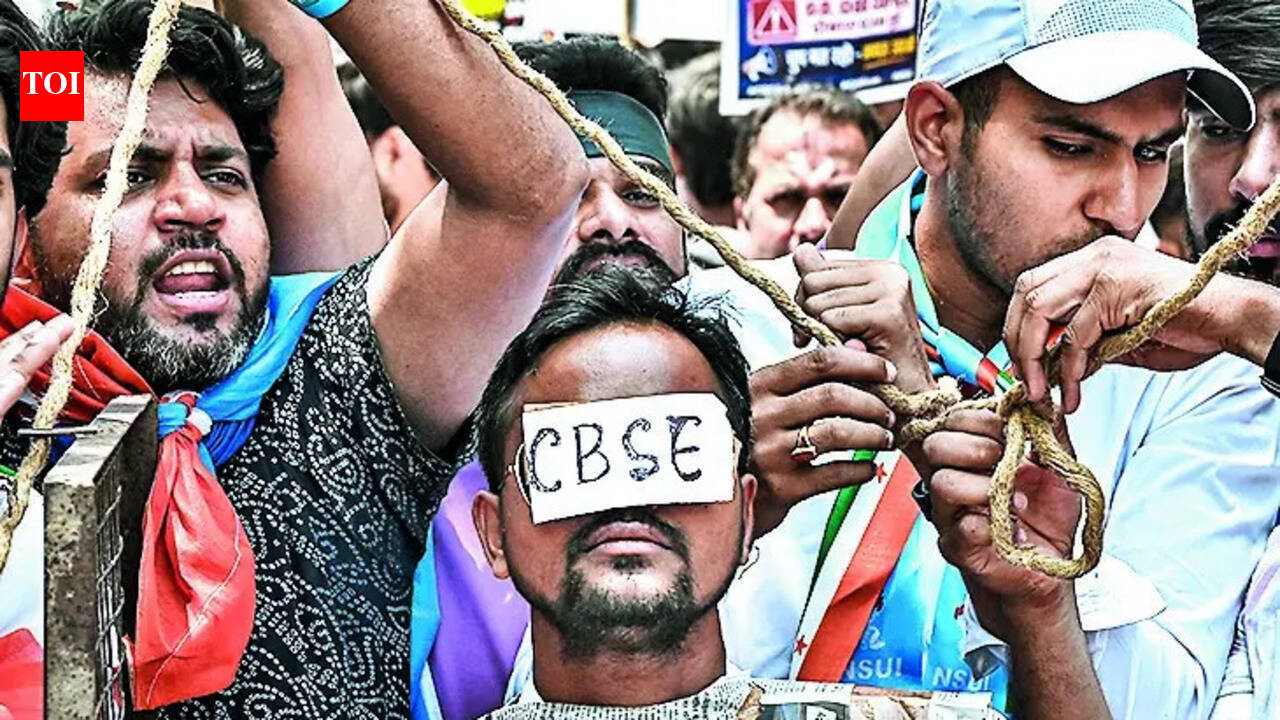
New Delhi: Hyderabad-based Koempt Edutech Pvt Ltd, which has faced criticism over the on-screen marking (OSM) system used for re-evaluation of Central Board of Secondary Education (CBSE) Class 12 answer sheets, will continue to handle the process, according to news agency ANI.However, as a safeguard against possible data breaches and cyber attacks, CBSE has now transferred all relevant data from Coempt’s servers to its own servers.Sources told ANI, “Koempt Edutech Pvt Ltd will continue to scan answer sheets for revaluation. Its OSM platform will be used for the process. Steps have been taken to secure the portal against data breach and possible cyber attacks. CBSE has transferred all answer-sheet data and records from Koempt’s servers to CBSE servers for greater control and security.”CBSE has been embroiled in controversy after some Class 12 students alleged that the scanned copies of their answer sheets uploaded by the board did not match their handwriting, raising concerns about possible mismatches in the on-screen marking (OSM) system.The board’s OSM project has also come under scrutiny as procurement records revealed that Koempt Edutech had narrowly outperformed Tata Consultancy Services (TCS) in the technical evaluation before gaining a decisive lead with a significantly lower financial bid.Read this also CBSE’s defeat: Coempt beats TCS in technical evaluation, now eyes on tender designThe evaluation process has raised questions among some procurement observers as to whether the tender criteria favor companies with specialized exam-scanning experience over companies with broader technology and systems integration capabilities.This contract involves scanning and digital evaluation of approximately 9.9 lakh Class 12 answer sheets under the CBSE’s fully digitized evaluation system introduced this year.However, CBSE rejected The allegations regarding the award of the contract to Koempt Edutech were described as “misleading” and “not based on facts”.

Source link

‘Don’t want to be Jimmy Carter’: Trump explains why US troops did not extract uranium from Iran

'Don't want to be Jimmy Carter': Trump explains why US troops did not extract uranium from Iran

us President donald trump Revealed that he once considered a plan to send US troops to Iran to extract its enriched uranium reserves, but ultimately canceled it as tensions re-emerged in the Middle East along with ongoing diplomatic talks.Trump said the plan was rejected because it was considered “too risky” and would require widespread military mobilization. He said the operation would take at least two weeks and would involve the delivery of significant amounts of military hardware to Iranian territory. “I didn’t want to be like Jimmy Carter,” he said, referring to the former president’s failed attempt to free 52 U.S. embassy staffers taken hostage by Iran in 1980.Referring to the nuclear material as “nuclear dust”, Trump said that Pentagon planners had examined several methods to recover the stockpile.While the proposal was shelved, Trump said the United States still had the capability to carry out such an operation. “We can get it right now,” he said, “I don’t think they could stop us if we wanted, but there’s no reason to. It’s complicated.” The US President further noted that the material is currently safe and does not require immediate action, and said that Washington does not need a formal agreement with Tehran to take control of the enriched uranium.Trump also said he is not willing to meet directly with Iran’s supreme leader Mojtaba KhameneiHowever, he did not rule out the possibility if a broader diplomatic understanding is reached between the two countries. He said, “If it happens… I will respect it.”Islamic cleric Mojtaba Khamenei, 54, assumed supreme leadership of Iran after his father was assassinated in a joint US-Israeli military strike. Trump said that despite US and Israeli precision operations targeting Khamenei’s immediate family members, he still expected professional conduct from the Iranian leader. “We killed his father, his wife and his son, so maybe I’m not his favorite person...But in some circles, he actually has a very good reputation,” Trump said.In a parallel development, a report from Axios said senior US envoys Steve Witkoff and Jared Kushner visited Oak Ridge, Tennessee, on Thursday for consultations with technical experts expected to play a key role in upcoming nuclear talks with Iran.The White House is working toward a memorandum of understanding (MOU) with Tehran aimed at halting hostilities and pursuing comprehensive nuclear talks. However, officials and regional mediators involved in the process say the two sides remain deeply divided over key elements of the proposed agreement.Although talks are said to be in their final stages, officials have cautioned that the chances of success remain uncertain. A US official said the Oak Ridge visit should not be seen as a guarantee of an agreement, but rather a sign that discussions have entered a more serious phase.Key sticking points The slow pace of progress continues, with the Trump administration pushing for a strict 60-day deadline to deplete Iran’s enriched uranium, while Tehran is pushing for a 90-day deadline.Meanwhile, the chaos in the Middle East has already crossed 3 months, now approaching the 100-day mark. The conflict began on 28 February, when the US and Israel launched joint strikes on Iran. Following the attack, the country retaliated by seizing the vital Strait of Hormuz, disrupting 20% ​​of global oil supplies, disrupting economies.

Source link

‘Indecent behaviour’: India condemns disruption of CJI Surya Kant’s UK speech. india news

'Indecent behaviour': India condemns disruption of CJI Surya Kant's UK speech

New Delhi: The Indian High Commission in London on Friday condemned the “indecent behavior of the audience” during Chief Justice of India (CJI) Surya Kant’s lecture at Birkbeck College, videos of which surfaced online, showing a participant attempting to raise questions about dissent and democracy in India during the event.“Such unruly audience behavior is unacceptable and inconsistent with the respectful engagement that governs public discussion. Differences of opinion are a natural part of a democratic society. However, they must be expressed in a civil and respectful manner,” the High Commission post said.The statement comes after a clip circulated on social media in which a participant tried to ask questions to the Chief Justice while he was delivering a lecture on artificial intelligence and international law. Organizers intervened and stopped the conversation from continuing, and asked attendees to keep focused on the topic of the event.Speaking at Birkbeck College, University of London, Justice Kant said artificial intelligence has emerged as one of the defining legal and governance challenges of the modern era, the consequences of which will shape the future of democratic societies and international law.During his address, Justice Kant argued that artificial intelligence has moved beyond the realm of theory and is now having a direct impact on public institutions, legal systems and governance structures across the world.He said AI represents one of the greatest challenges facing modern international law and stressed that the way governments and societies respond to the technology will have long-term implications in the coming years.“Technology is neither inherently benevolent nor inherently harmful. Its impact depends on the legal, political, and ethical framework within which society chooses to deploy it. Therefore, the responsibility of law is neither to oppose technological progress nor to surrender unquestioningly to it. Its responsibility is to ensure that technological power remains accountable to constitutional values, democratic legitimacy and human dignity.”The Chief Justice said that AI is already impacting many sectors including governance, commerce, communications, defense and justice system.“Governments now use algorithmic systems to allocate welfare benefits, assess immigration applications, monitor borders, regulate financial systems, and support policing functions. Militaries are increasingly developing autonomous capabilities. There is more than enough access,” he said.Justice Kant also highlighted the growing role of AI in judicial administration, pointing to its use in legal research, case management, translation services, transcription, document organization and identification of precedents.According to the organisers, questions related to India’s democratic record and allegations related to hostility towards dissent were not considered as the session was intended to remain focused on artificial intelligence and its legal implications.One attendee tried to express concerns about the protection of India’s democratic values ​​in the age of AI and described it as hostility towards dissent. However, the organizers stopped the intervention before any discussion could escalate.Addressing the broader implications of emerging technologies, the Chief Justice stressed that AI raises complex questions that extend beyond national boundaries and require coordinated legal responses.“The central challenge before us is to ensure that, in the age of intelligent machines, humanity retains the authorship of the principles by which it is governed. If international law can rise to that challenge, artificial intelligence can become not only a technological revolution, but an opportunity to reaffirm the values ​​that lie at the foundation of democratic civilization,” he underlined.Justice Kant is currently on a six-day visit to the United Kingdom, where he is interacting with legal and academic institutions on issues related to technology, law and global governance.

Source link

Shreyas Iyer includes T20I captain Vaibhav Suryavanshi in the squad for UK tour

India have ushered in a new era in T20I cricket by appointing Shreyas Iyer as captain for the upcoming tours of Ireland and England, moving on from World Cup-winning captain Suryakumar Yadav. The decision marks another bold leadership change as the selectors continue to shape the team’s white-ball future.

The much-awaited inclusion of teenage sensation Vaibhav Suryavanshi is also likely to be included in the team announcement. After a record-breaking IPL campaign, the 15-year-old has been included in the squad for the first time and is set to be a part of India’s T20I plans for the Ireland and England series as well as the Asian Games later this year.

Many more to follow…

– ends

Published on:

June 6, 2026 13:31 IST

Source link