TMC MP gets ‘Y’ category CISF security. india news

TMC MP gets 'Y' category CISF security

The Center has provided ‘Y’ category armed security to senior TMC leader and Lok Sabha MP Kakoli Ghosh Dastidar from May 19, an official said in New Delhi on Wednesday. The Home Ministry has enhanced the security cover given to Dastidar by the CISF – a central armed police force primarily tasked with protecting critical infrastructure and providing security to high-risk individuals – following the Intelligence Bureau’s security assessment report. Under the ‘Y’ category, the protected person is generally assigned a team of armed personnel for round-the-clock protection. Sources said the decision to provide security to Dastidar, who represents Barasat constituency, was taken after reviewing her threat profile. Officials indicated that the security cover would be reviewed from time to time. agencies

Source link

PM Modi gets highest honor of FAO for major agricultural schemes. india news

PM Modi gets highest honor from FAO for major agricultural schemes

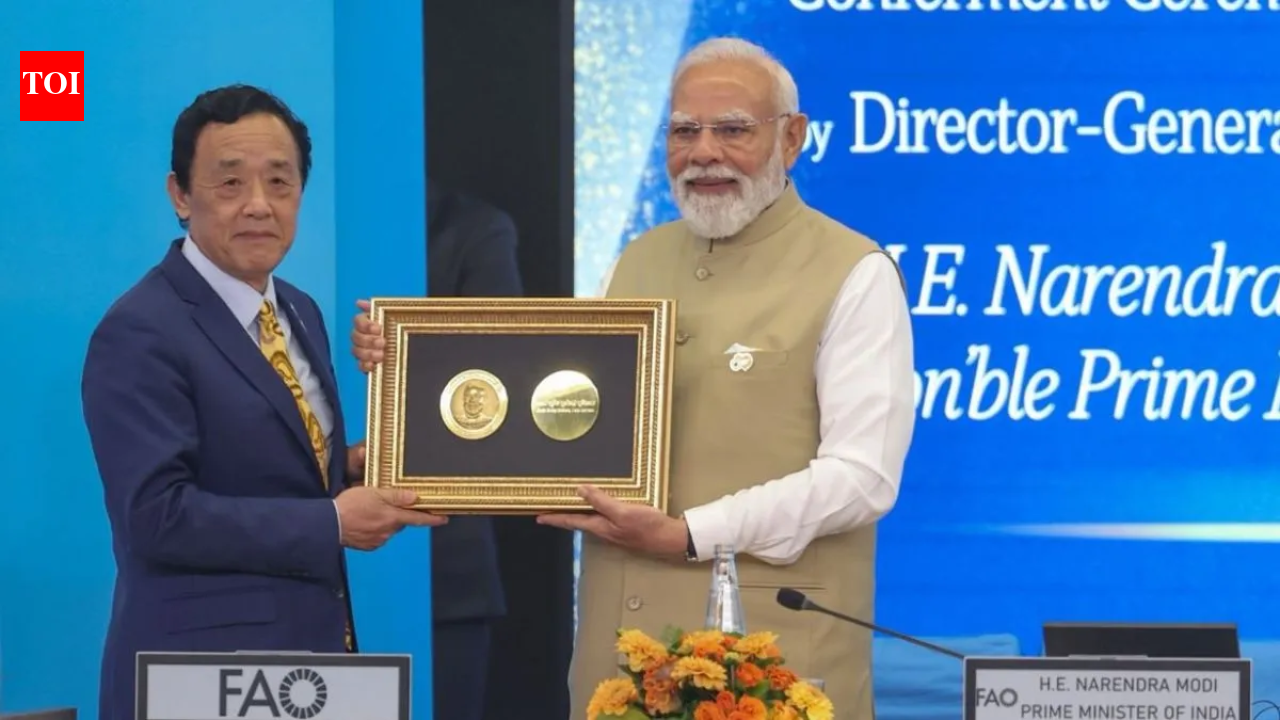
New Delhi: The Food and Agriculture Organization (FAO) on Wednesday awarded its highest honor Agricola Medal to PM Narendra Modi in recognition of his government’s landmark schemes to increase agricultural productivity, promote food security and farmers’ welfare as well as his overall commitment towards public welfare. Receiving the award in Rome from the specialized UN agency leading international efforts to defeat hunger and improve food security, PM Modi said it reflects India’s unwavering commitment to food security and sustainable development, and is an honor for the country’s farmers and others working in the sector. Qu Dongyu, Director-General of FAO, lauded the Prime Minister’s “extraordinary leadership and vision in leading the country’s efforts to transform India’s agricultural landscape through farmer-centric, innovative and path-breaking initiatives”. He also highlighted his government’s financial inclusion initiatives, the world’s largest food-based social safety net covering 800 million people since the COVID pandemic, direct income support to over 110 million farmers, national efforts to advance regenerative and natural farming, and global efforts to promote nutrient-rich millets, including the International Year of Millets in partnership with FAO. The honor is sure to boost PM Modi’s political clout in the face of the opposition, which has accused him of crony capitalism and said it has come at the expense of farmers and the working class. Since assuming power in 2014, the Modi government has come up with several schemes to help the agriculture sector, including annual cash assistance of Rs 6,000 and crop insurance for farmers. However, Congress and other opposition parties have accused him of working for big corporate houses and not doing enough for farmers. He has cited as an example in this context the agricultural reform laws made by his government, which were later withdrawn due to opposition from a section of farmers.

Source link

Will the indictment of Raul Castro for the 1996 downing of civilian airliners bring the US and Cuba closer to war?

Will the indictment of Raul Castro for the 1996 downing of civilian airliners bring the US and Cuba closer to war?

The US indictment of Raul Castro in the 1996 shooting down of civilian planes has heightened tensions between Washington and Havana, with some analysts warning that the move could take the two Cold War rivals closer to open conflict.Charges against the 94-year-old former Cuban president were announced this week in Miami, where Cuban exile groups welcomed the verdict as they awaited long-awaited justice for the deaths of four Cuban Americans when Cuban fighter planes shot down two planes operated by Brothers to the Rescue in 1996.But in Cuba, Raul Castro is still seen by supporters as one of the main symbols of the communist revolution he founded along with his revolutionary brother Fidel Castro.“He is the living embodiment of the revolution,” former US diplomat Ricardo Zuniga told CNN.Zuniga was involved in secret talks that restored diplomatic relations between the US and Cuba during the Obama administration. He warned that the indictment could cut off communications between the two governments and make tensions even more dangerous.“Ultimately, frustrations on both sides could lead to conflict as Washington cuts off communications with the Cuban government through this indictment,” he said.The allegations come at a time when Cuba is already facing one of the worst economic and humanitarian crises in decades. Fuel shortages, food shortages and lengthy power outages have fueled growing despair across the island, while new US sanctions and embargoes have increased pressure on Havana.US President Donald Trump has criticized the Cuban government in recent months and has also suggested he is open to a possible deal.“Whether you change the regime or not, I can (make the deal). It’s been a harsh regime and they killed a lot of people,” Trump said Tuesday.POTUS said: “But this is a country that really needs help. They can’t turn on the lights, they can’t eat. We don’t want to see that.”At the same time, Secretary of State Marco Rubio, a Cuban-American and longtime critic of the Castro family, has taken a much tougher stance. He believes that the current Cuban leadership should be removed from power.The indictment has emboldened anti-Castro groups in Miami, many of whom believe Cuba’s communist government is weakening and could eventually collapse under the pressure.“Castro’s time is over,” Cuban-American congresswoman Maria Elvira Salazar said on X.For Cuban exile communities, the 1996 shootings remain one of the most painful chapters in US–Cuba relations. Brothers to the Rescue aircraft were flying missions involving Cuban refugees and had previously dropped anti-government leaflets in Havana. Cuban officials at the time insisted that the planes violated Cuban airspace and called the attack an act of national sovereignty.Now, if the US attempts to pursue Castro more aggressively, the impeachment could lead to a direct confrontation. The charges could theoretically provide a legal basis for extradition efforts or further action against senior Cuban officials.Cuban President Miguel Diaz-Canel has responded boldly, accusing Washington of trying to impose political change on Cuba. The Cuban military has stepped up exercises across the country, CNN reports, while a state message warned citizens to prepare for possible aggression.Diaz-Canel also warned that a “blood bath” would await any attacking force.Analysts say that despite Cuba’s weak military position, any military conflict would carry enormous risks. Unlike Venezuela, where the US has recently increased pressure on the government of Nicolas Maduro, Cuba’s political and military leadership has been tied for decades to the revolutionary system created by Fidel and Raul Castro.Even though Raul Castro officially stepped down from power several years ago, he still holds tremendous symbolic influence within Cuba. He is regularly referred to as the leader of the revolution, and senior officers continue to consult him on major decisions.Zuniga warned that completely isolating Cuba’s leadership could make the situation more unstable rather than less.“By cutting off communications, they may fail to understand on the Cuban side that the next step could be some type of attack from the United States,” he said.He added: “But there is nothing to destroy that is not already in disrepair.”

Source link

Censor board should make protocol on spy films: Delhi HC | india news

Censor Board should make protocol on spy films: Delhi High Court
The petition alleged that the film compromised the security of India’s on-field undercover agents.

New Delhi: A PIL filed by a serving Sashastra Seema Bal (SSB) personnel raising concerns over Ranveer Singh starrer film ‘Dhurandhar: The Revenge’ disclosing strategic and sensitive information about the country’s intelligence and defense operations and seeking formulation of a ‘spy films protocol’ is essential for the Censor Board to have certain guidelines related to spy films, the Delhi High Court observed on Wednesday. Should”. “The concerns raised by the petitioner need to be considered and addressed appropriately,” a bench of Chief Justice DK Upadhyay and Justice Tejas Karia said. Though films are meant to entertain, they have an impact. The bench disposed of the PIL by directing the Ministry of Information and Broadcasting and the Central Board of Film Certification (CBFC) to “consider the entire writ petition as a representation of the petitioner and take appropriate decision on the issues raised”. It requested the authorities to convey their decision on the representation and to convey to the petitioner if any corrective measures have been taken. The PIL argued that the film violated the Official Secrets Act as it showed “in-depth” tactical operations, sensitive locations and agents, and some scenes also revealed information that was not in the interest of the country’s security. The petitioner further argued that the actions and characters based on high-ranking officers and martyred soldiers in the film are so blatant that it is not in the best interest of the country, and even some successful military operations have been missed in the film. The petitioner also objected to the use of “classified protocols” and the depiction of “deep cover identities” in some scenes of the film. He claimed that the film “directly compromised the security of our on-field undercover agents” and that local authorities in Karachi were on “spy alert” because of it. The PIL seeks formulation of a protocol to stop the exposure of the country’s agents and cancellation of the certification given to the film.

Source link

IPL 2026 | ‘We have been quite poor’: Hardik Pandya’s blunt verdict on Mumbai Indians’ IPL campaign cricket news

IPL 2026 | 'We have been very bad': Hardik Pandya's blunt verdict on Mumbai Indians' IPL campaign
Hardik Pandya (Image Credit: BCCI/IPL)

New Delhi: Disappointment on Captain hardik pandyaHis face was clearly visible, a major reason behind which is proving to be poor fielding. Mumbai IndiansDefeat against Kolkata Knight Riders at Eden Gardens on Wednesday.After MI scored 147/8 in 20 overs, they had a few chances on the field but failed to capitalize on them. The frustration reached its peak in the 10th over when KKR’s Rovman Powell hit a pull shot off Hardik Pandya.Deepak Chahar at fine leg looked set to take the catch, but he left it to Robin Minz coming in from deep square leg and the ball eventually fell safely between the two fielders.“(What was going on in the field?) I don’t know. I think throughout the season, we’ve been pretty bad fielding. I think we dropped a lot of catches, obviously nobody wants to do that. But in that part of the game, I think there is nothing to hide,” Pandya said after the match.He said, “I think if you get chances, if you want to win the game, you have to convert all the chances, even half chances. But yes, when you give up chances that can change the game, it is always that you are chasing the game.”Kolkata Knight Riders stayed alive in the playoff race with a crucial four-wicket win as the Sunil Narine-led bowling attack once again performed well on the difficult surface at Eden Gardens.Needing a win to stay in the competition, KKR put up a disciplined effort to restrict the already-eliminated five-time champions to 147/8. Ajinkya Rahane Won the toss and decided to field.This is the third instance of Pandya losing four consecutive matches as captain in the IPL.“(Were you about 20 runs short?) Yes, I mean, quite amusing. Certainly as a batting group, we were 20 runs short. I think we lost a lot of wickets in the powerplay, but if Tilak and I had stayed longer, and we had made a few more partnerships and got 15-20 runs, I think we would have had a good chance,” Pandya said.

Source link

Angst among students in Gujarat due to GCAS irregularities. ahmedabad news

GCAS glitch sparks anger among students in Gujarat
Members of Akhil Bharatiya Vidyarthi Parishad (ABVP) staged a vigorous protest against the GCAS system, highlighting several anomalies and demanding immediate reforms.

Ahmedabad: Admission to government and select private universities across Gujarat through the Gujarat Common Admission System (GCAS) portal has created widespread dissatisfaction among students due to persistent technical and procedural glitches.On Wednesday, members of Akhil Bharatiya Vidyarthi Parishad (ABVP) staged a vigorous protest against the GCAS system, highlighting several anomalies and demanding immediate reforms. Despite protests from students and parents since its launch two years ago, the government has been insisting on using a centralized centralized portal for admissions.Students have reported that many integrated courses are not appearing as options during the registration process due to pending approvals, limiting their options. Additionally, technical glitches such as the absence of an edit option while choosing between regular and distance learning courses have prevented students from completing their applications. The delay in receiving OTP on mobile phones has further increased the frustration.Concerns have also been raised about students appearing for supplementary examinations, as there is no clarity on how those passing later will be accommodated in the admission process. Similarly, there remains ambiguity regarding the quota for CBSE board students, creating uncertainty about their chances of securing admission.ABVP workers visited the GCAS office at Knowledge Consortium of Gujarat (KCG) and demanded immediate resolution of these issues. He warned that continued negligence could have a serious impact on the academic future of students.Another point of criticism is the registration fee structure. Students will have to pay Rs 300 (general category) or Rs 150 (reserved category), irrespective of whether they have secured admission. With millions of applicants expected, this could generate substantial revenue. Critics argue that the complex process may indirectly push students toward private universities, raising concerns about privatization in higher education.

Source link

Mysterious 2,000-year-old jars from Pompeii finally revealed with 3D scan: How the Romans made them, and why their function remains a mystery world News

Pompeii's 2,000-year-old mysterious vessels finally revealed by 3D scan: How the Romans made them, and why their function remains a mystery

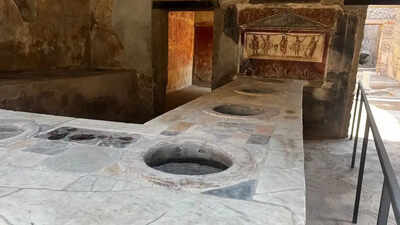
In the ancient ruins of Pompeii, time seems unusually still. Roads, houses and small shops are frozen after the eruption of Mount Vesuvius in 79 AD. Of the many finds scattered across the site, the most puzzling is a set of ceramic jars built directly into the stone counters inside the Roman tavern. Archaeologists have studied them for decades, yet their purpose remains unclear. The jars are physically present, but their story is out of reach. That uncertainty has made them one of the quietest mysteries of everyday Roman life.Now, new research using advanced scanning technology is beginning to change the way we understand these objects. Answers are still sketchy, but the details that are emerging are beginning to reshape long-held beliefs. The findings suggest that these jars may contain more information about Roman craftsmanship and daily trade than previously thought.

The mystery of the Pompeii tabernacle and the built-in jar that survived for nearly 2,000 years

At Pompeii, archaeologists have identified more than 150 small tavern-style establishments known as tabernae. These were simple one-room shops that served food and drink to locals and travelers. Many of these places have ceramic jars permanently set into stone counters. These jars vary in size and shape. Some are tall and narrow, reaching about three feet in height. Others are smaller and more circular. They are not removable, and they were clearly built as part of the structure rather than added later.For years, researchers could only investigate them by looking at them. Opening them was never an option as it would have destroyed both the ships and their archaeological context. As a result, their purpose remained uncertain. Scholars have debated whether they stored food, liquids, or something entirely different. No single explanation has been confirmed.

What 3D scans of Pompeii jars reveal about Roman craftsmanship

A recent study published in Archaeological Method and Theory used non-invasive scanning techniques to examine the jars. Instead of physically touching or removing them, the researchers used a handheld light scanner to capture their internal structure. The team analyzed about 40 jars from 14 different wineries. They then created detailed 3D models based on the scans. These models allowed them to study the internal shape, alignment, and structural stability of each ship.The results showed that the jars were probably made using a slow-turning potter’s wheel. The process was not entirely industrial, but neither was it entirely handmade. This appears to be a controlled method that still allows for small variations during production.

How ancient potters created jars through layered, step-by-step techniques

From the analysis it can be inferred that ancient potters used a step-by-step process in making these jars. They would build a part of the ship, stop, add new material and continue the process. This resulted in small errors in different parts of each jar. Some jars exhibit high stability with respect to their manufacture, while others do not. This implies that multiple workshops or potters were involved in making them. In some cases, jars from different wineries display similar shapes and construction patterns. This indicates some form of training among the potters of the area. On the other hand, most other jars vary considerably in terms of both their size and internal structure.

what were these jars used for

Despite all the recent discoveries about how these vessels were made, their original purpose has not yet been established. Scientists cannot establish exactly what was stored in them. According to some scholars, the contents of the jar may have been some cooked food, such as a stew. This hypothesis is more likely than any liquids due to the fact that they were fixed inside the counter and therefore could not be easily cleaned.Nevertheless, there is no chemical evidence proving the above hypothesis. There are other possible uses of the jar that are still under discussion. These can be used to store semi-solid components or local foods to be consumed in taverns.


Source link

Hotels, guesthouses get industry status in Ladakh. india news

Hotels, guesthouses get industry status in Ladakh

Srinagar: Ladakh Lieutenant Governor Vinay Kumar Saxena on Wednesday granted “industry” status to hotels and guesthouses registered with the tourism department in an aim to strengthen the hospitality sector in the Union Territory.This order will come into effect on June 1. This is expected to benefit 1,257 hotels and guesthouses in the UT, including 1,078 in Leh and 179 in Kargil, as they can now avail electricity and water tariffs at industrial rates, which are lower than commercial rates. Stakeholders, including the All Ladakh Hotel and Guesthouse Association, had been pressing for granting industry status to the sector.“The hospitality and tourism sector has significant potential to promote sustainable economic development and tourism in Ladakh. This improvement will also enhance the visitor experience and establish Ladakh as a world-class tourism destination rooted in sustainability, culture and hospitality,” Saxena said.Now hospitality units will get incentives, concessions and infrastructure support at par with other industries in Ladakh. Most of these hotels operate only for about six months in a year and remain closed during the harsh winters, when temperatures drop as low as minus 40 degrees Celsius at some places, resulting in high maintenance costs, making the hotel and guesthouse business unsustainable.The new tag makes hotels and guesthouses eligible for concessional bank loans under the industrial policies of the UT and Central government. These hotels and guesthouses will also be exempted from property tax, and will also be able to access capital incentives, subsidies and other schemes.

Source link

Cabinet approves proposal, Indigo will operate on Gaya-Bangkok route. patna news

Cabinet approves proposal, Indigo will operate on Gaya-Bangkok route

Patna: The state cabinet on Wednesday approved the Civil Aviation Department’s proposal to select Indigo Airlines for biweekly international flight operations between Gaya and Bangkok (Thailand). This service is expected to start soon.The cabinet meeting was held under the chairmanship of CM Samrat Chaudhary. Additional Chief Secretary, Cabinet Secretariat Department, Arvind Chaudhary said that M/s InterGlobe Aviation Limited, the holding company of Indigo Airlines, was selected through the tender process.He said the Cabinet approved a Viability Gap Fund (VGF) of Rs 10.40 crore for the airline operator for one year. Since the company was the only bidder, the selection was done on the basis of nomination.“Initially, the number of passengers may not be up to desirable levels. Therefore, a viability gap fund of Rs 5 lakh is being paid to the firm for each round-trip flight from Gaya to Bangkok and from Bangkok to Gaya, and this will be payable for one year.”He said the Cabinet approved the proposal looking forward to the early start of the international service.“The long-term feasibility of the international flight between Gaya and Bangkok is assured, as a large number of tourists from Thailand come to India every year to visit important Buddhist sites, with Buddhist sites in Bihar such as Bodh Gaya and other places holding special significance,” he said.He further said that this step will increase the number of tourists in the state and strengthen Bihar’s presence on the international tourism map, besides boosting economic activity in sectors like hospitality, hotels, transport and handicrafts.Overall the cabinet approved 13 proposals during the meeting.In another major decision, the Cabinet approved the release of Rs 428 crore to the Water Resources Department (WRD) for supplying water to the upcoming Dobhi Industrial Enclave under the Amritsar-Kolkata Industrial Corridor (AKIC).Officials said the required water supply will be ensured through reservoirs to be constructed by the WRD. According to the master plan, the industrial sector will initially require 8.5 million liters per day (MLD) of water, while the final demand is estimated to be 19 MLD. The annual water requirement has been estimated at 8.5 million cubic meters (MCM).For this, 324 acres of land will be provided by Bihar Industrial Area Development Authority (BIADA) near Dobhi for the construction of a reservoir with 8.5 MCM storage capacity. Water will be drawn from the rain-fed Leelajan river for 40 days to fill the reservoir and meet the estimated demand of 19 MLD.The Cabinet also approved the release of Rs 747 crore from the State Contingency Fund for central grants to the health sector for the financial year 2026-27 on the recommendation of the 15th Finance Commission.The amount will be used to strengthen health services in block-level primary health centers (PHCs), including opening diagnostic centers and setting up health and wellness centres.Another proposal approved by the Cabinet was to continue the recommendations of the Fifth State Finance Commission for release of grants to urban and rural local bodies during 2026-27, as the recommendations of the Sixth State Finance Commission have not been received yet.The Cabinet also approved the Young Professionals Selection Policy, 2026, which aims to appoint technical and specialized professionals to institutions under the Department of Science, Technology and Technical Education. This policy seeks to improve efficiency in technical institutions by involving young professionals.To strengthen the border security and intelligence network along the “highly sensitive” India-Nepal border, the Cabinet approved the creation of the post of Inspector General of Police (Border) in the Special Branch of the Home Department.

Source link

Israeli parliament votes on advance bill to dissolve the Knesset, paving the way for early elections

Israeli parliament votes on advance bill to dissolve the Knesset, paving the way for early elections
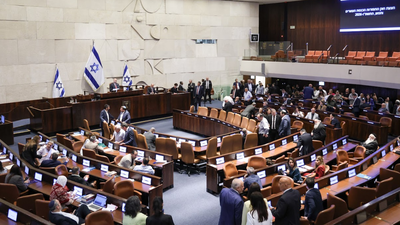
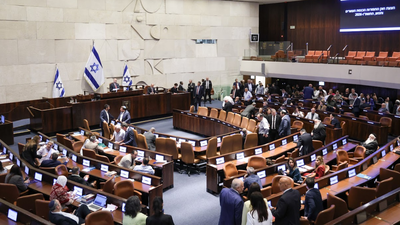
Image used for representative purposes

Israeli lawmakers voted overwhelmingly on Wednesday to advance a bill to dissolve the Knesset, a move that could pave the way for early elections and deepen political uncertainty for Prime Minister Benjamin Netanyahu’s coalition.In the initial reading, 110 out of 120 members of Parliament supported the motion, with no votes against it and the remainder abstained. The bill, introduced by the ruling coalition, has now moved to the committee stage before going through three more readings needed for final approval.If ultimately passed, the dissolution would automatically trigger elections within 90 days, potentially pushing voting to October 27.The development comes amid growing tensions within Netanyahu’s right-wing coalition, particularly over disputes with ultra-Orthodox parties. They have accused the prime minister of failing to meet commitments to pass a law granting military service exemptions to their communities, a long-standing political flashpoint in Israel.Coalition tensions have opened the door to opposition parties who are pushing for early elections and trying to capitalize on Netanyahu’s declining political standing in opinion polls. Israeli political columnist Miriam Shermer said, “The dissolution of the Knesset, approved in preliminary reading this Wednesday, could still be suspended if the exemption (for ultra-Orthodox students) is already passed.” He said the situation could still change depending on security developments or legislative deals, as cited by AFP.On Wednesday, coalition chairman Ofir Katz said: “This coalition has fulfilled its days.”Political analysts say the timing of the move could shape the election narrative, with some suggesting that Netanyahu may prefer to hold early elections to avoid the anniversary of the October 7 attacks dominating the election campaign.“The election campaign has begun,” opposition leaders have said, as rival factions begin setting the stage for another closely contested and fractured vote with so far no clear path to a stable majority.

Source link