


Decoding Bengal SIR data: Of 123 in the margins, 49 in close focus india news
 BJP Winning 207 seats, surpassing most expectations, powerful TMC Were reduced to 80, and other parties were reduced to mere footnotes.Many pundits believe that the anti-incumbency wave was so intense that it perhaps drove much of the unease and anger around SIR, which TMC wanted to exploit. Some have previously argued that the deletion was done in a politically motivated manner to tilt the situation in favor of the BJP, particularly pointing to the “logical inconsistency” factor introduced late in the SIR process.Here, we decode the data based on various boundaries.To understand the potential impact of SIR, the most obvious starting point is to examine seats where voter deletion was greater than the margin of winning the seat.This analysis uses constituency-wise deletion calculations by the Saber Institute, mapped with 2026 result-margin data. Pure extinction here means extinction due to reasons other than death. The net-deletion table covers 294 assembly constituencies and involves 66,62,010 deletions.And this is where the first big number comes in.In 123 of the 293 declared seats in Bengal, the net deletion was larger than the margin of victory. Of these, BJP won 83 seats, TMC won 38 and Congress won 2 seats. The BJP’s tally of 83 seats is almost two-thirds of the 123, which is roughly in the same area as its overall dominance in the election.There is a second, more intense layer. Supplementary deletions from the supplementary/adjudication layer crossed the margin of victory on 49 seats. This refers to under-decided voters whose names were ultimately removed. At last count, out of about 60 lakh names under consideration, 27.16 lakh were removed. When mapped constituency-wise, BJP won 26 of these 49 seats, TMC 21 and Congress 2.For clarity, we are using the term stress in the narrow arithmetic sense. A seat is counted as an extinction-stressed seat when the number of extinctions is greater than the margin of victory. So if a constituency was won by 5,000 votes and the net deletion was 12,000, that seat enters the tension list because the deletion was more than double the margin.
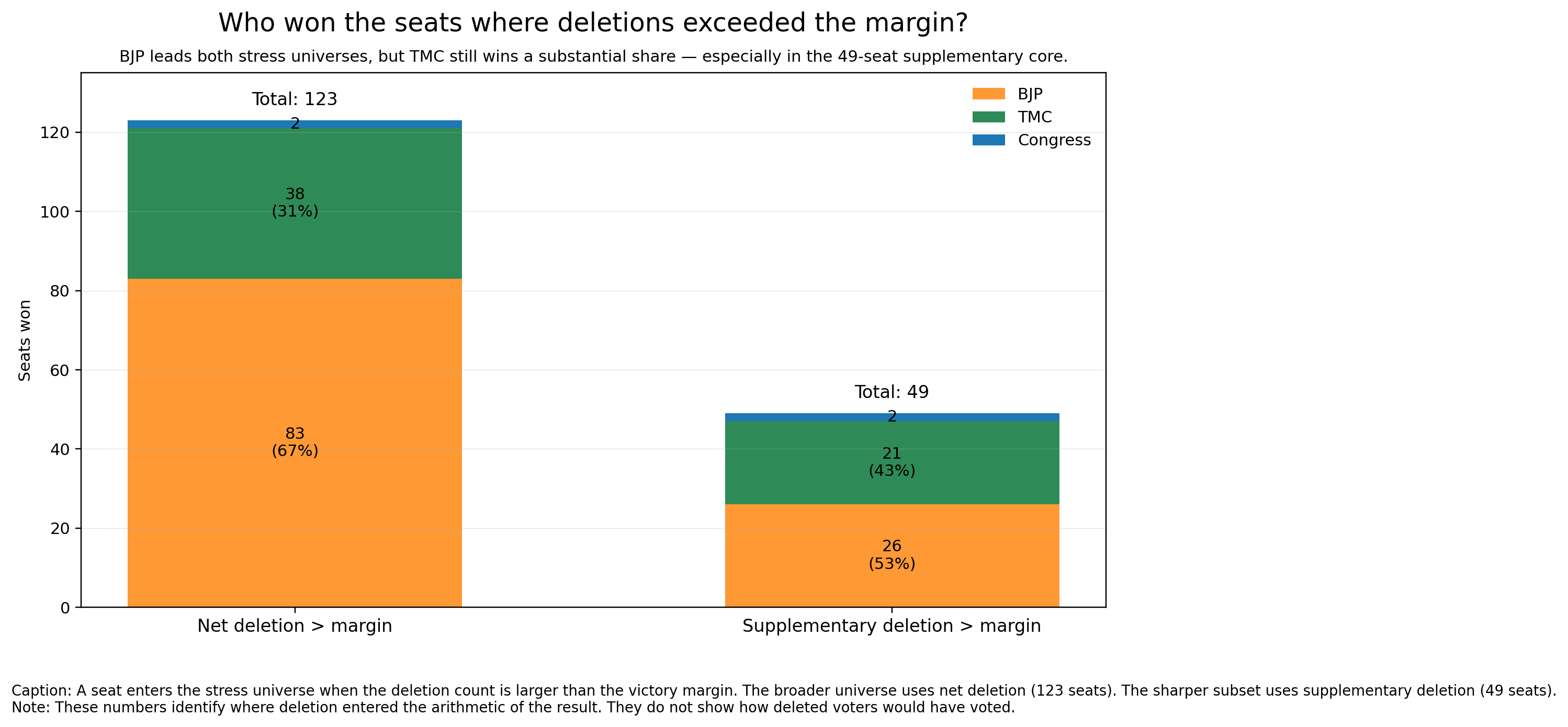
This does not mean that the result would have changed. It only means that the number of deletions compared to the margin was large enough to be electorally significant.All 49 of these complement-deletion strain seats were already inside the larger 123-seat net-deletion strain universe.
These numbers matter because they keep the debate from becoming vague. On 65 seats, the net deletion was not just bigger than the margin; This was more than double the margin. On 20 seats this difference was more than five times. Even by the narrow complementation-deletion test, 23 seats crossed the 2x mark and 10 seats crossed the 5x mark.That is not a clerical footnote.Take Rajarhat New Town. BJP won by just 316 votes. The net deletion there was 50,274. Complementary deletions alone were 24,132. According to complementation testing, the difference in deletions was more than 76-fold; According to the net-deletion test, this margin was more than 159 times greater.In Satgachia, BJP’s margin was 401, while pure deletion was 17,783 and supplementary deletion was 8,785. In Kashipur-Belgachia, BJP won by 1,651, while the net loss was 39,278.These figures do not say that the result would have changed. He says that the number of deletions was so large that it could not be ignored.But this is where the story becomes more interesting than partisan talk. High extinction tension does not always mean a victory for the BJP.Look at Samserganj. TMC won by 7,587 votes. Congress remained at second position. The net deletion was 83,662. Complementary deletions alone were 74,775, approximately 10 times the margin. If the tension of extinction had automatically translated into BJP’s advantage, Samserganj would not have looked like this.Therefore, the more acute political question is not just where extinction has gone beyond the margins. Was intense vote-share churning seen on these seats too? Did BJP move forward rapidly? Did TMC fall drastically? Did the extinction-margin map overlap with the political swing map?The clear benchmark comes from the 129 seats that went directly from TMC in 2021 to BJP in 2026. On these seats, BJP’s average vote-share gain on an adjusted basis was 10.63 percentage points, while TMC’s average decline was 8.90 points. The average two-way churn was 19.53 points.The strongest churn signal comes from the overlap of the top 50 BJP-gained seats and the top 50 TMC-gained seats, both measured in percentage-point terms. Both lists include thirty-five constituencies. Among these, BJP gained an average of 15.93 points, while TMC fell by 12.35 points. That is the real churning area, where the rise of BJP and the fall of TMC happened simultaneously.This matters because the 123 extinction-margin seats are not of a political type.
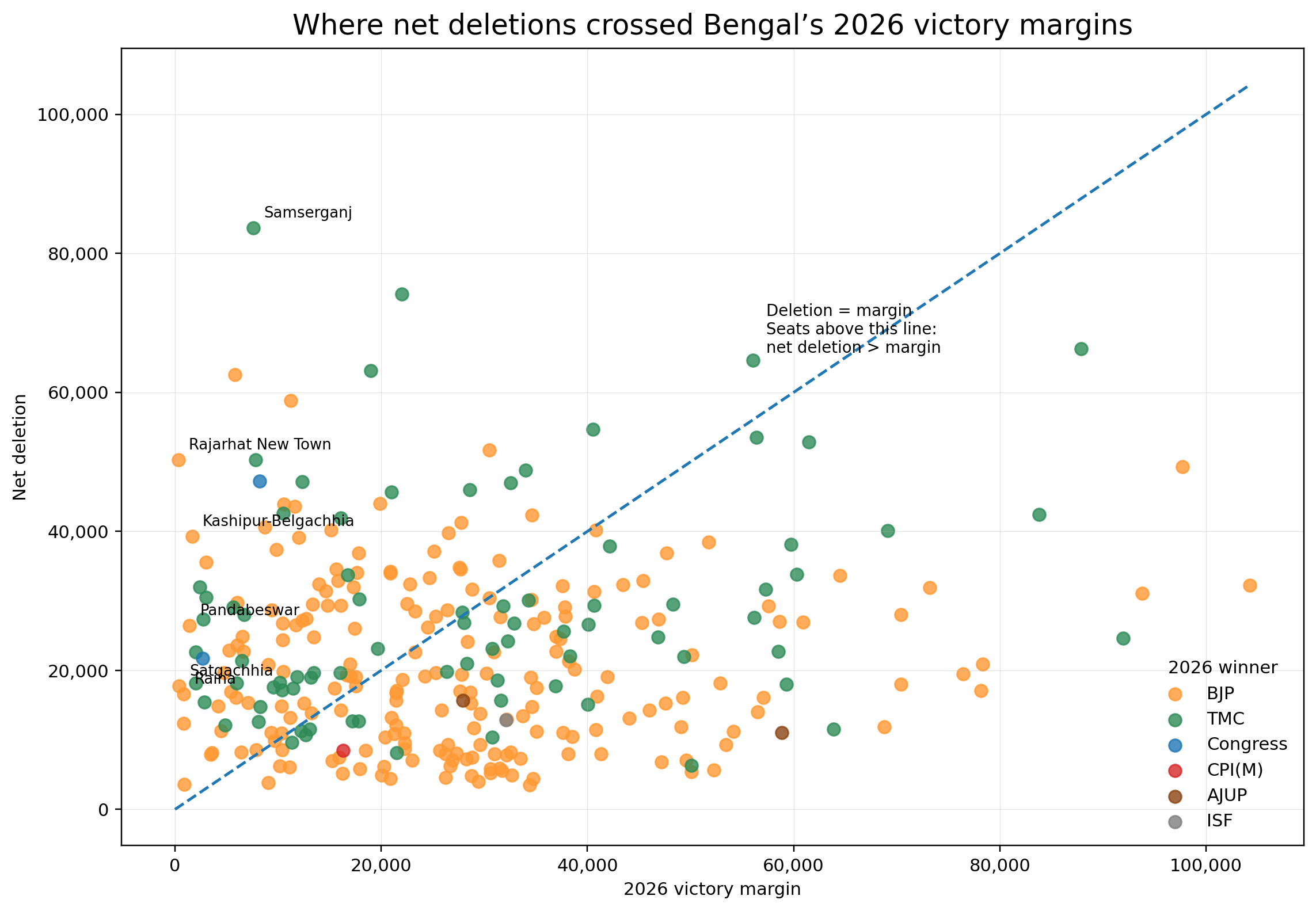
There are some BJP-changed seats, where the tension of deletion and churning went on simultaneously. There are some TMC-eroded seats where the beneficiary was not always the BJP. Some are seats with only arithmetic tension, where deletions exceeded the margin but the vote-share movement was not dramatic.Bhabanipur is a good example of the first type. It is not part of the 49-seat complementation-deletion strain list. There the complement was smaller than the deletion margin. But the widespread net deletion was 2.66 times the margin. At the same time, BJP’s vote share increased by 17.86 percentage points, while TMC’s vote share fell by 15.52 points.So Bhabanipur is not a story of decision-making. It’s a net-deletion-plus-churn story.Jadavpur also tells a similar story. The net deletion was 1.25 times the margin. The complementary deletion was small. But BJP’s vote share jumped by 21.29 points, while TMC’s fell by 11.58 points. Jadavpur is not in the supplementary core, but is part of the broader extinction-margin and churn map.However, Nandigram is different. This technically falls into net-extinction stress territory, but only justifiably. BJP won by 9,665. The net deletion was 9,891, just 226 more than the margin. Complementary deletions did not cross the margin. BJP’s vote share increased by only 1.88 points. TMC’s decline was 1.09 points.There are also different political types within the 49 complement-stress seats.
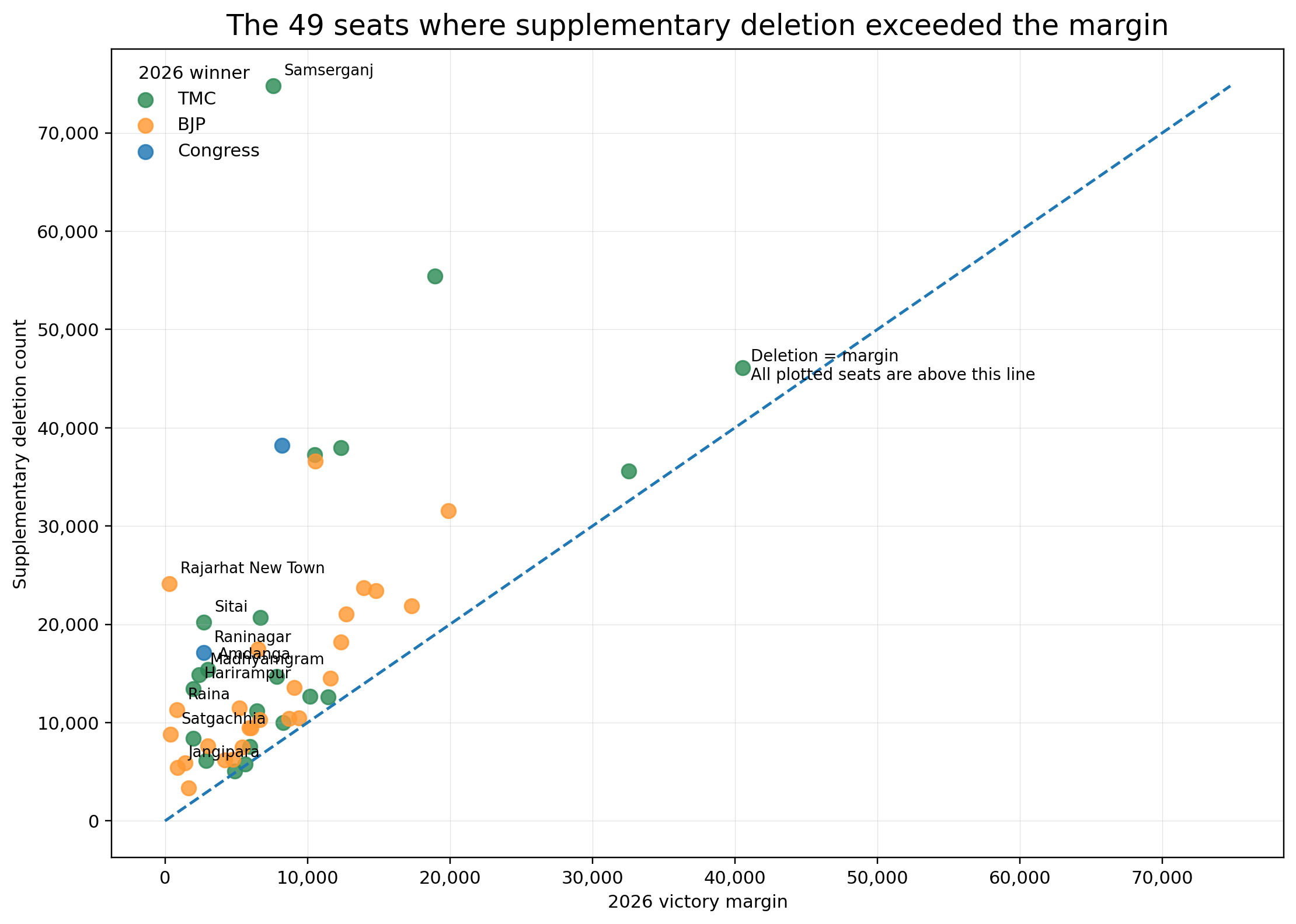
There are some clearly BJP-whipped seats. For example, supplementary deletion in Jangipur shows a difference of more than three times, with the BJP gaining 20.73 points, and the TMC falling 30.88 points. Rajarhat New Town, Kashipur-Belgachhia, Manikchak and Monteshwar also fall in this strong zone: crossing the extinction margin, BJP rose sharply and TMC fell sharply.But the second set tells a different story. Farakka, Raninagar, Lalgola, Raghunathganj, Mothabari, Suti and Samserganj show TMC’s erosion under high electoral stress, but the beneficiary was not always the BJP. In Murshidabad and parts of Malda, the Congress and the local competition structure mattered. TMC’s falling vote does not always translate into increasing BJP’s vote.Then there is the third bucket. The extinction-to-margin ratio was high in Raina, Pandabeswar and Jangipara, but the BJP-TMC churn was weak. Pandabesvara is particularly useful as a warning. BJP won and the margin of supplementary deletion was more than four times, but TMC’s vote share actually increased by 0.29 points. It cannot be called an anti-TMC churning seat.In a smaller group, especially in Kolkata and urban-surrounding areas, margin tension prevailed with the BJP’s sharp rise and TMC’s sharp decline.Therefore, there is no definitive way to say that the seats most affected by SIR disproportionately helped a certain political party. Looked at at a micro level, this broadly reflects the current ground situation in that constituency. The SIR had “Special” in the name, but the results were not statistically tragic. What stood out was the margin mathematics that held it back.