
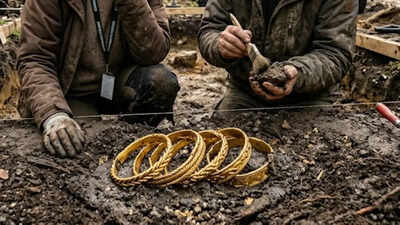

This 1,000-year-old Viking treasure found in Denmark contains almost pure gold arm rings World News
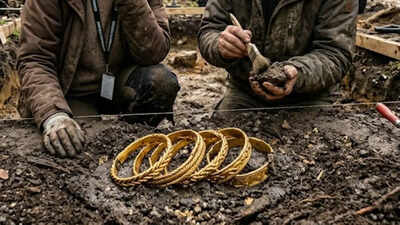
In Denmark, archaeologists were really surprised when they found an extraordinary hoard of Viking Age gold in a forest in Himmerland. The treasure includes six solid gold arm rings weighing 762.5 grams; As reported, this is the third largest discovery of its kind of this era in Danish history North Jutland Museum. These treasures date back to the 10th century and were partially uncovered in the soil by a resident on a forest path rather than at the burial site. This could mean that it was deliberately placed there or hidden during political unification. Now declared state property, this ‘rolled treasure’ provides a rare, tangible link to the high-status craftsmanship and symbolic wealth of the Viking elite.
Unique Viking Age gold arm rings found in Denmark
In the forests of Himmerland, archaeologists found a hoard of six distinctive gold bracelets made entirely of solid gold, with a total weight of 762.5 grams. These treasures date back to the late 900s, possibly during the time of Harald Bluetooth. Torben Sarouw, cultural heritage manager and archaeologist at the Museum of North Jutland, explained how similar these rings are to each other. He notes that they would have been produced as a matching set, which would have served as a status symbol for wealthy Vikings. Such wealth has rarely been found in a single archaeological discovery.
Identified as Denmark’s third largest Viking gold treasure
According to a published report at the Museum of Northern Jutland, the find ranks as Denmark’s third-largest Viking Age gold treasure, largely due to its heavy weight and high purity. Such pure gold deposits are incredibly rare in Scandinavia, where silver is more commonly found. The sheer size of the find indicates ownership by someone very powerful or influential. As a result, archaeologists now have important new insights into how wealth was distributed in Northern Jutland in the late 10th century.
Why was gold buried alone
Museum archaeologists using a metal detector found the rings along a path in the Roald Skov forest. They were lying close to each other, it seemed as if someone had buried them together. Nearby, there were no burial mounds or signs of settlements, so experts believe the treasure may have been offered to the gods or hidden by an important person in a time of trouble.
How does Denmark protect its ancient stores?
After they found it, the discovery was immediately reported to the museum and classified as Denefo (treasure trove). This Danish law places important cultural objects in the hands of the public. The rings ended up in the National Museum of Denmark, where experts will carry out conservation and study their metallic properties. By doing so, they ensure that the 1,000-year-old gold is preserved under climate-controlled conditions. Experts also plan to examine how the rings were made to determine whether local artisans worked on them or whether the gold came from elsewhere.