
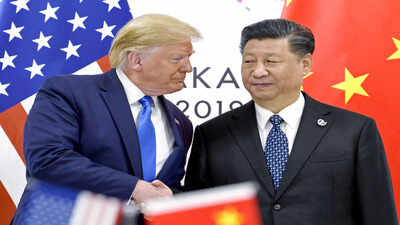

Don Tzu vs. ‘Philosopher King’ Xi: Decoding the worldviews of Donald Trump and Xi Jinping world News
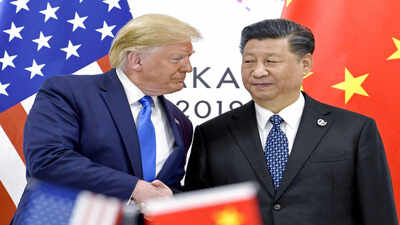
In April, a particular meme took over the Chinese Internet: Don Tzu. an illustration of donald trump And Sun Tzu, it imagined the 47th President of the United States as a strategic sage whose wisdom somehow escaped both grammar and causality. The meme was filled with Trumpian aphorisms on “winning”, including gems like “Break the enemy’s blockade by blocking the enemy’s blockade”, “If you don’t know what you’re doing, neither does your enemy”, and “You can’t lose if you don’t have a goal.” Sun Tzu wrote The Art of War. Don Tzu appears to have written The Art of What Is Happening?The meme worked because it revealed something real about how Trump uses power. He does not practice strategy in the old sense with principles, discipline, patience and a clearly defined end position. If one is generous, his genius lies in turning confusion into leverage. He makes so much noise that everyone else has to explain it. He declares victory before the war, during the war, after the war and sometimes instead of the war. In the Trumpian universe, the declaration is not a description of reality. There is an effort to change this.Which brings us to the man standing across the table. If Trump is Don Tzu, Xi Jinping The philosopher is the king. A recent New York Times report on Xi behind closed doors described a ruler who has no close domestic rivals, who is willing to preach to weaker leaders, and who models himself on ancient Chinese rulers who combined political authority with civilizational learning. Don Tzu is funny because he turns strategy into nonsense. Xi is annoying because he turns other people’s nonsense into proof of his own seriousness. Trump moves into politics like a man convinced the room exists because he has entered it. Xi approaches politics like a man who is convinced that this room has existed for 5,000 years and is patiently waiting for everyone else to figure out the correct form of address.
art of winning without any consistency
Trump’s philosophy is often mistaken for the absence of philosophy, but if practiced with enough confidence the absence can become a system. Every problem becomes a deal, every deal becomes a performance, every performance needs a winner, and the winner, ideally before even checking the paperwork, is Donald Trump.
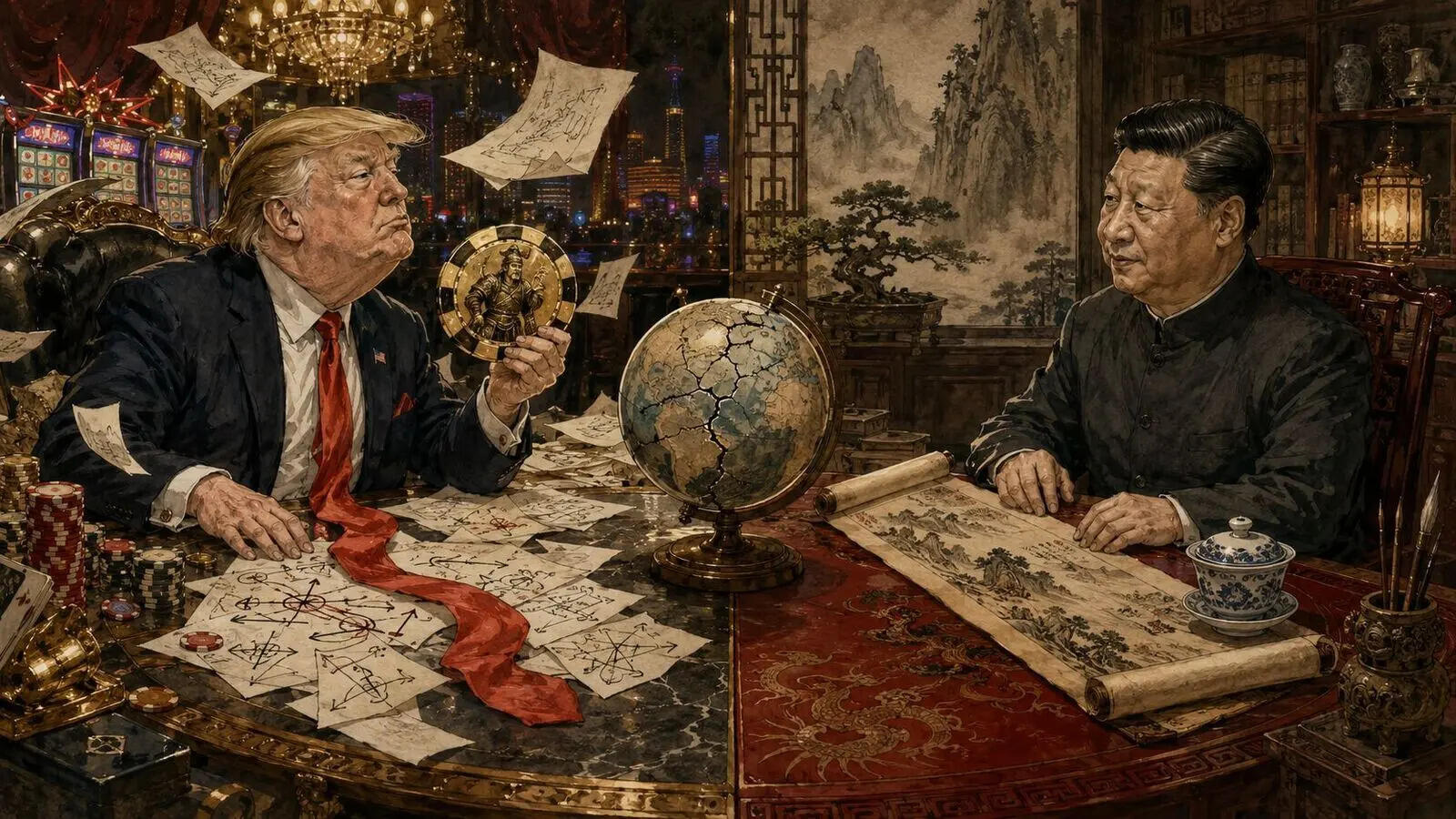
That’s why Trump’s foreign policy has always had the air of a casino floor where there’s also a house, a bouncer, and a guy selling souvenir steaks near the exit. Alliances are unpaid invoices. Trade deficit is an insult. Summits are televised manhood competitions in which someone has to come forward afterward and tell the camera that the conversation was historic, beautiful, and very strong. Form is more important than substance because form is substance.Trump’s inconsistency has political utility because it defies explanation. Allies, enemies, markets, bureaucrats, generals and journalists spend enormous energy trying to figure out whether his latest statement is policy, provocation, bargaining chip, grievance, brain freeze or some previously unseen fifth state of the matter. If you don’t know what you’re doing, your enemy doesn’t know either. If there is no stated objective, there can be no failure. If reality contradicts the statement, reality may be accused of liberal bias.
uses of she and order
Xi appears to have already understood Trump, though not with admiration. In details of Xi’s last meeting with Barack Obama in Lima in 2016, Trump had shocked the world by winning the US presidential election, and Xi was shocked that American voters could choose such an unconventional person. Obama tried to portray Trump’s rise as the result of American economic frustration, including anger over lost manufacturing jobs and intellectual property theft. Xi was reportedly angry. He put down his pen, folded his hands and uttered a line that sounded less like diplomatic analysis than a verdict carved on a palace wall: If an immature leader throws the world into chaos, the world will know who to blame.The moment is significant because it reflects Xi’s view of Trump, America and the consolidation of democracy. Trump was proof that the American system has lost the ability to filter seriousness, that democracy can turn outrage into leadership, that the liberal order has given rise to a man who treats institutions as props and norms as traps. For a leader who has spent years presenting China as stable, disciplined and historically consistent, Trump’s rise was a gift from the gods of comparative politics. Beijing did not need to make any arguments about Western disarray. America had exported the live stream.Xi’s political performance is built around the opposite proposition: chaos is Western, order is Chinese, and history has finally found its adult superintendent. The Chinese Communist Party claims legitimacy not just from revolution or economic development, but from its role as custodian of Chinese history. Xi has intensified that claim. He speaks as if China is not simply a modern nation-state, but a civilization that was temporarily out of whack for a few centuries and is now regaining its rightful place in the universe. During Obama’s 2014 visit to Beijing, aides were expected to discuss the South China Sea. Instead, Obama and Xi reportedly had a long conversation about whether an individualist society and a collectivist Confucian society could be compatible. That was politics conducted as a study of civilization.
How do they treat the middle powers?
The difference between Trump and Xi in their dealings with middle powers is highlighted with unusual clarity. Trump treats the middle powers like supporting actors in a drama of American grievances. Canada, Denmark, NATO allies and trading partners are often included not as diplomatic entities with their own constraints and dignity, but as extras in White House productions about American strength. The Greenland case is the clearest example of this. Trump’s recurring interest in acquiring or controlling the autonomous Danish territory turned an ally’s sovereign question into a dominance ritual, forcing the islanders and Denmark to explain that they were not distressed assets on a golf-course balance sheet. Trump’s approach is pressure attached to a microphone. He doesn’t just want concessions; He wants other countries to be forced to obey him.
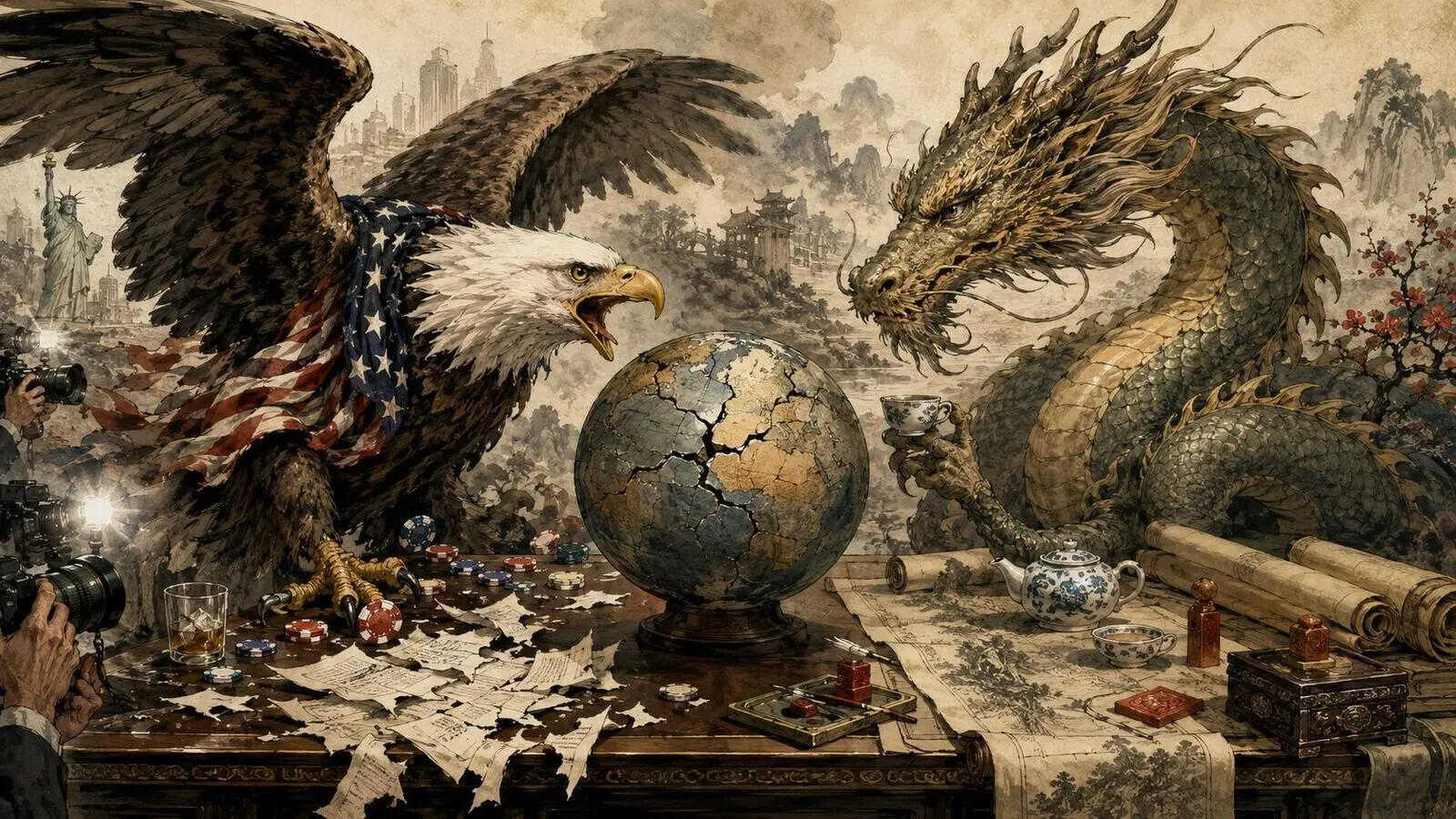
Xi’s style of behavior toward middle powers is distinct, though not necessarily soft in substance. He doesn’t need a carnival. He prefers controlled rooms, stern smiles and reprimands as protocol. exchange with 2022 justin trudeau remains the clearest example. Xi confronted the Canadian leader at the G20 in Indonesia after details of their previous conversation emerged in the media. Xi told Trudeau that this was not appropriate and not how the negotiations were conducted. Trudeau tried to explain that Canada believes in open dialogue and agree-to-disagree diplomacy. Xi cut him off, said he should first create conditions, shook his hand and left.That brief exchange contained the grammar of Xi’s power. He was not objecting to just a leak. He was objecting to the violation of hierarchy. Speak in the right room. Raise objections in the right tone. Do not embarrass the Sovereign in public. Mark Carney’s account of his meeting with Xi points in this direction. According to Carney, Xi spent the first part of their conversation explaining how he wanted the personal relationship to work. The message, as Carney explained, was simple: No surprises, be direct, raise the issues privately and don’t lecture me in public.So the difference is sharp. Trump humiliated the middle powers by publicly applying pressure; Xi disciplines protocols by sanctifying them. Trump uses them to demonstrate that America can still push. Xi uses these to demonstrate that China should not be talked about as if it were another country.
complaint and destiny
His criticisms of democracy are similarly revealing. Trump’s criticism is emotional. Democracy is legitimate when it loves it, questionable when it rejects it and sacred when it returns it to power. Xi’s criticism is historical. Joe Biden has reiterated Xi’s statement in which he said that democracy cannot survive in the 21st century because consensus is very difficult and autocratic rule can escalate rapidly. For Trump, democracy is a test of loyalty. For Xi, it is a museum exhibit: perhaps brilliant, certainly interesting, but too slow for the coming century.His foreign policies flow naturally from these dispositions. Trump wants deals. Xi wants architecture. Trump wants obvious concessions: purchases, tariff relief, the promise of factories, a handshake that can be sold to voters. Xi wants slow and deep changes: acceptance of China’s red lines, respect for its status, and recognition that Taiwan is not just a flashpoint but a sacred question of national integrity. Trump’s time horizon is the news cycle, market reaction, and rallying applause. Xi’s time horizon is the Party Congress, the five-year plan and the historical arc. Trump wants the trophy. Xi needs a map.
chaos of the new world
The easy read is that Trump and Xi are opposites: Trump is anarchy, Xi is order; Trump improvised, Xi planned; Trump shouted, Xi was lecturing; Trump is the casino, Xi is the court. It’s more disturbing to read in depth. They are rival answers to the same crisis. Both have emerged in an era when the old liberal order no longer commands automatic trust. Both speak on complaints. Both distrust barriers. Both privatize power. Both view rules as tools created by others for their own benefit.The difference is in the method. Trump wants every morning to start with his mood. Xi wants every century to start from China. Trump insisted on reality and twisted it. Xi twisted reality by historicizing it. Trump turns politics into a spectacle so attention becomes a privilege. Xi turned politics into destiny, so power became an inevitability.Don Tzu and the philosopher King Xi are what happens when the old world loses faith in its own rules. A man says there are no rules, only winning. Another says there are rules, but China wrote them before you were born. The rest of the world sits between them, waiting to know whether the future will be shaped by the man who treats geopolitics like a casino, or by the man who treats it like a dynasty with broadband.