

Asus is putting AI in every product. It also wants you to choose when to use it
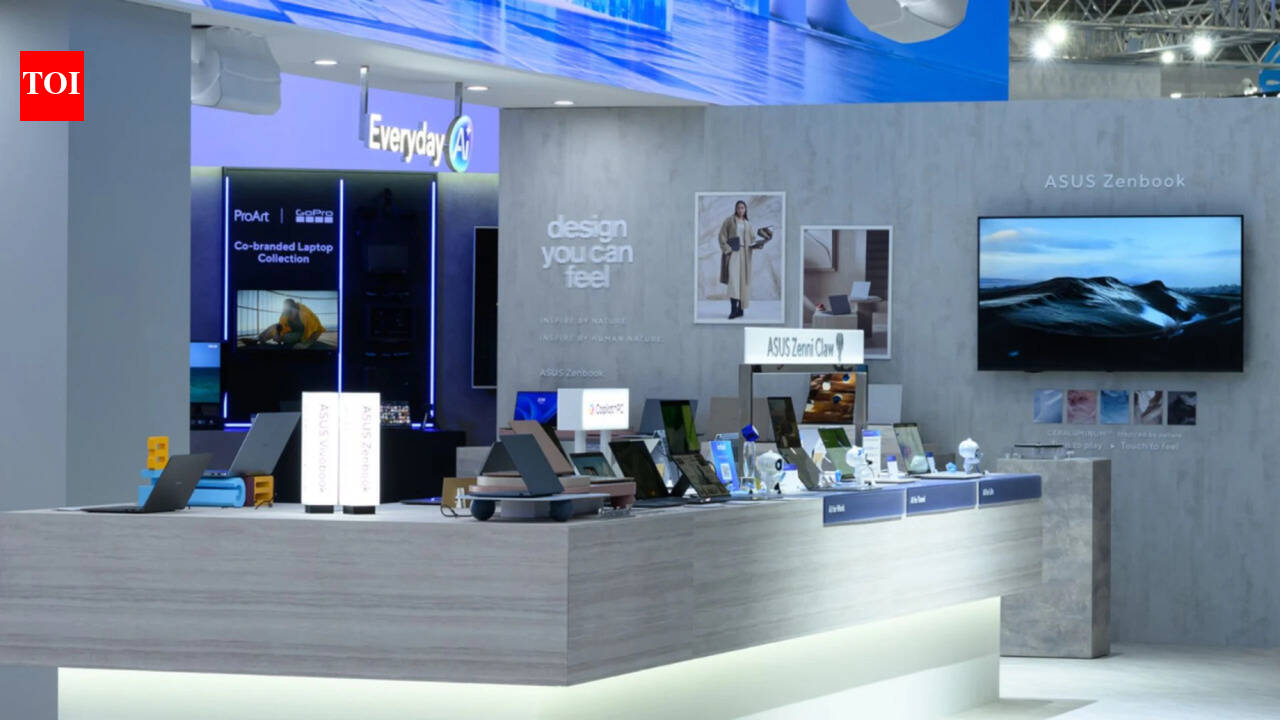
Two years into AI PCs, the category is still making more noise than it should. Every OEM is shipping NPUs. Every keynote is an AI keynote. The Topps count has moved from headline feature to spec-sheet boilerplate. Buyers are being asked to pay a premium for capabilities most of them have yet to find a reason to use.Amidst that noise, individual OEMs are arriving at their own answers as to what AI on personal computers is really for. At Computex 2026, Asus Arrived with something quite specific.The company branded its entire lineup as Ubiquitous AI. AI runs across every product line and every category on the show floor – from the entry-level VivoBook to the ProArt Creator laptop on Nvidia’s new RTX Spark platform. Tying it all together was a new agent called Zenny Claw.But on the sidelines of the show, TimesofIndia.com sat down with Sascha Krohn, Asus’ technical marketing director, and the framing he personally offered was more cautious than the booth suggested. Krohn, who has been Asus’ public voice on technology strategy in several Computex cycles, thinks AI is incorporated into every product the company offers. He also believes that the customer should be the one to decide what to do with it. Both parts of it were intentional, he said in different forms through the conversation.
Everything gets AI. Whether people use it or not is their decision
“We’re all working on AI and this is a big story for us,” Krohn said. “Ubiquitous AI is one of the themes here. We’re bringing AI into everything. It doesn’t matter whether it’s cloud or on-premise AI or edge AI, and now even hybrid solutions like our Zeni Claw agent. We’re all on AI. For every product line, for every product.”A few minutes later, without prompting, he added the second part: “We are not imposing this on our customers. We are enabling it. We are offering options for them. If they don’t want to use it, that’s completely up to them.”He kept coming back to that idea again and again through conversation. AI is in the device because the platform supports it. Whether the user accesses it or turns it off is up to them. It’s the same with customization—what to let it see, how much to let it do. Pressed on whether Asus was simply riding the agent wave that ran through nearly every announcement at Computex 2026, he didn’t dodge. “We are all working on AI. But we are not imposing it on our customers. “We’re enabling it.”The silicone at the bottom of the lineup is what really makes that option count. The Windows laptop sector was an Intel-AMD duopoly for most of the last decade. Qualcomm broke it. Now Nvidia has also come. Four platforms mean four sets of capabilities, and four ways for Asus to match the chip to what the buyer is actually doing with the machine rather than picking a default and applying it everywhere.“It’s a really exciting time. There are more options than ever,” Krohn said. “If you’re an engineer and work at Asus, why do you go to Asus? You don’t want to just do the boring, new platform, easy work every year. You want to do something different and new, and maybe even a little bit crazy.”So the ZenBook 14 now comes with both Snapdragon X and Intel Lunar Lake variants. The ProArt P16 and P14 come on Nvidia’s new RTX Spark mobile platform. AI capability is what drives the entire pricing ladder – VivoBook at entry, VivoBook S in the middle, S Flip with OLED and metal a step up, ZenBook at the top. The buyer chooses the chip, form factor, price point. The AI shows up regardless.What that AI actually looks like is partly Microsoft’s call and partly Asus’s. The Copilot+ floor is the part that no Windows OEM can avoid – Microsoft’s features come with the platform – although Microsoft has also been quietly working on some of this for the past year, pulling Copilot integrations out of apps it had already pushed them into and shelving plans for system-level additions. It turns out that users are not accessing AI as often as marketing had assumed.On top of that floor, Asus adds its own implementation. StoryCube is for creators who want to organize their footage before editing. Zeni Claw Agent is for buyers who want the device to handle routine tasks in the background. Different features for different users. On Krohn’s account, which of them the buyer actually reaches out to is the buyer’s call.
Hardware is what remains
A day before the interview, Asus’ Design Center in Taipei told us about the new ZenBook series. HW Wei, Associate VP at ADC, described the design language as a counterweight to what the company is selling at the time.“We always think about nature-inspired, nature-to-design,” Wei said. “Why nature? Because it’s really hard for us, especially in today’s AI age. People are wondering is it real or not? But when a lot of this type of concise information comes to humans, humans always look at it. Which one will be more comfortable for us? So nature will be our answer.”I asked Crohn about it. The hardware intentionally reads the physical while the software runs in the opposite direction. How does the company keep the two together?He replied, “I would say it’s AI capable.” “Whether you use that functionality or not is entirely up to you. And what you use it for, too. When it’s something physical, it’s there. It’s always there. But when it’s software or features, it’s something you can use or not use. You can turn it on or off. You can customize it.”This is the line that connects the positions together. AI is optional. The device itself is not there. Two years of agents and co-pilots and NPUs have made one thing clear, which is that the software layer is the part that will keep changing. Hardware is the part the buyer commits to. Asus, seeing where it does its slow work, has decided which makes more sense.To help keep up with the betting, Krohn has read up on AI himself, which is pretty old-fashioned. It’s a tool, he kept saying, in different forms. People decide what to do with it. This is what makes “enabling, not propelling” actually mean something – AI can be optional because the device doesn’t need to cause someone to buy it, and the buyer doesn’t need to be told what to do with it.