
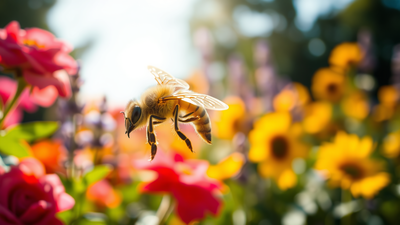

Bees helped scientists create tiny drones that navigate without GPS and find their way home
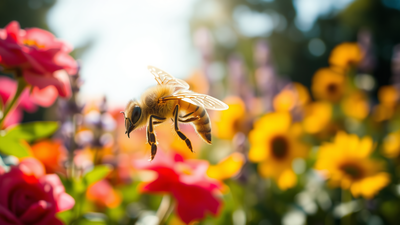
Most drones rely on GPS and powerful computers to find their way. This makes them heavy, expensive, and power hungry, which is basically not practical for anything small. But bees? They navigate perfectly with brains smaller than a grain of rice. Now, scientists at Delft University of Technology have discovered their secret and have created drones that do the same thing. The system, called B-Nav, allows small drones to fly hundreds of meters away and still find their way home without using almost any computing power. It all started with a simple question: If bees can do it with almost nothing, why can’t our robots? The answer always turned out to be hidden in nature, just waiting for someone to look closely enough.
How bumblebees find their way home: the inspiration behind B-Nav
Here’s what happens when a bee leaves its hive for the first time. It doesn’t fly and fly away just to find flowers. Instead, it takes a short learning flight right near home, memorizing the landmarks and the layout of its neighborhood. After those initial scout flights, the bee can fly far along winding, winding paths and still return almost straight home. It’s like stepping out of your house for the first time, walking down some streets, remembering what they look like, and then being able to walk back out of nowhere in the city.Scientists have understood its basics for years. Bees use something called odometry; They keep track of how far they have gone and in what direction, such as counting steps while walking. But odometry gets messed up over time. Small measurement errors add up. So bees also remember what their environment looks like in important places, especially around the house. They combine these two methods: approximate distance and direction estimation and visual memory. And it works brilliantly.The challenge was to discover what and how bees learn visually. That was the gap that needed to be filled. Researchers led by Guido De Kroon at Delft University wanted to know whether imperfect distance and direction estimation could still be enough for a machine to learn to come home. Could a small neural network store only visual memories without the need for detailed maps? This became the basic idea behind the B-Nav.
Building drones that think like bees: the Bee-Nav system explained
The research team included roboticists from Delft University and biologists from Wageningen University in Germany and Carl von Ossietzky University of Oldenburg. Together, they created something that mimics the actions of bees, in the same order that bees do it.First, the drone makes a short learning flight near its starting point. When it flies, it uses a tiny omnidirectional camera to capture 360-degree images of everything around it. These images are not stored in much detail. They’re processed by a compact neural network, basically a stripped-down AI brain that learns how the house looks from different angles and distances.Once the drone has completed its learning flight and collected its visual memories, it is ready to explore. The drone flies away from home on whatever path is available, using odometry to track its speed. But like the bee, the drone doesn’t rely solely on odometry. As it approaches a familiar area, it begins to use its learned visual memories to correct errors it made during its journey. The visual network says “Hey, I recognize this place” and guides the drone back home.according to Nature paper published in May 2026The system works remarkably well. The drone returned within 0.5 meters of home in 100 percent of flights between 30 and 110 meters. Even on long flights between 200 and 600 meters it was successful in 70 percent of the cases. These are solid numbers for something so light and simple.
The memory trick that makes everything work: why 42 kilobytes is enough
Here’s the part that blows people’s minds: The entire neural memory required for this system is only 42 kilobytes. This is not a typing error. It’s about the size of a small email attachment from the 1990s. For short flights in controlled environments, the memory requirement drops to only 3 kilobytes.Most autonomous drone systems use large-scale computers and continuous mapping systems. They require powerful processors, huge memory storage and lots of power. Bee-Nav does the same thing with a smaller fraction of the same. The philosophy is simple: don’t store what you don’t need. Store only what is important for navigation.This difference means everything when you’re trying to build a really small, lightweight drone. The whole approach assumes you can solve navigation with less hardware and better thinking. This is the kind of insight that only comes from carefully studying biology. Bees did not evolve brains specifically to navigate; They developed brains for many tasks. But somehow they are incredibly skilled at this particular task.
Real-world uses: Where these drones actually work
The most obvious application is greenhouse and agricultural monitoring. Lightweight drones can inspect tomato crops, detect diseases or pests early and help farmers increase yields while reducing wastage. These drones should be safe for people working nearby. You can’t move heavy machines around workers. Bee-Nav makes this possible.Disaster areas are another area where GPS fails. Search and rescue teams working after earthquakes or floods can use these drones to explore areas before sending people. Warehouse inspections, building surveys and even exploring caves where GPS signals don’t reach are all made practical with truly autonomous, lightweight drones.Scalability is also interesting. Researchers say that today you can easily install B-Nav on a drone weighing 30 to 50 grams. Ultimately, they want to reach true bee-sized drones, although this will require solving other problems such as small batteries. But the intelligence part? He is ready to go.
Why this matters for the future of robotics and autonomous systems
This research proves something important: You don’t need massive computational power and detailed maps to achieve autonomous navigation. You need clever algorithms and inspiration from nature. It’s a lesson the robotics field is learning again and again: The best solutions sometimes come from looking at what nature has already figured out.For a world that wants smaller, cheaper, safer autonomous robots, Bee-Nav is a step forward. This shows that small drones can be really smart without being expensive or dangerous. They can explore, learn and return home. It’s the foundation of everything engineers want to build on top. It turns out that bees were doing advanced robotics millions of years before humans invented computers.