‘We will not allow North-South to be divided’: Amit Shah hits back at opposition on delimitation. india news
'We will not allow North-South division': Amit Shah hits back at opposition on delimitation
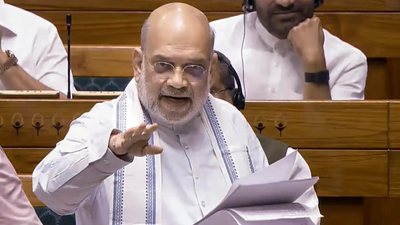
Union Home Minister Amit Shah

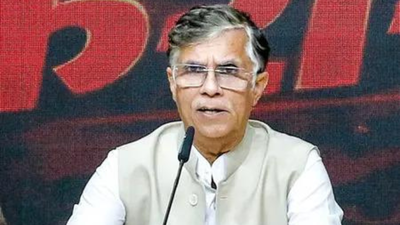
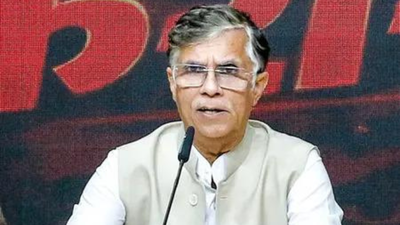
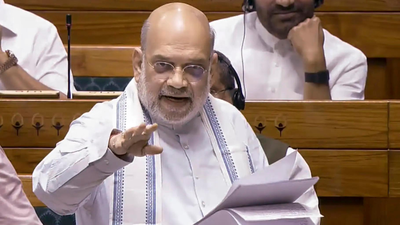
New Delhi: Union Home Minister Amit Shah On Friday he hit out at the opposition over its criticism of the Women’s Reservation Bill and the proposed delimitation, accusing it of pushing the “North-South divide narrative”.Speaking in the Lok Sabha ahead of voting on the bill, Shah sought to garner support and said delimitation would ensure fair and equal representation across states.“Let me make it clear once again: the Southern States have the same rights in this House as the Northern States. In fact, even a small Union Territory like Lakshadweep has the same rights as Uttar PradeshGujarat and Bihar,” he said.Addressing concerns about the “North-South divide”, Shah cautioned against framing the issue in regional terms.He said, “This country should not be divided through such narratives, not the North-South narrative and not any other divisive framework. It should not be broken into pieces like this. What are they trying to mean? When the members sitting in this House think about which state they come from when they speak or take decisions? … When we take the oath, we do so with complete sincerity and heart.”He further accused critics of misusing constitutional discourse.Shah said, “Those who have taken the constitutional oath are now trying to promote the narrative of North-South divide. We will not let this happen…”Backing his argument with numbers, the Home Minister said the southern states will not lose representation after delimitation.“Karnataka, Andhra PradeshTelangana, Tamil Nadu and Keralam – Out of 543 parliamentary seats, the strength of these five states is currently 129, which is 23.76%. After the 50% increase, when we allocate seats for these five states, it will increase from 129 to 195, representing 23.87% of the 816 seats. No one will be harmed,” he said.Taking a strong dig at the Centre’s proposal on women’s reservation, Samajwadi Party supremo Akhilesh Yadav said, “Based on the experience of almost 11 years, even if the Bharatiya Janata Party (BJP) gives a written assurance that they will appoint a woman Prime Minister, we will still not trust them…”
Source link

Evening News concludes: Rahul Gandhi criticizes Center on Delimitation Bill; TCS Nashik case accused moves court for bail and more. india news

Evening News concludes: Rahul Gandhi criticizes Center on Delimitation Bill; Accused in TCS Nashik case move court for bail and others
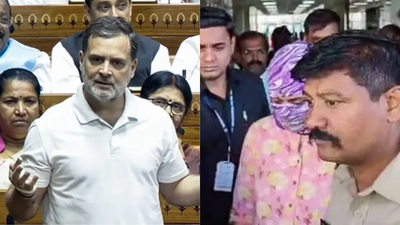
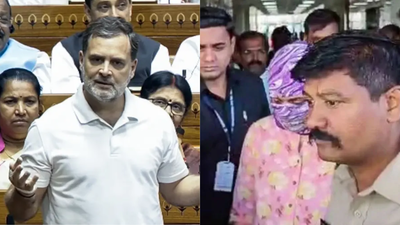
  • Rahul Gandhi Center accused of using women reservation bill and as tools for delimitation exercises political engineeringHe alleged that it could weaken OBC and Dalit representation.
  • In TCS Nashik caseThe accused are moving the court for bail, including anticipatory relief for an absconding pregnant woman, who denies allegations of harassment and religious coercion.
  • The Supreme Court refused to grant relief to Pawan Kheda and directed him to seek bail from the competent court of Assam.
  • Rajasthan Royals Manager Romi Bhinder has been fined and warned after the Board of Control for Cricket in India’s ACSU accepted his medical justification for using phones in the IPL dugout.
  • Lebanon has described direct talks with Israel as “crucial” as Iranian oil exports resume and tensions remain despite a ceasefire with Hezbollah.

Here are the top 5 news of the day

Rahul Gandhi accused the Center of political engineering through women’s reservation bill.

During the debate on the Women’s Reservation Bill and delimitation proposals, Rahul Gandhi launched a scathing attack on the Center and alleged that the law was being used to rebalance India’s electoral balance instead of empowering women. Accusing the government of using women’s reservation to serve political purposes, she also alleged that the Center is trying to weaken the political voice of OBCs and Dalits through constituency realignment. Read the full story

TCS Nashik case: Accused preparing to seek bail from court

In the alleged TCS Nashik sexual harassment and religious coercion case, the accused are now moving to Nashik court for bail and anticipatory bail. Advocates Baba Sayyed and Rahul Kasliwal, who are representing some of the accused, are preparing anticipatory bail for a woman accused, who has not been arrested yet, as well as regular bail petitions for those already in judicial custody. The absconding accused is also approaching the Nashik court for anticipatory bail citing her pregnancy and medical condition. Meanwhile, lawyer Baba Sayyad, representing the absconding female accused, is saying that there is no allegation of religious conversion or harassment against her. Read the full story

Supreme Court refused to give relief to Pawan Kheda

supreme court of india Has refused to enhance transit anticipatory bail security for Congress Leader Pawan Khera asked them to approach a competent court in Assam. Khera had moved the top court seeking extension of relief till April 20 in a case related to allegations against the wife of Assam CM Himanta Biswa Sarma. A bench of judges rejected his plea for extension, but clarified that the Telangana High Court’s earlier order barring it from granting transit anticipatory bail would not affect the court’s jurisdiction in Assam. The court also said that Kheda is free to approach the appropriate court and seek assistance if needed if the court is not functioning. Read the full story

Rajasthan Royals manager Romi Bhinder ‘warned and fined’ for using phone in dugout

Rajasthan Royals manager Romi Bhinder has been fined and warned for using a mobile phone in the dugout during IPL 2026. The Times of India has learned that the Anti-Corruption and Security Unit (ACSU) of the Board of Control for Cricket in India reached the decision after a detailed review of Bhinder’s response to the show cause notice. Read the full story

Lebanon calls Israel talks ‘important’ as oil shipments from Iran resume

Lebanon’s president has said direct talks with Israel are “crucial” as regional tensions continue to rise. In a parallel development, the first Iranian oil shipment has left the Gulf following the US-imposed blockade. Meanwhile, just hours after a 10-day ceasefire came into force in Lebanon, Israel’s Defense Minister said the operation against terrorist group Hezbollah is not yet complete. Follow live updates

Source link

Raghav Chaddha: ‘My party leaders are not here’: Raghav Chaddha takes indirect dig at Aam Aadmi Party in Rajya Sabha. india news

'My party leaders are not here': Raghav Chadha takes indirect dig at Aam Aadmi Party in Rajya Sabha

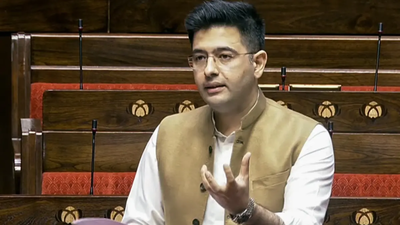
New Delhi: Raghav Chaddha Starting his speech in the Rajya Sabha on Friday, he made sharp remarks referring to the recent leadership change. Aam Aadmi Party.Addressing the House, Chadha said, “The leaders of the party to which I belong are not present in the House. The newly appointed deputy leader of the party I belong to is also not present in the House. I am the recently removed Deputy Leader and am present in the House. Thank you very much for giving me the opportunity to speak.”

Watch

‘Interesting idea’: Raghav Chadha hints at starting his own political party

Chadha’s comments come amid a growing rift between him and the AAP leadership after his removal from the post of Deputy Leader in the Rajya Sabha and the appointment of Ashok Kumar Mittal in his place.The result has triggered a public war of words within the party, with senior AAP leaders accusing Chadha of betrayal and diverting himself from the party line. Saurabh Bhardwaj had recently alleged that Chadha has been protected BJP Leaders and Recently Joined Enforcement Directorate Action against Mittal regarding internal discordThe Enforcement Directorate recently conducted searches under the Foreign Exchange Management Act at premises linked to Mittal in Punjab and Haryana, including premises linked to educational institutions linked to him. AAP leaders called this action politically motivated and premature. punjab assembly elections.AAP’s national coordinator Arvind Kejriwal While accusing the Center of starting preparations for Punjab elections through central agencies, party leaders Sanjay Singh and Manish Sisodia also attacked BJP over the alleged misuse of institutions.Chadha, once one of the most prominent national faces of AAP and considered a close aide of Kejriwal, has reportedly faced differences with the leadership in recent months over strategy, parliamentary approach and absence during key political moments. Chadha has denied the allegations against him and called them baseless.His comments in the Rajya Sabha are likely to further fuel speculations of internal tension at a crucial time for AAP, especially in Punjab where the party faces upcoming electoral challenges.

Source link

‘Government is taking away their power’ vs ‘Why did Rajiv Gandhi protest’: Rahul-Rijiju clash over OBCs during women’s quota-delimitation debate | india news

'Government is taking away their power' vs 'Why did Rajiv Gandhi protest': Rahul-Rijiju clash over OBCs during women's quota-delimitation debate
Kiran Rijiju and Rahul Gandhi in Lok Sabha

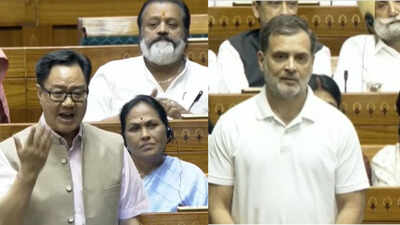
New Delhi: A heated argument broke out between the leader of the opposition in the Lok Sabha. Rahul Gandhi and Union Minister Kiran Rijiju During the speech of Congress MP on Women’s Reservation Bill.Rijiju intervened after Gandhi, in his address, accused the BJP-led Center of trying to avoid giving power and representation to OBCs.Gandhi said, “It is a historical fact of how Indian society treated Dalits, OBCs and their women… What is being attempted here is to circumvent the caste census. They are trying to avoid giving power and representation to my OBC brothers and sisters and instead snatch power from them.”Rijiju intervened, alleging that Gandhi’s father, former Prime Minister Rajiv Gandhi, had opposed OBC reservation both when he was in power and when he was out of power.He also questioned why Congress did not give constitutional reservation to OBCs despite ruling the country for almost 60 years.The Parliamentary Affairs Minister said, “When Congress ruled this country for more than 60 years, why did it not give constitutional reservation for OBCs? Congress will have to answer.”“When Rajiv Gandhi was Prime Minister – and even then – he opposed OBC reservation. Can Rahul Gandhi explain why?”. Rijiju asked.Earlier, Gandhi accused the government of trying to change India’s electoral landscape by linking women’s reservation to delimitation and said the opposition would not allow the bill to be passed.His comments came ahead of the Lok Sabha voting on the Constitution (131st Amendment) Bill, which proposes to increase the number of Lok Sabha seats to 850. While the ruling NDA, with 293 MPs, holds the majority in the 545-member House, it needs a two-thirds majority to pass legislation.

Source link

Delimitation Bill: Congress President Mallikarjun Kharge vowed to defeat the Delimitation Bill in the Lok Sabha. india news

"Will defeat the delimitation bill in Lok Sabha": Congress President Mallikarjun Kharge

“Will defeat delimitation bill in Lok Sabha”: Congress President Mallikarjun Kharge (Photo credit: ANI)

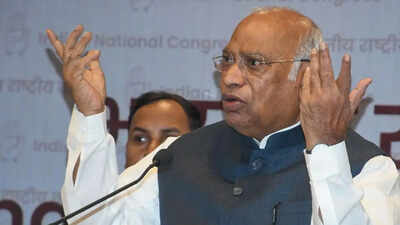
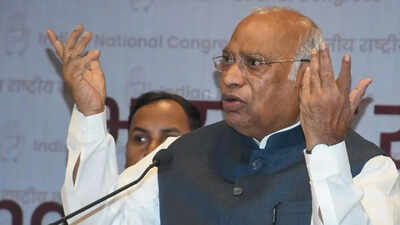
New Delhi: Leader of Opposition in Rajya Sabha and Congress President, Mallikarjun KhargeIndia Bloc MPs are opposing the Constitution (131st Amendment) Bill and the Delimitation Bill in the Lok Sabha and will “defeat” the proposed laws, said on Friday. Mallikarjun Kharge said, “Our people are fighting and will defeat it in the Lok Sabha.”The Lok Sabha is under discussion on the Constitution (One Hundred and Thirty-First Amendment) Bill, 2026 as well as the Union Territories Laws (Amendment) Bill, 2026, to extend it to Delhi and Jammu and Kashmir, and the Delimitation Bill, which aims to enlarge and redraw the Lok Sabha constituencies, thereby increasing them to 850 seats.Opposition parties have alleged that if the delimitation process is done on the basis of the 2011 census, the representation of the southern states in the Lok Sabha will reduce.

Watch

‘Will not reduce South’s share’: Amit Shah clarifies on delimitation, calls opposition’s claims ‘misleading’

Congress MP K Suresh described the delimitation bill as “dangerous”, alleging that it would “ruin” the opposition parties. He said, “We are not opposing the Women’s Reservation Bill. We are opposing the Delimitation Bill. This will be a dangerous bill and will completely devastate the opposition parties in the country.”CPI MP P Sandosh raised questions on the need to integrate delimitation, census and reservation for women MLAs and sought answers from Prime Minister Narendra Modi. P Sandosh told ANI, “The Women’s Reservation Bill is an act which was passed unanimously by the Parliament of India, we all cooperated with the government. Unfortunately, the government is trying to misuse the Women’s Reservation Bill to disrupt the federal structure of the country.” Why did you put delimitation, census and all those things together? this is the question. And the Prime Minister should answer this question.Meanwhile, JD(U) MP Sanjay Kumar Jha questioned the Bharat Bloc over its opposition to the bills, noting that all parties unanimously passed the Nari Shakti Vandan Act 2023.”PM Modi has clearly said in his speech that no change has been made in the delimitation. You passed it in 2023, so what is there to oppose in it? What kind of threat is this to democracy? They do not trust the women of this country,” the JDU MP said.The Congress had also issued a three-line whip to its MPs in the Lok Sabha to remain present in the House for the special sitting from April 16 to 18 and support the party’s stand.To pass the Constitution (131st Amendment) Bill, the Center will need a two-thirds majority of 362 seats in the Lok Sabha.

Source link

‘Gift wrapped in barbed wire’: Tharoor criticizes Center for linking women’s reservation to Delimitation Bill. india news

'Gift wrapped in barbed wire': Tharoor criticizes Center for linking women's reservation with Delimitation Bill

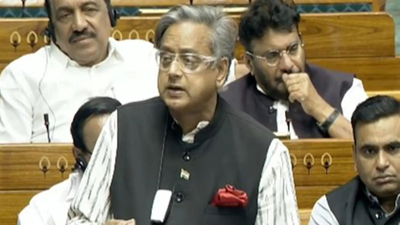
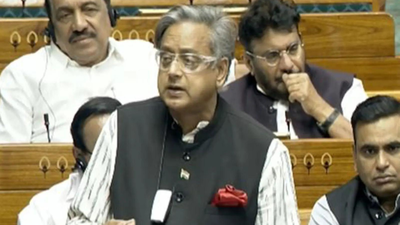
New Delhi: Senior Congress leader Shashi Tharoor Friday termed the proposed delimitation process as “political demonetization” and criticized the Center for linking the implementation of women’s reservation to the expansion of Parliament and redefinition of constituencies based on census.Participating in the debate in the Lok Sabha on three bills related to amendment of the Women’s Reservation Act and setting up of the Delimitation Commission, Tharoor said the government has unnecessarily linked the widely supported reform to a highly contentious political process.Tharoor said, “Delimitation will become political demonetisation. Don’t do that.”She said there was almost unanimous political support across parties for women’s reservation and argued that the measure should be implemented immediately without relying on delimitations.He said, “Today we stand at the threshold where there is almost unanimous political consensus in favor of women’s reservation. Every major party realizes that the time of symbolism is over and the era of mass participation must begin and yet I find myself deeply troubled by the legislative exercise before us.”Tharoor mentioned the Prime Minister Narendra ModiComments supported women’s representation, but said the proposal was burdened with unnecessary conditions.He asked, “The Prime Minister says he has brought the gift of justice ‘Nari Shakti’, but he has wrapped it in barbed wire, linking the implementation of women’s reservation to the expansion of Parliament, 2011 census data and the delimitation process… Why should we confuse a moral imperative with a demographic sphere?”She said that women’s reservation is ready to be implemented on the basis of existing parliamentary strength and there is no need to wait for future reorganization of constituencies.“Women’s reservation is ripe for the harvest and should be implemented immediately on the basis of existing parliamentary strength,” she said.Warning of wider political implications of redrawing of constituencies, Tharoor said delimitation is not just an administrative process but a change in the balance of political power.“Delimitation is not just a bureaucratic rearrangement of maps, it is a profound shift in political power that is intended to…any The delimitation process is fraught with complexities that can tear apart the fabric of our federalism,” he said.He also criticized the speed with which the government was pushing the legislation and compared it to the hasty move of demonetisation.He said, “You have proposed delimitation with such haste, the same haste that you showed on demonetisation. Unfortunately, we all know how much loss this caused to the country. Delimitation will become political demonetization. Don’t do that,” Tharoor said.Tharoor said the opposition supports the principle of women’s reservation but believes it should not be made dependent on the future delimitation process. She called for wide-ranging discussions with all political parties, saying that both women’s representation and delimitation had a significant impact on India’s electoral structure and federal balance.The debate took place after the Constitution (131st Amendment) Bill, aimed at amending the women’s quota law, was introduced in the Lok Sabha on Thursday following a division of votes.Two additional general bills, the Delimitation Bill and the Union Territory Laws (Amendment) Bill, were also introduced to facilitate the implementation of the proposed amended women’s quota law in the Union Territories of Delhi, Puducherry and Jammu and Kashmir.

Source link

Pawan Kheda: Passport controversy: Supreme Court refuses to give relief to Pawan Kheda, rejects plea to increase transit anticipatory bail. india news

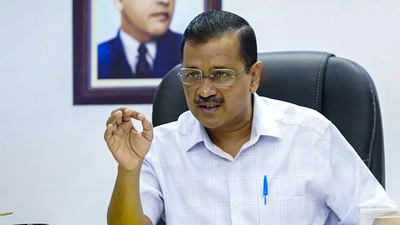
पासपोर्ट विवाद: सुप्रीम कोर्ट ने पवन खेड़ा को राहत देने से इनकार किया, ट्रांजिट अग्रिम जमानत बढ़ाने की याचिका खारिज कीSupreme Court Congress on Friday refused to extend transit anticipatory bail security for leader Pawan Kheda, and asked him to approach a competent court in Assam in connection with a case related to allegations against the wife of Assam Chief Minister Himanta Biswa Sarma.A bench of Justices JK Maheshwari and Atul S Chandurkar rejected Khera’s plea seeking extension of the relief period till April 20 so that he can approach a court in Assam.
Court clarified earlier order

While refusing to grant the relief, the top court clarified that its earlier order by the Telangana High Court staying the grant of transit anticipatory bail would have no adverse effect on the court having jurisdiction in Assam.“The court deciding the application will not be adversely affected by any order granting transit bail or otherwise,” the bench said, according to news agency ANI. He said that any anticipatory bail plea should be decided on its merits, without being influenced by previous orders.The court also said that if the court is not functioning then Khera is free to approach the appropriate court and seek assistance from the registry if necessary.“In view of the above, the respondent is free to approach the appropriate court. If the court is not functioning, a request may be made to the court registry, and it will act as per law. With the above observations, the petition is disposed of.”

Background of the case

This development comes after the Supreme Court had earlier stayed the Telangana High Court order granting one week’s transit anticipatory bail to Khera, effectively making him arrestable by the Assam Police.During the previous hearing, the court had questioned the jurisdiction of the Telangana High Court in considering Khera’s plea in a case registered in Assam. The state had argued that Kheda was engaged in “forum-shopping” by approaching a court outside the state where the FIR was filed.The case pertains to allegations that Kheda made false statements against the wife of the Chief Minister of Assam.The controversy stems from a press conference held on April 5, where Khera had alleged that Sarma’s wife Riniki Bhuyan Sharma held multiple passports and owned foreign assets, which were not disclosed in the chief minister’s election affidavit for the April 9 assembly elections. Both Sarma and his wife rejected the claims as “false and fabricated”.Following the remarks, a case was registered against Khera at the Guwahati Crime Branch police station under sections 175 (false statement in relation to an election), 35 and 318 (cheating) of the Indian Justice Code.With Friday’s order, the Supreme Court has reiterated that Khera should seek relief from an Assam court, which will independently assess his anticipatory bail plea.

Source link

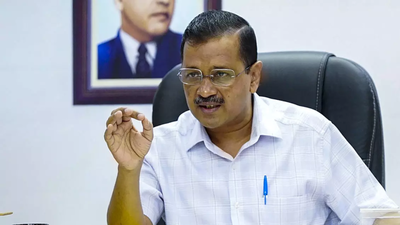
Kejriwal targets PM Modi: ‘Tell us how much black money has been recovered’: Arvind Kejriwal targets PM Modi over raids on AAP leaders. india news

'Tell us how much black money was recovered': Arvind Kejriwal targets PM Modi over raids on AAP leaders

New Delhi: The Enforcement Directorate On Friday, premises linked to Punjab Industries Minister Sanjeev Arora were searched. Officials said raids were conducted at several places linked to Arora in Ludhiana and elsewhere as part of the ongoing investigation. The AAP leader had also faced agency action in 2024, when the ED alleged that companies linked to him and others caused loss to the state exchequer and earned huge proceeds of crime through alleged misuse of industrial land for residential projects.Former Delhi Chief Minister and AAP supremo Arvind Kejriwal criticized the raid, saying it was the second raid on someone Aam Aadmi Party Writing on NetaReacting to the development, senior AAP leader Saurabh Bhardwaj wrote on Twitter, “ED has now raided Punjab minister Sanjeev Arora. This is a clear pattern. This is how the BJP starts its preparations for the state elections.” His comments come amid a series of actions involving AAP leaders in Punjab in the last two days.Earlier this week, the ED searched the residence of AAP Rajya Sabha MP Ashok Kumar Mittal in Jalandhar as well as premises associated with his educational institutions in Punjab and Haryana under FEMA provisions. The raid attracted attention because it came after Mittal was appointed the party’s deputy leader in the Rajya Sabha, replacing Raghav Chadha.

Source link

Bengal Elections: Why SIR is valid for Kalimpong residents. india news

Bengal Elections: Why recognition for SIR Kalimpong residents?

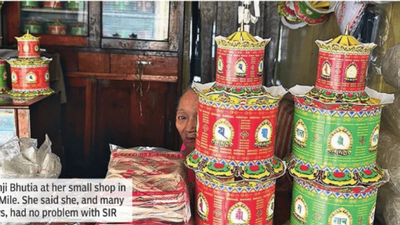
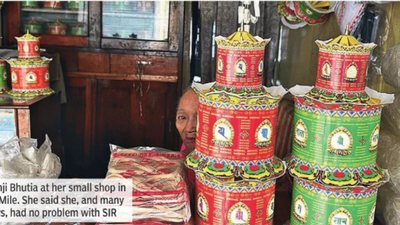
In Bengal, the Special Intensive Revision (SIR) of electoral rolls has sparked intense political controversy, with allegations that a large number of people are at risk of their names being removed from the electoral rolls. But in the Tibetan settlement of Kalimpong, many residents remember the experience of voter verification very differently – as a process that validates settled communities rather than excludes them.In this mountainous town, where Tibetans have lived for decades for generations, residents and settlement officials say investigations have so far revealed only a small number of anomalies. Many argue that when such exercises are done carefully and with reference to past records, they can confirm legitimate voters rather than disenfranchise them.In a small shop at 10th Mile, 72-year-old Khamji Bhutia dismissed apprehensions about the practice. He said, “We have no problem with SIR. We were born here.”That sense of confidence comes from a long local history. After China’s occupation of Tibet in 1959, not all Tibetans came to Kalimpong. Some families had already settled in the city when Kalimpong was an important trading centre. Traders traveled through Nathu La and Jelep La carrying wool, salt, borax and livestock; Some stayed, opened businesses and built homes.“I came many years before China took over Tibet,” said Jampel Kaldhen, 82, who came to Kalimpong in 1954 when he was 12. He said that language was not a barrier for him. “My third language was Sanskrit. I could communicate easily in Hindi.”Others came later, fleeing repression and rebuilding their lives in India. Many people found work as laborers before moving into small trades and businesses.“We all worked as labourers. We used to go to build roads in the lava, all men and women… we all worked. We built that road,” said Namdol Bhuta, 78, referring to the route to the tourist spot in Kalimpong district.For many here, that history shapes the way they view election verification. Inclusion of names in the voter list is not just a matter of documentation; It is a symbol of residence, labor and belonging built over decades.Residents and local officials say most Tibetans in Kalimpong already have documented continuity of residence. According to people familiar with the settlement, the Tibetan population in the area is estimated to be around 1,928. They say the current questions largely reflect a generational divide: many elderly Tibetans still hold refugee certificates, while younger members of the community, especially those born in India, are more likely to have Aadhaar cards and voter ID cards.“Those who remain with refugee certificates are often deeply attached to their Tibetan identity and prefer not to move away from it,” said Tenzing Bhutia, a resident of Kalimpong.Tashi Bhutia, a retired teacher of St. Augustine’s School, said his grandfather was born in Darjeeling. His father was later sent to Tibet to become a monk and returned years later. He emphasized that the community cannot be viewed through a refugee narrative. He said, “Not all Tibetans here fled Tibet after 1959. Some were born here. Some had been living here for generations.”Local Tibetan settlement official Tseten said that most Tibetans in Kalimpong had obtained documents before 2000, and had participated in earlier elections, including 2002. This has helped during the current revision as many names can be checked from the old voter list, he said.“We don’t have a lot of cases in the SIR, just a few cases. Most have their own documents,” Tseten said. “I don’t think there are deleted cases.”The Kalimpong experience does not address the larger political argument over SIR in Bengal. But this points to a difference: verification practices do not need to automatically become a means of exclusion. Where authorities rely on old records, documentary continuity and local history, settled communities are less likely to be treated as suspicious.

Source link

Delimitation Bill: Since 1951, the Lok Sabha share of the Hindi belt has fallen more than that of the South. india news

Delimitation Bill: Hindi belt's Lok Sabha share has declined more than the South since 1951

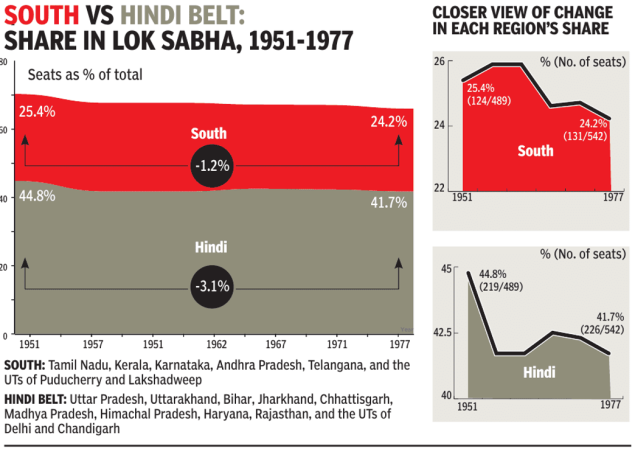
Amid the oft-repeated debate over whether northern states could benefit from future Lok Sabha expansion at the expense of the South, the historical record tells a more complex story. Between 1951 and 1977, when parliamentary seats were periodically reallocated following the census exercise, the share of Lok Sabha seats in both the Hindi belt and the southern states saw a decline. But the Hindi belt’s share fell much more – 3.1 percentage points, while the South’s declined by 1.2 points.The main reason was not the rise of the South over the North or vice versa, but the increased representation of the Union Territories and the increasing share of the Western and Eastern States. The comparison also needs to be read carefully: the map of India looked very different in 1951, before the linguistic reorganization of states. By 1956, the states were more or less in their present form, but at that time many union territories had little or no representation in the Lok Sabha.

-

Overall, the data shows that changes in parliamentary representation were shaped not only by the North-South balance, but also by state reorganisation, UT representation and the evolving federal map of India.

Watch

‘Will have to pay the price for a long time’: PM Modi warns opposition in Lok Sabha on women’s quota bill

► The 1951 election took place before the linguistic reorganization of states, so state boundaries were very different from what they are today ► After the reorganization of 1956, the states were largely in their present form, but many union territories still had little or no representation in the Lok Sabha ► The decline in share was partly driven by increased representation of Union Territories and gains from western and eastern states ► Even in 1977, the last election in this analysis, because there was no reallocation of Lok Sabha seats thereafter, Daman and Diu did not exist as a separate union territory. ► This comparison tracks total Lok Sabha seat share, not voter population per Member of Parliament or constituency size ►Figures for 1951 and 1957 refer to seats, not constituencies, as some constituencies then elected two members

Source link