ICMR rings alarm bell: India’s waistline is in danger. india news

ICMR rings alarm bell: India's waistline is running fast

New Delhi: To tackle rising obesity in India, ICMR has launched a nationwide exercise to find out what really works to reduce weight and associated health risks, at a time when almost one in four adults in the country is overweight or obese.The scale of the problem is becoming hard to ignore, with more than 25% of India’s adult population facing excess weight, leading to a rise in diabetes, hypertension and heart disease in both urban and rural areas.Despite years of research and a proliferation of diet plans, fitness regimes and awareness campaigns, there is still no clear, unified answer to which approach works best – or for whom. To bridge this gap, the Indian Council of Medical Research (ICMR) has invited researchers to contribute data from all studies for a large-scale analysis.The aim is to compare the effectiveness of different strategies – from diet and physical activity to behavioral and multi-component interventions – and to understand how they perform in different population groups.The analysis will go beyond weight loss to track blood sugar, blood pressure and cholesterol levels, reflecting growing concern that obesity is closely linked to a broader set of lifestyle diseases.The main focus will be to identify why the same intervention works for some people but not others, with the researchers examining variation across age, gender, income level and geography, including rural areas where undernutrition is persistent as well as obesity.Experts say the challenge is becoming more complex, with weight alone no longer a reliable indicator of health risk. Increasingly, metabolic disorders are appearing in normal weight individuals, while some people who are overweight may not have immediate complications.This initiative is expected to generate India-specific evidence to guide future treatment guidelines and public health strategies, as policymakers grapple with the rapidly growing health challenge across age groups and regions.
Source link

Lok Sabha: From women’s reservation to delimitation: Focus on 3 major bills in Lok Sabha today; Why they matter india news

India Bloc supports women's reservation but opposes delimitation, highlighting threat of political power shift

New Delhi: The special session of Parliament on Thursday is set for heated debate as three key bills – the Constitution (One Hundred and Thirty-First Amendment) Bill, 2026, the Delimitation Bill, 2026, and the Union Territories Laws (Amendment) Bill, 2026, which includes a proposal to implement women’s reservation from the 2029 Lok Sabha elections and a controversial delimitation exercise, are to be introduced. Opposition parties have expressed strong objection to the plan to redraw constituencies and increase the number of seats in the Lok Sabha.

Watch

India Bloc supports women’s reservation but opposes delimitation, highlighting threat of political power shift

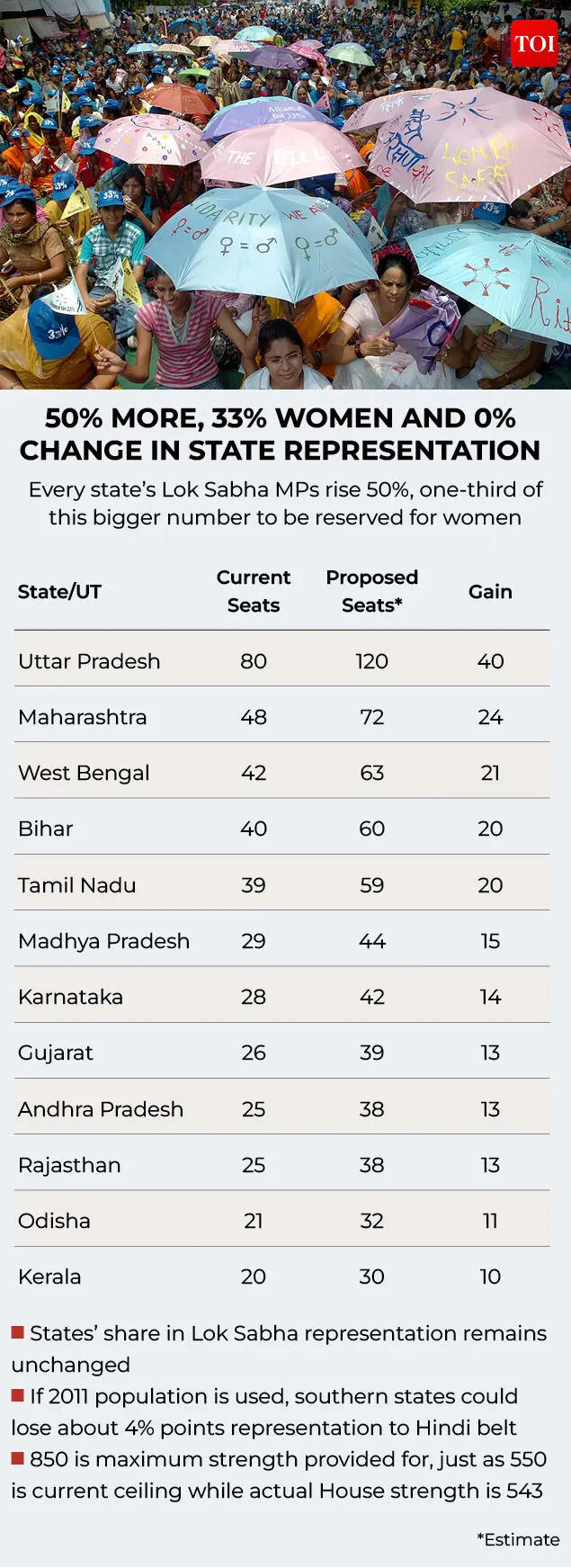
Opposition’s stanceWhile opposition leaders have strongly opposed and criticized the delimitation bill, they have expressed support in principle for the women’s reservation proposal, raising concerns over its implementation and timing. Tamil Nadu Chief Minister mk stalin They protested in Namakkal on Thursday by waving black flags and burning copies of the delimitation bill, signaling strong opposition to the proposed exercise, which they argue could significantly reduce the representation of the southern states.Congress President and Leader of Opposition in Rajya Sabha Mallikarjun Kharge Said that the opposition supports women’s reservation but has objections to the way it is implemented. He said that the opposition parties are opposing the proposed delimitation structure and want to implement it immediately, and are also raising questions on its functioning. Assam And Jammu and Kashmir.Congress general secretary Jairam Ramesh said there is a “unanimous resolve” among opposition parties to oppose the delimitation process, adding that linking it to women’s reservation is problematic. He further said that the opposition wants women’s reservation to be implemented from the 2029 elections on the basis of the current strength of 543 Lok Sabha seats.Leader of Opposition in Lok Sabha Rahul Gandhi The proposal called Lok Sabha constituencies a “dangerous plan” for electoral gain, warning that it could distort representation in the states. Congress leader KC Venugopal termed the bill an “anti-national act”, arguing that it could affect marginalized communities and weaken the federal structure.what does bill want to doThe Constitution (One Hundred and Thirty-First Amendment) Bill, 2026:The central government has prepared the Constitution (131st Amendment) Bill, 2026, which proposes to increase the strength of the Lok Sabha from the current 550 members to a maximum of 850, which will include 815 members from states and 35 members from Union Territories. The Constitution (One Hundred and Thirty-First Amendment) Bill, 2026 seeks to implement women’s reservation in legislatures from the 2029 Lok Sabha elections based on the 2011 census.

50% more, 33% women and 0% change in state representation

The government has been requesting the Prime Minister’s support for the amendment Narendra Modi Unanimity was urged to ensure its implementation. Law Minister Arjun Ram Meghwal is expected to introduce this bill in the Lok Sabha, which proposes related legislation as well as procedural steps to get it passed. According to Bar & Bench, the government is planning to implement women’s reservation before the 2029 general elections by bringing an amendment to operationalize the 2023 Act and a constitutional amendment to separate the delimitation process from the 2027 census.Delimitation Bill, 2026 : The Delimitation Bill, 2026 provides for readjustment of seats in the Lok Sabha and State and Union Territory Legislative Assemblies and division of each State and Union Territory into territorial constituencies. The exercise is based on population-based revision using the 2011 census. It proposes delimitation as a sweeping political change aimed at changing the size and composition of the state legislative assemblies and the Lok Sabha. The implementation of the proposed Delimitation Bill is also linked to population-based amendment of constituencies based on the 2011 census. The proposal is being opposed by several opposition parties, who have expressed concerns over its impact on representation, including the proposal to increase the number of Lok Sabha seats from 543 to 850.Union Territory Laws (Amendment) Bill, 2026: The Union Territories Laws (Amendment) Bill, 2026 seeks to align electoral and administrative provisions in Union Territories with the proposed changes under women’s reservation and delimitation-related legislation. It is expected to be introduced by Home Minister Amit Shah as part of the legislative package.

Source link

Women Empowerment: ‘Respect for women is the honor of the nation’: PM Modi on Women’s Reservation Bill before special Parliament session. india news

'महिलाओं का सम्मान राष्ट्र का सम्मान है': संसद के विशेष सत्र से पहले महिला आरक्षण बिल पर पीएम मोदी

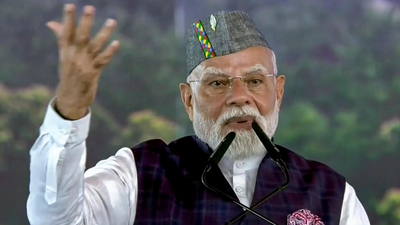
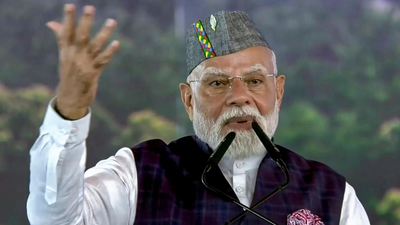
File photo: PM Modi (Photo credit: PTI)

New Delhi: Prime Minister Narendra Modi Wrote about women empowerment on social media before the special session of Parliament on Thursday.In a post on Twitter, the Prime Minister said the country is set to take a “historic step” to empower women as lawmakers are set to discuss a crucial bill regarding the women’s reservation framework.

Watch

Women’s Quota Bill: Government clarifies 850-seat Lok Sabha plan, opposition expresses concern over delimitation

He wrote, “In the special session of Parliament starting today, our country is going to take a historic step towards women empowerment. The honor of our mothers and sisters is the honor of the country.”The post also includes a Sanskrit verse that highlights the role of women in removing ignorance and illuminating the society with knowledge.

women reservation bill in focus

The special session to be held from April 16 to 18 is expected to consider amendments to implement the women’s reservation law, which aims to ensure one-third representation for women in the Lok Sabha and state assemblies by the 2029 general elections.The Center is seeking broad political support for the move. Earlier, PM Modi had urged opposition parties to support the amendment, saying it reflected the aspirations of “every sister and daughter of this country”.Along with the reservation bill, the government is also set to introduce major legislation including the Constitution (One Hundred and Thirty-First Amendment) Bill, 2026 and the Delimitation Bill, 2026.

Opposition expressed concern over delimitation

While opposition parties have expressed support for the early implementation of women’s reservation, they have raised concerns over the proposed delimitation process associated with the reforms.Leaders are expected to meet to finalize their strategy for the session, although protests have emerged in some states. Tamil Nadu Chief Minister MK Stalin has opposed the delimitation proposal, calling it a move that will affect the state’s representation.The Center has proposed increasing the Lok Sabha seats from 543 to a maximum of 850 as part of broader reforms, a move that has triggered a wide political debate ahead of the session.

Source link

33 years after dishonorable farewell, SC orders honorable farewell to former IAF pilot india news

33 years after dishonorable farewell, SC orders honorable farewell to former IAF pilot

New Delhi: Keeping in mind that it is respect that is the most important thing for a defense personnel, Supreme Court On Wednesday directed that a seventy-year-old former Indian Air Force The pilots, who had a dishonorable exit from the service 33 years ago, will now be given a farewell with dignity as their dismissal was arbitrary and in violation of the law.After fighting a legal battle lasting over 33 years, the officer got his honor restored and the Supreme Court held his dismissal illegal and directed the Center to give him 50% of the pay and allowances and all promotion and pension benefits from 1993 till the date of his retirement from service.“Justice demands that the humiliation with which the Appellant had to live for more than three decades be ended, his wrongful termination of service set aside and his honor restored… The dismissal order dated 22 September 1993 is cancelled. The Appellant has crossed the age of superannuation and hence, he cannot be reinstated in service. However, in law, he is entitled to claim all the consequential service benefits which he would have received, had he not been constrained with such illegal order of dismissal,” the bench of Justices Dipankar Datta and KV Vishwanathan said.“Restoration of honor remains the foremost concern of the defense personnel. We restore it with the direction that on a date to be fixed by the Chief of the Air Staff, the appellant shall be debarred in the normal manner to which he would otherwise have been entitled but for the order of dismissal,” the bench said. Squadron Leader R Sood was ordered by his superior to throw a drunk driver out of the premises and following the order Sood took him to a secluded place and later a dead body was found there. He was tried in a criminal court but acquitted as there was no evidence against him. However, he was court martialed resulting in his dismissal in 1993.

Source link

It is difficult for the court to give verdict on centuries-old religious beliefs: CJI Surya Kant. india news

It is difficult for the court to give verdict on centuries old religious beliefs: CJI Surya Kant

New Delhi: CJI Surya Kant on Wednesday said, “The most difficult part for the constitutional court is to decide whether the age-old faith of millions of devotees is right or wrong.” Dhananjay Mohapatra’s report.Justice MM Sundaresh sympathized with the CJI’s reasoning: “That too without listening to the views of those lakhs of devotees and based solely on the pleadings of the PIL petitioners, the State and religious organizations.”The comments come as the temple administration wing of the CPM-controlled Kerala government’s Travancore Devaswom Board on Wednesday said the Supreme Court could not strike down the age-old practice barring entry of women of menstrual age group into the Sabarimala Ayyappa temple as it was integral to the character of the deity as a brahmachari (atheistic celibate).Senior advocate AM Singhvi, appearing for TDB, told a nine-judge bench that while there are over 1,000 temples in India where women of all ages can enter and worship Lord Ayyappa, the deity at the Sabarimala temple has unique features and expressions.The TDB suggested that the Supreme Court should be extremely cautious while considering PILs of certain persons inviting judicial interference in matters of faith, belief and religion.Referring to the Supreme Court verdict in 2018 on the Sabarimala temple entry issue, Singhvi said, “Lord Ayyappa in Sabarimala is the only form of Ayyappa in the form of eternal celibacy, i.e. ‘Naishtika Brahmachari’.”Pointing out that the entry of fertile women in the age group of 10-50 years is prohibited in the temple, he said, “The foundation of his power and fame is his capacity as an eternal celibate. Therefore all forms of female reproduction and all practices of ‘grihasthashram’ should be sincerely kept away from the inner nature and identity of the deity.”Singhvi’s argument summed up the CPM’s political dilemma, where it had gone from enthusiastically supporting the Supreme Court’s decision in the Sabarimala case to opposing it with equal enthusiasm. This reversal led to a backlash, resulting in the CPM’s defeat in the 2024 Lok Sabha elections.Terming the 2018 Supreme Court judgment as wrong, Singhvi said, “This distancing and exclusion of fertile women with child-bearing potential has a direct bearing on the faith, belief and purpose for which the worshipers approach the deity and cannot be construed as exclusion for remotely extraneous and irrelevant reasons.”The TDB said it is not gender-exclusion as women below 10 years of age and above 50 years of age are allowed to enter the Sabarimala temple. According to age-old religious belief, “Maintaining the sanctity of the idol/deity in the form of secular celibacy is also a paramount object to be tried to achieve”.Singhvi told the bench that PILs should be discouraged in matters related to religious rights, which have innate rights.

Source link

Court summons Robert Vadra, 8 others on May 16 in laundering case. india news

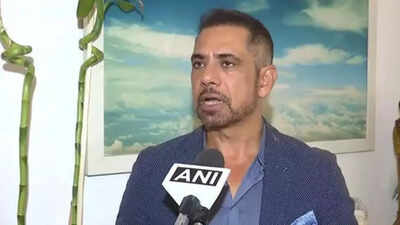
कोर्ट ने लॉन्ड्रिंग मामले में रॉबर्ट वाड्रा और 8 अन्य को 16 मई को समन भेजा हैrobert vadra According to Kaushiki Saha’s report, he and eight other accused were directed to appear on May 16 in a money laundering case related to Gurgaon’s Shikohpur land deal.The ED’s prosecution complaint (equivalent to a chargesheet), filed in July 2025, portrayed the deal as a sophisticated scheme to generate and launder the proceeds of crime, with Vadra as the main beneficiary. Vadra has denied any wrongdoing, calling the case a “political vendetta” against him and his family, including his wife, Congress MP Priyanka Gandhi Vadra, former Congress president Sonia Gandhi and Leader of the Opposition in the Lok Sabha Rahul Gandhi.Apart from Vadra, summons were issued to Kewal Singh Virk, Skylight Hospitality LLP, Sky Light Realty Pvt Ltd, Real Earth Estates LLP, Blue Breeze Trading LLP, North India IT Parks LLP, Lambodar Art Enterprises India LLP and SGY Properties Pvt Ltd (earlier Omkareshwar Properties Pvt Ltd). However, the court did not summon another accused, Satyanand Yaji, saying there was no material to proceed against him.The case pertains to a February 2008 transaction in which Skylight Hospitality, where Vadra was previously a director, purchased 3.5 acres of land in Shikohpur for Rs 7.5 crore. The company sold this land to DLF in September 2012 for Rs 58 crore.Additional Sessions Judge Sushant Changotra, examining the ED’s prosecution complaint, underlined the “very narrow” scope of investigation at this stage, saying the court only needed to comprehensively examine the documents and satisfy itself that prima facie, there were “sufficient grounds to proceed further in the case”.The court said that Vadra, as a “major shareholder and primary director/partner”, had allegedly played an active role in the offenses under sections 3 and 4 of the PMLA.
Source link

Self-enumeration of 12 lakh households in 11 states/UTs for Census 2027. india news

12 lakh households in 11 states/UTs conduct self-enumeration for Census 2027

New Delhi: Nearly 12 lakh households have so far conducted self-enumeration across 11 states and union territories for the Houselisting Operation (HLO) phase of Census 2027. More than half of these families have availed the self-enumeration facility in the last four-five days.With the conclusion of the 15-day self-enumeration window in Andaman and Nicobar Islands, Goa, Karnataka, Odisha, NDMC and cantonment areas of Delhi NCR, Mizoram, Sikkim and Lakshadweep on Wednesday, census field operations, involving door-to-door enumerators, will begin in these eight states/UTs from Thursday.The field operation will last for a month – till May 15. Given that the 12 lakh households enumerated so far constitute only a small percentage of the total population of the eight states, the enumerators’ visits will be important to obtain complete and accurate data on housing conditions and household amenities. A Home Ministry spokesperson said the HLO phase forms an essential basis for evidence-based planning and formulation of welfare and development programmes.The self-count window is open till April 19 in Gujarat and Dadra and Nagar Haveli and Daman and Diu and till April 24 in Uttarakhand. It will start in Andhra Pradesh, Arunachal, Haryana, Chandigarh, MP and Chhattisgarh from Monday and in Bihar from Friday.

Source link

Will drop ‘false’ cases against Gorkha leaders, says Amit Shah. india news

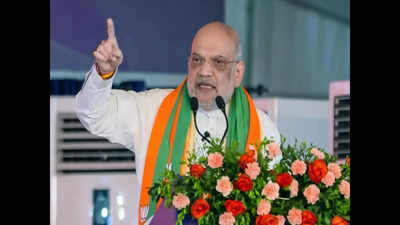
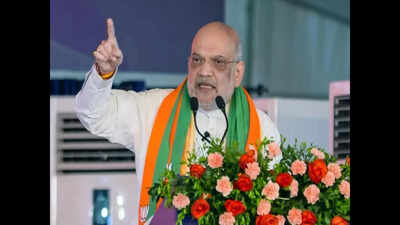
गोरखा नेताओं के खिलाफ 'झूठे' मामले हटा देंगे: अमित शाहAmit Shah Made several promises on Wednesday targeted at North Bengal, including withdrawal of “false” cases against Gorkha representatives and inclusion of Rajbanshi language in the Eighth Schedule of the Constitution, which recognizes official languages ​​in India.He said the Center was already working on a solution to the Gorkhaland issue, for which it had appointed an interlocutor and held three meetings in Delhi to find a solution, but CM Mamata Banerjee had refused to attend it. He said, “The people of Darjeeling are true patriots. They deserve their rights and justice, which have been denied to them.” Addressing an election rally in Jalpaiguri, Shah said the BJP government would withdraw every false case registered against political workers, regardless of party affiliation, and end what he called “police raj” in Bengal. He specifically mentioned the Gorkha representatives facing hundreds of cases. Shah also warned Trinamool workers against violence on polling day and referred to the attack on the convoy of BJP candidate Rathindranath Bose. He said, “I am warning Trinamool goons to stay indoors on April 23. Otherwise they will be behind bars after May 5.” He said the BJP would end “mafia raj”. At a rally in Falakata, Shah accused the state government of “step-motherly” behavior towards North Bengal and promised to increase the wages of tea garden workers by Rs 500 and create a dedicated battalion in the state police for the region. Raising the issue of women’s safety, Shah cited the incidents of RG Kar, Sandeshkhali and Durgapur Medical College. He said, “If BJP forms the government, women will be able to move around freely even at midnight.”
Source link

National security is not just the responsibility of the army but the collective duty of the citizens: NSA Ajit Doval. india news

National security is not just the army but the collective duty of the citizens: NSA Ajit Doval
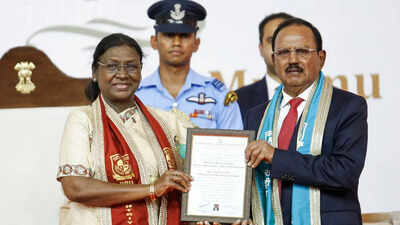
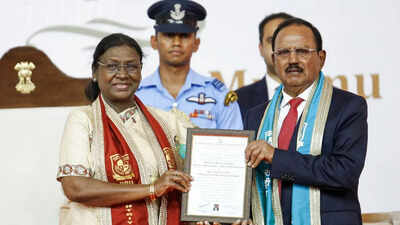
Ajit Doval with President Draupadi Murmu

New Delhi: National Security Advisor (NSA) Ajit Doval has said that “after a long time, we are witnessing a new awakening in India”, where national security is no longer the sole domain of uniformed personnel, but the collective responsibility of every citizen.“National security is the responsibility of the entire country and not just the armed forces, police or intelligence. It is our collective strength. Our collective strength together builds national morale,” he said while addressing students at the fifth convocation of the National Defense University (RRU) in Gandhinagar on Tuesday.Doval said, “National security is a vast, complex and multidimensional phenomenon. It involves many components: a country’s military power, technological prowess, natural resources, diplomatic strength and human capital.” After receiving an honorary doctorate from President Draupadi Murmu, he said that the biggest errors while assessing comprehensive national power are in evaluating the will of a nation and the inherent strength of its people.Citing global examples, the NSA said, “If Russia (then USSR) withdrew from Afghanistan (in 1988–89), or if the US was forced to withdraw from Vietnam (in the 1970s) or if the US failed to achieve its objectives in Afghanistan – it was not due to lack of technology or military might. Rather, the decisive factor was the spirit and commitment of the local people; what we refer to as the will of the nation.”Doval highlighted that security is an area where consequences are absolute. He urged the graduating students to remain fully committed to national service with discipline, preparation and dedication, saying, “There is no concept of silver medal in security; there is victory or defeat. If you win, the country is safe; if you lose, survival itself is at stake.”

Source link