

Shock to Trump, US judge reduces fee to $100,000: How this affects H-1B visa applicants
“Banning the entry of certain non-immigrant workers,” US President donald trump Announced as he signed a proclamation on September 19, 2025, unveiling one of the toughest changes ever to the H-1B visa program in the name of protecting American jobs and preventing alleged abuses of the system.Under the order, foreign professionals seeking some new H-1B visas will effectively face a hefty $100,000 hurdle, a move that immediately shocked the global technology industry and especially thousands of willing workers in India.However, the plan to put the brakes on the aspirations of many applicants was canceled on Monday after a federal judge in Massachusetts threw out Trump’s controversial $100,000 fee, saying the administration lacked the legal authority to impose an unauthorized tax on employers seeking to hire highly skilled foreign workers. The decision by U.S. District Judge Leo Sorokin is seen as one of the most significant judicial setbacks to Trump’s sweeping effort to restrict legal immigration through executive action.The Court concluded that the fee far exceeded the charges authorized by Congress, effectively turning it into a tax that the executive branch cannot impose unilaterally.
The $100,000 fee was not immigration policy, it was an economic boycott dressed up in legal language. The court has rightly recognized it as an unauthorized tax.
Rajeev Dabhadkar
What started the matter?
The controversy began when Trump, through a presidential proclamation, imposed a $100,000 fee for employers to pay the fee for some new H-1B workers recruited from abroad.The move immediately faced legal challenges from a coalition of 20 Democratic state attorneys general. They argued that the President had effectively created a new tax without congressional approval and had exceeded his authority under the Immigration and Nationality Act.States also warned that huge increases would discourage companies from sponsoring skilled foreign workers and harm state economies, universities, hospitals and technology industries that rely heavily on H-1B talent.In his ruling, Judge Sorokin agreed with the states’ argument and said the structure of the payment makes it a de facto tax.“Here, the substance and application of the $100,000 payment show that it is a tax, no matter what the payment is called,” the judge wrote. He also said that only Congress has the power to impose such a levy.
What actually changed in 2025?
In September 2025, Trump signed a proclamation called the Ban on Entry of Certain Nonimmigrant Workers, which introduced a $100,000 fee on new H-1B petitions filed on or after September 21, 2025.The administration said the measure is intended to improve the program, curb abuses, and protect American workers.Subsequent guidance from U.S. Citizenship and Immigration Services clarified that the fee will not apply to existing visa holders, renewals, or petitions filed before the effective date. Some exemptions were also outlined in “exceptionally rare circumstances”, including cases involving the national interest or a shortage of qualified US workers.The Trump administration defended this policy as part of its “America First” approach to immigration.Officials said the fee was designed to protect American workers, discourage companies from hiring cheap foreign labor, and generate revenue for immigration enforcement and border security.The White House also cited cases where companies had reduced domestic hiring while increasing H-1B sponsorship, arguing that the system was being abused.
Why did the court cancel it
In detailed findings, the court said the policy would cause widespread disruption in essential sectors such as education and healthcare.The plaintiffs argued that the fee would block faculty recruitment, put pressure on public universities, and reduce access to specialized medical professionals.He warned that the policy would “cause widespread harm throughout plaintiff states” by weakening health care systems, increasing the costs of state insurance programs, and reducing the availability of qualified professionals.Judge Sorokin agreed that these impacts reinforced concerns that the policy exceeded executive authority.
What is the H-1B program?
The H-1B visa allows U.S. employers to hire foreign professionals in specialty occupations that require at least a bachelor’s degree or equivalent expertise.These roles include software engineering, medicine, finance, biotechnology and academic research. This program is widely used by technology companies to recruit engineers and coders, especially from India and China.Each year, the US issues 65,000 regular H-1B visas, with an additional 20,000 reserved for applicants with advanced US degrees. Because demand far exceeds supply, the program operates through a lottery system.Indian professionals account for nearly 70 percent of all H-1B beneficiaries, making any policy changes to the program particularly important for India’s technology workforce.Before the Trump administration’s proposal, employers typically paid between $2,000 and $5,000 in filing-related costs, depending on the type of petition.The new rule dramatically increased that burden to $100,000 for some new H-1B applications, making it one of the largest immigration-related costs ever.
Why does this matter for Indian workers?
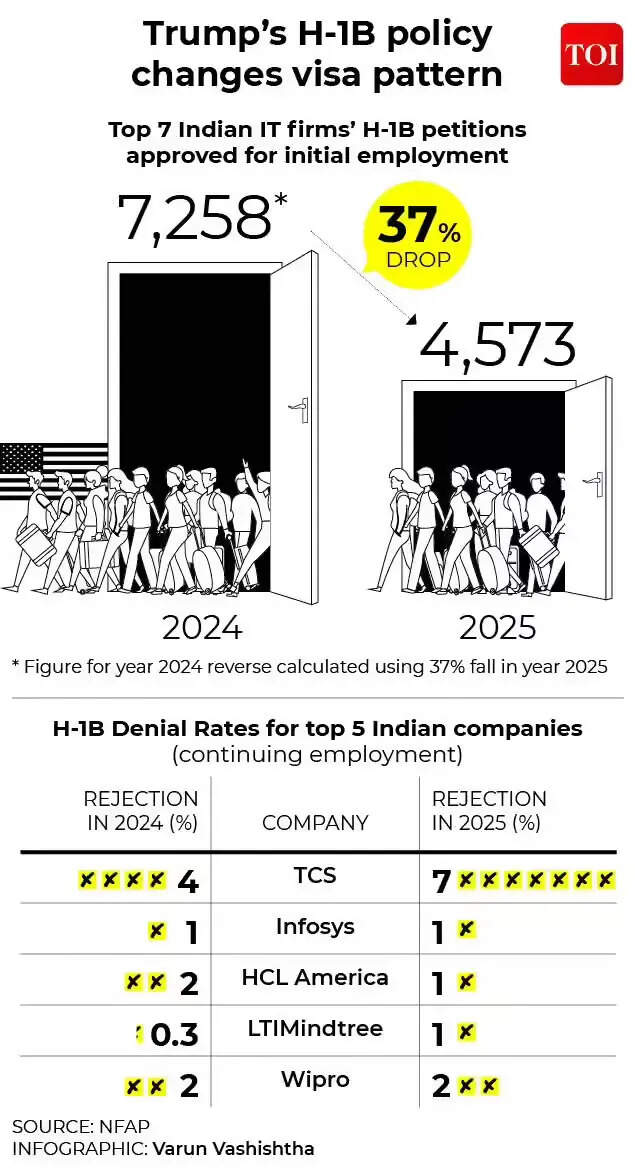
Indian professionals dominate the H-1B system, accounting for nearly three-quarters of approvals in recent years. According to USCIS data, the average salary for H-1B professionals in technology and engineering often ranges from $110,000 to more than $140,000 annually. Because of these income levels, H-1B workers contribute substantial tax revenues to federal, state, and local governments.Data cited by Pew Research shows that India is the top country of birth for H-1B workers. Nearly 73% of H-1B workers whose applications were approved in FY 2023 were born in India, with the majority of approvals each year since 2010 going to Indian-origin professionals. China is the second largest source, accounting for about 12% of approvals in 2023.Gil Guerra, an immigration policy analyst at the Niskanen Center, told the BBC in 2025 that because the fee would only apply to new H-1B recipients, it would be more likely to cause medium and long-term labor shortages rather than immediate disruption.
Indian professionals may also benefit from this decision, making it easier for US employers to hire specialized foreign talent. Kuldeep Kumar, partner at Mainstay Tax Advisors, who specializes in global mobility and cross-border taxation matters, said the decision could encourage employers who were hesitant due to the huge additional costs.“This is a favorable development and may encourage many US employers who require specialized foreign talent to access the global labor market, who may be reluctant to do so due to the significant cost implications of the tariff,” Kumar told TOI.
India cannot depend indefinitely on any one country as the primary destination for its skilled workforce.
Rajeev Dabhadkar
At the same time, Rajiv Dabhadkar, founder of National Organization for Software and Technology Professionals (NOStops), said that this decision has brought a broad lesson for India.He said the decision should also serve as a reminder that India cannot depend indefinitely on any one country as the primary destination for its skilled workforce.
what the experts said
Dabhadkar said the decision preserves the role of the H-1B program as an important channel for global talent.“While the $100,000 fee would not have been a routine cost increase, it would have fundamentally changed the business case of hiring foreign professionals, particularly Indians, who are the backbone of the H-1B workforce. If it had remained in place, many employers would probably have shifted work abroad instead of importing talent,” he told TOI.He argued that the measure was more than a routine immigration policy change.He said, “The $100,000 fee was not immigration policy, it was economic exclusion in legal terms. The court correctly identified it as an unauthorized tax.”Dabhadkar also said that the episode highlights the need to strengthen opportunities for India domestically.He said, “The deeper message for India’s knowledge workforce should be clear: the era of relying on a single geopolitical path for professional development is over. India must now invest as seriously in creating world-class opportunities at home as its professionals have invested in creating them abroad.”However, Kumar cautioned that the legal battle may not be over.“However, it is important to note that the Federal Court’s decision was based on a finding that the fee was, in fact, a tax. “Under the U.S. Constitution, the power to tax lies with Congress, not the President,” he said. “Therefore the decision is likely to be challenged on appeal. If the decision is stayed by the appellate court, the fee may remain in force until the case is finally resolved,” he said.
How did the Trump administration respond?
The Department of Homeland Security criticized the decision, calling it judicial overreach and accusing the court of interfering with immigration reforms.A statement from DHS said it “disagrees with this blatant judicial activism that seeks to dismantle President Trump’s historic efforts for immigration reform.”Trump also reacted sharply, saying, “These federal judges are really giving us a hard time. What’s happening with the court system is really crazy… They’re hurting our country very badly.”White House spokeswoman Taylor Rogers said the administration was confident the decision would be overturned on appeal.“President Trump has the clear legal authority to restrict entry to any class of aliens that he does not believe to be in the best interests of the United States, and that is exactly what he did,” she said.
what happens next?
The Massachusetts federal court’s ruling means the $100,000 fee cannot currently be enforced and must be set aside. However, the legal battle is not over yet. The Trump administration has already signaled its intention to appeal.The decision also highlights a growing legal divide. In a separate case, a federal judge in Washington previously upheld the charges, agreeing that the administration had broad authority under immigration law to restrict the entry of foreign nationals. That decision is now subject to appeal.What happens next will depend on higher courts, including the U.S. Court of Appeals for the First Circuit. The Trump administration may also seek a stay to keep the tariffs in effect while the litigation continues.However, for now, the ruling effectively halts the charges nationwide, providing relief to employers, universities, and thousands of foreign professionals who rely on the H-1B program to work in the United States.“In addition, other restrictive measures related to the H-1B selection process will remain in place. The long-term impact will depend on the outcome of the appellate proceedings and any subsequent policy changes,” Kumar said.