
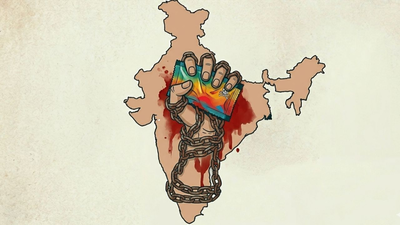

Two rupees for cancer: India’s smokeless tobacco epidemic that no one is stopping. india news
None of us is unaware of the fact that nicotine is bad. In India you cannot even go to a cinema without tobacco awareness advertisements playing. Your cigarette boxes and tobacco pouches have the most frightening graphics to discourage you from buying them. But you still do it.The cycle of addiction has never been something you should fear.Add to this how superficial these efforts are when you compare the buzzy commercial of a man coughing on his deathbed to the most stylish character in movies casually smoking a cigarette. You start the movie knowing that smoking causes deaths. You spend the next two hours seeing that it doesn’t kill – instead, seeing it makes someone look “hot” or “powerful.” The biggest names in our entertainment industry are quick to enhance their image by signing tobacco brand deals, almost equating it to a luxury lifestyle.A message plays before the film. This is the second film only.Asking people to quit tobacco in a country where more than 2 in 10 are dependent on it is an extreme virtue signaler. And another issue unique to the South Asian subcontinent is that of smokeless tobacco.About 20 crore Indians consume smokeless tobacco every day. Smokeless tobacco comes in small plastic pouches which are sold at every corner shop for a few rupees. Gutkha. Khaini. Jarda. It’s sitting quietly on the shelf next to the biscuits and candy. One of the most carcinogenic products ever available for retail sale can be purchased for Rs.2. “More than 28 types of carcinogens have been isolated from these products,” says Dr Madhurima Nandi, an academic research associate at the University of Edinburgh.“India is home to more than 80% of the world’s smokeless tobacco users. This is not a global problem. This is our problem. And yet, while cigarettes have graphic warnings on packets and face higher taxes, smokeless tobacco remains cheap, widely available, and less-regulated.While the rest of the world is struggling with vapes creating a new market for young tobacco users, something India has covered, at least legally. The biggest concern for our country is that countless people are “painting it red” every day.
–
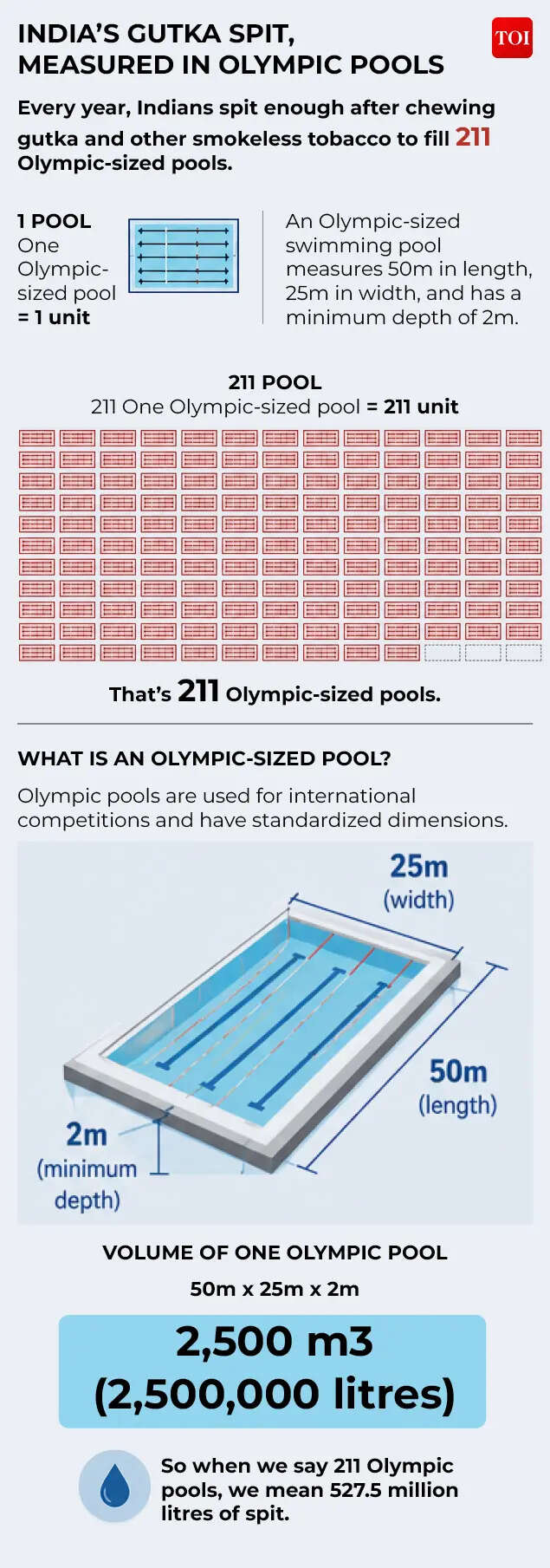
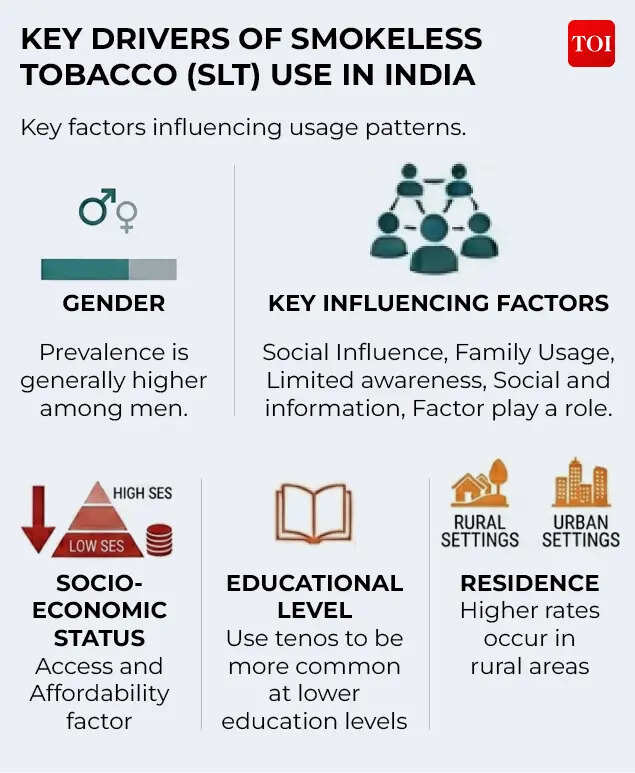
Enough to fill 211 Olympic-sized pools each year. Similarly, Indians spit after chewing gutkha and other smokeless tobacco. Indian Railways spends approximately ₹1,200 crore annually to clean these stains from trains and stations. Due to this, the pillars of Howrah Bridge have started rusting.But the problem did not start from yesterday.Tobacco cultivation began in India in 1605. The Portuguese introduced it in Kaira and Mehsana districts of Gujarat. What started as a colonial crop became a cultural fixture. Over the centuries, it has embedded itself in daily life, betel leaf after meals, tobacco distributed among laborers, a quiet addiction that demands little money and provides relief for a short period of time.Then came Gutka. A man named Mansukhbhai Kothari from Gujarat figured out how to make betel powder and sell it in small, cheap packets. Five rupees. Two rupees. Sometimes less. It was cheap in a way that cigarettes never were. And it became an instant hit. Gutka delivers nicotine into the bloodstream faster than cigarettes. It’s about three times more addictive. Even the process behind consumption is more instantaneous than smoking cessation.Which brings us to the sociological divide. Smoking and smokeless tobacco use are not the same problem in India. They do not affect the same people equally.Cigarette smoking in India is concentrated among the wealthier, urban population. A survey by the International Institute for Population Sciences found that daily smokers are wealthier and more educated than non-smokers. The poorest households have the lowest smoking rates. It’s no secret, cigarettes are expensive. Heavy taxes are imposed on them. The price of one packet is as much as a laborer can earn in a day.Smokeless tobacco is the opposite. It is cheap and easily available. According to Dr. Nandy, the main determinants of SLT use in India are clear: “gender (males more than females), educational level (illiterate more than literates), urban-rural residence (rural more than urban), socio-economic status (low than high), and low taxes on SLT products.” She adds that “peer pressure, parental use and limited knowledge about harmful effects” are also major factors.
–
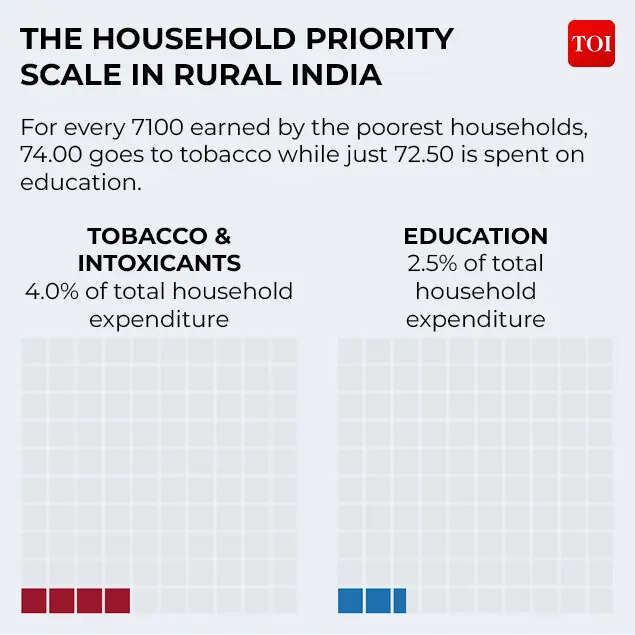
For a daily wage laborer tired after a hard day of physical labour, a ₹2 packet of gutkha is the most affordable option. When there is no money for food, it works to satisfy hunger. Nicotine releases dopamine and makes you feel full. This is the reason why even beggar children in India prefer to take small amounts of money instead of packets of biscuits. This small change allows them to eat Gutkha and keep themselves full and doped up for much longer than a single biscuit.said a poor child begging in the area next to Nehru Place metro station. “Biscuit doesn’t fill the stomach. Gutkha reduces hunger a bit. If you want to give money then give me this, don’t want the rest of the cheese.”The poorest households in rural India spend about 4% of their total expenditure on tobacco and drugs. They spend only 2.5% on education. Every year, an estimated 18.4 million Indians are pushed into extreme poverty due to tobacco-related disease and death. They not only lose their savings but also their main earner. The family remains poor.
–
The tobacco industry is not the cause of poverty in India, but the profits it makes.In relation to the smokeless tobacco epidemic, the level of Indian culture of ‘Jugaad’ has gone beyond what is necessary. Commenting on the misuse of these drugs by young children, an auto driver near Hauz Khas said, “You can make as many laws as you want. But there is always a jugaad (loophole).” He blamed not only the system but also the parents for the misuse of SLT. He said that drugs make you so happy that you forget the difficulties and that is why many children born in poverty are introduced to these drugs by their parents very early.While calling for a complete ban at this stage is impractical, we have seen how functional it has been with vapes. When you ban something you immediately create a profitable black market for it. The best way forward is to make the product less accessible, less attractive and less affordable.The 2011 gutkha ban was a good intention that became a case study in failure. Manufacturers did not stop selling their products. They simply divide the contents into two separate pouches – tobacco in one, flavorings in the other – sold side by side. The customer buys both and mixes them at home. Technically, no laws are violated because none of the bags alone contain a prohibited combination. This is Jugaad on an industrial scale and has made a mockery of the ban.Close this loophole. If a product is consumed as Gutkha, it should be regulated as Gutkha. Different sachets that are sold together and intended to be mixed should be considered a single product under the law.Then fix the packaging. When plastic ban was imposed in 2011 Supreme Court Banned plastic pouches for gutkha, tobacco and pan masala. Walk into any corner store today and you’ll still find them in plastic. Enforce restrictions. Impose fine on manufacturers. Seize the products. Make compliance visible. A law that is not enforced is not a law at all. This is just a suggestion.Next, look at the price. Gutka packet worth Rs 2 is not a product. This is a trap. Kids can afford it. Daily wage laborers buy this instead of food. Set a minimum pack size and make the cheapest legal pack price at least Rs 20 or Rs 30. Poor people will not stop using tobacco overnight, but few will. And many children will never start.Then control who can sell it. Today anyone can sell tobacco in India. No licensing is required, no training is mandatory, and there are no consequences for violations. Retail license required. Cancel it if it sells to minors or violates packaging laws. Himachal Pradesh has already done this. Punjab and Patna are moving in that direction. The rest of the country can follow suit.Increase the legal age. The current minimum age for purchasing tobacco in India is eighteen years, but this is not enforced. Increase it to 21. Sri Lanka has done so, and seven other countries have followed suit. Research shows that delaying the age of first use dramatically reduces the likelihood of lifetime addiction.Increase taxes. WHO recommends that taxes account for at least 75% of the retail price of tobacco products. India is nowhere near smokeless tobacco. Cigarettes are heavily taxed, but not smokeless tobacco. This is not an accident. This is a policy option that prioritizes revenue over public health. Higher prices reduce consumption, and a 10% price increase leads to an 11% decline in demand among low-income households. These are the people who need security the most.Dr. Nandy argues that “there is an urgent need to address these determinants with strict government policies on taxation and tobacco control. Mass media campaigns more directed at predefined populations and clear risk labeling of products can significantly help reduce use.”The child near Nehru Place metro station does not need any other awareness advertisement. He’s seen the graphic on the pouch and knows it’s bad for him. He buys it anyway because it is cheaper than two rupees worth of food. As long as the government does not make smokeless tobacco unobtainable, unavailable or distasteful, he will continue to buy it. The industry will keep selling it. Railways will keep getting it cleaned. And 18.4 million Indians will continue to fall into poverty every year.