
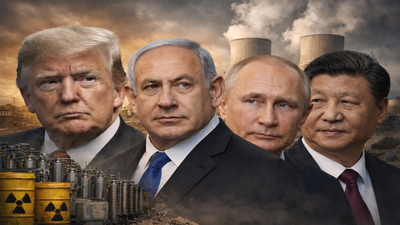

What is so special about Iran’s uranium that America, China and Russia all want it?
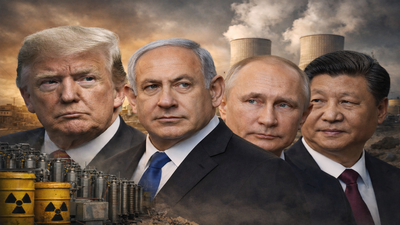
Iran’s rich uranium reserves have become the centerpiece of an increasingly complex global power competition, with the United States, China and Russia all seeking a role in determining its future, while Tehran says the material will not be handed over to anyone.What was once a technical issue within nuclear diplomacy has now become one of the most politically charged questions in international relations. For Washington, control over Iran’s uranium could mean blocking the path to any future nuclear weapons. For Moscow and Beijing, it provides influence on the shape of future Middle East agreements. For Iran, it represents sovereignty, strategic leverage, and national prestige.
The issue came back into the spotlight after US President Donald Trump claimed that Washington and Tehran were moving toward a deal under which Iran’s uranium would be recovered and eventually brought to the United States.Speaking to Reuters in a phone interview, Trump said the United States would work jointly with Iran to recover the stockpiles.Trump said, “We’re going to get through this together. We’re going to go leisurely with Iran and go down and start digging with big machinery.” “We’ll bring it back to the United States.”Trump said the material, which he described as “nuclear dust,” would be recovered “very soon.”Iran immediately rejected this suggestion.Iranian Foreign Ministry spokesman Esmail Baghai said, “Iran’s enriched uranium will not be transferred anywhere; transferring uranium to the United States is not an option for us.”The sharp contradiction in the talks brokered by Pakistan, reportedly with the support of Egypt and Türkiye, has exposed one of the central unresolved disputes.
Why does Iran’s uranium matter so much?
Uranium in its natural form cannot be used directly in nuclear weapons. It must first be enriched, a process that increases the concentration of the uranium-235 isotope.Low-enriched uranium is commonly used for civilian nuclear reactors. Highly enriched uranium could potentially be used in nuclear weapons.Western officials estimate that Iran has substantial reserves at several enrichment levels. According to US estimates cited in international reports, Iran has about 450 kilograms enriched to 60 percent purity, about 1,000 kilograms enriched to 20 percent and about 8,500 kilograms enriched to 3.6 percent.The 60 percent stockpile is particularly sensitive because it is considered only a small technological step up from weapons-grade enrichment of about 90 percent.This makes Iran’s uranium stockpile one of the most heavily monitored nuclear stockpiles in the world.Iran denies seeking nuclear weapons and says its nuclear activities are solely for peaceful civilian uses.
What is “nuclear dust”?
Trump’s use of the phrase “nuclear dust” is not a technical scientific term. This appears to be a political description of uranium material that they believe is buried, damaged or dispersed following earlier military attacks on Iranian nuclear infrastructure.The phrase probably refers to enriched uranium or uranium compounds stored inside damaged underground facilities, particularly near Isfahan, where parts of Iran’s nuclear program were reportedly affected during previous attacks.Experts say that uranium does not simply disappear after an attack. Depending on storage conditions, it may be recovered in containers, sealed chambers, buried debris, or damaged tunnels. That’s why Trump suggested digging with “big machinery.”In practical terms, “nuclear dust” means residual nuclear material that may still have strategic value even if the facilities around it have been destroyed.
Why does the United States want this?
For Washington, removing Iran’s uranium would be the most direct way to reduce Tehran’s ability to move rapidly toward a nuclear weapon.Trump has presented the issue as evidence that his administration can achieve a stronger arrangement than previous nuclear agreements.Trump also said Thursday that Iran had agreed to “a very, very powerful statement … that they will not have nuclear weapons.”If the uranium were transferred to the United States or neutralized under US-backed supervision, Trump could present it as a major diplomatic victory and a major security achievement.He also expressed confidence about the talks.He said, “I think the agreement will be reached very quickly. We are dealing very well with Iran.”
Why does Russia want a role?
Russia has publicly renewed its offer to host Iran’s enriched uranium under a future deal.The Kremlin said Moscow was ready to take possession of the materials, reviving an approach used in earlier diplomacy.“This proposal was put forward by President Putin in contact with both the United States and regional states. “The proposal still stands, but has not been acted upon,” Kremlin spokesman Dmitry Peskov said.Russia previously played a key role in the 2015 nuclear deal, when Iran shipped low-enriched uranium abroad as part of compliance measures.For Moscow, taking over the stockpile would restore influence in nuclear diplomacy, expand its Middle East relevance and position Russia as an indispensable mediator between Washington and Tehran.
Why is China interested?
China has also emerged as a potential player.China is prepared to take possession of Iranian uranium or melt it to low enrichment levels suitable for civilian use if both Washington and Tehran agree, the report said, citing diplomats familiar with Beijing’s thinking.China’s interest is strategic and economic.Beijing is Iran’s largest trading partner and the largest buyer of Iranian oil. There are strong incentives to prevent further conflict in the Gulf and to stabilize energy flows through the Strait of Hormuz.The Chinese role will also boost Beijing’s diplomatic standing and strengthen its image as a stable force in global crises.Trump is expected to visit Beijing for talks with the Chinese President Xi JinpingWhere Iran is expected to be on the agenda.
Why does Tehran refuse to give it up?
For Iran, the uranium issue is not just about nuclear science. It is closely related to politics, prestige and sovereignty.Iranian leaders have long portrayed enrichment capabilities as a symbol of technological progress and resistance to foreign pressure.Analysts say handing over the reserves to the United States would be politically difficult to defend domestically.“Iran’s attachment to uranium enrichment is deeply ideological,” Professor Ali Ansari told the Guardian. “It’s almost an obsession with national prestige.”Regardless of whether Tehran accepts inspections, a temporary limitation, or external monitoring, physically handing over the uranium could be viewed internally as a capitulation.This helps explain the immediate and obvious rejection of Trump’s claims.
Why would it be difficult to remove
Even if a political agreement is reached, physically removing the content can be one of the most difficult parts of any deal.Some of the uranium is believed to be stored in underground tunnels or damaged facilities near Isfahan.Military and nuclear experts have warned that any recovery mission would require excavation, safe transport, radiation precautions and international verification.One expert described the challenge clearly.“You basically have half a ton of weapons-grade uranium that you have to extract. And there are a million things that can go wrong.”This means that diplomatic success will be only the first step. Implementation may take weeks or months.
$20 billion report adds controversy
Fresh questions also emerged after Axios reported that the United States is considering releasing $20 billion of frozen Iranian assets if Tehran gives up its uranium stockpile.The report said Washington was previously prepared to release $6 billion for humanitarian purposes, while Iran had sought $27 billion.Trump strongly denied that the money was part of any arrangement.“This is a complete lie. No money is changing hands,” he said.He later posted on Truth Social: “No money is changing hands.”A White House spokesperson said the administration “will not negotiate through the press” and that the unnamed sources “don’t know what they’re talking about.”
what happens next
Negotiators are expected to continue talks in the coming days, but the uranium dispute remains a clear barometer of whether a comprehensive solution is truly possible.Washington wants a guarantee that Iran cannot move forward rapidly in the direction of making a bomb. Iran wants relief from sanctions, security assurances and recognition of its right to peaceful nuclear energy.Russia and China see an opportunity to shape the outcome.Whether Iran’s uranium is removed, diluted, stored abroad or kept under tight surveillance could determine whether diplomacy succeeds or collapses.For now, a stockpile of uranium has become the strategic prize that the United States, China and Russia all want, and an asset that Tehran has refused to surrender.