66% of births in 2024 were preterm; Birth gap for majority now 36 months india news

66% of births in 2024 were preterm; Birth gap for majority now 36 months

New Delhi: Nearly two-thirds of all live births in India – 66.4% – were first-borns, while births to the fourth child and beyond remained at barely 3.5%, the 2024 Sample Registration System statistical report showed. On birth spacing, which is an important factor for maternal health and child development, the data shows that 53.5% of second or subsequent births occurred 36 months or later after the previous birth.According to 2024 data, about 23% of births were second-order births, a term used to refer to a second child, and 7.3% were third-order births.In terms of urban and rural trends, the data shows that 65.4% of live births were first-order births in rural India and the percentage was 69% for urban areas. Among larger states and union territories, Telangana has the highest percentage of first-order births at 82.7%, while Kerala has the lowest at 47.9%. Interestingly, Kerala had the highest percentage of second order and third order births at 34.9% and 13.3%.While Kerala had the highest percentage of second-order and third-order births, Telangana had the lowest at 13.4% and 2.9% respectively, the 2024 Sample Registration System statistical report showed.Madhya Pradesh has the highest percentage of fourth or higher order births at 6.5%, while Andhra Pradesh ranks lowest at 0.5%.Data on birth order and the interval between consecutive live births have been collected under the Sample Registration System (SRS) since 1990.Birth order – the chronological order of child births within a family – and birth intervals are key indicators of spacing between children and fertility levels.

Kerala is at second place in child birth rate, Tagana is at the bottom.

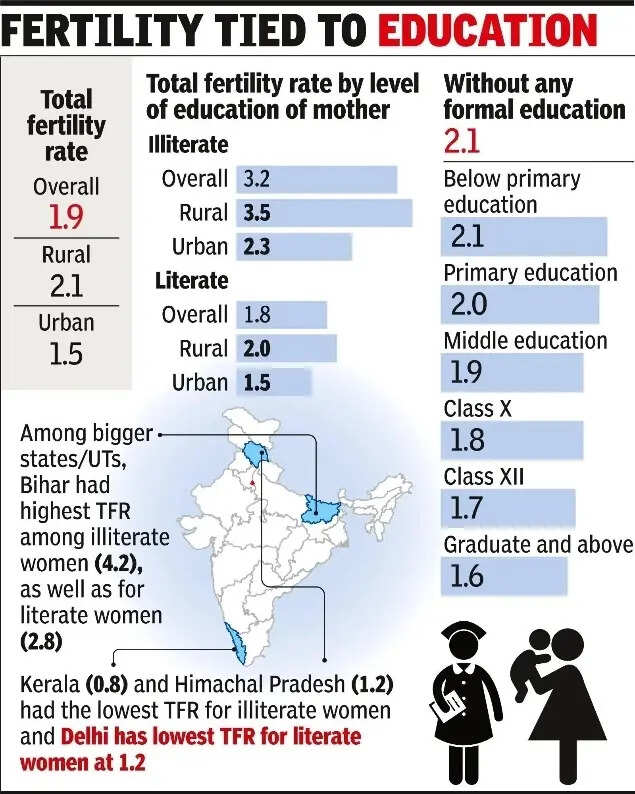
The trend in terms of birth order in 2024 is in line with previous years.In 2023, first-order births were 66%, and fourth or higher order births were 3.6%.In 2022, 64% of live births were first-order births and fourth or higher-order births were 4.7%.As far as spacing of births is concerned, 53.5% of second and higher order births occurred 36 months or more after the previous live birth and only 1.4% of live births occurred within 10–12 months of the previous live birth. According to the data, 19.3% of births occurred within 12–24 months and 25.8% occurred within 24–36 months of the previous live births. The percentage distribution varies considerably across states and union territories. For example, the percentage of second and higher order live births occurring 36 months or more after the last live birth ranged from 32.8% in Andhra Pradesh to 79% in Assam.Previous research drawn from government data such as the National Family Health Survey has repeatedly underlined the urgent need for better birth spacing methods in family planning. He highlighted that pregnancies less than a year apart increase the risk of diarrhoea, respiratory infections and stunting among children under five in India.The report also points to a strong relationship between women’s education and fertility rates. While India’s total fertility rate is 1.9, which remains below the replacement level of 2.1 in 2024, illiterate women recorded a much higher fertility rate of 3.2 compared to 1.8 among literate women.

Source link

High courts will have to pronounce verdict within 3 months of reserving verdict: Supreme Court. india news

High courts will have to pronounce verdict within 3 months of reserving the verdict: Supreme Court

New Delhi: To curb the habit of “hesitate and forget” among some high court judges, Supreme Court On Friday, it set a deadline of three months for the high courts to pronounce their decisions, and also said that orders in bail cases should be passed immediately.As a series of appeals against convictions in criminal cases are pending indefinitely, a bench of Chief Justice Surya Kant and Justice Joymalya Bagchi said the high courts should show extra diligence in deciding cases related to personal liberty, regular and anticipatory bail.CJI Kant said, “Bail petitions should be heard and the order should preferably be pronounced and uploaded on the same day. If it is reserved, it should be narrated the next day and uploaded on the website.”Mere prompt announcement of the order of grant of bail will no longer suffice as the Supreme Court has ordered that the jail authorities should also be informed with equal promptness so as to ensure that the undertrial prisoner/convict is released from custody immediately, preferably on the same day or certainly by the next day, unless there is a need to keep him behind bars in other cases or there is failure to furnish the bail bond.The Supreme Court asked the trial courts concerned to report compliance with the bail order to their high courts.However, the SC gave some leeway to the HC and said that if a bench is of the opinion that giving a reasoned judgment will take time in cases where the order is urgently required, then it can pronounce the operative part immediately and follow it in the next 15 days. However, it added that high courts must upload all judgments within 24 hours of the judgment being delivered.CJI Kant and Justice Bagchi said the HC registry will have to give a monthly report on the number of reserved judgments to the Chief Justice, who can confidentially inform the judges concerned about cases in which judgments were reserved for two months.If the judge or bench concerned fails to deliver the judgment in three months, the HC CJ shall request them to do so in the next two weeks, otherwise the matter may be assigned to another judge/bench for fresh hearing and speedy decision, the SC said while accepting or modifying several suggestions made by amicus curiae Fauzia Shakeel.Apart from the steps to be taken by the CJ, the Supreme Court gave freedom to the parties in such situations to file applications for transfer of their cases to some other bench. It says that every judgment should mention the date on which the judgment was reserved.

Source link

60% chance of weak monsoon, IMD reduces rain forecast. india news

60% chance of weak monsoon, IMD reduces rain forecast

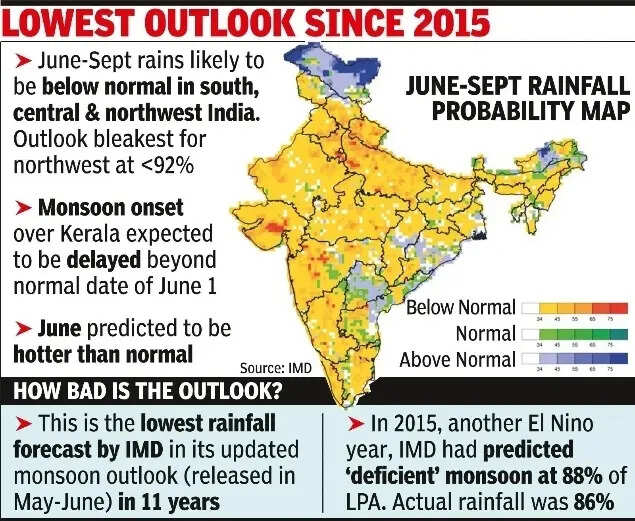
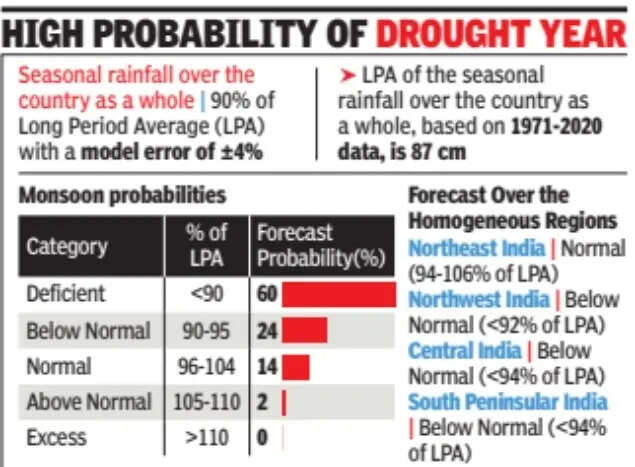
New Delhi: Even though India is facing energy disruptions due to the West Asia crisis, there could be more troubles for the economy. The IMD on Friday confirmed its forecast of ‘below normal’ monsoon rainfall this year, while further lowering the rainfall threshold during the June-September season, which has a high probability of ‘deficit’ rainfall, also known as a dry year.According to the IMD, rainfall during the season is likely to be 90% of the long period average (LPA) – revised down from 92% estimated in April – with a 60% chance of ‘deficient’ rainfall (less than 90% of the LPA), a situation that could not only impact the agriculture sector but also negatively impact water reservoirs, groundwater recharge and hydropower potential, leading to a crisis at multiple levels.

60% chance of weak monsoon, IMD reduces rain forecast

The IMD attributed the monsoon decline to the possible development of strong El Nino conditions – a climate phenomenon characterized by warming of ocean waters in the central and eastern equatorial Pacific – which is often associated with harsh summers and weak monsoons over India.Accordingly, the IMD has also indicated a hot June in the country, and has predicted ‘above normal’ heatwave days in June over many parts of UP, Haryana, Punjab, Bihar, Odisha, Chhattisgarh, Gujarat and Andhra Pradesh and parts of Maharashtra, Telangana, Himachal Pradesh and Tamil Nadu. However, Rajasthan and Jharkhand may experience ‘below normal’ heat wave days during the month.The latest climate model forecasts indicate that El Nino conditions are likely to develop during the southwest monsoon season,” IMD chief Mrityunjay Mohapatra said, noting that it is expected to move from weak in June to moderate in July-August and strong in September, impacting the entire rainy season.In such a scenario, there is a possibility of a slight delay in the onset of monsoon over Kerala compared to the normal date of June 1 and its subsequent progress over the rest of the country, as well as a delay in commencement of sowing operations, as more than half of India’s cultivated area remains rain-fed.Although the IMD had a few days ago predicted the onset date of monsoon over Kerala as May 26 (+/- with a model error of four days), it now expects it to be any day within the next seven days. Since the ‘monsoon core zone’ – an area encompassing most of central and western India, which largely depends on rain for farming operations – is also predicted to receive ‘below normal’ rainfall, its impact will be felt on the total area of ​​kharif crops and their final production.The risks to the country’s agriculture sector may further increase due to the crisis in West Asia, which has already put pressure on the availability of inputs (diesel and fertilizers) and their costs, thereby impacting the rural economy and ultimately India’s economy in the current financial year.

Image (10)

However, Union Agriculture Minister Shivraj Singh Chouhan said the country is fully prepared to deal with any situation and is prepared with contingency measures in terms of other interventions such as selecting drought-tolerant and climate-resilient crop options (such as low-water-intensive varieties of millet and paddy, other crops) in vulnerable districts and providing adequate inputs (seeds and fertilizers) to farmers.Contingency measures include promotion of drought-tolerant crop varieties on a large scale, weather-based agro-advisory services, efficient water management and location-specific adaptation strategies to reduce agricultural losses and protect farmers’ livelihoods.Chouhan asked state governments to be prepared for challenging weather conditions in view of the threat of El Nino and assured them of all possible help from the Central government, adding that there is adequate availability of seeds and fertilizers to meet the demand during the upcoming sowing season.The minister also asked states to prepare their agricultural roadmap based on agro-climatic conditions, available resources and local capacity during the concluding day of a national conference on Kharif preparedness on Friday amid increasing risks to agricultural operations due to El Nino.

Source link

Arms, IED smuggling network under investigation, NIA conducts raids in four states. india news

Arms, IED smuggling network under scanner after NIA raids in four states

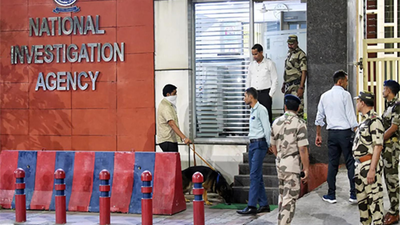
New Delhi: The National Investigation Agency (NIA) on Friday conducted searches at a dozen locations in four states in connection with the alleged smuggling of arms, ammunition and IEDs into the country from across the India-Pakistan border as part of a conspiracy to carry out terrorist attacks in Punjab, Delhi and other parts of India. The searches included four places in UP, two each in Rajasthan and Bihar and three in Maharashtra. An NIA spokesperson said that during the coordinated operation by the NIA teams, several digital devices were seized which will be forensically analyzed to unravel the entire terror conspiracy in the case. A case was registered by the Special Operations Cell of Punjab Police in Amritsar in February this year after the arrest of a man after he was found with IEDs packed in a metal box along with a remote control set, a mobile handset, a foreign-made .30 bore pistol with magazine and 20 live cartridges. Various sections of the Indian Justice Code (BNS), Unlawful Activities (Prevention) Act, Arms Act, Explosive Substances Act and NDPS Act were invoked in the FIR. After taking over the investigation, NIA found that the purpose of cross-border smuggling was to carry out IED blasts at various places in Punjab, Delhi and other parts of India to cause widespread damage to life and property and disrupt the peace and stability of the country. Investigation further revealed that the arrested accused was in contact with several people in different parts of the country to carry out terrorism, arson and other violent activities. The NIA said efforts are on to identify other Indian and international elements involved in the conspiracy.

Source link

After the retirement of Sameer Kamat, Defense Secretary Rajesh Kumar Singh got the additional charge of DRDO Chairman. india news

After the retirement of Sameer Kamat, Defense Secretary Rajesh Kumar Singh got the additional charge of DRDO Chairman.
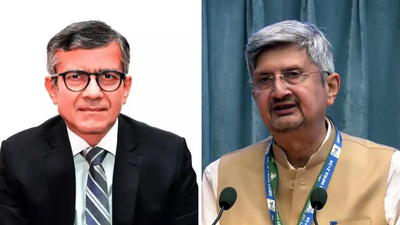
Rajesh Kumar Singh and Sameer Kamat

New Delhi: Defense Secretary Rajesh Kumar Singh Has been given additional charge of the post of Secretary and Chairman, Department of Defense Research and Development Defense Research and Development Organization (DRDO) because current DRDO chief Sameer V Kamat is retiring.Singh will assume additional responsibilities from May 31 as the Appointments Committee of the Cabinet (ACC) issued the order on Friday evening.During Kamat’s tenure as DRDO chairman from August 2022, the research organization focused on structural reforms, advancing cutting-edge technologies like quantum computing and stealth unmanned combat aerial vehicles, and accelerating indigenous systems for the armed forces.Kamat emphasized on advancements in Electromagnetic Aircraft Launch System (EMALS), indigenous electric propulsion for warships and space-based intelligence, surveillance and reconnaissance (ISR). His tenure also saw the expansion of 15 DRDO Industry Academy Centers of Excellence to pursue translational research.Rajesh Kumar Singh, a 1989 batch IAS officer of Kerala cadre and current Defense Secretary, took over as Defense Secretary in South Block on November 1, 2024. Before assuming the post, he had taken charge as OSD (Defence Secretary-designate) on August 20, 2024. Before his appointment as Defense Secretary, Singh served as Secretary in the Department for Promotion of Industry and Internal Trade from April 24, 2023, to August 20. 2024. Earlier, Singh had held several key positions including Director (Works and Urban Transport) in the Ministry of Urban Development, Commissioner (Land) in DDA and Joint Secretary in the Ministry of Petroleum and Natural Gas.

Source link

Operation Sheruwali enters seventh day; Search continues in Rajouri, Jammu and Kashmir. india news

Operation Sheruwali enters seventh day; Search continues in Rajouri, Jammu and Kashmir

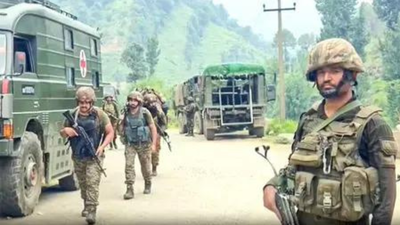
JAMMU: A joint team of Army, Jammu and Kashmir Police and CRPF continued to search for two to three terrorists hiding in the dense forests of Dorimal-Gambhir Mughalan belt in Manjakot sector of Rajouri district, as Operation Sheruwali entered its seventh day on Friday.Officials said helicopters, drones and sniffer dogs were assisting troops on the ground. Additional reinforcements were also sent to close potential escape routes and assist the forces in the ongoing counter-insurgency operation, which was launched on 23 May after a brief gunfight between militants and security personnel.Heavy firing and shelling took place in Dorimal on Thursday as search teams continued to tighten the cordon. Earlier, security forces had busted a terrorist hideout loaded with some essential items on May 25, the third day of the operation. Later that place was destroyed.Several top officials, including Northern Army Commander Lieutenant General Prateek Sharma and IG CRPF (Jammu) Amol V Homkar, visited Rajouri last week for operational review and situational assessment.

Source link

UP: Namami Gange department launched transparent digital transfer campaign, 170 officers transferred. india news

UP: Namami Gange department launched transparent digital transfer campaign, 170 officers transferred

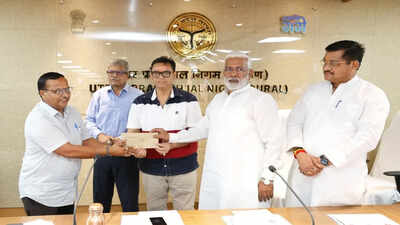
New Delhi: The Namami Gange and Rural Water Supply Department of the Uttar Pradesh government on Friday conducted large-scale transfers through a completely transparent and digital process with an aim to eliminate corruption and manual interference.The officers and employees were allotted postings on the basis of merit and seniority in an open selection process conducted before ministers and senior officials under the supervision of Jal Shakti Minister Swatantra Dev Singh.A total of 170 officers and employees were transferred, including 131 from the Rural Water Supply Department, 28 from the Minor Irrigation Department and 11 from the Ground Water Department. The transfers include two chief engineers, 15 superintending engineers, 35 executive engineers, 40 assistant engineers and 78 junior engineers.To ensure transparency, the department installed eight digital screens displaying the vacant districts. Officers were called one by one to select available postings, who were immediately locked in the system. Transfer letters were sent directly to their mobile phones in a matter of seconds.Employees unable to be physically present were allowed to participate online and present their choices live before senior officials and ministers.According to the department, seniority and work performance were evaluated through key performance index (KPI) scores, which formed the basis of the transfer process.Additional Chief Secretary Anurag Srivastava said the initiative reflects Chief Minister Yogi Adityanath’s zero-tolerance approach towards corruption and has boosted confidence among the employees.Officials described the exercise as a major step towards transparent governance in the state’s water management departments.

Source link

Pope Leo XIV and PM Modi give same message on AI: Ethics before efficiency india news

Pope Leo XIV and PM Modi give same message on AI: Ethics before efficiency

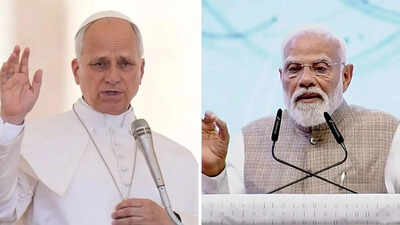
New Delhi: Pope Leo XIV’s first major ethical reflection on Artificial Intelligence appears to echo Prime Minister Narendra Modi’s repeated calls for human-centred, ethical and inclusive AI governance, with both leaders warning that the technology should serve people rather than be limited to data, profit or power.in their encyclopedia Magnifica Humanitas: On the Security of the Human Person in the Time of Artificial IntelligencePope leo XIV presents AI as one of the defining ethical questions of the era. The document places human dignity, truth, justice, freedom, action and peace at the center of the AI ​​debate.Even before the Pope, PM ModiIn speeches at global forums including the GPAI Summit, the AI ​​Action Summit in Paris and the India AI Impact Summit 2026, a similar argument was made: AI must remain trusted, safe, inclusive and directed towards public welfare rather than pure commercial or geopolitical competition.The strongest point of convergence is the idea that AI should remain focused on the human person rather than the machine.Pope Leo XIV writes, “In the age of artificial intelligence, when human dignity is threatened by new forms of dehumanization, we have a duty to remain deeply human.”PM Modi had used almost identical framing in a policy context, saying, “Technology exists to serve humanity, not to replace it.”At the India AI Impact Summit 2026, PM Modi described the central challenge as “how to make AI human-centric rather than machine-centric, sensitive and responsible rather than reckless.” The Pope’s warning that no machine can replace “the greatness of humanity” echoes PM Modi’s insistence that technology should enhance, and never eliminate, human judgment and responsibility.The Vatican document repeatedly warns against a “culture of power” driving the AI ​​race, particularly through the concentration of data, computation and technological influence in the hands of a few corporations and states.Pope Leo XIV argues that “technology is never neutral” because it reflects the values ​​and intentions of those who create, finance, and regulate it. He also rejected the idea that ethics could remain a voluntary corporate principle without legal accountability.The Pope writes, “It is not enough to invoke morality in the abstract; what is needed is strong legal frameworks, independent oversight, informed users, and a political system that does not shy away from its responsibility.” He added: “A more ethical AI is not enough if morality is determined by a few people.”PM Modi had similarly argued that AI governance cannot be left to markets or technology companies alone.“Ethics in AI cannot be optional or limited. Benefits must be aligned with purpose,” he said at the India AI Impact Summit 2026.The convergence is particularly visible in how both leaders define the purpose of the technology.Pope Leo XIV writes that technology can “heal, connect, educate and protect our common home,” but warns that it can also “divide, exclude and generate new forms of injustice.”PM Modi has repeatedly referred to the Indian civilizational phrase ‘Sarvajan Hitaya, Sarvajan Sukhaay’ and said that the ultimate goal of technology should be “welfare of all, happiness of all”.For both, AI is not just an efficiency tool or a race for technological supremacy. Its validity depends on whether it improves health, education, agriculture, public services, climate action and last-mile welfare delivery.Equity and access is another major area of ​​overlap.The Pope warned that when technological goods remain concentrated “in the hands of a few”, new imbalances arise, especially for poor societies and vulnerable populations.PM Modi had given a parallel argument from the perspective of the Global South. Speaking at the GPAI summit in 2023, he warned that unequal access to technology has deepened inequalities over the past century and said humanity must avoid repeating that mistake with AI.“Governance also means ensuring access for all, especially in the Global South,” PM Modi said at the Paris AI Action Summit in 2025.He also called for a global partnership on AI to be more inclusive of developing countries and their priorities.The two leaders also agree on the dangers of dehumanization and reducing humans to algorithmic categories.Pope Leo XIV has cautioned against “the pretense that a single language, even a digital language, can translate into data and display everything, including the mystery of the individual.”PM Modi warned in exactly the same formulation that “AI should not reduce humans to mere data points or raw materials.”While the terminologies are different – ​​metaphysical on the one hand, evolutionary on the other – both reject the same reductionist logic: human identity can be completely quantified, optimized or controlled by machine systems.Both leaders also see risks in implicit bias and exclusion within AI systems that present themselves as objective.Pope warned that AI could reinforce “the stereotypes or ideological biases of its designers and developers” while hiding behind a “veil of neutrality”.PM Modi similarly argued for “quality data sets free from biases”, warning that in a deeply diverse society like India, AI bias can emerge through language, culture, region, gender and socio-economic realities.At the Paris AI Action Summit, they used a simple example to illustrate the problem: If asked to picture someone writing with the left hand, an AI system would likely picture a right-handed person because that’s what the dominant training data shows.The future of work is another point of overlap.The encyclopedia acknowledged widespread concerns over automation, unemployment and de-skilling, warning that job losses are not just an economic problem, but also affecting dignity, families and social fabric.Pope Leo XIV argues that every expansion of automation must be accompanied by protections for employment, retraining, and worker participation.PM Modi had taken a more transition-focused approach, but reached a similar conclusion: “Job loss is the most dangerous disruption of AI. But, history has shown that work does not disappear because of technology. Its nature changes and new types of jobs are created.”He has repeatedly argued that preparation, skill, and human-AI collaboration are the best safeguards against disruption.The convergence ultimately points to a broader global argument: AI governance cannot be left to a handful of companies or powerful states acting alone.Pope Leo XIV called for “shared responsibility and courage” to ensure that technology serves humanity rather than domination or exclusion.PM Modi advocated a global compact on AI based on human oversight, security-by-design, transparency and safeguards against deepfakes, terrorism and criminal abuse.Their proposed MANAV framework – ethical and moral systems, accountable governance, national sovereignty, accessible and inclusive, and legitimate and legitimate AI – translates these principles into the Indian policy idiom.The Pope’s framework emerges from Catholic social teaching rooted in human dignity, solidarity, labor rights and the common good. PM Modi’s framework is inspired by democratic governance, developmental priorities and the civilizational ethos of India.Yet both interventions emerged from the same underlying concern: that artificial intelligence might outgrow the ethical and institutional frameworks needed to control it.Together, both approaches suggest the emergence of a broad global consensus: AI should not become a means of domination, exclusion, or dehumanization. It must remain accountable to the human person.

Source link

CBSE OSM controversy: Flaws detected in 20 answer sheets; Over 13,000 copies were manually evaluated, the report said India News

CBSE OSM controversy: Flaws detected in 20 answer sheets; More than 13,000 copies were manually evaluated, the report said

New Delhi: The Central Board of Secondary Education (CBSE) detected around 20 cases of manipulation in answer sheets during the first-time implementation of its on-screen marking (OSM) system this year, while over 13,000 answer sheets ultimately had to be evaluated manually due to scanning quality issues, government sources told PTI on Friday.The matter came to light when students looked at the scanned copies of their answer sheets uploaded on the CBSE portal and found that some were not theirs.“There was a case of Vedant. Vedant got the answer sheet and was horrified to see that it was not his answer sheet. There was a glitch in the scanning. There was also a girl named Sanjana there,” sources told PTI.Class 12 student Vedant had earlier gone viral on social media alleging that the Physics answer sheet uploaded by CBSE during the revaluation process was not his. Many other students, including Sanjana, also reported similar issues online.CBSE later contacted the students and shared the correct answer sheets. The board said that matters related to mismatched answer sheets and other concerns in the revaluation process are being handled on “top priority”.“In some cases, there were irregularities in scanning. There are around 20 such cases. This was pointed out by the students after seeing their answer sheets,” sources said.According to sources, more than 98 lakh answer sheets comprising about 40 crore pages were scanned under the OSM system.“Out of these 98 lakh answer sheets, around 68,000 were found to have quality issues during scanning and were re-scanned. Ultimately, a little over 13,000 copies did not achieve the required legibility quality even after re-scanning,” sources told PTI.The controversy over the digital assessment system has forced CBSE to postpone the opening of its Class 12 result post-verification and revaluation portal from May 29 to June 1.In a post on X, CBSE said the portal is being strengthened to ensure a “transparent, smooth and error-free process” for students applying for verification of marks, photocopies of answer sheets and revaluation services.A CBSE official said the website infrastructure is still being upgraded to avoid disruptions during the application process after many students reported technical glitches while accessing the post-result services.Students and parents had raised issues ranging from difficulty in accessing scanned copies of evaluated answer sheets to payment gateway failures and incorrect fee display on the portal.Concerns intensified after questions were raised over CBSE’s new OSM system introduced for Class 12 evaluation this year. Union Education Minister Dharmendra Pradhan recently acknowledged anomalies in the digital assessment system and assured students that corrective measures will be taken.The Board has advised students not to panic and use the official support channels for assistance regarding verification and revaluation services.CBSE expects huge traffic on the portal, lakhs of students can apply for post-result services. Reports suggest that more than four lakh applications for scanned copies of answer sheets had already been received.Officials defended the rollout of OSM, saying the technology-driven assessment improves transparency and allows answer sheets to be shared with students digitally.“Technology is the future. From next year, answer sheets will also be available in DigiLocker along with marksheets,” sources said.“From next year, all the answer sheets will be sent together on DigiLocker. Technology gives you a certain kind of transparency, which is not possible otherwise,” he said.“Whenever you do something for the first time, there are challenges,” sources said.Sources further said that Koempt and Tata Consultancy Services (TCS) had technically qualified in the final round of bidding for the project, with Koempt emerging as the lowest bidder.“When the financial bids were opened, Coempt had bid around Rs 24.75 per answer sheet including taxes, while TCS had bid around Rs 65-66 without taxes,” sources said.The contract has come under political scrutiny after Congress leader Rahul Gandhi alleged that Koempt, earlier known as Globarena, had a controversial past in Telangana. He has demanded an independent judicial investigation and SIT investigation into this matter.

Source link

UN-awarded Tamil Nadu farmer turns coconut losses into profits through multi-crop, tree-based farming india news

UN-awarded Tamil Nadu farmer turns coconut losses into profits with multi-crop, tree-based farming
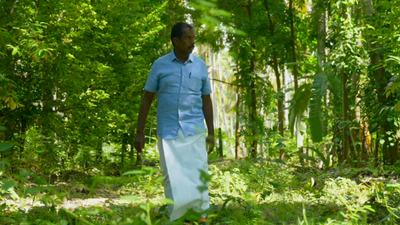
Valluvan (58), a farmer in Pollachi district, said he is spending Rs 500 per tree annually, while the earning is only Rs 300.

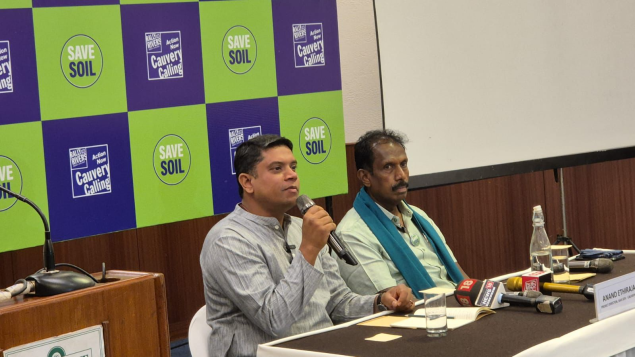
New Delhi: A Tamil Nadu farmer, who once lost Rs 200 on growing each coconut tree, has transformed his 11-hectare holding into a Rs 2.5-3 lakh per acre enterprise through multi-crop, tree-based farming – earning him recognition as a UN FAO Soil Farmer Hero. Valluvan (58), a farmer in Pollachi district, said he was spending Rs 500 per tree annually while earning just Rs 300, leaving him stuck in a cycle of losses before he changed his approach in 2009. “I was losing money on every coconut tree I owned. I knew I had to find a solution,” he told reporters in New Delhi. The change came after the emergence of Isha Foundation’s The Save Soil – Cauvery Calling programme, promoted by spiritual leader Sadhguru Jaggi Vasudev, which advised a shift to multi-crop, multi-tier tree-based agriculture.

-

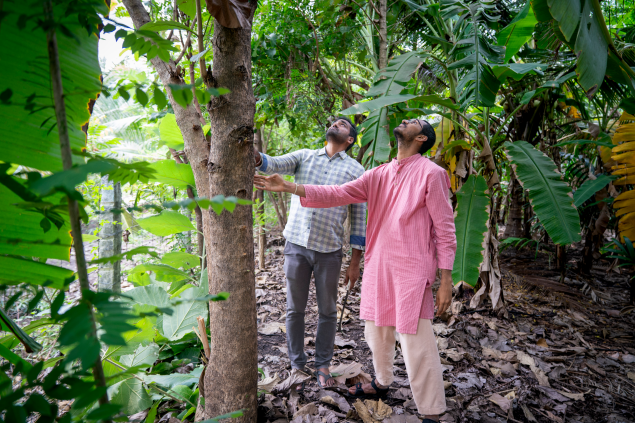
From three crop varieties, Valluvan now cultivates more than 14 varieties on the same land – coconut, nutmeg, black pepper, seven banana varieties, turmeric, elephant yam, curry leaves and 30 tree varieties. Income steadily increased from Rs 30,000 to Rs 2.5-3 lakh per acre, while the organic carbon content of the soil increased from 0.5 per cent in the first year to 1.56 per cent in the seventh year. The farm also faced two severe droughts, including a 2017 crisis when groundwater levels dropped more than 1,000 feet and there was no rain for two consecutive years – a period when many neighboring farmers cut down their coconut trees. Through mulching and rainwater harvesting pits, the field maintained adequate moisture without additional irrigation. It now uses one-tenth the water it once required, and Valluvan hopes to eliminate irrigation needs altogether within a few years.

-

“Even sensitive crops like nutmeg and pepper, which farmers say require a lot of water, survived without additional irrigation,” he said. The farm’s multi-crop model also acts as an economic hedge, said Anand Ethirajalu, project director of Save Soil – Cauvery Calling. “If coconut prices fall, his nutmeg saves him. If nutmeg also falls, his banana saves him. He has a range of crops,” Ethirajalu said, comparing the strategy to that of a cricket team with equally capable options. Since its 2019 expansion, Cauvery Calling has planted 13.4 crore trees on private agricultural lands in Tamil Nadu and Karnataka – about 10 per cent of the 242 crore trees targeted to restore year-round flow in the Cauvery river basin. However, Ethirajalu identified scaling, funding and policy barriers as major obstacles to widespread adoption, calling for drip-irrigation support for wood crops, removal of restrictive state-level timber-sale regulations, and insurance and subsidy schemes for tree-based agriculture. “The only solution to global warming and the climate crisis looming over the entire world is tree-based agriculture,” Valluvan said.

Source link