

Census effect: Cities will see ‘less crime’ next year. india news
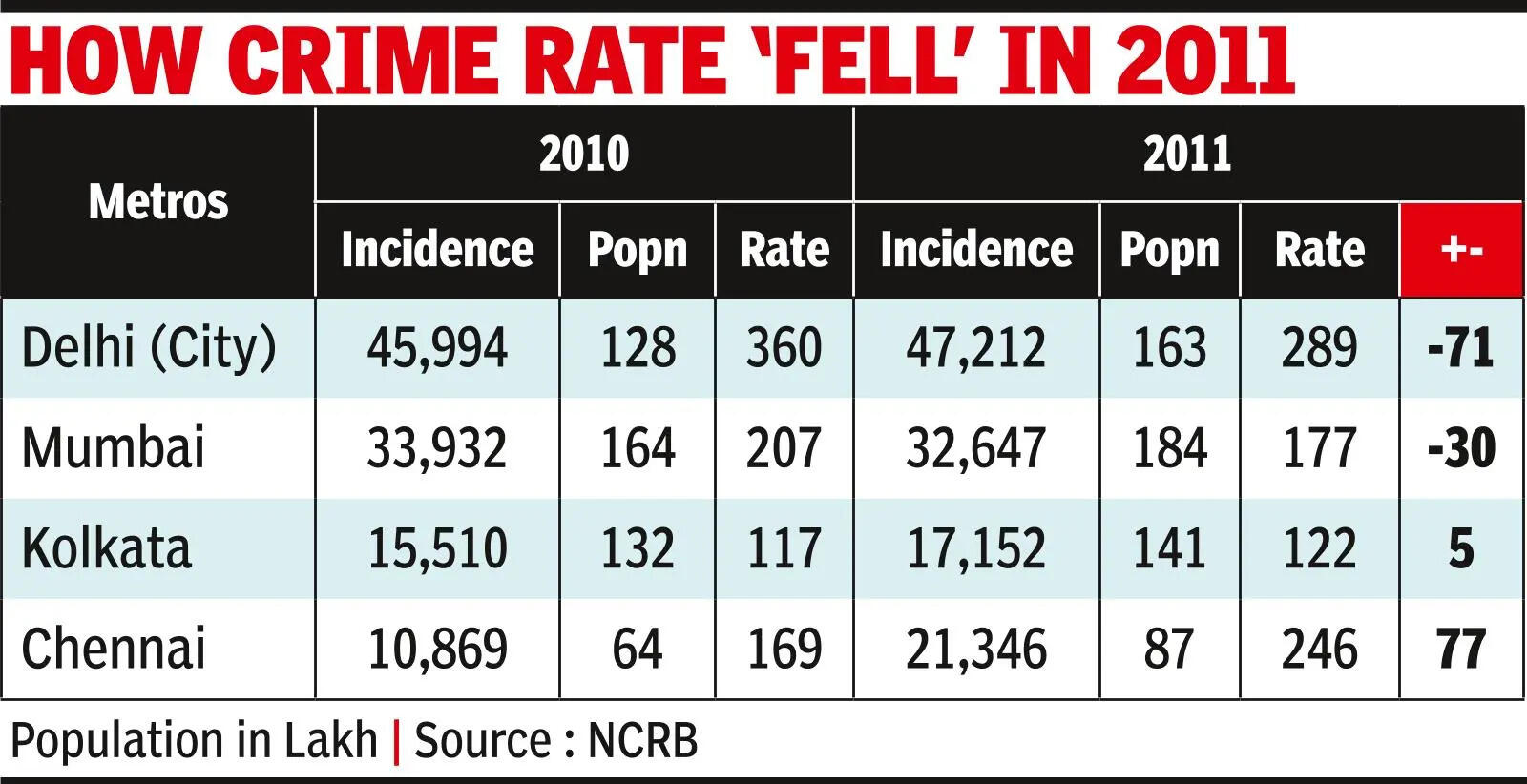
In 2027, most Indian cities will see a decline in crime rates. This is a safe prediction. Historical precedent shows that crime rates in large Indian cities fall rapidly in the census year.This is not because of better policing, but because of a mathematical glitch – which the National Crime Records Bureau mentions in its fine print, but which is often missed in reports based on its own data.NCRB updates the number of crimes every year. But for cities, it uses the population from the last census as the denominator to calculate the crime rate. That population number remains unchanged until the next census. So, while recorded crimes may increase or decrease each year, the population used to calculate the rate remains stable – usually for a decade, and this time for more than 15 years.This is why comparisons like “Delhi’s crime rate has increased” or “Delhi’s crime rate is higher than Mumbai’s” can be misleading unless the population base is understood.
Take Delhi. In the latest NCRB report, based on 2011 census, the population of Delhi city is still 1.6 crore. But the estimated population of Delhi NCT is 2.2 crores. Since Delhi city covers almost the entire NCT, clearly there cannot still be only 1.6 crore people in the city if NCT has 2.2 crore people.This difference leads to rapid changes in crime rates. The number of IPC crimes for Delhi and Delhi city is the same – 2,75,402. But because the NCRB uses different population bases, Delhi’s crime rate is shown as 1,259 per lakh, while Delhi city’s rate is 1,688 per lakh – 34% higher.There is an example of what happens when the population denominator is updated. In the 2001 census, there were 35 cities in India with a population of more than one million.
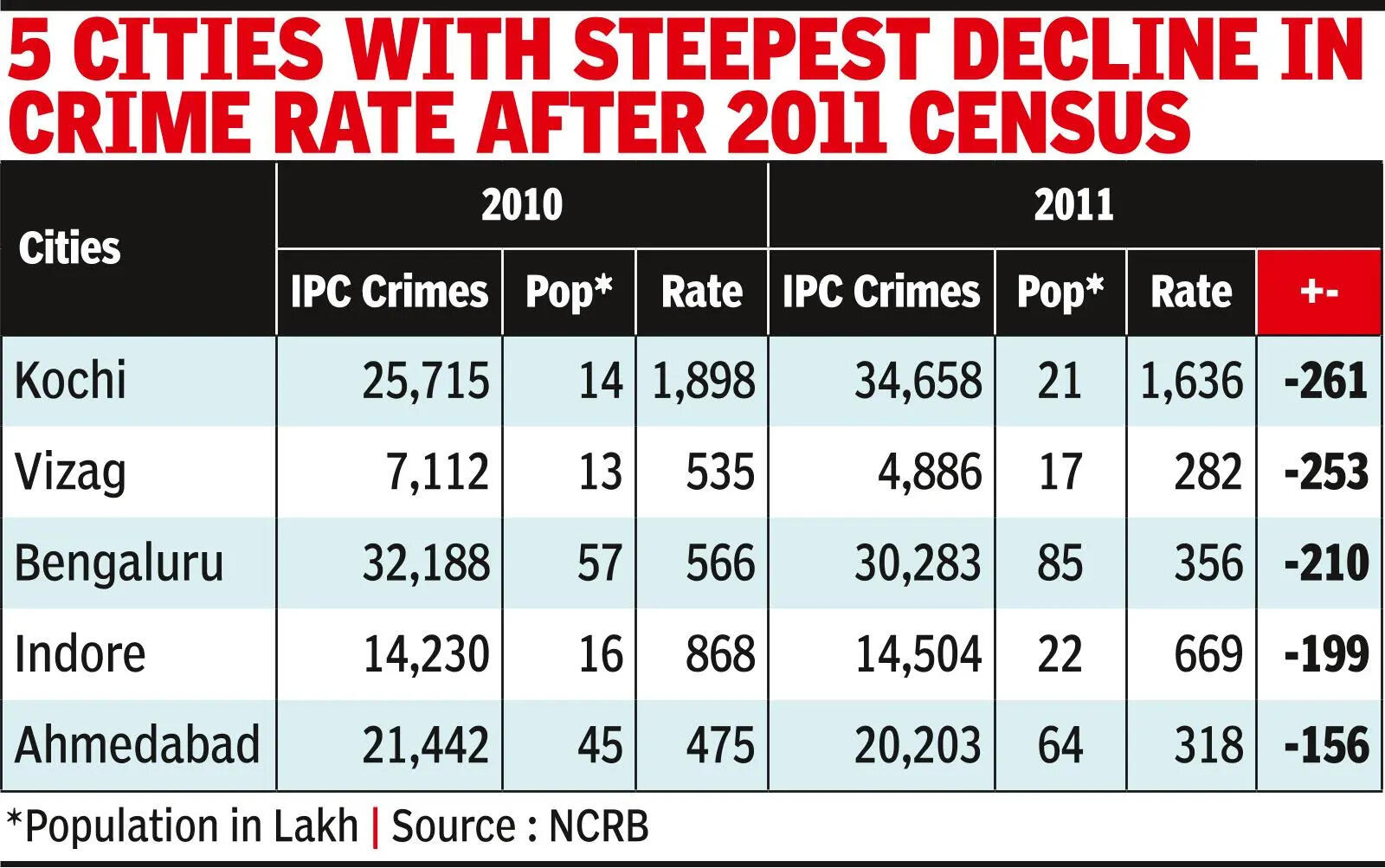
When city populations were updated in 2011, crime rates declined in 27 of them. Kochi’s rate dropped from 1,898 per lakh to 1,636. Visakhapatnam, Bengaluru, Indore, Ahmedabad and Bhopal also saw a decline of more than 150 points. The sharpest ‘decline’ occurred in rapidly growing cities, where old population numbers became the most obsolete.That’s the census effect. NCRB uses the same city population till the next census as official city-wise estimates are not available.
Juvenile crime rate may be slightly underestimated in NCRB calculations
A constant divisor shows the rate increasing progressively. When the census finally updates the population, the rate may drop dramatically, even if the actual number of crimes does not decline.Similar issues emerge in other NCRB categories also. Crime rate against children, and crimes committed by juveniles, India’s population under 18 years of age – 44.4 crore as per 2011 census. But with fertility rates declining, UN estimates show that the population under 18 years of age is now around 433 million. This means that NCRB’s calculations may slightly underestimate juvenile crime rates and crimes against children.The opposite may be true for senior citizens. NCRB uses the senior citizen population of 2011 – 10.4 crore people aged 60 or above. But India is ageing, and the United Nations estimates the over-60 population will hit 157 million in 2024. If so, the NCRB may be significantly overstating the rate of crime against senior citizens.Lesson: Crime numbers and crime rates don’t always tell the same story. The number of crimes is an annual count. The rate depends heavily on the population used in the denominator. In census years, that denominator changes – and with it, crime rates may appear to improve overnight.