

Beyond helmets: Neowatch wants to make rider airbags India’s next safety habit
India’s motorcycle culture has changed dramatically over the past decade. Riders are traveling farther, machines are becoming more powerful, and protective jackets and gloves are increasingly appearing on highways and weekend rides. Yet the main safety conversation has not moved beyond helmets.
According to Rajat Bhandari, Managing Director, Neowatch, this is where the industry is missing a vital aspect. “The rider safety conversation in India has largely revolved around helmets,” says Bhandari. “But real-world accident patterns show that many life-altering injuries occur in areas where helmets do not protect. To meaningfully reduce injury severity, we need to think beyond traditional gear and focus on intelligent protection that responds quickly during a crash.”
Neowatch, an Indo-French venture focused on wearable airbag systems for riders, is attempting to pioneer that change. Its pitch is straightforward: While helmets protect the head, serious injuries and deaths often involve the spine, neck and torso – which are left exposed in many crashes. As motorcycles become faster and touring culture grows, this vulnerability is becoming more apparent.
From niche gear to everyday utility
However, the company’s strategy is not to position the airbag as a device reserved for specialist racing gear or long-distance riding. Instead, NeoKavach is attempting to integrate safety into everyday riding habits.
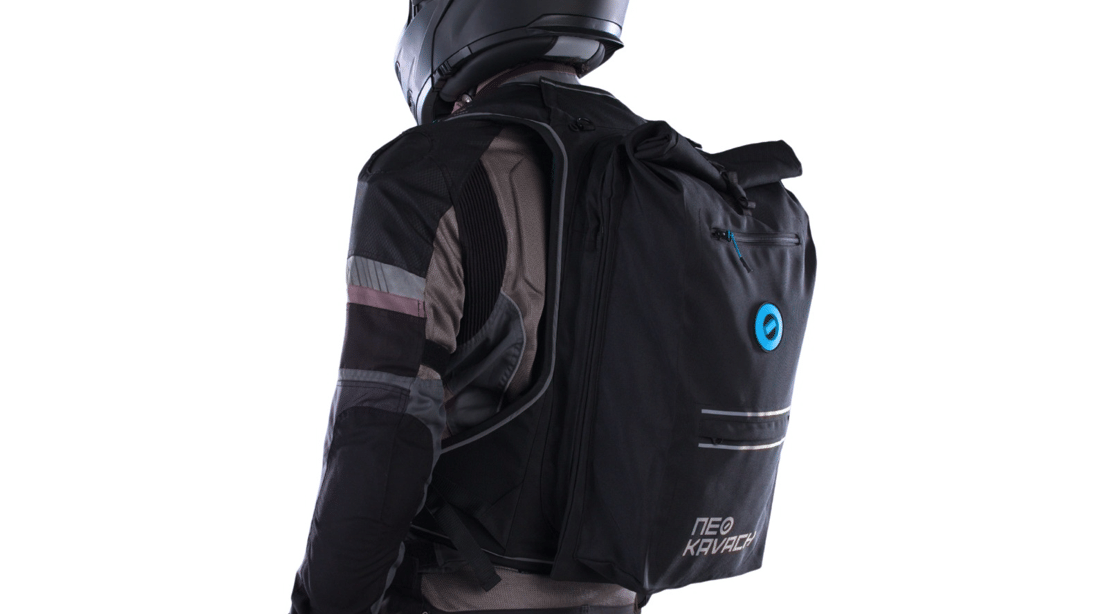
To that end, it offers two primary formats: an airbag vest that can be worn over existing riding gear, and an airbag-integrated backpack that is designed for daily use. The latter reflects a well-thought-out design philosophy – making security feel like a utility rather than an added burden.
“The exciting thing is that riders are no longer asking whether safety is needed or not. They’re asking how it can fit naturally into their daily riding,” says Bhandari. “The strong response to the backpack format reflects a clear preference for a design that balances protection, comfort and practicality.”
Backpacks include features typically associated with commuter gear – storage compartments, waterproof materials, helmet holders, and hydration packs – while an airbag system is intended to deploy during a crash. Meanwhile, the vest is designed to be worn over existing jackets without replacing them.
The idea is practical: If riders already carry a backpack or wear protective gear, adding an airbag to those habits could increase adoption.
Technology to suit Indian conditions
The Neowatch’s airbag system relies on a mechanical trigger that activates when the rider disembarks the motorcycle and inflates in approximately 100 milliseconds. Its purpose is to stabilize the neck and protect the upper body before impact.
The company says it opted for mechanical activation rather than sensor-based systems because Indian riding conditions can be unpredictable. Speed breakers, potholes and rough roads can trigger mis-deployments in electronic systems calibrated for a more uniform environment.
“World solutions are not always India solutions,” says Bhandari. “In our circumstances, you need something that deploys reliably in a real accident but does not fail due to rough roads or sudden braking.”
The technology itself isn’t exactly new. NeoKavach’s partner, Helite, has been manufacturing airbag systems in Europe for more than two decades, primarily for equestrian sports, motorcycles and motorsports. NeoKavach is attempting localization – adapting the technology to Indian climate, usage patterns and price expectations.
For example, ventilation has been a major design consideration. The vest is engineered for airflow and aims to remain wearable even in high temperatures. “If riders can’t wear it in the Indian heat, they won’t wear it at all,” says Bhandari.
strength challenge
Perhaps the biggest barrier to the adoption of advanced riding gear in India has historically been cost. Imported airbag systems can run into six-figure price tags once duties and logistics are included.
NeoKavach’s localization strategy aims to bring prices to a more accessible level for premium motorcycle owners. The company says its base vest starts at around ₹32,400, with the backpack variant costing more depending on the configuration.
“We wanted this product to be cost-effective and for as many people as possible to use it,” says Bhandari. “If the price of security is out of reach, adoption will always be limited.”
Another differentiating factor that the company emphasizes is reusability. The airbag’s CO₂ cartridges can be replaced by the user after deployment rather than sending the gear back to a service center – something that can be expensive and inconvenient with some imported systems.
“That usability matters,” says Bhandari. “If a rider has a minor fall during a trip, they should be able to quickly reset the system and continue.”
early signals from the market
Neowatch says early consumer research indicates a change in rider mindset. Studies conducted in major cities show that riders view advanced safety gear as a necessity rather than a niche accessory. High-risk scenarios such as highways, wet roads and unpredictable traffic are increasing interest in additional protection.
Research also shows that practicality plays a decisive role in adoption. The airbag backpack format, for example, scored high marks in everyday relevance and willingness to pay, especially among urban travelers.
“What we’re seeing is that the adoption of security is linked to how seamlessly it fits into daily life,” says Bhandari. “If it feels like an extra task, people may not use it consistently. If it feels like part of their routine, they will use it.”
OEMs, riders and the wider ecosystem
NeoKavach is also exploring partnerships with motorcycle manufacturers, riding clubs and racetracks to expand awareness and adoption. The company says discussions are underway with several OEMs to integrate the airbag system into their accessory ecosystem or co-branded gear offerings.
The long-term opportunity may overtake the enthusiasts. Delivery riders and fleet operators represent a large and high-risk segment, although pricing and product design will need to be optimized for mass adoption.
“Over time, as volumes grow and costs come down, there will be opportunities to bring it to wider segments,” says Bhandari. “But even today, there is a growing willingness to invest in safety among premium motorcycle owners.”
NeoKavach also sees export potential. Manufacturing in India allows the company to supply products globally while adapting designs to local needs. In some cases, India-specific designs may find popularity in foreign markets.
Gradual change in safety culture
At present, rider airbags remain a niche product category in India. Helmets are mandatory by law; Jackets and gloves are becoming increasingly common among enthusiasts; Airbags are still new territory.
But the trajectory of motorcycle safety in global markets shows that incremental layers of protection become mainstream over time, often driven by a mix of regulation, consumer awareness and OEM involvement.
“As bikes become more powerful and riding becomes more widespread, the conversation naturally turns to safety,” says Bhandari. “The helmet was the first step. We believe the next step is to protect the rest of the body.”
Whether wearable airbags become standard gear for Indian riders will depend on how quickly the ecosystem – manufacturers, riders and policy makers – embraces that idea. For Neowatch, the goal is to make the technology visible, practical, and affordable enough that riders start seeing it not as optional gear, but as part of the ride.