
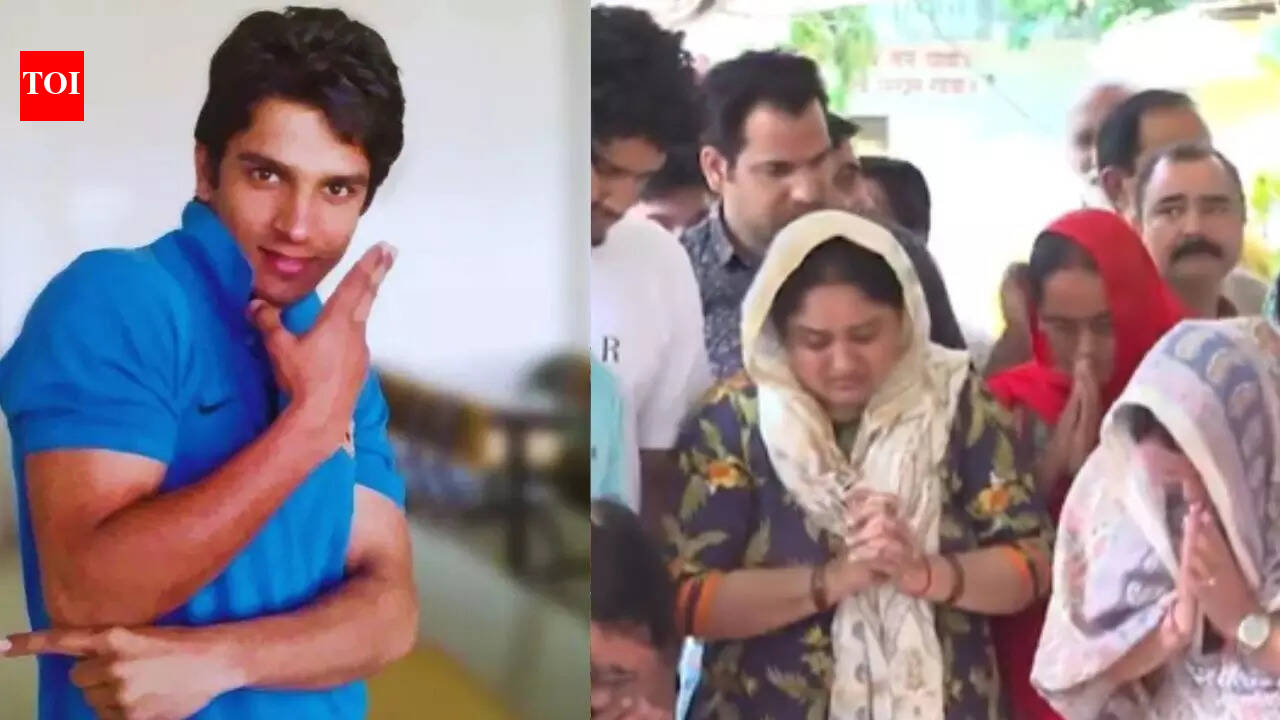

Harish Rana’s family donated his corneas, heart valves. delhi news
New Delhi: The last rites of Harish Rana, the first person to receive legal passive euthanasia in India, were performed in the national capital after his death at the All India Institute of Medical Sciences.According to news agency ANI, the family donated his corneas and heart valves.Rana, 31, remained under special medical care for a long time and died on Tuesday, marking a significant moment in India’s legal and medical landscape.In an official statement, AIIMS confirmed that Rana died at 4.10 pm at the institute.“Harish Rana passed away on March 24, 2026 at 4.10 pm at AIIMS, New Delhi. He was under the care of a dedicated team of doctors and was admitted to the Palliative Oncology Unit (IRCH) under the leadership of Dr. (Prof.) Seema Mishra, HOD, Onco-Anesthesia. AIIMS expresses its heartfelt condolences to his family and loved ones during this difficult time, the press release said.Earlier this month, in a landmark decision, supreme court of india Ghaziabad resident Rana, who was in a persistent vegetative state for more than a decade, was allowed to undergo passive euthanasia.A bench of Justices JB Pardiwala and KV Vishwanathan allowed withdrawal of Clinically Assisted Nutrition and Hydration (CANH). Rana was in an unwell state after accidentally falling from a building in 2013.Passive euthanasia refers to the withdrawal or withholding of life-sustaining treatment so that a patient who has no reasonable chance of recovery can be allowed to die naturally.Expressing deep sorrow while delivering the judgement, the court said that all stakeholders, including the patient’s family and the medical board that assessed his condition, were in agreement that no meaningful purpose would be served by continuing aggressive medical assistance.The bench also highlighted the absence of a comprehensive law on end-of-life care and urged the Central government to consider legislation in line with the principles laid down in the case Common Cause vs Union of India (2018).The court said, “The long absence of a comprehensive law on end-of-life care has forced this court to repeatedly step in to fill this void.”It said a dedicated legislation in this area would bring greater clarity and certainty on such emotionally complex issues.