
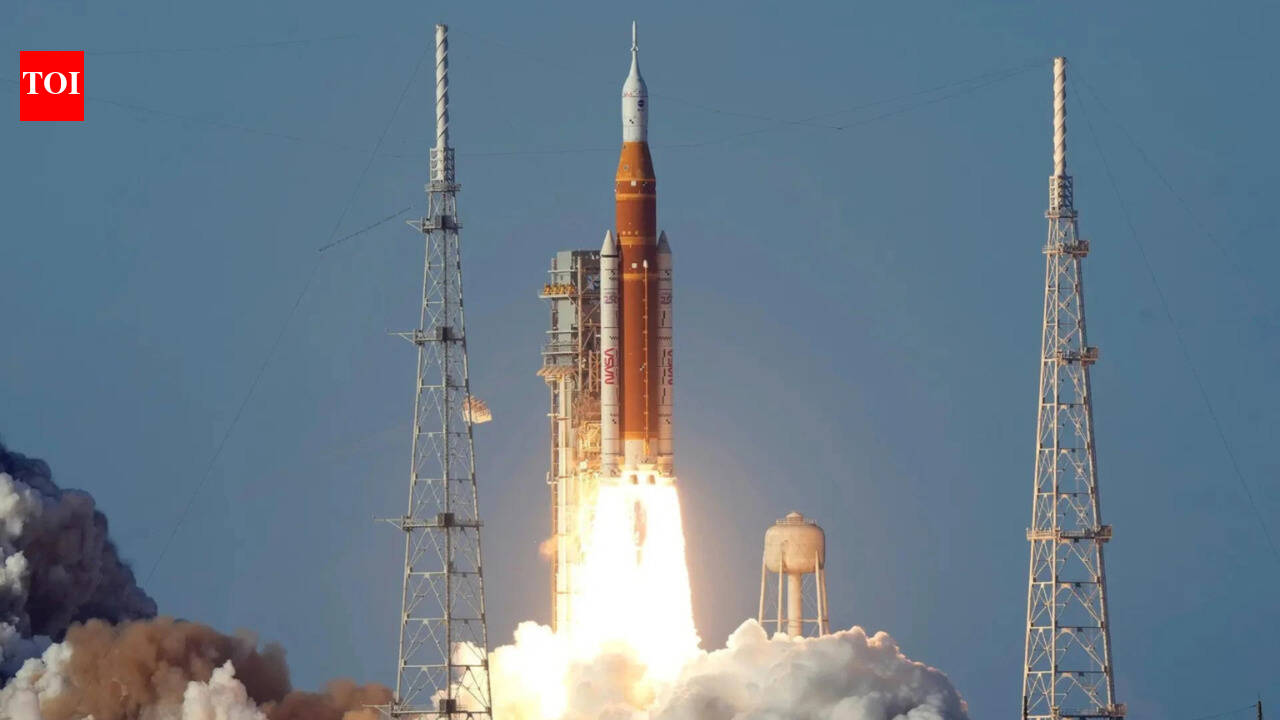

WATCH: NASA launches Artemis II, the first manned lunar mission in half a century
 NASA shares moments from the mission’s launch as the Space Launch System rises rapidly into the dark sky. As the rocket got smaller over the horizon, a thick plume of smoke and fire trailed the rocket.
Moon summons diverse crew 248,000 miles away
Artemis II lifted off from Florida’s Kennedy Space Center, the same pad that launched Apollo astronauts decades earlier, with surviving moonwalkers cheering the SLS rocket thundering into the evening sky. Commander Reed Wiseman yelled “Let’s go to the moon!” Lead pilot Victor Glover, Christina Koch and Jeremy Hansen of Canada, NASA’s most diverse lunar crew ever: the first woman, person of color and non-U.S. citizen in an Orion capsule heading 248,000 miles away.
Crew and flight path
Commander Reed Wiseman, pilot Victor Glover and NASA mission specialist Christina Koch, along with mission specialist Jeremy Hansen of the Canadian space agency, will begin a 10-day mission that will take them several thousand miles beyond the moon before returning to Earth. The spacecraft will follow a free-return trajectory using the Moon’s gravity for no additional engine burns.
Historic first time on board
The Artemis II crew includes NASA astronauts Reed Wiseman, Victor Glover and Christina Koch, as well as Canadian astronaut Jeremy Hansen. They’re on a nearly 10-day mission around the moon and back, and have traveled much farther in space than humans ever have.Victor Glover would become the first black person to travel beyond low Earth orbit, Christina Koch the first woman and Jeremy Hansen the first non-American to travel around the Moon.After nearly three years of training, they are the first team to fly in NASA’s Artemis program. Launched in 2017, the program aims to create a long-term human presence on the Moon over the next decade.
Why Artemis II matters
Artemis II becomes the first crewed flight of NASA’s Space Launch System rocket and Orion spacecraft, designed to carry humans deeper into space than any system since the Apollo era. The mission will test life-support, navigation and deep space communications systems critical to future lunar landings.The farthest point of the journey will take the crew about 4,700 miles beyond the Moon, farther than any humans have traveled since the previous Apollo mission. Re-entry is expected to be the most challenging phase, with Orion returning to Earth’s atmosphere at about 25,000 mph under a modified trajectory so that the capsule’s heat shield can function safely.
Background: Artemis Program
The launch marks a significant step forward for NASA’s Space Launch System (SLS) rocket, which has taken more than ten years to develop.About three and a half hours after launch, the Orion capsule manufactured by Lockheed Martin will separate from the rocket while in Earth’s orbit. The crew will then take manual control to test how well the spacecraft can steer and steer, completing the first of several planned tests.Artemis II is an early and important mission of NASA’s Moon program. The goal is to land astronauts on the Moon again by 2028 with the Artemis IV mission.NASA is under pressure to achieve this, as China is also expanding its Moon program and plans to send astronauts there as early as the 2030s.