


How to Survive Over Enemy Territory After a Jet Goes Down – The Downed Pilot’s High-Risk Journey
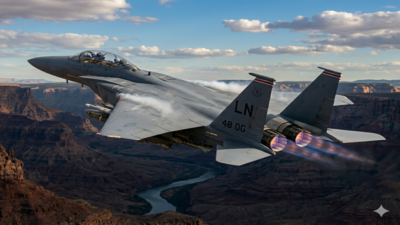
Military aviation experts have outlined what it takes for a fighter pilot whose jet was shot down to hide behind enemy lines, survive and be rescued by extraction troops, as US crews conduct search and rescue operations after a US Air Force F‑15E Strike Eagle was reportedly downed by Iran on Friday.According to reports, one crew member – possibly the pilot – has been rescued, and the search is on for the other crew member.
Read this also US jet shot down in Iran: Israel says one pilot rescued, search for second underwayRetired US Air Force Brigadier General Houston Cantwell recalled to AFP, “You’re like, ‘Oh my God, I was in a fighter jet two minutes ago flying at 500 miles an hour and a missile exploded 15 feet from your head.’Cantwell explained that a pilot’s training – known as survival, evasion, resistance and escape (SERE) – would likely begin before parachuting to the ground. He added, “Your best view of where you want to go or where you want to avoid is when you’re coming down with your parachute.”Read this also Iran has announced a reward of $ 60,000 for American pilots after shooting down the fighter jet.He warned that parachuting carries the risk of foot, ankle and leg injuries. The former airman said, “There are many stories of Vietnam survivors who suffered serious injuries simply because of ejection – compound fractures.”Once on the ground, pilots must immediately assess their situation. “Take stock of yourself to find out what state I am in? Can I even move? Am I even dynamic?” Cantwell observed.They then determine their location, whether they are behind enemy lines, and how best to hide or communicate. He added, “Try to avoid enemy capture as long as you can. And if I were in a desert environment, I’d try to find some water.”Read this also ‘Can anyone find our pilots? Please?’: Iran mocks US after loss of US jetCombat Search and Rescue (CSAR) teams play a vital role. “It gives you peace of mind … they’ll do everything they can to get you. Plus, they’re not going to be on a suicide mission,” Cantwell said.For a missing crew member, concealment is the top priority. “I want to try to get to a place where I can be fired.” Movement is usually safest at night, using rooftops in cities or fields in rural areas suitable for helicopter pickup.Cantwell also noted that pilots often carried personal weapons, such as pistols, to increase their chances of survival.‘Extraction soldiers are always ready’Meanwhile, Scott Fells, a retired master sergeant and former CSAR member, said evacuation troops are always on standby whenever American aircraft fly over enemy territory.Read this also ‘One after another’: Iran shoots down another US jet after F-15E crashes in Hormuz; WatchFales, who worked as a pararescue jumper, played a key role in the “Black Hawk Down” incident in Mogadishu, Somalia in 1993.“Before carrying out any operation… there is always a CSAR plan,” he told AFP.Also, intelligence teams collect and analyze every detail about the missing aviator. “Everything from human intelligence to imagery intelligence to all the different drones that we’re looking at – all the way to signals intelligence,” Fels explained. “All of this is being done to try to find this guy.”Once the aviator is located, a rescue plan is developed in real time inside the helicopter. He said, “They’re watching the gunners and looking for threats; the pilots are looking for a place to land, we’re getting to that downed aviator.”On the ground, the crew confirm the pilot’s identity and assess threats against medical needs. Fels described the process: “What kind of immediate danger are we in? How much time do we have to get this person out? What kind of injuries do they have? And then we’ll make up our mind what type, amount of treatment is necessary at the scene – or will we just grab and go, depending on the danger?”
voting
Should the US government continue to prepare CSAR plans for future military operations?
With a fellow soldier still missing in southwestern Iran, Fales remains cautiously optimistic. He said, “I’m hoping friendly people have found him and are hiding him, or he’s still escaping.”The US has suffered several air casualties during the ongoing United States-Israeli military campaign against Iran, which the Trump administration has dubbed Operation Epic Fury. In early March, three F‑15E jets were downed in a friendly fire incident in Kuwait, although all six crew members were recovered safely. A few days later, a KC‑135 Stratotanker crashed in western Iraq, killing all six crew.