Macaulay’s children are triggered because Pujarini Pradhan, from Medinipur, didn’t ask for permission to think, and speak English |

Macaulay's children are triggered because Pujarini Pradhan, from Medinipur, didn’t ask for permission to think, and speak English

The controversy surrounding Pujarini Pradhan, better known as @Lifeofpuja on Instagram (with 751K followers), reminded me of a peculiar exchange in a cab about 18 years ago. The year was 2008. Author Salman Rushdie had won the ‘Best of Booker’ Prize, and newsrooms all over New Delhi, and the whole world, were abuzz. More than usual. This was the day after the news made headlines. After shifts got over, we were talking about the immense feat of the Indian-born British author (he hadn’t taken his American citizenship at the time) and waiting for Jha ji, the commander of the fleet of cabs that ferried journalists home at night.Jha ji was our favourite. He remembered all our names, and was a father figure for all of us who had come from different cities to make Delhi home, and quietly missed the elders we had left behind. He was in his mid-50s and we were mostly early-20-somethings. He had a baritone Bollywood would envy, and soft yet wise eyes that would smile but never tolerate any nonsense. He respected us, and took pride in ensuring every journalist — possibly his children’s age — reached home safely.Two minutes into the cab ride, we started discussing Rushdie’s feat, our headlines, our copies, the usual. Jha ji, as he sometimes did, joined the conversation. “Kaisi hai unki kitaab?” (How is his book?) he asked, referring to Midnight’s Children, which had won Rushdie his first Man Booker in 1981. A recent joinee, barely a few weeks into the job, turned to him and asked: “Aap jaante bhi ho Salman Rushdie kaun hai, Jha ji?” (Do you even know who Rushdie is?)Our driver was so stunned he actually slowed the car, looked back, and said quietly: “Haan, unko ‘Best of Booker’ mila hai. Akhbaar hum bhi padhte hain, waise. Hindi akhbaar. Usme bhi duniya ki khabar milti hai.” (Yes, he’s being awarded ‘Best of Booker’. I, too, read a newspaper. In Hindi. There’s world news covered in Hindi newspapers too)Pin-drop silence for the rest of the ride. But one thing was unmistakable: Jha ji was hurt. Hurt that a few kids he respected would think so little of him.Why did this person think less of Jha ji? Was it because he assumed knowledge and intellect were the exclusive preserve of the convent-educated, English-speaking middle class and above? Did it not occur to him that newspapers are published in every Indian language, and that the world arrives in people’s homes in many tongues? Was it foolishness, naivety, arrogance or some seamless, unreflective amalgam of all three?Which brings us to Pujarini. The controversy erupted while Pradhan was busy cutting vegetables, making videos, and talking about everything from menstrual leave to Stanley Kubrick, from why she wears a ghunghat while calling herself a feminist to Satyajit Ray. All in the same breath, with an ease and clarity of thought that is genuinely rare. And she does it in English. Not the impeccable, urban-approved, Macaulayan English that unlocks professional doors in Delhi or Mumbai, but English spoken with the unmistakable accent of someone who grew up in rural West Bengal and has absolutely no apology to offer for it. She is from Medinipur, to be precise. Urban India has a word for this kind of English: desi. Or ghati. The contempt is baked into the vocabulary itself.We may have reached the far side of the moon, Artemis 2, a first for humankind as evidence of just how far the human mind can stretch when it dares to dream. And yet that same brain remains perfectly capable of dragging others down simply to feel taller by comparison. Schadenfreude is as old as hunger. So is ignorance. We cannot always achieve something to feel superior, so we find the next best thing: diminishing someone else. Is she even real? How does she have access to international cinema? How can a rural woman edit her own content? As if curiosity has a postcode. As if Ray and Kubrick belong only to those with a metropolitan address and a particular vowel formation.This is not merely “influencer drama.” It is a sociological case study, a live demonstration of how urban Indians, conditioned by a colonial legacy that was never quite dismantled, continue to weaponise the English language to exclude and delegitimise voices that do not conform to metropolitan standards of aesthetics or articulation. It is the person in the cab, replicated across a thousand comment sections.When influencers like Niharika Jain and Aishwarya Subramanium accused Pujarini of being inauthentic, the accusation wasn’t really about authenticity. It was about register. About the unsettling dissonance they felt watching someone analyse Pather Panchali in an accent they had been trained—socially, culturally, almost genetically at this point—to associate with the domestic help rather than the film critic. The outrage wasn’t intellectual. It was hierarchical.To understand why Pradhan’s accent caused what some breathlessly called an “internet meltdown,” you have to go back to 1835 and Thomas Babington Macaulay’s infamous Minute on Education: a document that set out, with remarkable candour, to manufacture a class of Indians who were Indian in blood but English in taste, opinion, and intellect. Intermediaries. A buffer class that would administer an empire and, long after that empire crumbled, would continue to administer its values. What Macaulay built wasn’t just a school system. It was a self-replicating hierarchy of credibility, and nearly two centuries later, it runs on autopilot, maintained not by British colonisers but by their most devoted inheritors.

Macaulay's spectral influence on modern India

The ‘Macaulayan ghost’ haunts corporate offices and social media platforms with equal comfort. You’ll find it in the colleague who switches to English mid-meeting to subtly reassert authority, in the recruiter who mistakes fluency for intelligence, in the comment that says “at least learn to speak properly before having opinions”

The ‘Macaulayan ghost’ haunts corporate offices and social media platforms with equal comfort. You’ll find it in the colleague who switches to English mid-meeting to subtly reassert authority, in the recruiter who mistakes fluency for intelligence, in the comment that says “at least learn to speak properly before having opinions”. As if grammar were a prerequisite for thought. These are people who genuinely need a Prozac to recover from the Oxford Comma becoming history.

Community response to structural bias

What makes this more than a social media spat is that the bias Pujarini encountered isn’t just human — it’s infrastructural. Research into digital access in India reveals that over 53% of students from non-metro backgrounds believe their accent or mother tongue actively works against them when interacting with technology. They practise what researchers call “linguistic self-censorship”—consciously avoiding cultural references, flattening their speech, editing themselves before they even begin—to avoid being penalised by systems calibrated to a “standard” English that was never theirs to begin with. When urban influencers questioned Pujarini’s authenticity, they were doing the same thing, just without an algorithm. They became the algorithm, human proxies enforcing a standard that has no business being a standard, deciding who gets to be taken seriously and who needs to prove themselves first.What the accusers didn’t anticipate was the wall they ran into. The backlash against the backlash was swift, sharp, and surprisingly precise. Particularly from the Bengali community and from anti-caste voices who identified, almost immediately, what was really being said. People noted that the “savarna feminist” solidarity on display had a hidden clause: it extended only to those who cleared a certain socio-economic bar. “Bangali meye ra shob paare (Bengali girls can do anything)” became something of a rallying cry, less about regional pride than about collective refusal. What emerged wasn’t just defence of one creator; it was a reckoning with the particular cruelty of being told you don’t belong in a conversation you walked into on your own, with nothing but curiosity and years of quietly paying attention.There was one moment in all of this that cut through everything else. When critics pointed to the quality of her editing and colour grading as proof she couldn’t possibly be working alone, Pujarini’s response was three words: “Like it’s hard?”, a reference to Legally Blonde that was, in itself, a small act of cultural warfare. She wasn’t being dismissive. She was making a precise point: these are learnable skills, available to anyone with internet access and patience. The assumption of hidden expertise behind her work said far more about her critics than about her. They had tried to use her competence against her. She turned it around and made competence sound like the most ordinary thing in the world. Because for her generation, it is.

Pujarini is refusing to perform suffering

Perhaps the most revealing thread in the entire controversy is what Pujarini didn’t do. She didn’t display hardship. She didn’t frame her life as a struggle to be overcome or a condition to be pitied. Her videos are unhurried — moringa pakodas, a handcrafted toothbrush holder, opinions on Kubrick delivered while chopping vegetables. And this, it turns out, was the quiet provocation at the heart of everything. Urban audiences have been conditioned to receive rural India as a site of suffering, a moral project, a place that needs saving. A rural woman who is simply happy, articulate, financially independent, and entirely uninterested in your sympathy doesn’t fit that frame. She doesn’t give the elite the psychological foothold of feeling superior. As she put it herself: “They want me to see suffering in every video. They want me to see sad.” By refusing to perform poverty, she became, in their eyes, suspicious. Which tells you everything about whose comfort the narrative was always designed to protect.

What Pujarini actually represents and why that’s threatening…

The deeper discomfort isn’t that she speaks imperfect English. It’s that she speaks it anyway. Unselfconsciously, without the apologetic hedging that the hierarchy demands of those it considers outsiders. She hasn’t sought permission. She hasn’t code-switched to earn legitimacy. She picked up the language, the cinema, the discourse, and walked straight in through the front door and the gatekeepers are livid precisely because there was no gate to stop her.This is the thing about the internet that its early evangelists got right and its critics underestimated: it is, at its best, genuinely indifferent to your accent. A YouTube algorithm does not ask where you are from. A film doesn’t reveal its meaning only to those who watched it in a multiplex. Knowledge has always found ways around the walls built to contain it. Real, curious, hungry knowledge. Jha ji read the Hindi newspaper. Pujarini watched The Shining in Medinipur. The walls were never as tall as their builders believed.What we are witnessing, in the fury directed at her, is not a culture war about authenticity. It is the sound of a particular class realising, with mounting dread, that the thing they mistook for intelligence was always just access. And access, it turns out, is no longer entirely theirs to control.

Who is lifeofpujaa Meet Pujarini Pradhan, the viral 'village girl' with Netflix and Audible collabs, facing backlash for being 'too articulate'

Photo: @lifeofpujaa/ Instagram

What’s the Pujarini Pradhan controversy all about?

Influencer Niharika Jain and former fashion editor Aishwarya Subramanyam, also known as @otherwarya accused Pujarini Pradhan @lifeofpuja of being “inauthentic”, “manufactured” and siad she was possibly an “industry plant”. Actress Samantha Ruth Prabhu, who played the fiery Sri Lankan Tamil liberation rebel in ‘The Family Man’, liked the reel questioning Pradhan’s authenticity. Director Kiran Rao, known for ‘Laapata Ladies’, liked the reel by Otherwarya too. Given Rao’s public stance on inclusivity, it was disappointing. But it was also ironic because ‘Laapata Ladies’ is a story of rural women breaking barriers by using their wit while fighting social stigma. But the accusation backfired as more people on social media defended her, calling out the hypocrisy of urban creators and influencers. She also got support from director Vikramaditya Motwane, director Gunnet Monga, actor Archana Puran Singh and influencer Kusha Kapila, among others.

Source link

Adyar residents demand improvement in infrastructure ahead of Tamil Nadu elections. chennai news

तमिलनाडु चुनाव: अड्यार उम्मीदवारों के लिए मांग सूची जारी

Edappadi K. Palaniswami, a prominent political leader of Tamil Nadu

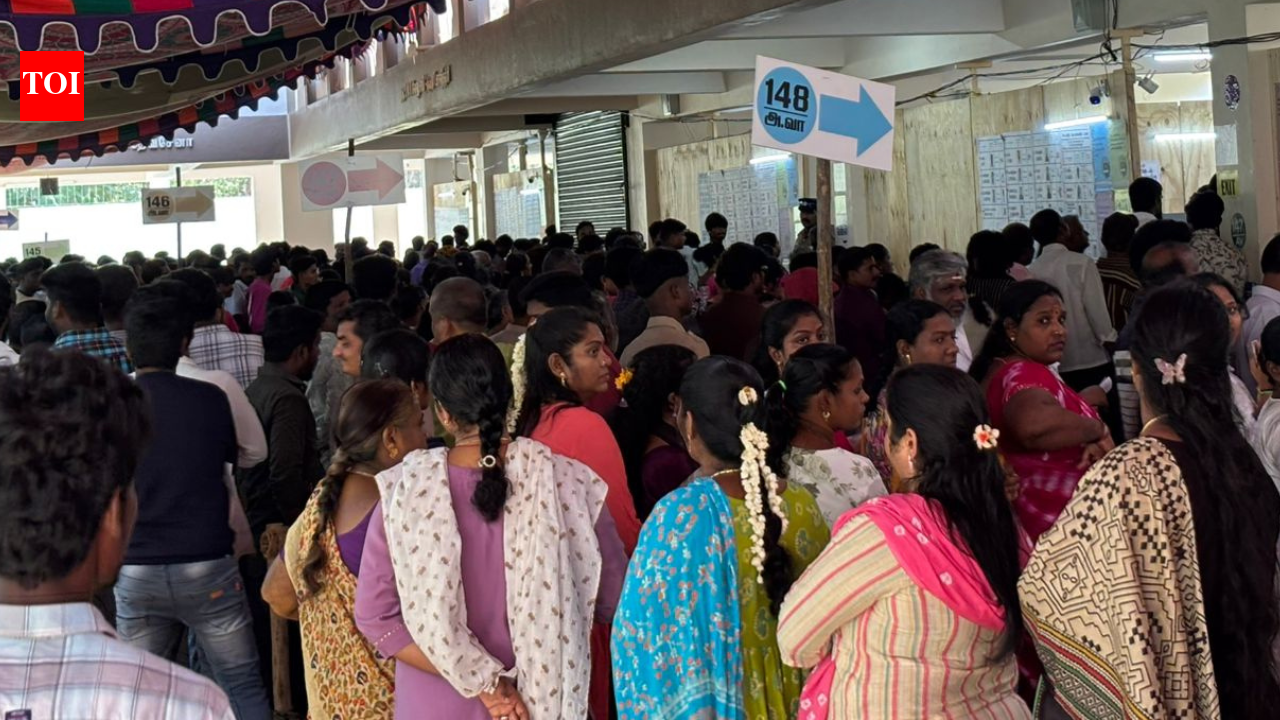
Chennai: Upgraded sewer lines, widening of Canal Bank Road, replacement of damaged transformers and streetlights are among the demands put forward by 5,000 residents of Kasturba Nagar in Adyar for the upcoming elections.Their primary concern is being unable to move freely due to encroachment on Canal Bank Road and Kamaraj Avenue between First Street and Old Mahabalipuram Road. 2022 Madras High Court order directed removal of encroachments, but Canal Bank Road received no relief. D Radhakrishnan of 4th Main Road said, “Most of the encroachments have developed into houses. There are also many eateries, resulting in parking of two-wheelers reducing the road space for pedestrians.” The presence of Tasmac on the stretch adds to the problems. Other demands include replacement of the damaged transformer on 8th Main Road, which causes frequent power outages, and replacement of malfunctioning CCTV cameras and lights. “We have prepared a list of these demands and will submit them to the candidates contesting in this election,” said D Balaji, vice president of Kasturba Nagar South Residents Welfare Association.Residents of other prominent nearby areas including Gandhi Nagar and Indira Nagar also said the same. A common demand is to replace sewer pipelines laid 30 years ago. K Aditya of Indira Nagar said, “Earlier, most of the residences were independent houses. Now, they have turned into flats with four times the number of residents. The pipelines cannot take the load.”

Source link

Microsoft responded to viral claims over the language of Copilot’s terms of service; Says: The phrase ‘entertainment purposes’ is…

Microsoft responded to viral claims over the language of Copilot's terms of service; Says: The phrase 'entertainment purposes' is...

Microsoft has now clarified that its Co-Pilot terms of use highlighted a clause stating the AI ​​tool is “for entertainment purposes only” after the viral post. The phrase, seemingly inconsistent with the way the company has marketed Copilot as a productivity and enterprise solution, immediately gained attention online and raised questions about Microsoft’s confidence in its flagship AI product.

Microsoft explains role of legacy language in viral controversy

In a statement first published by PCMag, a Microsoft spokesperson explained: “The phrase ‘entertainment purposes’ is legacy language from when Copilot originally launched as a search companion service in Bing. As the product has evolved, that language no longer reflects how Copilot is used today and will be replaced with our next update.”The company further stressed that CoPilot’s current role as integrated into Microsoft 365 and enterprise workflows goes far beyond entertainment. CEO Satya Nadella recently praised Copilot’s accuracy and latency during a January earnings call, underscoring its importance to Microsoft’s AI strategy.

How competitors build their AI tools

Microsoft’s terminology is different than that of rivals. OpenAI, Anthropic, Meta and XAI all include disclaimers about AI limitations but avoid the phrase “entertainment purposes”. For example, OpenAI’s terms warn users not to rely on outputs as the sole source of truth, while META explicitly prohibits using AI outputs for regulated activities such as medical or financial advice. Elon Musk’s xAI goes further, requiring users to indemnify the company against liability.The “Entertainment” section dates back to the initial Bing Chat terms in 2023, before Microsoft rebranded the service as Copilot. Observers say bizarre disclaimers are not new to Microsoft – some have pointed to humorous provisions in previous software licenses, including Windows NT of the 1990s.

Source link

Five dogs rescued from circus in Chhattisgarh district after joint raid by PETA India and police. raipur news

Five dogs rescued from circus in Chhattisgarh district after joint raid by PETA India and police

Raipur: Five dogs, which were allegedly being used illegally to perform in a circus in Chhattisgarh’s Sakti district, were rescued on Monday following the joint intervention of an NGO PETA India and the district police. The action was taken after video footage purportedly showed Indian Spitz dogs being asked to perform at Jyoti Circus, which had recently camped at the Dabhra fair in the district. According to PETA India, the dogs were being used without performing animal registration certificates, mandatory under the Prevention of Cruelty to Animals Act.A video from the circus shows dogs placed on individual plastic chairs inside the performance area while a ringmaster directs them through gestures and commands. Four dogs were reportedly forced to walk on their hind legs during this act.PETA India said that five dogs were handed over during the intervention and will now be rehabilitated and put up for adoption.Kiran Ahuja of PETA India said, “Animals used in circus performances are subjected to unnatural, stressful training, constant travel and are kept in cages or chained when not in use.” Immediate assistance was provided by Sakti SP Prafulla Thakur due to which rescue was possible.He also urged the circus to surrender any remaining dogs or other animals allegedly kept for display.Animal rights groups have long argued that circus animals face harsh living conditions, inadequate care, and coercive training methods. PETA India said that several inspections and investigations in the past have pointed to cruelty in animal circuses, including confinement, lack of proper veterinary care and repetitive behavior associated with stress.The group has advocated mechanical alternatives to live animals in circuses, noting that some circus operators have already shifted to non-animal acts.The police have not yet registered a case against the circus management in this matter.

Source link

Richest candidates in Tamil Nadu elections: Tamil Nadu elections: AIADMK’s Lima Rose Martin declares assets worth Rs 1,049.5 crore, becomes richest candidate in the state | trichy news

Tamil Nadu elections: AIADMK's Lima Rose Martin declared assets worth Rs 1,049.5 crore, becomes the richest candidate in the state

Trichy: AIADMK candidate Lima Rose Martin, wife of lottery businessman Santiago Martin and contesting from Lalgudi assembly constituency in Trichy district, has declared her total assets of Rs 1,049.5 crore in her election nomination papers. He is the richest candidate in the Tamil Nadu elections, surpassing all the Chief Minister candidates of the state. The 58-year-old female candidate, who passed class VI from a government higher secondary school in Thiruvadanai near Ramanathapuram district, has declared her income of Rs 9.8 crore for the financial year 2024-25.

Watch

Tamil Nadu Elections 2026: MK Stalin vs AIADMK – Will victory be the X-factor?

Her husband Santiago Martin, whose annual income during the same period was Rs 11.3 crore, is known to have donated to several political parties in the country. The annual income of this affluent couple’s son, Jose Dyson Martin, was estimated at Rs 19.5 crore.Lima, a resident of GN Mills in Coimbatore, has declared her movable assets at Rs 139.6 crore, while her husband Martin’s movable assets have been declared at Rs 3,262 crore. The 159-page election affidavit lists the value of the AIADMK candidate’s immovable assets at Rs 909.9 crore and her husband Martin’s immovable assets at Rs 887.3 crore.Lima Rose has invested its shares in many sectors including real estate, merchandise, gaming and hotel services. In a striking similarity with TVK leader and actor-politician Vijay, who is contesting the TN Assembly elections, AIADMK’s Lima and her husband own three TVS XL mopeds. The Lima has only three cars to its name, Hyundai Creta, Mahindra Thar and Maruti Dezire. Her husband owns a Lexus LX 570, BMW 530d and a 1991 registered Maruti car. His son Jose Dyson Martin owns three Royal Enfield bikes. Lima Rose’s real estate assets are in Coimbatore, Madurai, Trichy, Tiruppur and Sivagangai districts. The candidate owns agricultural land in Singhola village, about 40 km north of New Delhi, and Nedumbassery in Ernakulam, Kerala. There are four pending criminal cases registered against him.

Source link

Nearly 80% of breast cancer biopsies turn out benign – new imaging tool promises clearer diagnosis and fewer biopsies

लगभग 80% स्तन कैंसर बायोप्सी सौम्य निकलती हैं - नया इमेजिंग उपकरण स्पष्ट निदान और कम बायोप्सी का वादा करता हैUnnecessary biopsies are associated with potential harms, including increased anxiety, complications from the procedure, and medical costs. Despite advances in breast imaging, breast biopsy remains the only definitive way to determine whether a suspicious lump is cancerous.My work as an engineer focuses on improving imaging technology to detect and diagnose cancer. Breast cancer grows when the tumor forms new blood vessels and consumes more oxygen. This makes examining blood vessels and oxygen levels potential biomarkers that could improve breast cancer diagnosis.Diffuse optical tomography, or DOT, is an imaging technique that uses near-infrared light to measure total blood hemoglobin concentration and oxygen levels – key indicators of tumor activity – in a breast lump. Patients do not require injections of contrast dyes to make the image clearer.My team and I found that combining ultrasound with DOT can improve the accuracy of breast cancer diagnosis and reduce unnecessary breast biopsies. Ultrasound provides information about the structure of a breast lump, while DOT provides information about its function, and together these data can improve the diagnosis of breast cancer.Improving breast ultrasound with DOT —————————————————– In our study, we imaged 226 patients recommended for routine breast biopsy using our new hand-held imaging technique, which combines ultrasound with diffuse optical tomography. These patients had either breast cancer or a benign lump, and their final diagnosis was confirmed by biopsy.Radiologists initially evaluated each patient using standard imaging methods such as ultrasound and mammography. They then reviewed additional information from the DOT images. Importantly, the radiologist and engineer were unaware of the biopsy results when determining the diagnosis.We observed significant biological differences between cancerous and benign tumors. Cancerous lesions had significantly higher hemoglobin levels and significantly lower oxygen levels compared to non-cancerous tissues. More aggressive cancers showed higher hemoglobin concentrations and lower oxygen levels than less aggressive tumors.When radiologists were able to review DOT measurements, biopsies of benign tumors decreased by approximately 25%. The false-negative rate was 1.8%, which is in line with medical guidelines that recommend monitoring rather than immediate biopsy.The future of breast cancer screening and diagnosis —————————————————— Breast cancer is the most common cancer in women worldwide. Nearly 2.3 million new cases and 670,000 deaths were recorded in 2022. If these rates continue, researchers estimate there will be approximately 1.1 million breast cancer-related deaths in 2050.More accurate, non-invasive diagnostic tools could not only reduce unnecessary biopsies but also lead to more accurate and efficient diagnoses. In addition to ultrasound, researchers have also explored combining other imaging techniques with DOT, including X-ray mammography, 3D mammography, and MRI.However, DOT systems combined with mammography and MRI are more difficult for routine use in the clinic than ultrasound. My team is working to further refine our technology, including incorporating AI tools to help process the imaging data.Reducing avoidable procedures can help maintain a patient’s quality of life and reduce health care costs. I believe that these reforms can collectively have a meaningful and far-reaching impact on patient care and the broader health care system.

Source link

‘Ramayana’: Nitesh Tiwari teases Yash’s Ravana will not be a traditional villain; Says ‘he had a lot more’

'Ramayana': Nitesh Tiwari teases Yash's Ravana will not be a traditional villain; Says 'he had a lot more'

director Nitesh Tiwari Fans are counting down the days to the release of his epic’Ramayana‘, starring Ranbir Kapoor And Yash is in the lead role. As the first part of the film franchise is set to release on Diwali 2026, the director highlighted the portrayal of its main rival, Ravana. Nitesh Tiwari on Yash’s RavanaWhile promoting the film in Los Angeles, director Tiwari, in a conversation with Collider, said that his main antagonist, played by Yash, will be presented with more depth and complexity rather than a one-dimensional villain. When asked if Ravana would be portrayed as a traditional villain, he shared, “There were many aspects to his life. He was a great warrior, a skilled musician, a scholar, a philanthropic king, a great Shiva devotee. So there was more to him than just being a black character.”Nitesh Tiwari on the search for RavanaThe filmmaker emphasized that highlighting these details of his life serves a deeper purpose in the film’s story. He further explained, “Why it’s important for us to showcase all these parts and aspects of his life, because there’s a very important lesson hidden in them. You can have all these great qualities, but if you’re ruled by vengeance and if you’re driven by ego, you know what the end results are going to be. So there’s a great lesson that’s hidden there.”Release date of ‘Ramayana’Ramayan, which stars Ranbir in the role of Lord Ram and Sai Pallavi as Sita, is being projected as a large-scale retelling of the ancient epic, blending visuals with emotions. The six-hour long film will reportedly be divided into two parts, with Part 1 releasing on Diwali 2026 and Part 2 releasing on Diwali 2027.

Source link

‘IITian Baba’ Abhay Singh gets married: Who is his wife Pratika?

'IITian Baba' Abhay Singh gets married: Who is his wife Pratika?
IITian Baba, Abhay Singh, who shot to fame at Mahakumbh 2025 for his blend of distinguished education and penance, has quietly married Pratika, an engineer from Mangaluru. The couple, who met about a year ago, got married on Mahashivratri and are now planning to start ‘Shree University’ to integrate spiritual practices and knowledge.

Abhay Singh, or IITian Baba, was one of the most sought-after names in the world of spiritual seekers and viral sensations ahead of Mahakumbh 2025. His unique story, combining elite education with tenacity, went viral online, making him an online sensation for his choice in life after being educated at IIT Bombay.And once again, he is in the headlines again, not for his unusual theories and beliefs about the universe, but because he quietly got married on Mahashivratri and the pictures with his wife went viral.

'IITian Baba' Abhay Singh got married, who is his wife Pratika?

Mahakumbh 2025 fame ‘IITian Baba’ Abhay Singh gets married, meets wife Pratika (Photo: X/@shivanshp007)

Who is IITian Baba’s wife? Copy of?

Pratika, an engineer from Mangaluru, Karnataka, shares Abhay’s tech roots. They reportedly connected at Sadhguru’s Adiyogi Ashram in Coimbatore about a year ago, possibly after the Mahakumbh, based on shared life values ​​and outlook. In a media statement quoted by ABP News Live, Abhay said he lives a “very simple, minimalist life” in Dharamshala, Himachal Pradesh.The couple got married at the Aghanjar Mahadev Temple on Mahashivratri on February 15, 2026, followed by a court marriage on February 19. On 6 March, he went to Jhajjar to meet his parents and handle bank business, where a crowd gathered who were astonished to see ‘Baba’s’ bride. The viral clip showed him signing documents and spending time in his father’s chamber, where Abhay was dressed in saffron robes.Pratika remains calm and praises Abhay as “simple, honest and sincere” in social media reports.

Who is ‘IITian Baba’ – Abhay Singh?

Abhay is a resident of Sasroli village of Jhajjar, Haryana. He cracked JEE Mains in 2008 with an All India rank of 731, earning a place at IIT Bombay for Aerospace Engineering from 2008–2012, followed by a master’s degree in design. ​​After stints in New Delhi and Canada, where he reportedly earned about Rs 3 lakh monthly or 36 LPA in an aerospace firm, he returned to India, taking up spirituality. The winter in Shimla, Mussoorie and Dharamshala influenced changes in his plans about life.He rose to fame at the 2025 Mahakumbh, where he was interviewed in ascetic garb, sparking a debate on science versus soul.His father, lawyer Karan Grewal and former president of the Jhajjar Bar Association, shared in an NDTV interview: “Our family wants Abhay to return home. But after achieving so much, it is not easy for him to come back. After this he decided to become a monk.He was always interested in spirituality. I was in touch with him till six months ago. After that, he blocked me and all communication with me. I heard that he was in Haridwar and I wanted to meet him but could not go and now it has gone viral in the media.Abhay’s YouTube channel on spirituality attracted early supporters, including his future wife.

What are the future plans of this couple?

Abhay told NDTV India that they are working on “Shri University” to unify spiritual practices, reconnect people with knowledge and promote Sanatan Dharma under one roof.

Source link

‘Give him time to integrate with the team’: Fleming on Samson cricket news

'Give him time to join the team': Fleming on Samson
Sanju Samson of Chennai Super Kings during a practice session. (PTI photo)

Bengaluru: New Zealand legend Stephen Fleming Has largely been the guiding force of the franchise from the dugout. Since taking over as head coach in 2009, he has overseen both high and low title-winning seasons. However, the last two seasons have tested the five-time champions, with consecutive failures to reach the playoffs and increasing scrutiny over auction strategy and team selection.Go beyond limits with our YouTube channel. Subscribe now!Fleming believes that the team is in a transitional period. Involvement of star wicketkeeper-batsman sanju samsonA key figure in India’s T20 World Cup triumph, he is part of that rebuild, although the opening batsman has managed just 22 runs in three matches. Fleming, however, backed him to do well. “It’s difficult when you’ve been at a franchise for a while and even though he probably feels pretty comfortable, there’s still an element of that bond and he’s going through the process of bonding with this team. There’s a little bit of work off the field that we’re doing to make the bond a little bit stronger but that’s OK,” Fleming said.

Source link

Priyadarshan breaks silence on the allegation of stealing Satyajit Ray’s Bengali song in ‘Bhoot Bangla’: ‘Nothing wrong’ hindi movie news

Priyadarshan breaks silence on allegations of stealing Satyajit Ray's Bengali song in 'Bhoot Bangla': 'Nothing wrong'
Filmmaker Priyadarshan addressed claims of plagiarism for his upcoming film ‘Bhoot Bangla’. He clarified that the use of a phrase from Satyajit Ray’s ‘Gopi Gine Bagha Byne’ was just a common word, ‘ghost’, and not a melodious imitation. Priyadarshan stressed his deep respect for Ray and explained that the lyrical choice was relevant to the title and theme of the film. Read further to know in detail.

film producer Priyadarshan Abhinit is all set for the release of his upcoming film ‘Bhoot Bangla’ Akshay Kumar. At the film’s trailer launch event on Monday, the director reacted to the reported use of an expression from the song ‘Bhooter Raja Dilo Bor’ in his upcoming horror drama.

Priyadarshan’s reaction allegations of plagiarism

The song ‘Ram Ji Bhala Karein’ from ‘Bhoot Bangla’ contains the hook line of the song ‘Bhooter Raja Dilo Bor’ from the National Award winning Bengali film ‘Gopi Gain Bagha Byne’. Satyajit Ray. Responding to the allegations of plagiarism, Priyadarshan said, “I respect him (Satyajit Ray) a lot, he is one of the gurus from whom I learned cinema. Second, the word you are saying is a ghost. Now, if I ask you, how many songs are the word ‘Deewana’ used in Indian cinema? That means only the first person, who used the word ‘Deewana’, has the right to use it.” It’s just a word. We can’t use, if someone uses two lines, everyone can use, but the tune has nothing to do with the song.As reported by IANS, the filmmaker further shared, “The lyricist has written those lines, and that’s why we were so confident that there is nothing wrong in it, and there is a reference to it because the film is ‘Bhoot Bangla’, and you should also understand that there is a previous film called ‘Bhoot Bangla’. Naturally, that title has been repeated now. So these things are repeated; there is nothing wrong in it. I respect Satyajit Ray like the God of Indian cinema. I do.

More information about ‘Bhoot Bangla’

Directed by Priyadarshan, the film stars Akshay Kumar, Paresh Rawal, Tabu, Rajpal YadavJishu Sengupta, Asrani, Mithila Palkar, and Rajesh Sharma.This film will be released in theaters on 16 April 2026.

Source link