

Ukrainian arms smuggler, Cuban fraudster, Lebanese criminal: America revokes the citizenship of all three, saying – this is not a cheap status
DOJ says US citizenship is not a cheap status as it revokes citizenship from three felons.
Ukrainian arms smuggler Vladimir Volgaev, Cuban woman Cabrera Diaz and Lebanese man Alec Nasreddin Kassir. All three of them had US citizenship until they no longer had to, because the Donald Trump administration detected traces of their crime and denaturalized them, revoking their US citizenship, making it clear that obtaining US citizenship does not make a person immune from punitive actions and citizenship can be revoked. Attorney General Pamela Bondy said, “US citizenship is a sacred privilege – not a cheap status that can be obtained dishonestly.” “These actions reflect the Justice Department’s ongoing efforts to strip citizenship from people who conceal crimes or defraud the American people during the immigration process.”
Ukrainian arms smuggler Vladimir Volgaev
Since 2011, Volgaev was involved in the procurement, packaging and smuggling of gun components to individuals in Ukraine and Italy. On September 30, 2025, the Department of Justice filed a complaint in the United States District Court for the Middle District of Florida, seeking Volgaev’s denaturalization based on his crimes and his failure to disclose them during the naturalization process.On March 23, the court ordered Volgaev’s US citizenship revoked. The court held that Volgaev had committed unlawful acts during the period before his naturalization, which required him to show good moral character, thus making him ineligible for naturalization. Additionally, the court found that Volgaev gave false testimony about his criminal background and acquired his US citizenship by knowingly misrepresenting these facts.
Cuban woman Cabrera Diaz
Mireles Cabrera Diaz, a native of Cuba and resident of Hialeah, Florida, became a naturalized U.S. citizen in 2017. He committed health care fraud between 2011 and 2014 before being naturalized. She admitted that she and her co-conspirators paid bribes to patient recruiters to refer fraudulent prescriptions to the pharmacy where she worked.The U.S. District Court held that Cabrera Díaz obtained his naturalization illegally. Among the requirements for naturalization, Cabrera Diaz was required to show that she was a person of good moral character during the “statutory period” from five years before she applied for naturalization until she took the oath of citizenship. The court concluded that she could not establish the good moral character required for naturalization because she had conspired to commit health care fraud.
Lebanese criminal Alec Nasreddin Kassir
Kassir committed marriage fraud because he claimed he was living with a U.S. citizen spouse during the three years immediately prior to filing his naturalization application in March 2010. On November 14, 2018, she pleaded guilty to passport fraud in the Southern District of Florida. In his criminal proceedings, Kassir admitted that he obtained his US passport through fraudulent procurement of his naturalization. He acknowledged that he was not living in a marital relationship or even in the same state with his alleged US citizen spouse; Rather, but they separated in 2009 and Kassir moved to Florida. Kasir’s immigration fraud was exposed during an investigation into the smuggling of counterfeit goods after he was naturalized, for which he was convicted of conspiracy to commit money laundering.

What is ‘Launching Soon’? Strange, unclear videos posted on White House official page amid US-Iran war world News

As tensions continue to rise between the United States and Iran, a somewhat ambiguous video posted by the White House late on March 25 has caused widespread confusion online, with viewers trying to link the timing to ongoing military operations, diplomatic signals, and even possible announcements. The posts, brief and without context, came just hours after a bombastic White House briefing on the war and fresh comments from Donald Trump, fueling speculation about what, if anything, might be “launched.”
Two short videos, one removed, and no clear explanation
While the administration has a track record of posting bizarre videos in recent days, including clips that mix actual war footage with memes, Hollywood action scenes and video-game or anime imagery related to the Iran conflict, this latest clip stands out. Unlike previous posts, which had a visual narrative or theme, this one lacks any clear context, making it seem strange and vague, giving the impression that it could have been accidental or even hacked.The first video was posted on the White House’s official X account at approximately 9:15 p.m. EST. A photo taken with a phone camera pointed toward the ground shows a woman’s black shoes and part of a dress.A woman’s voice is heard asking, “This is great. It’s launching soon, right?” While an off-camera male voice replies “‘Yes’.” The only text on the screen reads: “Sound on.” The clip was removed after about 90 minutes, but it had already begun circulating widely on social media. A second video arrived at around 10 p.m. EST and remains online. Lasting about four seconds, it shows a blank, dark screen interrupted by phone notification sounds. Static flickers across the frame briefly, and an American flag appears for a moment before fading again. One detail particularly attracted attention: the flag’s red and white stripes appeared vertical rather than horizontal, leading to speculation that the imagery might have some coded or symbolic meaning.The post, titled simply with phone and speaker emojis, offered no explanation. Together, both clips received millions of views in a matter of hours, while the second video alone crossed millions of impressions.
The White House’s response adds to the mystery
When a White House spokesperson was asked for clarification told people: “I wonder what’s going to launch soon!”, giving no real answer and leaving the question unresolved. There was no indication that the accounts were compromised, and officials did not say the posts were accidental. The deletion of the first clip as well as the lack of explanation have left the posts open to interpretation.
Online theories range from apps to military attacks
The absence of context immediately turned the clip into a blank canvas for speculation. Some users suggested that the posts could be teasing a new government app or communications platform. Others believed the video could be linked to a space launch, pointing to Artemis II, which is expected to send astronauts deep into space and could be launched as early as April. More worrisome interpretations linked the phrase “launching soon” to the ongoing conflict, with some users asking whether it referred to a missile attack or an escalation in the war. “What’s being launched??? A missile? An app? A mission??” One user wrote.Many users also posted slow-motion versions and screenshots, trying to decipher the blurry flashes on the screen, interpreting them as possible numbers, letters, or secret codes. Many people tried hard to figure out what was seen, analyzing frame by frame in search of hidden meaning. Others dismissed the post as overly dramatic or poorly timed, with one comment suggesting the White House communications team was doing “too much spy thriller” and calling the post “unnecessary drama” during an active conflict. More strange theories also surfaced, including references to nuclear weapons or even extraterrestrial activity, though mostly in jest.
Posted against the backdrop of escalating conflict
The timing of the post has been at the center of the reaction. Earlier on March 25, White House Press Secretary Carolyn Leavitt gave a forceful briefing, describing the scale of US military action against Iran. “United States forces continue to destroy the offensive and defensive capabilities of the terrorist Iranian regime,” he said. Leavitt claimed that US forces attacked 9,000 targets and destroyed 140 naval ships, calling it “the greatest naval destruction in a three-week period since World War II”. He also issued a warning related to the ongoing talks: “There must be no more death and destruction. But if Iran fails to accept the reality of the present moment, if they fail to understand that they have lost militarily and will continue to lose, then President Trump will ensure that they are hit harder than before.” “President Trump does not cheat and is prepared to unleash hell.” The briefing comes amid reports that Iran has rejected Washington’s 15-point proposal aimed at ending the war.
Trump’s latest comments and stalled talks
The morning after the video, Donald Trump posted on Truth Social, ramping up his rhetoric around the conversation. “The Iranian negotiators are very aloof and ‘weird’. They are ‘begging’ us to make a deal… and yet they say publicly that they are only ‘considering our proposal.’ Wrong!!!” he wrote. “They better get serious soon, before it’s too late, because once that happens, there’s no turning back, and that wouldn’t be good!”
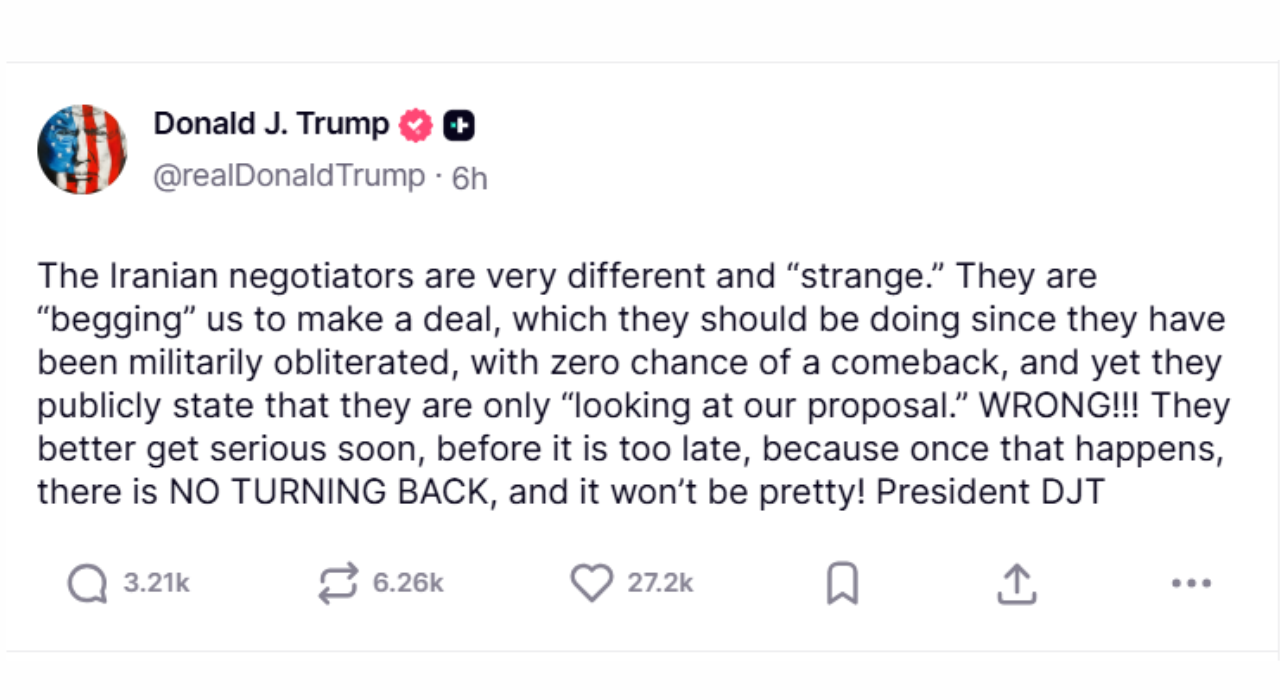
Truth Social @donaldj. Trump
According to Iranian state media, Tehran has rejected the US proposal and instead issued its own five-point framework, which reportedly includes demands for guarantees against renewed hostilities, compensation and control over the Strait of Hormuz.

Why did Indian-origin Democrat Arvind Venkat read Isha Upanishad in the Pennsylvania House?
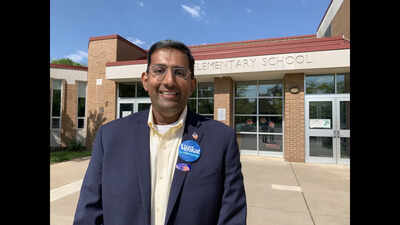
Representative Arvind Venkat read a prayer from the Isha Upanishad in the Pennsylvania House.
Representative Arvind Venkat read a prayer from the Isha Upanishad in the Pennsylvania House on Wednesday and said he wanted to pray from the Hindu text because this year marks the 50th anniversary of the opening of the Sri Venkateswara Temple in Penn Hills. The temple is the first independent Hindu temple built by Hindu immigrants to North America in 1976, Venkat said while reading the Sanskrit text and then the English translation.Arvind Venkat is an Indian-American physician and Democratic politician serving in the Pennsylvania House of Representatives. He represents District 30 in Allegheny County, covering the suburbs of Pittsburgh, and took office for the first time in January 2023 after winning the 2022 election; He was re-elected in 2024. Born on 6 June 1974 in Madurai, India, he later grew up in the United States, primarily in Michigan. He is known as the first Indian-American to serve in the Pennsylvania legislature and one of the few physicians in the state assembly in recent decades.Before entering politics, Venkat pursued a career in emergency medicine. He earned a degree from Harvard University and a medical degree from Yale School of Medicine, followed by residency training at the University of Cincinnati. He has worked as an emergency physician with Allegheny Health Network and has been affiliated with Allegheny General Hospital. In addition to clinical work, he has held academic and leadership roles, including teaching emergency medicine and holding leadership positions with the American College of Emergency Physicians.
Clear the way for re-election
Arvind Venkat has a clear path to re-election this fall after a judge recently ruled that his Republican challenger Ehab Akkari does not meet residency requirements to hold office as a state legislator. Pennsylvania law requires candidates for State House to be a resident of the state for four years, and a resident of the district they hope to represent for one year. But last week, a Republican voter challenged whether Akkari did so, citing the fact that Akkari, who lived in West Virginia and still runs a cosmetic-surgery practice there, bought his Wexford home in 2023, and did not register to vote here until 2024.Akkari testified that he decided to live in Pennsylvania and spent most of his time there in early 2022. He testified that he was in the midst of a divorce at the time and was working as a cosmetic surgeon for a practice in Cranberry, causing him to pay to live in a nearby hotel for more than a year.
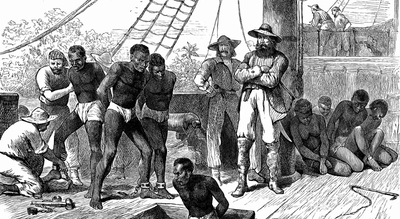
Despite acknowledging historical injustice, US, UK, EU push for UN slavery reparations. world News
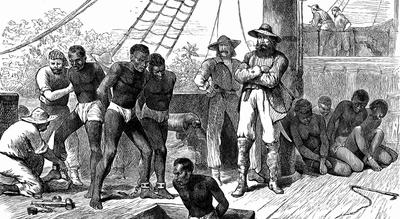
The United Nations General Assembly has voted to recognize the enslavement of Africans during the transatlantic slave trade as “the most serious crime against humanity”, a move supporters say aims to confront historical injustice and advance reparative justice. But the vote revealed clear divisions. While a large majority supported the resolution, Western powers including the United States, United Kingdom and European Union Member states either rejected it outright or refused to support it, not because of history, but because of how it should be defined, interpreted, and acted upon today.
A resolution built around history, justice and reparations
The resolution proposed by Ghana was adopted by 123 votes in favor, with three abstentions, including the United States, Israel and Argentina, and 52 abstentions, including the UK and all EU member states. It declares “trafficking in enslaved Africans and the racial enslavement of Africans the most serious crimes against humanity” and links that history to the present through “the persistence of racial discrimination and neo-colonialism.” Beyond recognition, the text calls on Member States to engage in discussions on reparative justice. This includes “a full and formal apology, measures of reparation, compensation, rehabilitation, satisfaction, guarantees of non-recurrence, and changes to laws, programs, and services to address racism and systemic discrimination.” It also urges the “prompt and unhindered return” of cultural objects, including artefacts, monuments and archives, to their countries of origin. Although General Assembly resolutions are not legally binding, they carry significant political importance and are often used to shape global norms and debates.
Why did the United States vote against?
united states acknowledging the horror People from the past opposed this proposal, arguing that it created both legal and ideological problems. Deputy US Ambassador Dan Negria said Washington “does not recognize a legal right to reparations for historical wrongs that were not illegal under international law at the time they occurred”. He also objected to the drafting of the resolution, saying: “The United States also strongly objects to the resolution’s attempt to rank crimes against humanity in any kind of hierarchy.” He said, “The claim that some crimes against humanity are less serious than others minimizes the suffering of countless victims and survivors of other atrocities throughout history.” Negría further criticized what he described as “the reprehensible use of historical wrongs as a leverage point to reallocate modern resources to peoples and nations who are distantly related to historical victims”, and questioned the lack of clarity on who would qualify as recipients of reparative justice.He also argued that the historical framework of the proposal was selective, stating that the time period referenced was “clearly chosen for political reasons rather than historical accuracy, and pointed out that the trafficking of African slaves began before the 15th century and continued beyond the 19th century.”
Why were the UK and EU absent?
united kingdom And EU member states Did not oppose the proposal outright, but declined to support it, citing concerns over legal principles and wording. Speaking on behalf of the UK, Acting Ambassador to the UN James Kariuki said Britain recognized “the abhorrent nature of slavery and the transatlantic slave trade” and acknowledged that its legacy “still leaves deep scars today”. However, he added that the UK “disagrees with the fundamental proposals of the text”. A major objection was the idea of ranking atrocities. Kariuki argued: “We should not create a hierarchy of historical atrocities… No one set of atrocities should be considered more or less important than another.” He also pointed to core legal principles, saying: “There is equally no duty to provide compensation for historical acts that did not constitute a breach of international law for acts committed at the time.” The European Union also expressed similar concerns. Gabriela Michelidou, speaking on behalf of the Bloc, said that the use of words such as “serious” was “not legally precise” and risked creating “a hierarchy between atrocity crimes”. He said the proposal contained an “unbalanced interpretation of historical events” and raised concerns about “suggestions of retroactive application of international rules that did not exist at the time and claims for reparations”. Both the UK and EU stressed that while they support remembrance and efforts to combat modern forms of slavery, they cannot support the resolution in its current form.
Ghana’s case for recognition and restorative justice
For Ghana and its allies, the proposal is less about legal technicalities and more about historical acceptance and long-term consequences. Ghanaian President John Dramani Mahama, who supported the initiative, told the gathering: “Today, we come together in full solidarity to affirm the truth and advance a path of healing and restorative justice.” “Adopting this resolution serves as protection against forgetting,” he said. “Let it be recorded that when history prompted, we did what was right for the memory of the millions who suffered the indignity of slavery.” Ghana’s Foreign Minister, Samuel Okudjato Ablakwa, rejected criticism that the resolution sought to categorize suffering. “The perpetrators of the transatlantic slave trade are known, the Europeans, the United States. We expect him to formally apologize to all Africans and all people of African descent,” he said. He also clarified the intention behind compensation, telling the BBC: “We are demanding compensation, and let us be clear, African leaders are not asking for money for themselves. We want justice for the victims and to support educational and endowment funds, skills training funds.” Ablakwa argued that the legacy of slavery is still visible today, adding: “Multiple generations have faced exclusion, racism due to the transatlantic slave trade, which has isolated and impoverished millions of people from the continent.”
A vote that reflects consensus and division
The resolution was adopted on the International Day of Remembrance of the Victims of Slavery and the Transatlantic Slave Trade, commemorating the estimated 12 to 15 million Africans who were forcibly transported over four centuries, with more than two million believed to have died during the journey. It is one of the strongest formal recognitions of the transatlantic slave trade within the UN system, linking historical injustice to current inequalities and calling for a structured global response. At the same time, the division in votes underlines a permanent divide. Although there is widespread agreement on the cruelty and historical importance of slavery, there is little agreement on how that history should be defined in legal terms, and whether it should carry financial and political obligations in the present.

New rules for immigrants in Texas from May 1: Thousands of licensed workers could become unemployed

Texas will not grant a business license to any immigrant who does not have a Social Security number.
A Texas department has unanimously passed a new rule that could jeopardize the jobs of thousands of licensed workers in the state. The Texas Department of Licensing and Regulation has reportedly removed the ability for undocumented immigrants to obtain licenses and certification, upholding Texas AG Ken Paxton’s move to eliminate the provision made in 2001. What does this mean? Workers without Social Security numbers will no longer be able to obtain or renew licenses for skilled work in the state. This change will come into effect from May 1. Paxton said, “Illegal aliens who do not belong in this country should not be rewarded for their criminal actions by obtaining business licenses that allow them to garnish the wages of American citizens.” “I have rescinded John Cornyn’s legal opinion, which laid out the red carpet for the invasion of our state to put Texans in last place. Illegals should be arrested and deported rather than given license to steal opportunity from Americans.“
What was the old testament?
In Texas, undocumented immigrants could get business licenses.
Which jobs will be affected?
Jobs that require a license, such as electricians, HVAC contractors, commercial drivers, hairdressers, cosmetologists and barbers, would fall under this. According to statistics, approximately 18,000 licenses in Texas are not linked to a Social Security number.
Non-citizens will still get a license if…
Non-citizens will still get a license if they can prove they were granted asylum, admitted as a refugee, or recognized as a victim of human trafficking. They are saying that citizenship is not mandatory to be a licensed trader in Texas, but they must have legal immigration status.Texas has woken up to the problem of what MAGA calls changing demographics caused by immigration. Texas has already imposed a freeze on H-1B hiring at all state agencies and institutions of higher education.
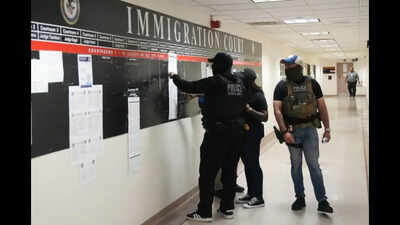
Yes, ICE lied about its power to arrest inside immigration courts, DOJ admits
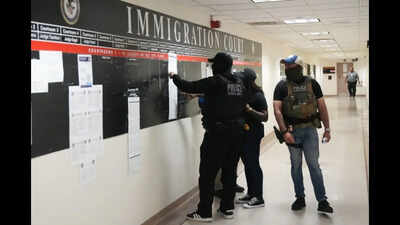
The DOJ admitted that ICE lied about its power to arrest inside immigration courts.
Over the past year, hundreds of people were arrested when they went to immigration courts regarding legal asylum cases or citizenship cases. A court filing shows that Immigration and Customs Enforcement was lying to immigration courts about having arrest authority. In a court filing Tuesday, Assistant U.S. Attorney Jeffrey Oestreicher for the Southern District of New York revealed that the memo the government relied on to support the arrests of hundreds of immigrants appearing in immigration courts “does not and has never authorized” civil immigration enforcement actions in those courts.It stems from a lawsuit brought by the New York Civil Liberties Union and various other civil rights groups challenging the government’s practice of dismissing asylum and citizenship cases and mass detaining law-abiding immigrants at New York City’s 26 Federal Plaza, as well as other immigration courts across the country.The prosecutor wrote that the government would withdraw several briefs based on the memo, as well as some statements made at oral arguments in federal court in September. Oestreicher wrote that U.S. District Judge P. Kevin Castell’s previous order would likely need to be “reconsidered and resubmitted.” In September, Castells ruled that ICE could make arrests in courts and also made it harder for judges to dismiss cases.
It’s ICE’s fault, not DOJ’s
Oestreicher claimed the mistake was not the Justice Department’s fault, but ICE’s. “The signatories below were specifically informed by ICE that the 2025 ICE Guidance applies to arrests in immigration court. Additionally, we discussed and received approval with assigned ICE counsel prior to filing each brief in this case and making any oral representations before the court and plaintiffs,” Oestreicher wrote.
‘It’s really a bomb blast’
Former New York City Comptroller Brad Lander, who was detained by ICE while attempting to escort an immigrant out of a courthouse in lower Manhattan during his campaign for New York City mayor in June, called the revelation a bombshell. “According to documents filed this morning by the U.S. Attorney for the Southern District of New York, ICE has been lying for a year — not only to the public, but to courts and prosecutors — about being authorized to make arrests at 26 Federal Plaza and other immigration courthouses,” Lander wrote on Wednesday. “This is truly a bombshell. All arrests in court must stop immediately. There must be a congressional investigation and civil rights action for every illegal kidnapping of immigrants who try to follow the rules and appear in court.“
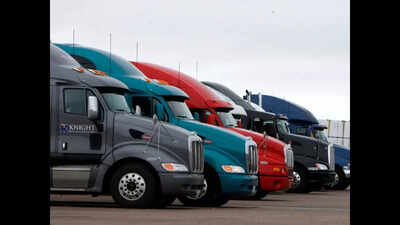
11 Indian truck drivers arrested in US, all found to have illegal commercial licenses
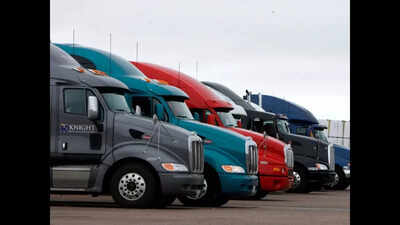
11 Indian truck drivers have been arrested in America. All of them are in the country illegally.
The Yuma Sector Border Patrol announced the arrest of 11 Indian semi-truck drivers in Arizona in February. All of them were present in the US illegally and had commercial licenses from Florida, New York, Pennsylvania, Indiana and California. “Yuma Sector Border Patrol agents arrested 11 Indian National semi-truck drivers in February, all of whom were found to be present in the United States illegally. The drivers held commercial licenses from Florida, New York, Pennsylvania, Indiana and California. Border Patrol is committed to upholding immigration laws and protecting our communities,” the Yuma Sector Chief Patrol Agent’s social media post said. The Yuma Sector is a division of the Border Patrol that covers parts of western Arizona and a small portion of eastern California. It includes border areas near the city of Yuma along the US–Mexico border in Arizona.
Big action against Indian truck drivers in America
Indian truck drivers have been in the news after some fatal accidents shook the administration due to misuse of commercial driver’s licenses. In August 2025, Harjinder Singh killed three people on a Florida highway after taking a wrong U-turn. Months later, Indian driver Jashanpreet Singh caused a multi-vehicle crash in California, killing three people. In February, Indian driver Rajinder Kumar killed a newlywed couple in Oregon; In Indiana, Sukhdeep Singh killed a 64-year-old man after he ran a red light.Investigators found that these road accidents were just the gateway to a larger issue, as almost all Indian truck drivers are in the US illegally. But they have valid commercial licenses and the Donald Trump administration has blamed ‘sanctuary’ states for issuing illegal driver’s licenses. The US Department of Transportation launched a campaign last year that disqualified more than 7,200 commercial truck drivers nationwide after failing a mandatory English proficiency test.

Saudi Arabia’s Jeddah hospital achieves medical feat: Robots take over pediatric surgery to treat rare Hirschsprung disease. world News

Doctors in Saudi Arabia have performed a complex robotic surgery on a two-year-old boy suffering from Hirschsprung’s disease, a rare condition that affects the functioning of the intestine.The baby, weighing about 10 kilograms, was treated at King Faisal Specialist Hospital and Research Center (KFSH) in Jeddah. Hirschsprung’s disease occurs when part of the colon does not have the nerve cells needed to move waste through the body. This can cause severe constipation and, in severe cases, intestinal blockage.To treat this, doctors performed a procedure known as the Soave pull-through. In simple terms, it involves removing the part of the colon that is not functioning properly and connecting the healthy part so that the intestine can function normally again.It is not easy to perform this surgery on small children. The space inside a baby’s pelvis is very small, and important nerves, muscles and blood vessels are located close to the area to be operated on. Any mistake can affect the way the intestine works in the long run.This is where robotic assistance played an important role. The robotic system gave surgeons a clear view and allowed them to operate with greater control and precision. This made it easier to handle the delicate tissues and carry out the procedure safely.This case highlights how advanced technology is being used to handle difficult medical situations, especially in children where surgery is more sensitive.KFSH said the process reflects its continued focus on using modern medical technologies to improve treatment outcomes.The hospital has also received several global recognitions. It was ranked 1st in the Middle East and North Africa and 12th worldwide among the Top 250 Academic Medical Centers for 2026. It has also been named the most valuable healthcare brand in Saudi Arabia and the wider region for 2025 by Brand Finance.Additionally, KFSH has been listed among the World’s Best Hospitals 2025, World’s Best Smart Hospitals 2026 and World’s Best Specialty Hospitals 2026 by Newsweek.
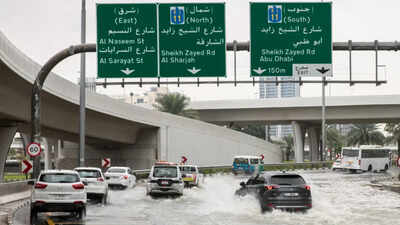
UAE car insurance explained: third-party vs comprehensive, which is right for you and whether it covers flood damage
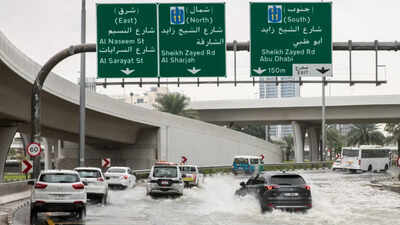
As car ownership continues to rise along with repair costs, extreme weather risks and high-value vehicles in the UAE, a question keeps coming up among residents: should you choose comprehensive insurance or stick to basic third-party cover? The difference is not just technical, it can mean the difference between a minor inconvenience and a major financial loss.
basic car insurance Rules in UAE: One is mandatory, the other is optional
In the UAE, you cannot legally drive without insurance but the law requires only the most basic forms:
- Third party insurance is mandatory
- Comprehensive insurance is optional upgrade
Without at least third-party coverage, your car cannot be registered or legally driven.
Third-party car insurance in the UAE: the legal minimum
Think of these as bare essentials.
What does third-party car insurance cover in UAE:
- harm to another person
Vehicle - Third party injury or death
- Damage to public or private property
What third-party car insurance in UAE doesn’t cover:
- damage to your own car
- your medical
Expenditure - Theft, fire, or natural disasters
In simple words, it protects others from you, not you from harm. That is why it is cheap and widely used for older or lower priced cars.
Comprehensive car insurance in UAE: full-spectrum protection
This is where coverage expands significantly.
What does comprehensive car insurance in UAE cover:
- Third-party insurance covers everything
- Damage to your own vehicle (even if it’s your fault)
- theft, fire, vandalism
- natural disasters (rain,
Floods sandstorm) - Sometimes personal injury and add-ons
In simple words, it protects both you and others in most scenarios. This makes it the preferred choice for:
- new cars
- luxury or financed vehicle
- Drivers looking for peace of mind
Cost difference: Why many people still choose basic car insurance cover in the UAE
The biggest deciding factor is price. Typical UAE Insurance Cost (2026):
- Third-party: AED 450 – 2,000/year
- Comprehensive: AED 1,200 – 5,000+/year
This is often 2-3 times more expensive, which is why budget-conscious drivers lean towards third parties but there is a trade-off:
- low premium
- Out of pocket risk
Side by Side Comparison –
| Speciality | third party insurance | comprehensive insurance |
|---|---|---|
| legal requirement | Mandatory | optional |
| Covers losses caused to others | Yes | Yes |
| covers your own car | No | Yes |
| Theft/Fire/Natural Disasters | No | Yes |
| Cost | Less | High |
| best for | old cars | New/high-value cars |
Recent trends in the UAE are reshaping the way residents think about insurance:
- Rising repair costs – Modern vehicles, especially EVs and luxury cars, are expensive to fix.
- Extreme weather risk – Heavy rainfall and flood events have made natural disaster coverage more relevant.
- Dense urban driving – More cars on the road means more chances of an accident.
All this makes comprehensive insurance less of a luxury and more of a protection.
So, which car insurance cover should you choose in UAE?
Choose third-party car insurance cover if:
- Your car is old or worth less
- You want the cheapest legal option
- You can bear the cost of repairs yourself
Choose comprehensive car insurance cover if:
- Is your car new, financed or expensive
- You want protection against theft or weather damage
- You prioritize financial security over risk
Hidden risks most car drivers ignore in UAE
The problem that many residents in the UAE underestimate is that if you are at fault in an accident with third-party insurance, the insurer pays for the other person’s damage, while you pay for your repairs entirely out of your own pocket. In the UAE, this can easily go into thousands of dirhams.Car insurance in UAE is evolving from a legal checkbox to a financial strategy decision where third party insurance is for compliance while comprehensive cover is for protection. As vehicles become more expensive and climate-related risks increase, more residents are reevaluating whether saving on premiums today could cost them much more tomorrow.Remember, third-party insurance keeps you legal while comprehensive insurance keeps you safe. The real question is not which one is better, the real question is how much risk you are willing to take on UAE roads.

Abu Dhabi confirms ballistic missile debris hits Swehan Street: Two killed as Iran vs US-Israel war escalates | world News

A missile interception over Abu Dhabi turned deadly today when debris fell onto a busy road, killing two people and injuring three others. The incident has raised concerns over the risks that can arise even during successful air defense operations.According to the Abu Dhabi media office, debris fell on Sweihan Street after a ballistic missile was intercepted by UAE air defense systems. Two victims have not yet been identified, while three others were injured. Many vehicles were also damaged in the incident.Officials confirmed that the missile was successfully intercepted, but fragments from the operation fell in a populated area, causing casualties and damage. As soon as the investigation into the incident began, emergency teams reached the spot.In a statement shared on X, the Abu Dhabi Media Office said further updates will be provided as more information becomes available. Officials also urged the public to rely only on verified, official sources for updates and avoid spreading rumors or unconfirmed reports.This incident highlights the potential hazards posed by falling debris during missile defense operations, even when interception systems function as intended.